Have you ever told someone, “Nice shirt!” and wondered if you used the right word—compliment or complement? Many people get confused because these two words sound the same but mean completely different things.
This confusion happens in school, workplace emails, social media comments, texting, and even professional writing. One small spelling mistake can change your whole meaning. That’s why so many learners search for compliment or complement meaning, correct spelling, pronunciation, examples, usage, and grammar difference.
People usually search for:
- Compliment or complement meaning
- Correct spelling and usage
- Difference between compliment and complement
- Simple examples in English
- Grammar rules and easy explanation
This topic is important because both words are used in daily English conversations, business communication, and online writing. If you mix them up, your sentence may still “look” correct but mean something totally different.
In this guide, you’ll learn the meaning, pronunciation, examples, usage, grammar rules, common mistakes, expert tips, and simple explanations in easy English.
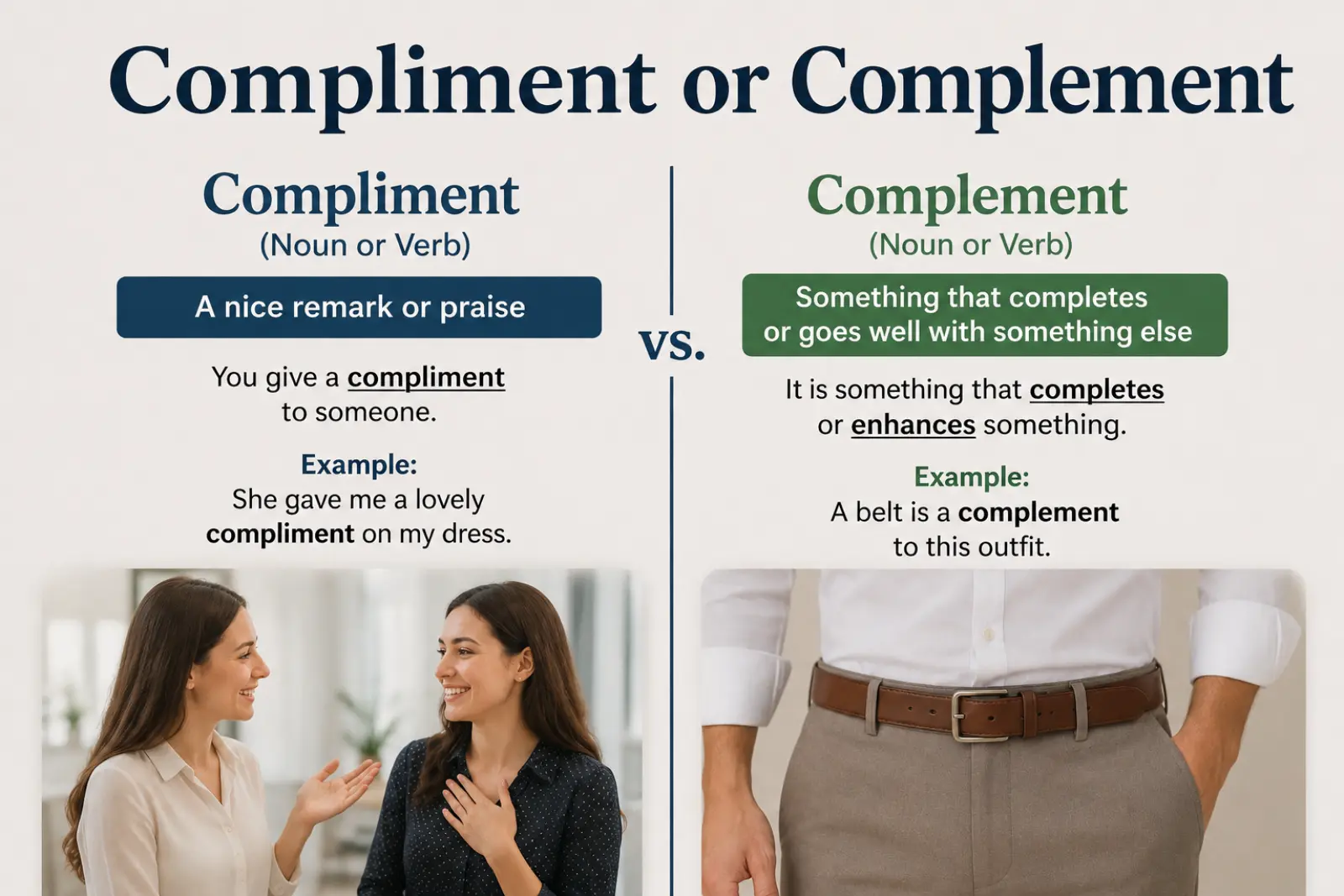
⭐ Compliment or Complement – Quick Answer
👉 Compliment = praise or nice words
👉 Complement = something that completes or matches something else
Examples:
- “You look great!” = Compliment ✅
- “That tie complements your suit.” = Complement ✅
Simple Rule:
👉 Compliment = Praise (think “nice comment”)
👉 Complement = Complete (think “complete match”)
Memory Trick:
“I compliment you with words, but one thing complements another by completing it.”
📖 What Does Compliment or Complement Mean?
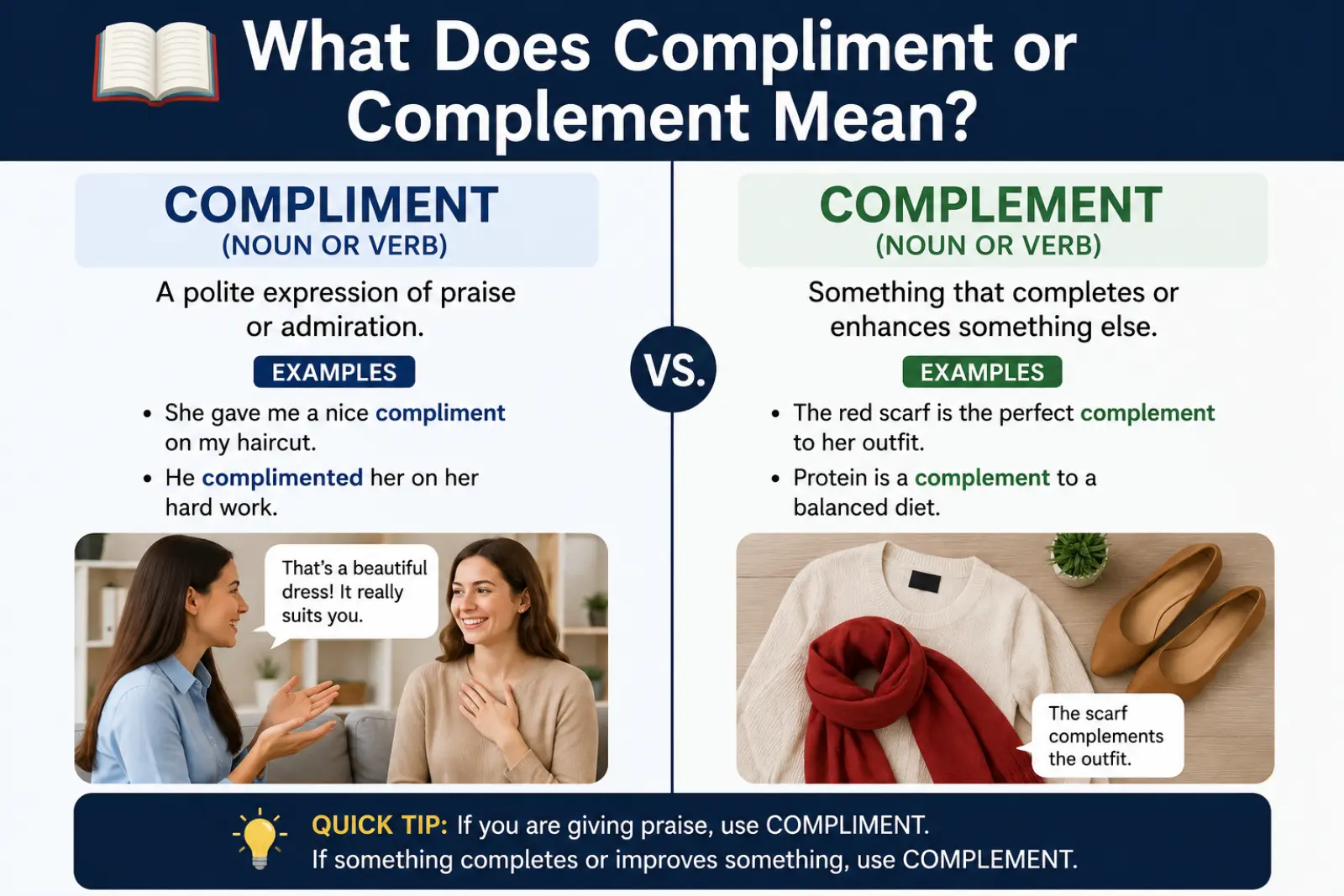
Compliment Meaning 🌟
A compliment is when you say something nice to someone. It shows praise, kindness, or admiration.
Example:
- “You did a great job!” is a compliment.
Complement Meaning 🔗
A complement means something that goes well with or completes something else.
Example:
- “The shoes complement your outfit.”
Synonyms
Compliment: praise, appreciation, approval
Complement: match, complete, enhance, go well with
Opposites
Compliment: insult
Complement: mismatch
Related Terms
- praise
- match
- harmony
- feedback
- appearance
Common Variations
- complimenting (verb form)
- complementary (adjective form)
- complimented (past tense)
🕰️ Origin of Compliment or Complement
Both words come from Latin roots.
- Compliment comes from Latin complere, meaning “to fill or complete politely,” later evolving into praise in Italian and French usage.
- Complement also comes from Latin complementum, meaning “something that completes.”
Over time:
- Compliment → became “kind words”
- Complement → became “something that completes or matches”
Even today, both words keep their original “completion” idea, but in different ways.
🔊 How to Pronounce Compliment or Complement
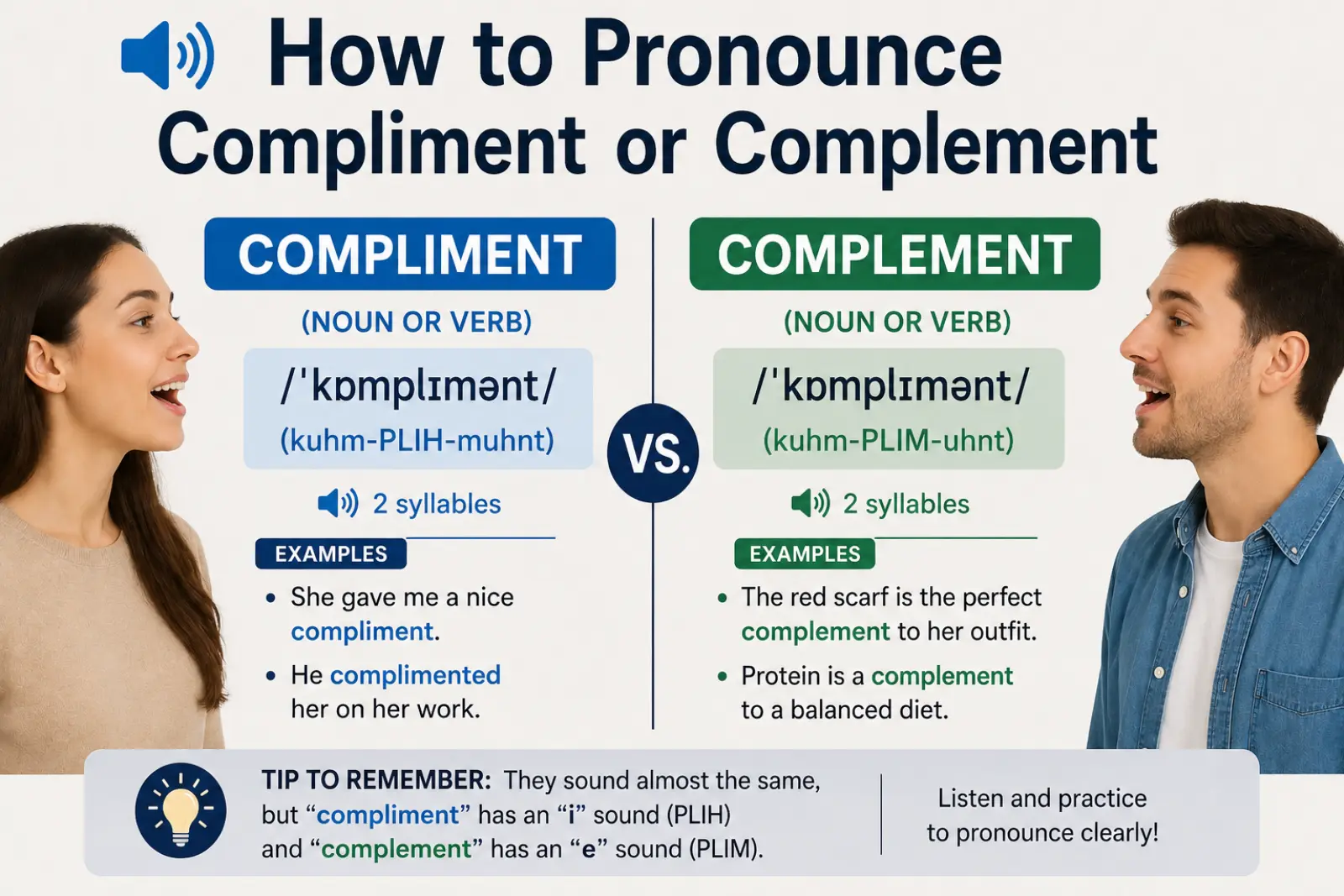
Compliment
- Pronunciation: kom-pli-ment
- Syllables: 3
- Common mistake: people say “com-ple-ment” (wrong for praise meaning)
Complement
- Pronunciation: kom-pluh-ment
- Syllables: 3
- Slight sound difference in the middle syllable
Easy Trick:
Say both slowly:
- Compliment → “pli” (like polite words)
- Complement → “ple” (like complete)
🇬🇧 British vs American English Usage
Good news: Both words are used the same in UK and US English.
| Feature | British English | American English | Notes |
|---|---|---|---|
| Compliment | same usage | same usage | praise |
| Complement | same usage | same usage | matching/complete |
| Meaning difference | same | same | no change |
✅ Which One Should You Use?
Use compliment when:
- Giving praise
- Writing comments
- Social media likes
- Talking politely
Use complement when:
- Talking about matching things
- Fashion or design
- Business presentation
- Product descriptions
Quick Examples:
- “You are amazing!” → Compliment
- “This color complements your room.” → Complement
❌ Common Mistakes with Compliment or Complement
Mistake 1
❌ “Your dress gives a nice complement.”
✔ “Your dress gets a nice compliment.”
👉 Praise needs “compliment”
Mistake 2
❌ “This food compliments the drink.”
✔ “This food complements the drink.”
👉 Matching needs “complement”
Mistake 3
❌ “He complement me on my work.”
✔ “He complimented me on my work.”
👉 Past tense + praise = compliment
Mistake 4
❌ “Your smile is a complement.”
✔ “Your smile is a compliment.”
👉 Smile = praise
Mistake 5
❌ Mixing spelling randomly
✔ Remember rule carefully
👉 One letter changes meaning completely
🌍 Compliment or Complement in Everyday Examples
Work
- “Your report is excellent.” (compliment)
- “This chart complements the report.” (complement)
School
- “Good answer!” (compliment)
- “This diagram complements the lesson.” (complement)
Social Media
- “You look amazing 😍” (compliment)
- “This filter complements your photo.” (complement)
Daily Life
- “Nice haircut!” (compliment)
- “This bag complements your outfit.” (complement)
Emails
- “Great presentation.” (compliment)
- “The data complements our findings.” (complement)
🧠 Compliment or Complement in Different Contexts
Education
Used in grammar learning:
- Compliment = praise students
- Complement = supports learning material
Business
- Compliment = customer praise
- Complement = product match strategy
Social Media
- Compliment = comments
- Complement = visual harmony
Branding
- Complement = colors, design, identity matching
Communication
Helps avoid misunderstanding in professional writing.
📈 Google Trends & Usage Data
People search this topic because:
- Both words sound identical
- Easy spelling confusion
- Common in exams and writing tests
- Used in job communication and social media
Popular countries:
- US
- UK
- India
- Pakistan
- Canada
- Australia
Related searches:
- compliment meaning
- complement meaning
- difference between compliment and complement
- grammar confusion words
Voice search:
- “What is difference between compliment and complement?”
- “How to use compliment in sentence?”
📊 Comparison Table: Compliment or Complement
| Feature | Compliment | Complement |
|---|---|---|
| Meaning | praise | match/complete |
| Pronunciation | kom-pli-ment | kom-pluh-ment |
| Grammar role | noun/verb | noun/verb |
| Usage | social praise | matching things |
| Common mistake | spelling confusion | spelling confusion |
| Example | “Nice job!” | “This fits well” |
💼 Compliment or Complement in Professional Life
In business communication:
- Compliment improves relationships
- Complement improves product quality and branding
Examples:
- “We appreciate your effort.” (compliment)
- “This service complements our system.” (complement)
Using correct words builds:
- Professional trust
- Clear communication
- Strong branding
🎓 Compliment or Complement for Students
Students often confuse these words because:
- Same pronunciation
- Similar spelling
- Different meanings
Easy trick:
- Compliment = “praise in class”
- Complement = “things that complete notes or lessons”
🔍 Signs and Uses of Compliment or Complement
Compliment
- Positive feedback
- Friendly messages
- Appreciation comments
Complement
- Matching colors
- Balanced design
- Supporting ideas
🧩 Simple Trick to Remember Compliment or Complement
👉 Compliment = “I like you” (words)
👉 Complement = “Complete match” (things)
Think of it this way:
- Compliment = talking nicely 💬
- Complement = fitting nicely 🧩
🏆 Expert Tips
- Always check context first
- If it’s praise → compliment
- If it’s matching → complement
- Read sentence twice before writing
- Practice with daily examples
🌐 Related Searches People Also Ask
- What is difference between compliment and complement?
- How do you use compliment in a sentence?
- What does complement mean in fashion?
- Is it compliment or complement for praise?
- Why do people confuse these words?
- Complement vs compliment examples
- Simple grammar rules for compliment
- Easy trick to remember complement
❓ FAQs
1. What is the main difference?
Compliment is praise, complement is matching.
2. Are they pronounced the same?
Almost, but slightly different stress.
3. Can both be nouns?
Yes, both can be nouns and verbs.
4. What is an example of compliment?
“You are smart!”
5. What is an example of complement?
“This color matches your dress.”
6. Why are they confusing?
Because they sound the same.
7. Is compliment always positive?
Yes, it is always positive.
8. Is complement used in fashion?
Yes, very often.
9. Which is more common?
Compliment is more common in daily speech.
10. Can I use them interchangeably?
No, meaning changes completely.
🏁 Final Verdict
Compliment = praise
Complement = match or complete
👉 Easy rule: Compliment = Words, Complement = Match
✅ Conclusion
Understanding compliment or complement is easy once you remember the simple rule: praise vs match. One is about kind words, and the other is about things that fit together perfectly.
If you remember just one thing:
👉 Compliment = talk nicely
👉 Complement = complete nicely.

Camila Green is an English language writer who specializes in confusing word comparisons and spelling explanations. She creates simple, beginner-friendly guides on topics like “niece or neice” and other common English mistakes. Her writing focuses on clarity, real-life examples, and easy learning. At VerrsaPick, she helps readers improve their English with practical and engaging content.