Have you ever wanted to write about waiting in line but suddenly wondered whether the correct word is queue or que? You are not alone. These two forms look similar, but they do not have the same meaning or usage in standard English.
The confusion often appears when people hear the word queue before seeing it written. Because queue has a surprisingly unusual spelling, beginners may write que instead. You may see this confusion in school assignments, workplace messages, emails, online searches, and everyday conversations.
People usually search for: queue or que meaning, queue spelling, how to spell queue, queue pronunciation, queue examples, que vs queue, and the difference between queue and que.
The good news is that the answer is simple: queue is the standard English word for a line of people or things waiting. Que is generally not the correct spelling when you mean a waiting line in English. However, que can appear as a word or abbreviation in other languages and contexts.
In this guide, you’ll learn the meaning, pronunciation, examples, usage, grammar rules, common mistakes, expert tips, and simple explanations in easy English.
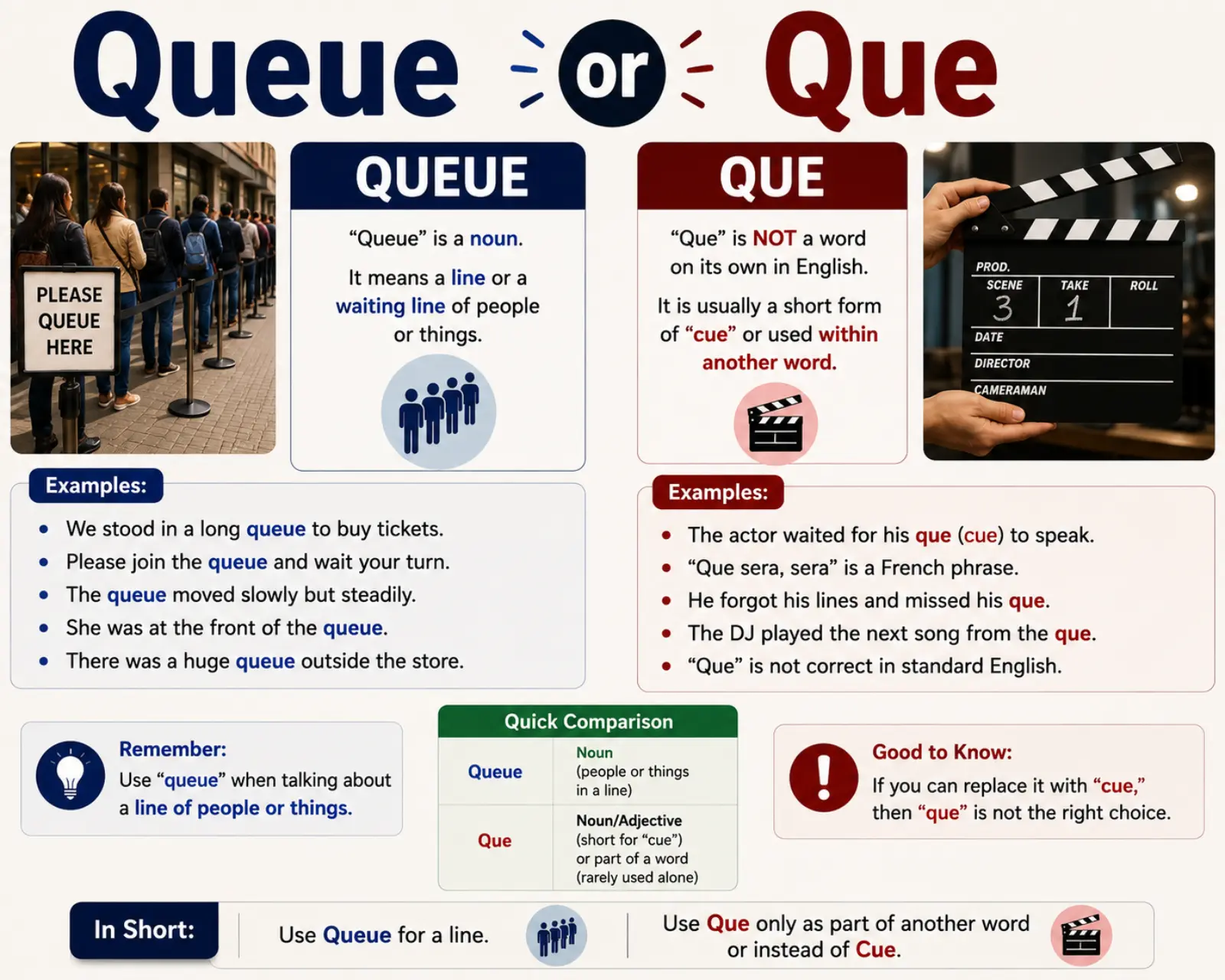
Queue or Que – Quick Answer
👉 Queue = a line of people or things waiting for something; it can also mean to arrange something in a waiting line.
👉 Que = usually not the correct English spelling when you mean a waiting line.
Examples
- We waited in the queue for tickets. ✅
- There was a long queue outside the store. ✅
- Please join the queue. ✅
- The songs are in a queue to play next. ✅
- We waited in the que. ❌
Simple Rule
👉 If you mean a line of people or things waiting, use queue.
Memory trick:
Think Q + U + E + U + E = a long line of letters, just like a long line of people waiting!
What Does Queue Mean?
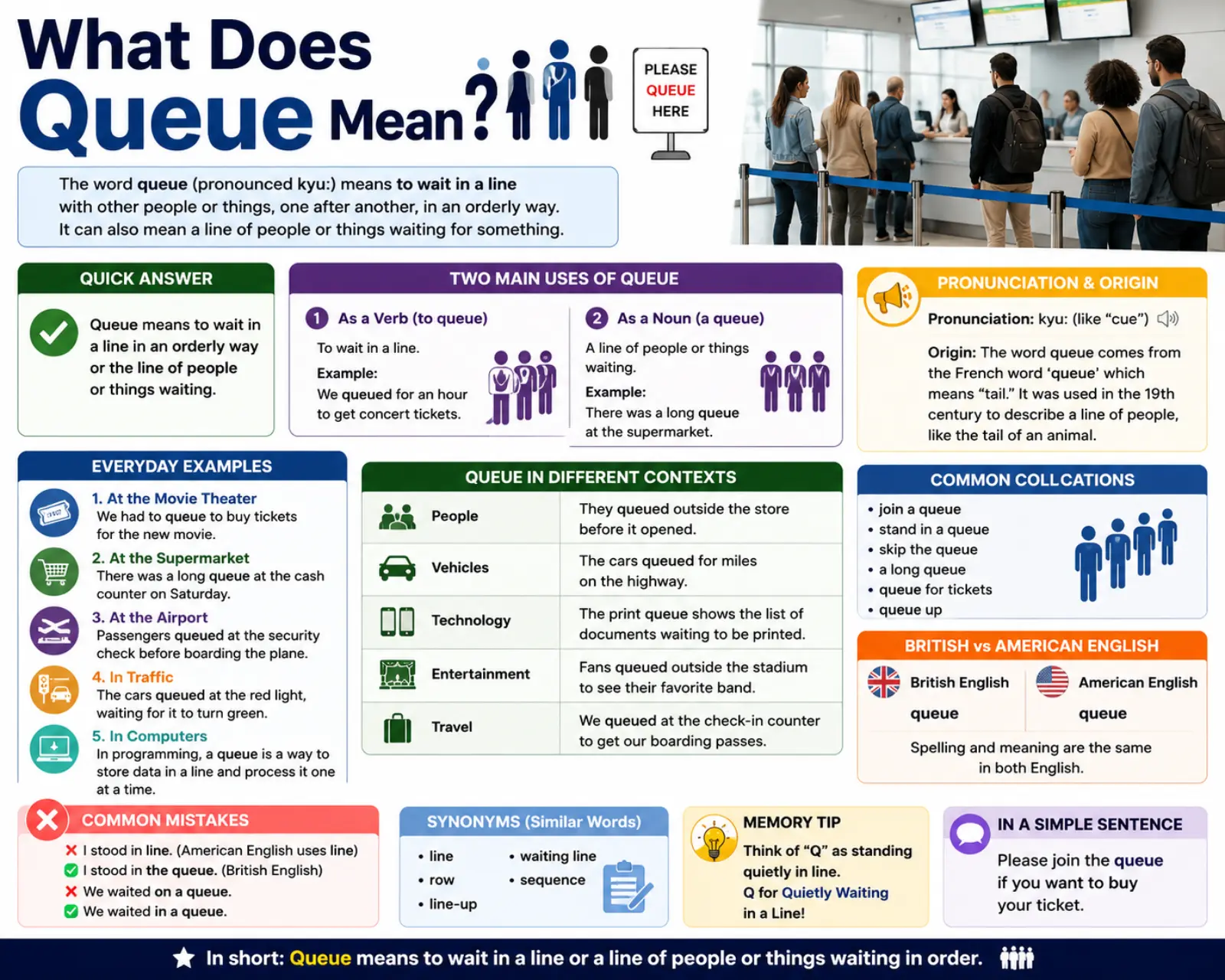
Queue is a noun and a verb.
As a noun, it means a line of people or things waiting for their turn.
There was a long queue at the bank.
As a verb, queue means to form a line or place something in a waiting list.
Customers queued outside the restaurant.
The word is also common in technology. For example, a computer program may put files, messages, jobs, or tasks into a queue so they can be processed one after another.
Synonyms
Depending on the situation, related words include:
- line
- waiting line
- waiting list
- sequence
- order
- lineup
In British English, queue is especially common for a physical line. In American English, line is often more natural.
Opposites
There is no perfect single opposite of queue, but depending on context, related ideas include:
- leaving the line
- serving immediately
- skipping the line
- processing something instantly
Related Terms
You may also see:
- queue up — form a line or prepare something to wait
- queued — placed in a queue
- queuing — the act of waiting in a queue
- queueing — another spelling of queuing
- waiting list — a list of people waiting for something
The Origin of Queue and Que
The English word queue comes from French queue, meaning “tail.” The idea is easy to understand: a line of people stretches out like a tail.
English later adopted queue to describe a line of people waiting.
The spelling can look strange because English keeps the French form queue, even though its pronunciation is much shorter.
Que, without the extra letters, is not normally the standard English spelling for this meaning. It may be encountered in Spanish, where qué means “what,” or in names, abbreviations, and other language contexts.
So, if you are writing ordinary English and talking about people waiting in line, choose queue.
How to Pronounce Queue
The pronunciation of queue is much easier than its spelling.
Queue → “kyoo”
It has one syllable.
The pronunciation is basically the same as the letter Q.
Easy Speaking Trick
Say:
Q → queue → “kyoo”
Do not try to pronounce every letter separately. You do not say “kwee-wee” or “kway-way.”
Example
I joined the queue.
Pronunciation: I joined the kyoo.
The unusual spelling is the main reason learners find this word confusing.
British English vs American English Usage
The word queue is standard in both British and American English. The biggest difference is how often people choose it.
| Feature | British English | American English | Notes |
|---|---|---|---|
| Queue | Very common | Correct but less common | “Line” is often preferred in the US |
| Line | Used | Very common | Natural in both varieties |
| Queue pronunciation | “kyoo” | “kyoo” | Same pronunciation |
| Que | Not standard for a waiting line | Not standard for a waiting line | Avoid it in normal English |
For example:
British English:
We stood in a queue for the bus.
American English:
We stood in line for the bus.
Both sentences are correct.
Which One Should You Use?
- people waiting for service
- customers waiting at a store
- cars waiting to move
- digital tasks waiting to be processed
- songs waiting to play
- emails waiting to be handled
- jobs waiting in a computer system
- writing naturally for an American audience
- talking about a physical waiting line in everyday US English
Quick usage table
| Situation | Best word |
|---|---|
| British customer waiting | Queue |
| American customer waiting | Line / Queue |
| Computer tasks waiting | Queue |
| Songs waiting to play | Queue |
| People waiting for tickets | Queue / Line |
| “Que” as a normal English waiting-line spelling | ❌ Avoid |
Common Mistakes With Queue or Que
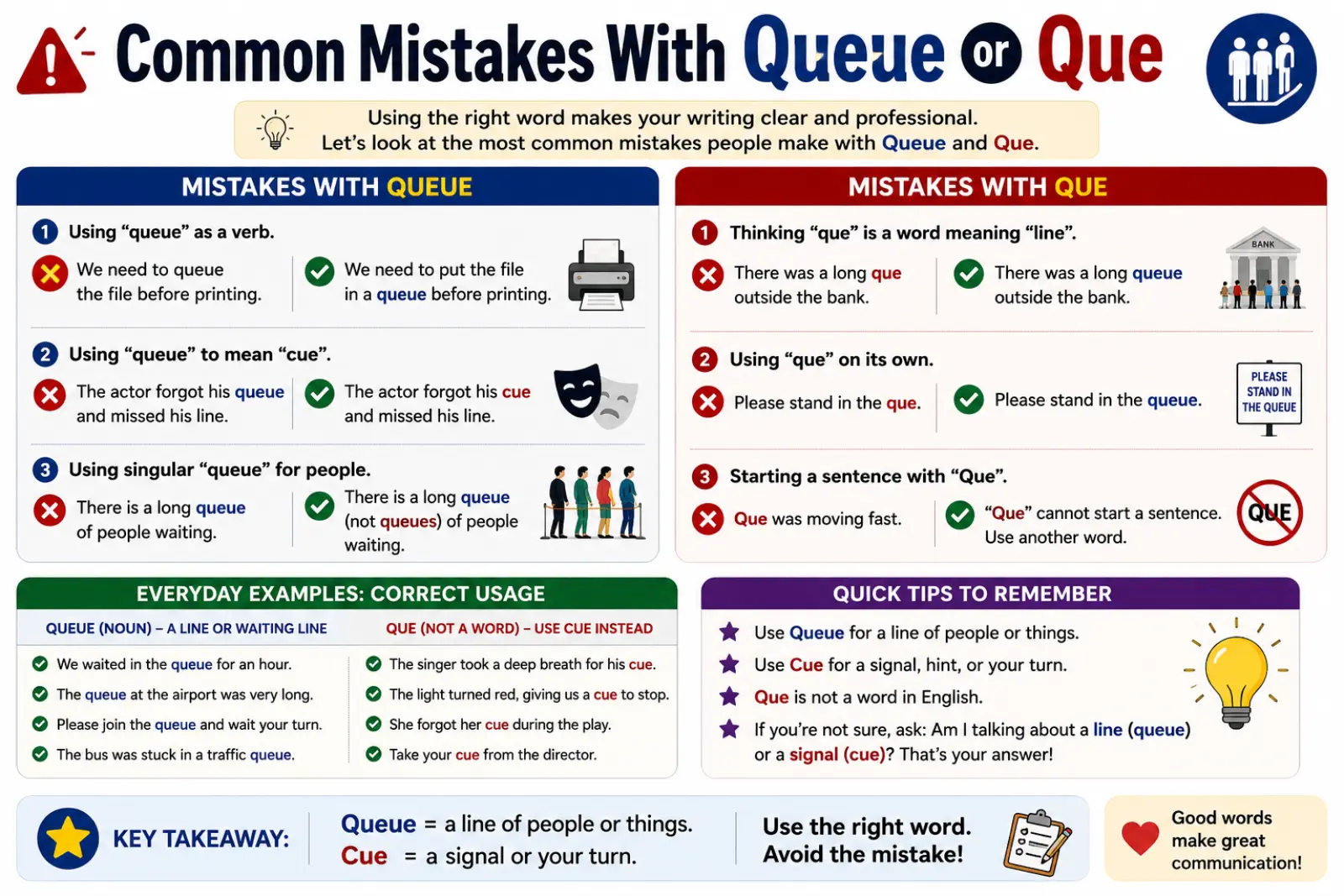
Mistake 1: Writing “que” instead of “queue”
❌ We stood in the que.
✔ We stood in the queue.
Why: Queue is the standard English spelling for a waiting line.
Tip: Remember that the word contains queue, not que.
Mistake 2: Pronouncing every letter
❌ Saying “kway-way” or “kwee-wee.”
✔ Say “kyoo.”
Why: English spelling does not always match pronunciation.
Mistake 3: Thinking queue and line are completely different
❌ “Queue is British, so Americans cannot use it.”
✔ Americans can use queue, although line is often more natural.
Mistake 4: Using “que” in formal writing
❌ Please stand in the que.
✔ Please stand in the queue.
Formal writing should use the standard spelling.
Mistake 5: Confusing queue with “cue”
Cue is a different word.
The actor waited for his cue.
A cue is a signal telling someone when to do something.
A queue is a waiting line or ordered list.
Queue or Que in Everyday Examples
Work
Your request is now in the queue and will be reviewed soon.
School
Students formed a queue outside the classroom.
Social Media
I have several posts in my publishing queue.
Daily Life
We waited in a long queue at the supermarket.
Your message has been added to the support queue.
Text Message
The line is huge. We’ve been in the queue for 20 minutes!
Online Content
Add the video to your queue so you can watch it later.
Conversation
Are you in the queue for coffee?
Queue in Different Contexts
Queue in Education
Students may use queue when talking about people waiting for buses, tickets, food, or school services.
The students formed a queue for lunch.
Queue in Business
Businesses use queues to describe customers waiting for service.
The customer support queue is getting longer.
Queue in Technology
In computing, a queue is a collection of items waiting to be processed in a particular order.
For example, a printer may place several documents in a print queue.
Your document is in the print queue.
Queue in Entertainment
Streaming apps, music players, and video platforms may use the term queue for items waiting to play.
I added three songs to my queue.
Queue in Gaming
Games can use queues for matchmaking.
You are currently in the matchmaking queue.
This means you are waiting for the system to find a suitable game or players.
Queue or Que Comparison Table
| Feature | Queue | Que |
|---|---|---|
| Standard English spelling for a waiting line | ✅ Yes | ❌ No |
| Meaning | Waiting line or ordered list | Not normally this meaning in English |
| Pronunciation | “kyoo” | Depends on context/language |
| Grammar | Noun and verb | Not the standard English noun for a line |
| British English | Very common | Incorrect for this meaning |
| American English | Correct, though “line” is common | Incorrect for this meaning |
| Technology | Very common | Not normally used |
| Formal writing | Correct | Avoid |
| Common mistake | — | Often confused with queue |
Queue in Professional Life
The word queue is useful in professional communication, especially in technology, customer service, administration, and operations.
Examples include:
- customer service queue
- support queue
- email queue
- print queue
- processing queue
- task queue
- job queue
- waiting queue
For example:
Your request has been placed in the support queue.
This sounds clear and professional.
In workplace software, queue can also describe work that has not yet been completed.
Queue for Students and Beginners
Beginners often struggle with queue because its spelling is unusual. Five letters produce only one short sound: “kyoo.”
The best way to learn it is not to memorize each letter separately. Learn the whole word as one unit:
queue = line = kyoo
Then practice it in short sentences.
Join the queue.
The queue is long.
I am in the queue.
These simple patterns make the word much easier to remember.
Common Uses and Patterns of Queue
You will commonly see queue in phrases such as:
- join the queue
- stand in the queue
- wait in the queue
- form a queue
- a long queue
- a short queue
- queue for tickets
- queue for food
- waiting queue
- customer queue
- print queue
- music queue
- processing queue
The word can describe both real-world waiting lines and digital waiting systems.
Simple Trick to Remember Queue or Que
Here is the easiest trick:
Queue = Q + 4 letters waiting behind it
Look at the word:
Q U E U E
The first letter Q is followed by four more letters, almost like people standing behind the first person in a line.
Think of it this way:
A queue is a line, and the word “queue” itself looks like a line of letters.
Another shortcut:
Queue sounds like Q.
So when you mean a waiting line, think:
Q = Queue = “kyoo.”
Expert Tips for Using Queue Correctly
- Memorize the pronunciation first: queue sounds like “kyoo.”
- Connect queue with line: If people are waiting, they may be in a queue.
- Do not shorten the spelling to “que” in standard English.
- Remember “cue” is different: A cue is a signal; a queue is a line.
- Use “line” for natural American English when talking about people waiting.
- Use “queue” confidently in technology: print queue, task queue, message queue, and processing queue are standard terms.
- Proofread carefully: This is one of those words where pronunciation gives very little help with spelling.
Related Searches People Also Ask
- Is queue or que correct? — Queue is correct when you mean a waiting line.
- How do you spell queue? — It is spelled Q-U-E-U-E.
- How do you pronounce queue? — It is pronounced “kyoo.”
- Is queue a British word? — It is especially common in British English, but it is also correct in American English.
- What is the American word for queue? — Americans commonly say line.
- Is que a word in English? — It can appear in special contexts, but it is not the normal spelling of a waiting line.
- What is the difference between cue and queue? — A cue is a signal; a queue is a line or ordered list.
- Why is queue spelled with so many letters? — The spelling comes from French.
- Can queue be a verb? — Yes. For example, “People queued outside.”
- What does queue mean in technology? — It is a group of tasks or items waiting to be processed.
- What does queue mean in gaming? — It usually means waiting for matchmaking or another game process.
- Is “in the queue” correct? — Yes. It means waiting in a line or ordered system.
FAQs About Queue or Que
Is “queue” or “que” correct?
Queue is correct when you mean a line of people or things waiting.
Is “que” an English word?
It can appear in names, abbreviations, or other language contexts, but que is not the standard English spelling for a waiting line.
How do you pronounce queue?
Queue is pronounced “kyoo,” with one syllable.
Is queue British or American?
It is used in both British and American English. However, Americans often prefer line for a physical waiting line.
What is the difference between queue and cue?
A queue is a waiting line or ordered list. A cue is a signal or prompt.
Why is queue so hard to spell?
Its spelling comes from French, while its pronunciation is very short. That makes it unusual for English learners.
Can queue be used as a verb?
Yes. You can say “We queued outside” or “The files were queued for processing.”
Is “waiting in the queue” correct?
Yes. “Waiting in the queue” is completely correct.
What does queue mean in technology?
It means items waiting to be processed, such as print jobs, messages, tasks, or files.
Should I use queue or line?
Use either depending on the audience and context. Queue is very common in British English, while line is often more natural in American English.
Final Verdict
Queue is the correct standard English word when you mean a line of people or things waiting.
- ✅ Queue = waiting line or ordered list
- ❌ Que = not the standard spelling for this meaning
- 🔊 Queue = “kyoo”
- 🇬🇧 British English = queue is very common
- 🇺🇸 American English = line is often more natural, but queue is still correct
- 💻 Technology = queue is widely used
Easy memory rule
Queue sounds like Q. If people are waiting in a line, think Q = queue.
Conclusion
The difference between queue or que is much easier once you connect the word with its meaning. If you are talking about people waiting for tickets, customers waiting for service, songs waiting to play, or computer tasks waiting to be processed, queue is the word you want.
The unusual spelling should not scare you. You do not need to pronounce every letter. Simply remember that queue sounds like “kyoo.”
If you are writing for an American audience, line may sound more natural for a physical waiting line. But queue remains a correct English word and is especially common in British English and technology.
Final memory trick: Queue = Q + a line of letters.

Camila Green is an English language writer who specializes in confusing word comparisons and spelling explanations. She creates simple, beginner-friendly guides on topics like “niece or neice” and other common English mistakes. Her writing focuses on clarity, real-life examples, and easy learning. At VerrsaPick, she helps readers improve their English with practical and engaging content.