Have you ever typed color and wondered whether you should add a u and write colour instead? You are not alone. This is one of the most common spelling differences between American and British English.
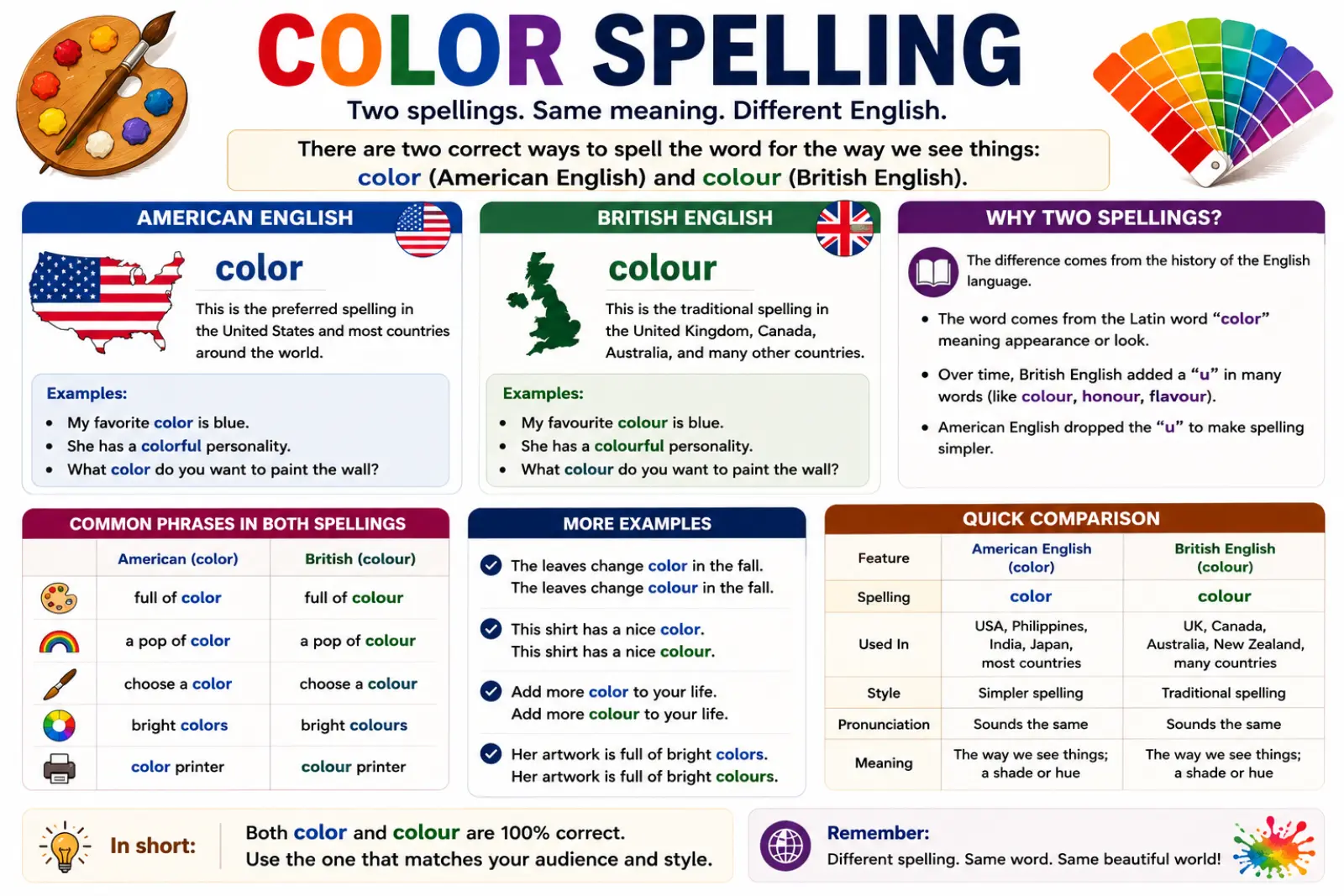
The good news is simple: both “color” and “colour” are correct spellings. The difference is mainly regional. Color is the standard American English spelling, while colour is the standard British English spelling. Cambridge also identifies color as the US spelling of colour, while Merriam-Webster lists colour as chiefly British.
This small spelling difference can become confusing when you are writing for school, work, an international audience, or an English-language website. You may also see both forms on social media, in books, advertisements, emails, and online content.
People usually search for color spelling, “color or colour,” “correct spelling of color,” “how to spell color,” “color British or American,” “colour vs color,” and “is colour spelled with a u?”
The important thing is not to think of one spelling as simply “right” and the other as “wrong.” Instead, choose the spelling that matches the variety of English you are using and stay consistent.
In this guide, you’ll learn the meaning, pronunciation, examples, usage, grammar rules, common mistakes, expert tips, and simple explanations in easy English.
Color Spelling – Quick Answer
👉 Color = American English spelling.
👉 Colour = British English spelling.
Both words have the same meaning: a visual quality such as red, blue, green, yellow, or black.
Examples
- The color of my car is blue. 🇺🇸
- The colour of my car is blue. 🇬🇧
- What is your favorite color? 🇺🇸
- What is your favourite colour? 🇬🇧
- She wore a beautiful colour. 🇬🇧
Simple Rule
👉 US English = color
👉 UK English = colour
Easy memory trick: British spelling often keeps the u in words such as colour, honour, and favour. American English commonly removes it: color, honor, and favor.
What Does Color Spelling Mean?
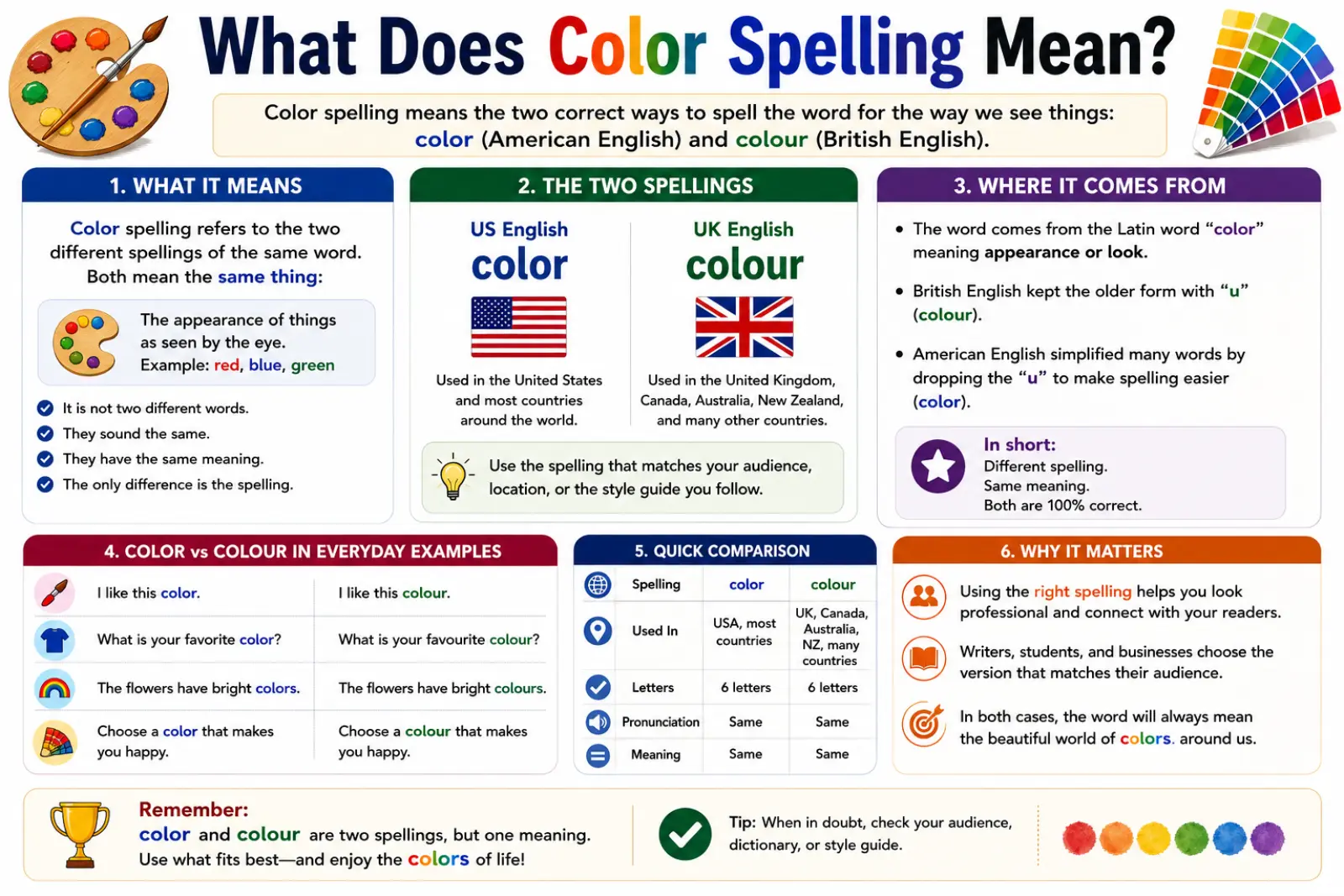
The phrase color spelling usually refers to the different ways of spelling the word color/colour in English.
The meaning does not change. Both forms refer to the appearance of something based on how light is seen, such as red, blue, green, or purple. Merriam-Webster gives color several related meanings, including hue, pigment, complexion, and visual appearance.
Synonyms
Depending on context, related words include:
- hue
- shade
- tint
- tone
- pigmentation
- coloration
Opposites
There is no single exact opposite of color, but in some contexts you may see:
- colorless
- monochrome
- black and white
Related Terms
Common words connected with color/colour include:
- colorful / colourful
- colored / coloured
- coloring / colouring
- discolor / discolour
- colorless / colourless
- color wheel
- color palette
- primary colors / primary colours
The Origin of Color and Colour
The word has a long history. Merriam-Webster traces color through Middle English colour, from Anglo-French and ultimately Latin color. The English noun has been used since the 14th century.
The different modern spellings developed through regional English spelling traditions.
American English gradually adopted the shorter color, while British English retained colour. The difference is similar to other spelling pairs such as:
- honor / honour
- favor / favour
- behavior / behaviour
- labor / labour
So color is not a modern internet spelling, and colour is not an old-fashioned mistake. They are established regional forms.
How to Pronounce Color and Colour
The pronunciation is almost the same in both forms.
Color: KUH-lər
Colour: KUH-lər
Cambridge gives US pronunciation as approximately /ˈkʌl.ɚ/ and UK pronunciation as /ˈkʌl.ər/.
Easy Speaking Trick
Think:
color → “kuh-lər”
colour → “kuh-luh”
The spelling changes, but the difference is much easier to notice on paper than in normal speech.
British English vs American English Usage
The main difference is spelling, not meaning or grammar.
| Feature | British English | American English | Notes |
|---|---|---|---|
| Main spelling | colour | color | Both are correct |
| Meaning | Same | Same | No meaning change |
| Pronunciation | Similar | Similar | Small accent difference |
| Plural | colours | colors | Same rule |
| Adjective | colourful | colorful | Same meaning |
| Verb | colour | color | Same meaning |
| Formal writing | Colour | Color | Follow local style |
| School writing | Colour | Color | Depends on curriculum |
Countries such as the UK commonly use colour, while the US commonly uses color. Canada often uses British-style colour, while English usage in Australia also commonly follows the colour spelling.
Which Color Spelling Should You Use?
Choose based on your audience.
- Writing for the United States: use color.
- Writing for the United Kingdom: use colour.
- Writing for Australia: generally use colour.
- Writing for Canada: generally use colour.
- Following a school or workplace style guide: follow its preferred spelling.
- Writing for an international website: choose one style and use it consistently.
For example, if your article uses American English, write:
The color of the building is beautiful.
If you are following British English, write:
The colour of the building is beautiful.
The biggest writing mistake is not choosing one particular form. It is mixing styles without a reason.
Common Mistakes With Color Spelling
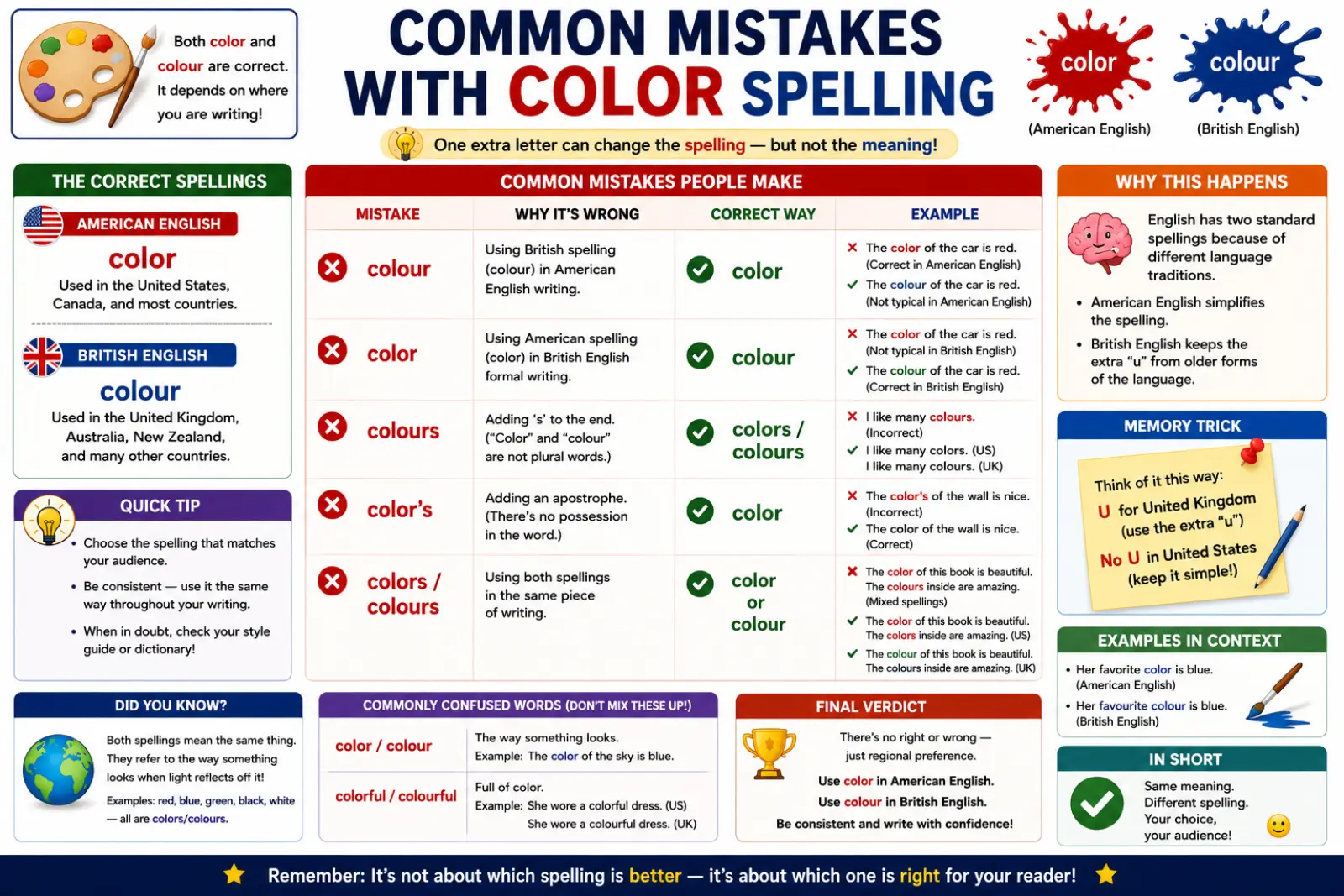
Mistake 1: Thinking “colour” is wrong
❌ Colour is an incorrect spelling.
✔ Colour is correct in British English.
Why? British English normally keeps the u.
Tip: Remember UK = colour.
Mistake 2: Thinking “color” is always wrong
❌ Color is misspelled because English uses colour.
✔ Color is the standard American English spelling.
Merriam-Webster identifies colour as a chiefly British spelling of color.
Mistake 3: Mixing spellings in one article
❌ The colour of the wall is bright. The color looks beautiful.
✔ The colour of the wall is bright. The colour looks beautiful.
Or, in American English:
✔ The color of the wall is bright. The color looks beautiful.
Tip: Pick one English style and stay with it.
Mistake 4: Forgetting related words
❌ colorful in an otherwise British-English article.
✔ colourful in British English.
American English usually uses colorful.
Mistake 5: Assuming pronunciation is completely different
❌ Color and colour are pronounced as different words.
✔ They have essentially the same pronunciation, with differences mainly related to accent.
Color Spelling in Everyday Examples
| Situation | American English | British English |
|---|---|---|
| Work | Please choose a color. | Please choose a colour. |
| School | What color is the flag? | What colour is the flag? |
| I like the blue color. | I like the blue colour. | |
| Social media | This color looks amazing! | This colour looks amazing! |
| Daily conversation | My favorite color is green. | My favourite colour is green. |
| Website | Select a color. | Select a colour. |
| Design | Change the color palette. | Change the colour palette. |
| Text message | I love this color! | I love this colour! |
Color Spelling in Different Contexts
Education
Students often notice color and colour in books from different countries. Neither spelling should automatically be marked wrong. The expected form usually depends on the English variety being taught.
Business and Workplace
Professional writing should match the company’s preferred English style.
For example, an American company may write:
Our new brand color is blue.
A British company may write:
Our new brand colour is blue.
Websites and Marketing
Website owners should consider their main audience. A US-focused website may naturally use color, while a UK-focused website may use colour.
Consistency is more important than switching between the two.
Technology and Design
You will frequently see color in software, programming, and design terminology, especially in US-based technical documentation.
For example:
- color picker
- color palette
- background color
- text color
- color code
British documentation may use colour in ordinary prose, although technical names and software properties can follow their own conventions.
Color Spelling – Google Trends and Usage
People search for color spelling because the difference is easy to notice and surprisingly confusing. Searchers often want a quick answer to questions such as:
- Is color or colour correct?
- Is colour British spelling?
- How do Americans spell colour?
- Why does colour have a “u”?
- What is the American spelling of colour?
- What is the British spelling of color?
The topic is especially useful for English learners in countries such as the US, UK, India, Pakistan, Canada, and Australia, where learners may encounter different English standards online.
Search behavior also tends to include long-tail questions such as “color vs colour meaning,” “correct spelling of color,” “color British or American,” and “why is colour spelled with u.”
There is no meaningful change in the word’s basic meaning because of the spelling. The difference is mainly a regional spelling convention. Cambridge explicitly labels color as the US spelling and colour as the UK spelling.
Color vs Colour Comparison Table
| Point | Color | Colour |
|---|---|---|
| English variety | American | British |
| Correct? | Yes | Yes |
| Meaning | A visual hue | A visual hue |
| Pronunciation | Similar | Similar |
| Common in US | Yes | No |
| Common in UK | Less common | Yes |
| Formal writing | Yes | Yes |
| Academic writing | Yes | Yes |
| Social media | Very common | Very common |
| Related form | colorful | colourful |
| Main issue | Regional preference | Regional preference |
Color Spelling for Students and Beginners
Beginners often struggle because English has more than one accepted spelling system.
You may learn colour from a British textbook and then see color on an American website. It can feel like one source is making a mistake.
It is not.
Easy beginner shortcut
Remember:
American English → COLOR
British English → COLOUR
You can also connect the U with UK:
👉 UK → colour
👉 US → color
This is not a grammar rule for every word, but it is a useful memory trick for this spelling pair.
Signs and Common Uses of Color Spelling
You will commonly see color/colour in:
- clothing descriptions
- paint and home design
- photography
- art
- websites
- graphic design
- branding
- school assignments
- emails
- product descriptions
- advertising
- social media posts
- everyday conversations
Common phrases include:
- favorite color / favourite colour
- bright colors / bright colours
- primary colors / primary colours
- color scheme / colour scheme
- color palette / colour palette
- color blindness / colour blindness
- color wheel / colour wheel
Simple Trick to Remember Color Spelling
Think of it this way:
🇺🇸 US = COLOR
🇬🇧 UK = COLOUR
Imagine the U standing for UK.
So when writing for a British audience:
COLO + U + R = COLOUR
For an American audience, remove the U:
COLOR
That simple visual trick can help you remember the spelling every time.
Expert Tips for Using Color or Colour
Here are a few practical writing tips:
- Know your audience. Decide whether your readers mainly use American or British English.
- Check your style guide. Businesses and schools may have a preferred English variety.
- Stay consistent. Do not randomly switch between color and colour.
- Check related words. Remember colorful/colourful and colored/coloured.
- Do not confuse spelling with meaning. Both forms describe the same basic concept.
- Use your word processor carefully. A US or UK spell-check setting may prefer one version.
- For SEO, match your audience. If most readers are in the US, color may fit naturally; for UK readers, colour is usually better.
Related Searches People Also Ask
- Is color or colour correct? Both are correct; the choice depends on English variety.
- Is color American spelling? Yes, color is the standard US spelling.
- Is colour British spelling? Yes, colour is the standard British spelling.
- How do Americans spell colour? Americans generally spell it color.
- How do British people spell color? British English generally uses colour.
- Why does colour have a U? British spelling retained the u in this word.
- What is the plural of color? American English uses colors; British English uses colours.
- Is colorful British or American? Colorful is American; colourful is British.
- Are color and colour pronounced differently? They are pronounced essentially the same, with accent differences.
- Should I use color or colour in an essay? Use the form expected by your school, teacher, or English variety.
FAQs About Color Spelling
Is “color” the correct spelling?
Yes. Color is the standard American English spelling.
Is “colour” also correct?
Yes. Colour is the standard British English spelling.
Which is more correct, color or colour?
Neither is universally more correct. Color is correct in American English, while colour is correct in British English.
How do you spell color in the UK?
In British English, it is spelled colour.
How do you spell colour in American English?
In American English, it is spelled color.
Do color and colour have different meanings?
No. They have the same basic meaning.
Is “colour” a spelling mistake?
No. It is a standard British spelling.
Should I use color or colour in professional writing?
Use the version that matches your audience, company style guide, or regional English standard.
What is the difference between colorful and colourful?
Colorful is American English, while colourful is British English.
Is the pronunciation of color and colour different?
They are pronounced almost the same. Regional accents may create a small difference.
Final Verdict
Color and colour are both correct spellings.
- 🇺🇸 Color = American English
- 🇬🇧 Colour = British English
- 🇦🇺 Colour = commonly used in Australian English
- 🇨🇦 Colour = commonly used in Canadian English
The easiest rule is:
👉 US = color
👉 UK = colour
Conclusion
The color spelling question is much easier once you understand that English has regional spelling standards. Color and colour mean the same thing, sound almost the same, and are both correct.
If you are writing for American readers, choose color. If you are writing for British readers, choose colour. The same idea applies to related words such as colorful/colourful and colored/coloured.
Most importantly, do not worry if you have seen both forms. Your English is not necessarily wrong because another writer uses a different spelling. Just identify your audience and remain consistent.
Final memory trick: US = COLOR, UK = COLOUR. The British “U” can remind you of the UK.

Camila Green is an English language writer who specializes in confusing word comparisons and spelling explanations. She creates simple, beginner-friendly guides on topics like “niece or neice” and other common English mistakes. Her writing focuses on clarity, real-life examples, and easy learning. At VerrsaPick, she helps readers improve their English with practical and engaging content.