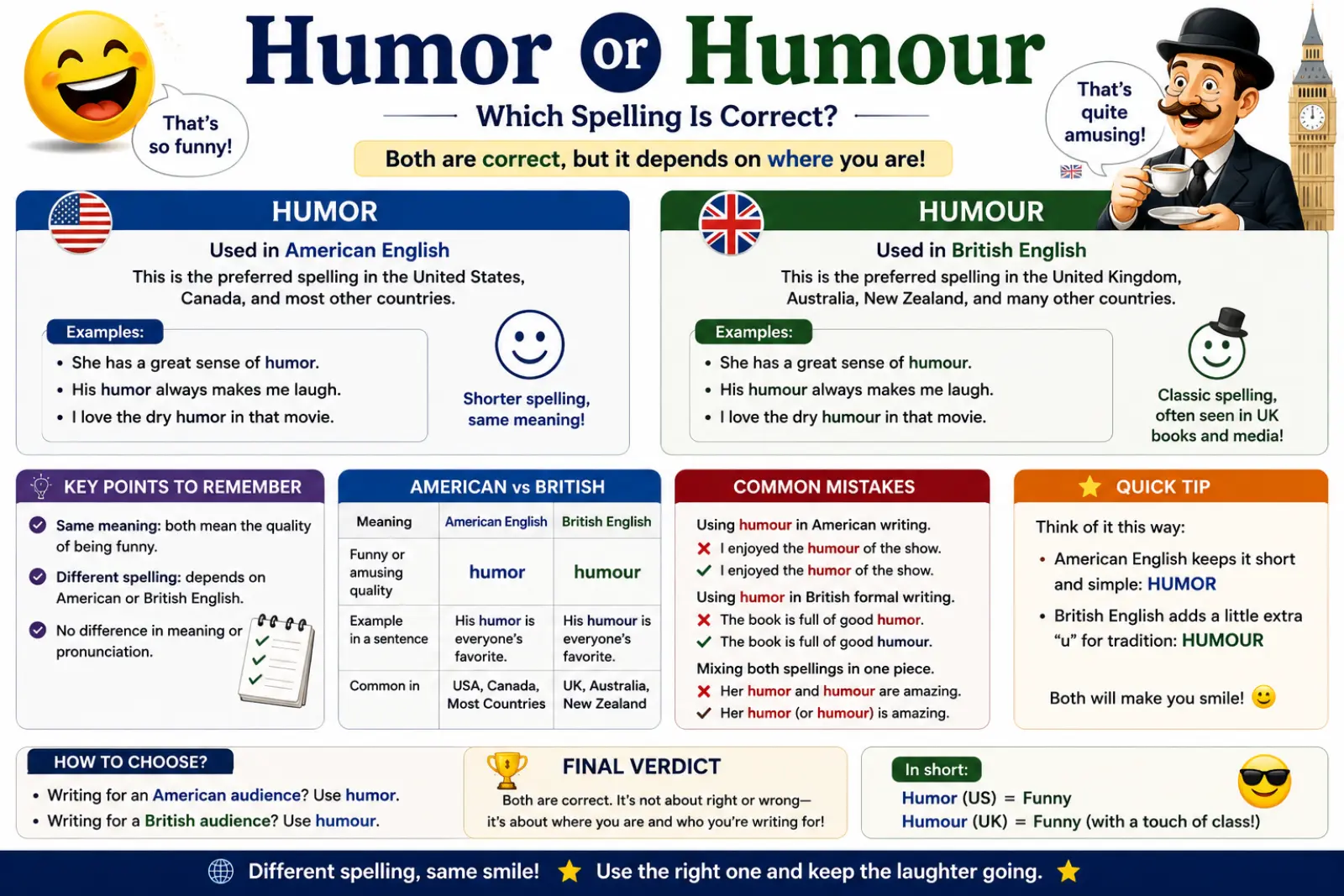
You may have written a sentence like “She has a great sense of humor” and then wondered whether it should be humour instead. This is a very common English spelling question because both humor and humour are correct.
The difference is mainly about British English and American English. Humor is the standard American spelling, while humour is the standard British spelling. The meaning is the same: the ability to find things funny or the quality that makes something amusing. Cambridge lists humour as the UK form and humor as the US form.
This spelling difference can be confusing for students, bloggers, writers, and English learners. You may see humour in British books, websites, and newspapers, while humor is common in American writing. Both forms are also understood in countries such as India, Pakistan, Canada, and Australia, although local style can vary.
People usually search for: humor or humour meaning, correct spelling, pronunciation, examples, usage, definition, grammar difference, American spelling, and British spelling.
The word is also common in everyday conversations, school assignments, workplace emails, social media posts, movies, books, comedy, and online content. Knowing which spelling to use can make your writing look more natural and consistent.
In this guide, you’ll learn the meaning, pronunciation, examples, usage, grammar rules, common mistakes, expert tips, and simple explanations in easy English.
Humor or Humour – Quick Answer
👉 Humor = the American English spelling.
👉 Humour = the British English spelling.
Both words have the same meaning and are pronounced almost the same.
Examples:
- 🇺🇸 She has a great sense of humor.
- 🇬🇧 She has a great sense of humour.
- His humor made everyone laugh.
- His humour made everyone laugh.
- I enjoy British humour.
- American humor can be very different from British comedy.
Simple Rule
👉 US English = humor
👉 UK English = humour
Think of humour as the British spelling with an extra u.
What Does Humor or Humour Mean?
Humor or humour means the ability to recognize, create, or enjoy things that are funny or amusing. It can also describe something that makes people laugh.
For example:
“She has a good sense of humor.”
This means she can understand and enjoy funny situations, jokes, or comments.
The word can also describe a person’s mood in some contexts. Cambridge gives both the amusement-related meaning and an older/formal meaning connected with a person’s mood.
Synonyms
Some useful synonyms include:
- amusement
- comedy
- fun
- wit
- playfulness
- funniness
- entertainment
However, these words are not always exact replacements. Wit, for example, often refers to clever and quick use of words.
Opposites
Depending on the context, possible opposites include:
- seriousness
- solemnity
- sadness
- dullness
- humorlessness
Related Terms
You may also see:
- humorous – funny or amusing
- humorist / humourist – a person known for creating humor
- humorless / humourless – lacking a sense of humor
- sense of humor / sense of humour – the ability to understand or enjoy funny things
The Origin of Humor or Humour
The history of humor/humour is surprisingly interesting.
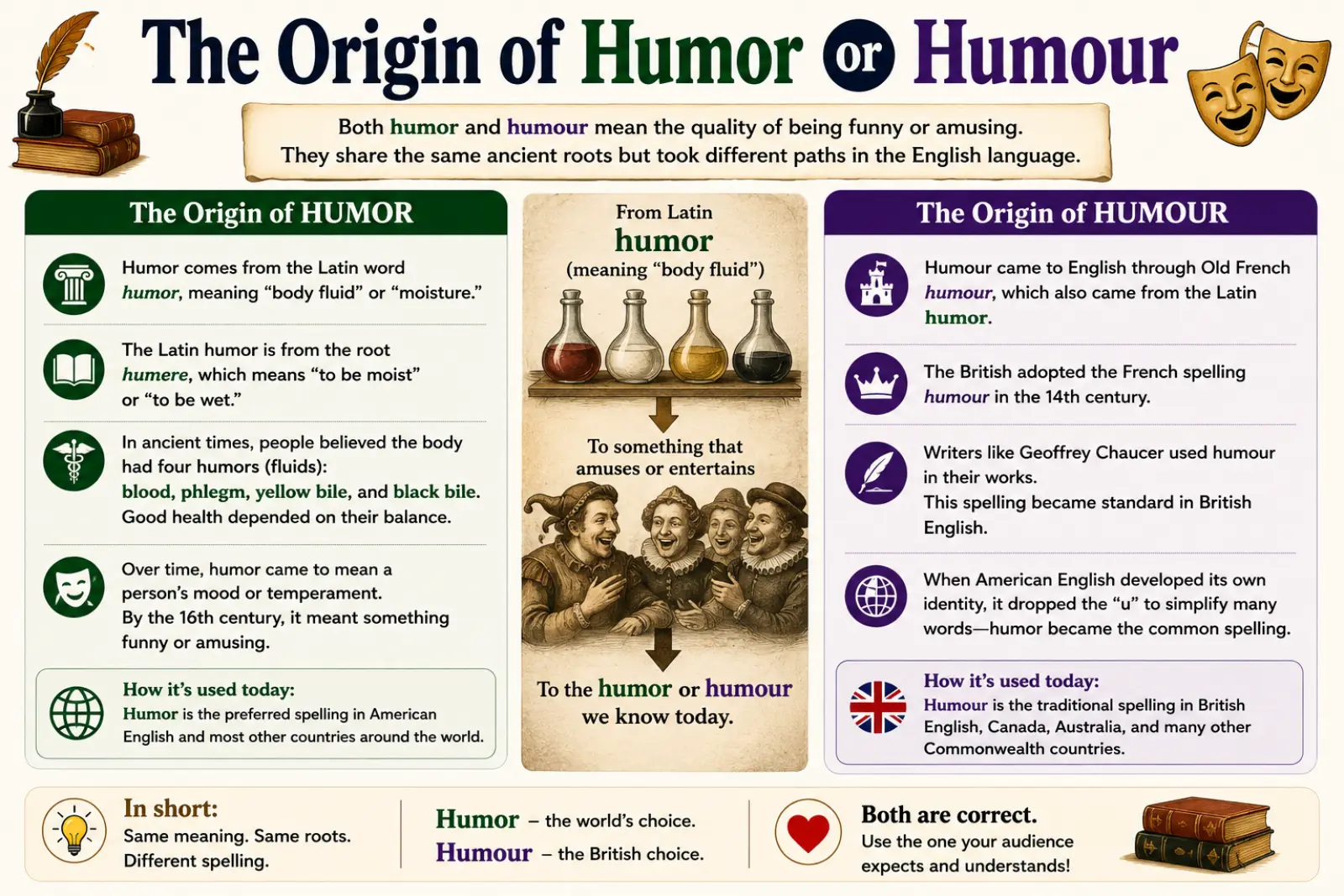
The word goes back to Latin umor, meaning “body fluid” or “moisture.” It entered English through Old French forms related to humour. In medieval medicine, the word was connected with the theory of four bodily fluids, or “humors,” that were believed to affect health and personality.
Over time, the meaning changed. It became connected with a person’s mood or temperament and later developed the modern meaning associated with funniness and amusement. The meaning of humor as something funny is recorded in English from the late 17th century.
The spelling difference also developed over time. Humour became strongly associated with British English, while American spelling reforms helped establish humor in American English.
So, neither spelling is a modern invention. Both have a long history.
How to Pronounce Humor or Humour
The pronunciation is nearly identical in British and American English.
Humor: HYOO-mer
Humour: HYOO-muh(r)
Cambridge gives approximately /ˈhjuː.mər/ for American English and /ˈhjuː.mə/ for British English.
Easy Breakdown
Hu-mor / Hu-mour
Say it like:
HYOO + mer
The first part sounds like “hue.”
Common Pronunciation Mistake
Do not pronounce it as if the h were completely silent.
❌ “yoo-mer”
✔ “HYOO-mer”
The exact final sound may vary slightly between accents.
British English vs American English Usage
The biggest difference is spelling, not meaning.
| Feature | British English | American English | Notes |
|---|---|---|---|
| Standard spelling | humour | humor | Both are correct |
| Meaning | Funny quality or amusement | Funny quality or amusement | Same meaning |
| Pronunciation | HYOO-muh | HYOO-mer | Slight accent difference |
| Example | sense of humour | sense of humor | Both natural |
| Related adjective | humorous | humorous | Same spelling |
| Formal writing | humour | humor | Follow local style |
| Academic writing | humour | humor | Be consistent |
| Social media | humour | humor | Both are common |
Cambridge specifically identifies humour as the UK spelling and humor as the US spelling.
Which One Should You Use?
Choose the spelling based on the English style you are writing in.
Use humor when:
- Writing primarily for a US audience
- Following American English
- Writing for an American school or company
- Using an American style guide
- Creating US-focused website content
Example:
His humor made the presentation more enjoyable.
Use humour when:
- Writing primarily for a UK audience
- Following British English
- Writing for a British publication
- Using British spelling conventions
Example:
His humour made the presentation more enjoyable.
Important Tip
Neither spelling is “more correct.”
The real mistake is mixing spelling systems without a reason. If your article uses British English, use humour consistently. If it uses American English, use humor consistently.
Common Mistakes With Humor or Humour
Mistake 1: Thinking one spelling is wrong
❌ “Humour is misspelled.”
✔ “Humour is the British spelling; humor is the American spelling.”
Tip: Remember that both are standard English spellings.
Mistake 2: Mixing the two styles
❌ One paragraph uses humor, while another uses humour.
✔ Choose one style and stay consistent.
This often happens when writers use different sources while researching.
Mistake 3: Confusing humor with humorous
❌ “He is full of humorous.”
✔ “He is very humorous.”
Humor/humour is usually a noun.
Humorous is an adjective.
Mistake 4: Confusing humor with comedy
❌ “Humor and comedy always mean exactly the same thing.”
✔ “Comedy is a form of entertainment, while humor is the quality or ability connected with what is funny.”
Mistake 5: Forgetting the spelling pattern
❌ humour in American-style writing when your publication requires US spelling
✔ humor
Tip: American English often removes the u from British -our spellings, as in colour/color and favour/favor.
Humor or Humour in Everyday Examples
| Situation | American English | British English |
|---|---|---|
| Work | His humor helped the team relax. | His humour helped the team relax. |
| School | I like her sense of humor. | I like her sense of humour. |
| Social media | His humor is hilarious. | His humour is hilarious. |
| Daily life | We have the same sense of humor. | We have the same sense of humour. |
| Thank you for your sense of humor. | Thank you for your sense of humour. | |
| Text message | I love your humor 😂 | I love your humour 😂 |
| Online content | The video uses dark humor. | The video uses dark humour. |
| Conversation | She has a great sense of humor. | She has a great sense of humour. |
Humor or Humour in Different Contexts
In Education
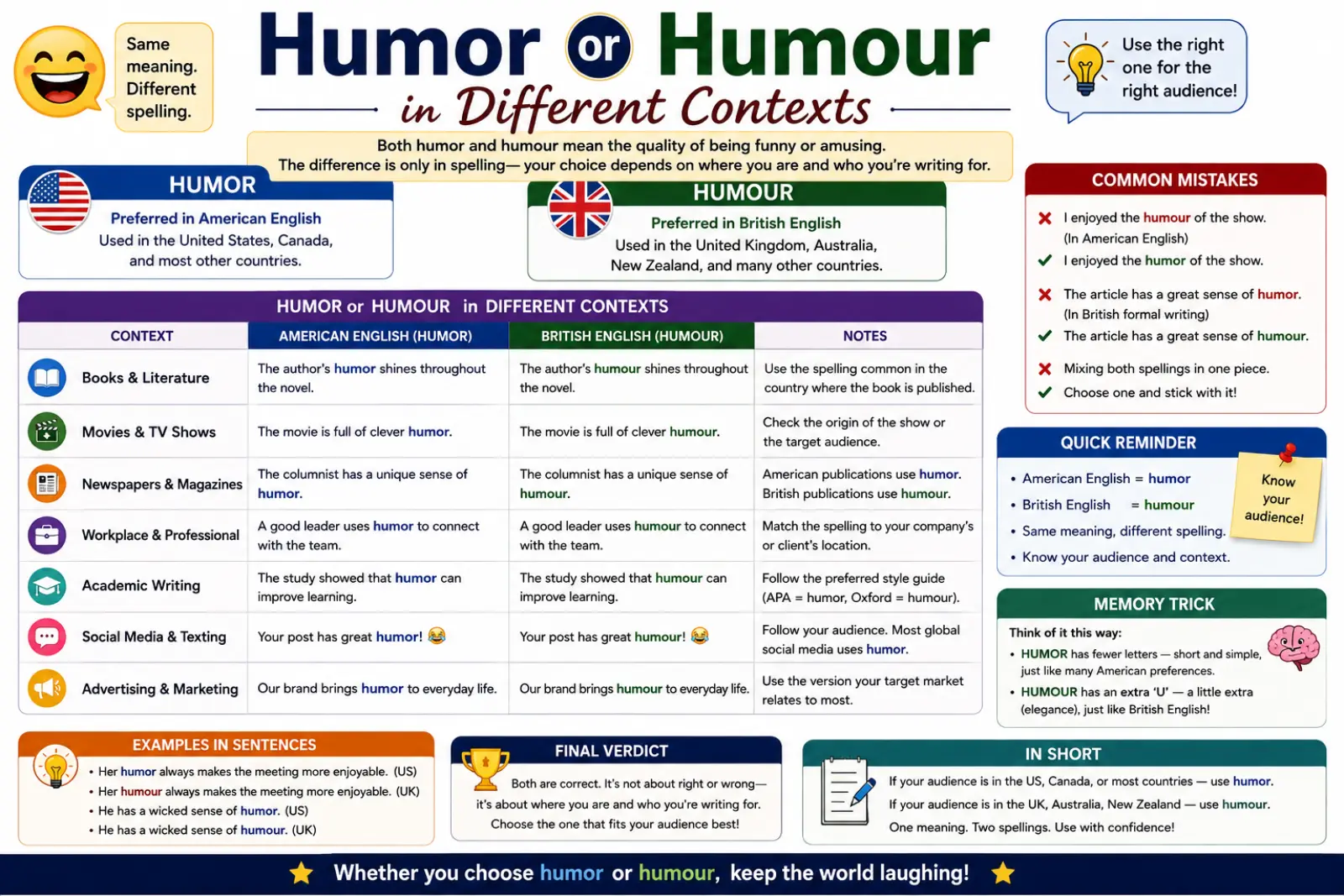
Students may encounter both spellings when reading international material.
For example:
“The author uses humor to make the story more enjoyable.”
A British textbook might use:
“The author uses humour to make the story more enjoyable.”
In Business
Humor can make presentations and workplace communication feel friendly, but it should be used carefully.
“A little humor made the presentation less stressful.”
In professional settings, avoid jokes that could offend people or be misunderstood.
On Social Media
Humor is extremely common in memes, captions, comments, videos, and online communities.
You may see phrases such as:
- dark humor
- dry humor
- sarcastic humor
- relatable humor
- British humour
- American humor
In Writing
Writers use humor to make stories, articles, speeches, and personal essays more interesting.
For example:
“The writer uses gentle humor to discuss everyday problems.”
Humor or Humour – Google Trends and Usage
People searching “humor or humour” are usually trying to solve a spelling or style question rather than learn a completely different word.
Common long-tail searches include:
- Is humor or humour correct?
- Is humour British or American?
- How do you spell humor?
- How do you spell humour?
- What is the difference between humor and humour?
- Which is correct in American English?
- Which is correct in British English?
- How do you pronounce humor?
- How do you pronounce humour?
Search behavior can vary by country. Users in the US are more likely to encounter humor, while users in the UK commonly encounter humour. English learners in India and Pakistan may encounter both forms because educational and online materials can use different English standards.
Canada and Australia also use spelling conventions influenced by British English, although individual style guides and publications can differ.
Rather than treating one form as universally correct, the useful lesson is simple: identify your target English variety and remain consistent.
Comparison Table: Humor vs Humour
| Feature | Humor | Humour |
|---|---|---|
| Correct spelling | ✅ Yes | ✅ Yes |
| Main variety | American English | British English |
| Meaning | Funny quality or amusement | Funny quality or amusement |
| Pronunciation | HYOO-mer | HYOO-muh |
| Noun | Yes | Yes |
| Adjective | Humorous | Humorous |
| Professional use | Yes | Yes |
| Academic use | Yes | Yes |
| Social media use | Yes | Yes |
| Main difference | No u | Includes u |
Humor or Humour in Professional Life
Spelling consistency matters more than choosing one form.
If you are writing a US business proposal, use humor:
“The speaker used humor to connect with the audience.”
For a British company, humour may be preferred:
“The speaker used humour to connect with the audience.”
This small detail can make your writing feel more natural to the intended audience.
For websites, blogs, marketing materials, and company documents, decide on your English style before publishing. Then apply it consistently throughout the content.
Humor or Humour for Students and Beginners
The easiest way for beginners to understand this spelling is to connect it with other -or/-our differences.
| American | British |
|---|---|
| humor | humour |
| color | colour |
| favor | favour |
| honor | honour |
| behavior | behaviour |
The pattern is not perfect for every English word, but it is a useful memory aid.
If your teacher uses American English, write humor. If your class follows British English, write humour.
Common Uses of Humor or Humour
You will commonly see the word in phrases such as:
- sense of humor
- sense of humour
- good humor
- good humour
- dark humor
- dark humour
- dry humor
- dry humour
- humorous story
- humorous comment
- humorist
- humorless
These phrases describe different types or uses of something funny, playful, or amusing.
Simple Trick to Remember Humor or Humour
Here is the easiest trick:
👉 US = humor
👉 UK = humour
Think:
American spelling = shorter
British spelling = keeps the U
You can connect it with:
color → colour
favor → favour
honor → honour
humor → humour
Think of It This Way:
Imagine the British spelling is carrying an extra U.
US: humor
UK: humour
Once you remember this pattern, the spelling becomes much easier.
Expert Tips for Better Spelling
1. Know your audience
Before writing, decide whether your readers expect American or British English.
2. Check your style guide
Businesses, universities, newspapers, and websites may have their own spelling rules.
3. Stay consistent
Do not randomly switch between humor and humour.
4. Learn related words together
Memorizing humor/humour alongside color/colour and favor/favour can make the pattern easier.
5. Remember the adjective
Both varieties use humorous.
She gave a humorous speech.
The adjective does not become humourous in standard spelling.
Related Searches People Also Ask
Is humor or humour correct?
Both are correct. Humor is American English, while humour is British English.
Is humour British spelling?
Yes. Humour is the standard British spelling.
Is humor American spelling?
Yes. Humor is the standard American spelling.
Do humor and humour mean the same thing?
Yes. They have the same basic meaning.
Is there a pronunciation difference?
There can be a small accent difference, but the words are essentially pronounced the same.
What is the correct spelling of sense of humor?
“Sense of humor” is standard American spelling; “sense of humour” is standard British spelling.
Is humorous spelled differently in British English?
No. Humorous is generally spelled the same in both varieties.
Why does British English use humour?
British spelling retained the u in this word, while American spelling adopted the shorter -or form.
FAQs About Humor or Humour
Is “humor” or “humour” correct?
Both are correct. Humor is American English, and humour is British English.
Which spelling should I use in an American article?
Use humor.
Which spelling should I use in British English?
Use humour.
Do humor and humour have different meanings?
No. They normally have the same meaning.
How do you pronounce humor?
It is commonly pronounced HYOO-mer in American English.
How do you pronounce humour?
It is commonly pronounced HYOO-muh in British English.
Is “humorous” British or American?
Humorous is used in both British and American English. It means funny or amusing.
Is humor a noun?
Yes. For example: “Her humor made everyone laugh.”
Can humor be a verb?
Yes. In both varieties, the verb can mean to go along with someone’s wishes to avoid upsetting them.
Is “sense of humor” correct?
Yes. It is the standard American spelling. In British English, write sense of humour.
Final Verdict: Humor or Humour?
The answer is simple:
👉 Humor = American English
👉 Humour = British English
Neither is wrong. The important thing is to use the spelling that matches your chosen English style.
Easy Memory Rule
US drops the U → humor
UK keeps the U → humour
Conclusion
If you have ever wondered about humor or humour, you do not need to worry about choosing between a correct and an incorrect spelling. Both are correct.
The difference is mainly regional. American English uses humor, while British English uses humour. The meaning, basic grammatical role, and everyday use remain the same.
You may see these spellings in schoolwork, books, business writing, social media, websites, emails, and everyday conversations. The best habit is to choose one English style and use it consistently.
Final memory trick:
American = humor. British = humour.
Once you remember the extra U, this common spelling confusion becomes much easier.

Camila Green is an English language writer who specializes in confusing word comparisons and spelling explanations. She creates simple, beginner-friendly guides on topics like “niece or neice” and other common English mistakes. Her writing focuses on clarity, real-life examples, and easy learning. At VerrsaPick, she helps readers improve their English with practical and engaging content.