Have you ever seen both madam and madame and wondered which one is correct? You may notice madam in English conversations, letters, customer service, and formal speech, while madame often appears when talking about French language and culture. Because the two words look and sound similar, it is easy to mix them up.
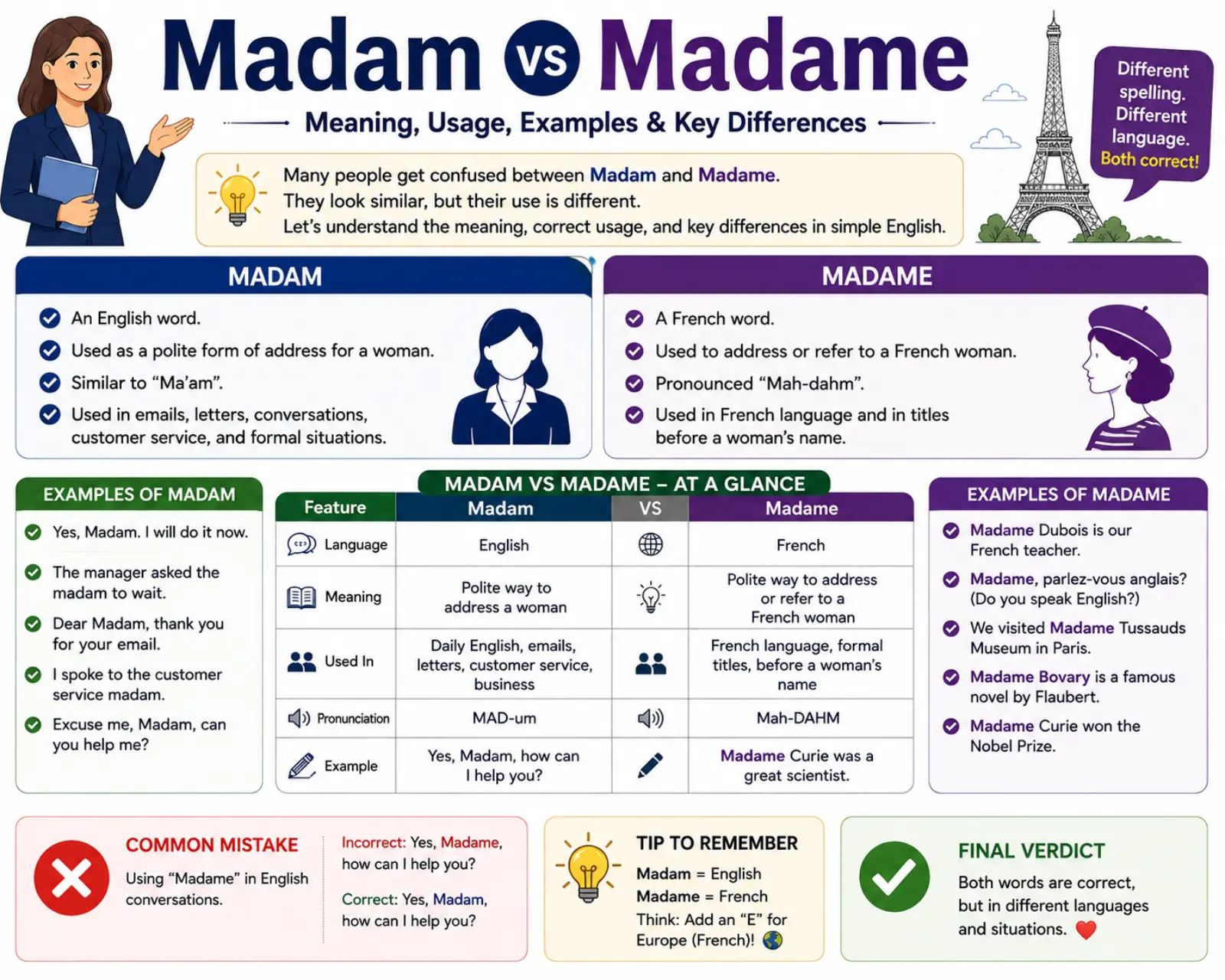
The good news is that both “madam” and “madame” are correct words, but they are used in different ways. Madam is the standard English form of a polite or formal way to address a woman. Madame is the French form and is also used in English in certain French-related names, titles, or expressions.
People usually search for madam vs madame meaning, correct spelling, pronunciation, examples, usage, definition, and grammar difference. Understanding the difference can help you write better emails, letters, business messages, and everyday conversations.
You may encounter these words at school, in the workplace, in customer service, in formal letters, in books, online, or when learning French. Choosing the right word depends mainly on the language and situation.
In this guide, you’ll learn the meaning, pronunciation, examples, usage, grammar rules, common mistakes, expert tips, and simple explanations in easy English.
Madam vs Madame Quick Answer
👉 Madam = the standard English term used politely to address a woman.
👉 Madame = the French equivalent of Mrs. or a polite title for a woman; it is also used in some English contexts connected with French culture.
Examples
- Madam, may I help you? ✅
- Dear Madam, ✅
- Madame Dupont is our guest. ✅
- Bonjour, Madame. ✅
- The hotel manager politely addressed her as madam. ✅
Simple Rule
👉 Use madam in normal English.
👉 Use madame when using French or referring to a French title, name, or setting.
What Does Madam vs Madame Mean?
Madam
Madam is a formal and polite English way to address a woman.
For example:
Excuse me, madam.
It can also appear in formal letters:
Dear Madam,
The word is especially common in customer service, official communication, formal speech, and traditional polite language.
Madame
Madame is the French equivalent of a respectful title for a woman. It is commonly shortened to Mme in French.
For example:
Madame Martin
In English, madame may be used when speaking about a French woman, a French-speaking setting, or a person whose title is traditionally styled Madame.
Synonyms and Related Terms
Depending on context, related terms include:
- Mrs.
- Ms.
- Ma’am
- Lady
- Miss
- Woman
- Mistress
These words are not always interchangeable, so context matters.
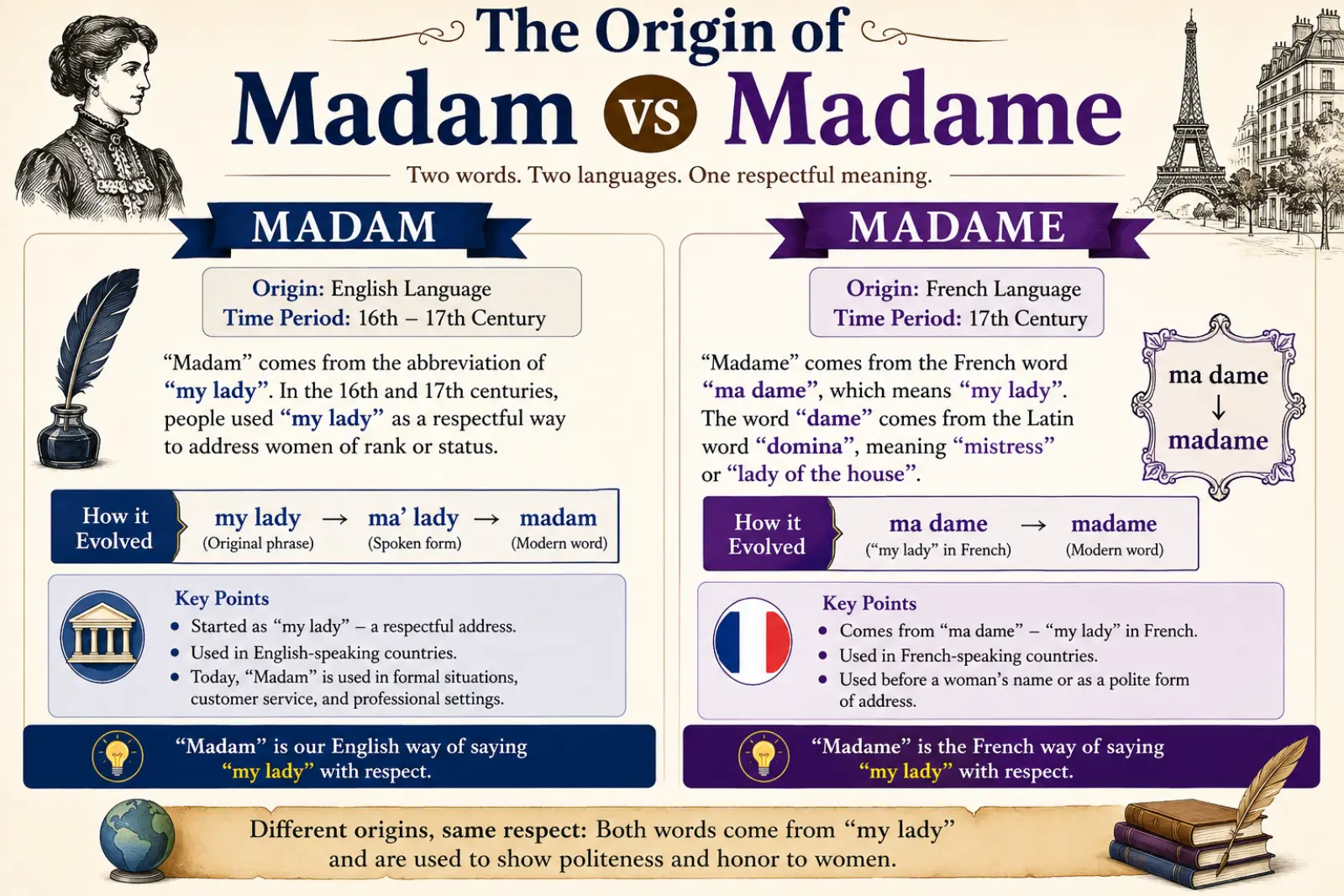
The Origin of Madam vs Madame
Both words have a shared historical background.
Madam developed in English from madame, which comes from French. The French word is built from ma meaning “my” and dame meaning “lady.”
Over time, English adopted and changed the word into madam. French continued using madame.
This explains why the two words are so similar. They are closely related, but English and French use them according to their own language conventions.
How to Pronounce Madam vs Madame
Madam
Madam is commonly pronounced:
👉 MAD-um
It has two syllables.
Example:
Excuse me, madam.
Madame
In English, madame is often pronounced approximately:
👉 MAD-um
In French, the pronunciation is closer to:
👉 ma-DAHM
The exact sound depends on the speaker and language.
Easy Speaking Trick
Remember:
English → madam
French → madame
Do not worry if the two sound similar. The main difference is often their spelling and language context.
British English vs American English Usage
Both British and American English use madam, although the word can sound quite formal.
| Feature | British English | American English | Notes |
|---|---|---|---|
| Madam | Common | Common | Formal English |
| Madame | Used in special contexts | Used in special contexts | Often French-related |
| Meaning | Polite address | Polite address | Similar |
| Formal letters | Yes | Yes | “Dear Madam” |
| Customer service | Yes | Yes | Formal tone |
| French title | Madame | Madame | Same spelling |
There is no major British-American spelling difference between these terms.
Which One Should You Use?
The simplest choice is:
- Use madam in ordinary English.
- Use madame when the context is French.
- Use Madame + surname when using a French title.
- Use Dear Madam in a formal English letter when the woman’s name is unknown.
- Avoid using madam casually if the situation calls for a more natural modern term such as ma’am, Ms., or the person’s name.
Mini Usage Table
| Situation | Best Choice |
|---|---|
| Formal English address | Madam |
| English formal letter | Dear Madam |
| French woman/title | Madame |
| French conversation | Madame |
| French business setting | Madame |
| Casual American conversation | Ma’am may sound more natural |
Common Mistakes With Madam vs Madame
Mistake 1: Treating them as completely different words
❌ “Madam and Madame have totally unrelated meanings.”
✔ They are closely related, but madam is the English form and madame is French.
Mistake 2: Using “madame” in every English sentence
❌ “Madame, can I help you?” in an ordinary English setting
✔ “Madam, can I help you?”
Tip: If you are speaking normal English, madam is usually the safer choice.
Mistake 3: Using “madam” in a French sentence
❌ “Bonjour, Madam.”
✔ “Bonjour, Madame.”
If the sentence is French, use the French form.
Mistake 4: Confusing madam with Mrs.
Madam is a form of address, while Mrs. is a title normally used before a woman’s surname.
Madam, please take a seat.
Mrs. Smith is waiting.
Mistake 5: Assuming madame is always more polite
Neither word is automatically “more polite.” The correct choice depends on language, culture, and context.
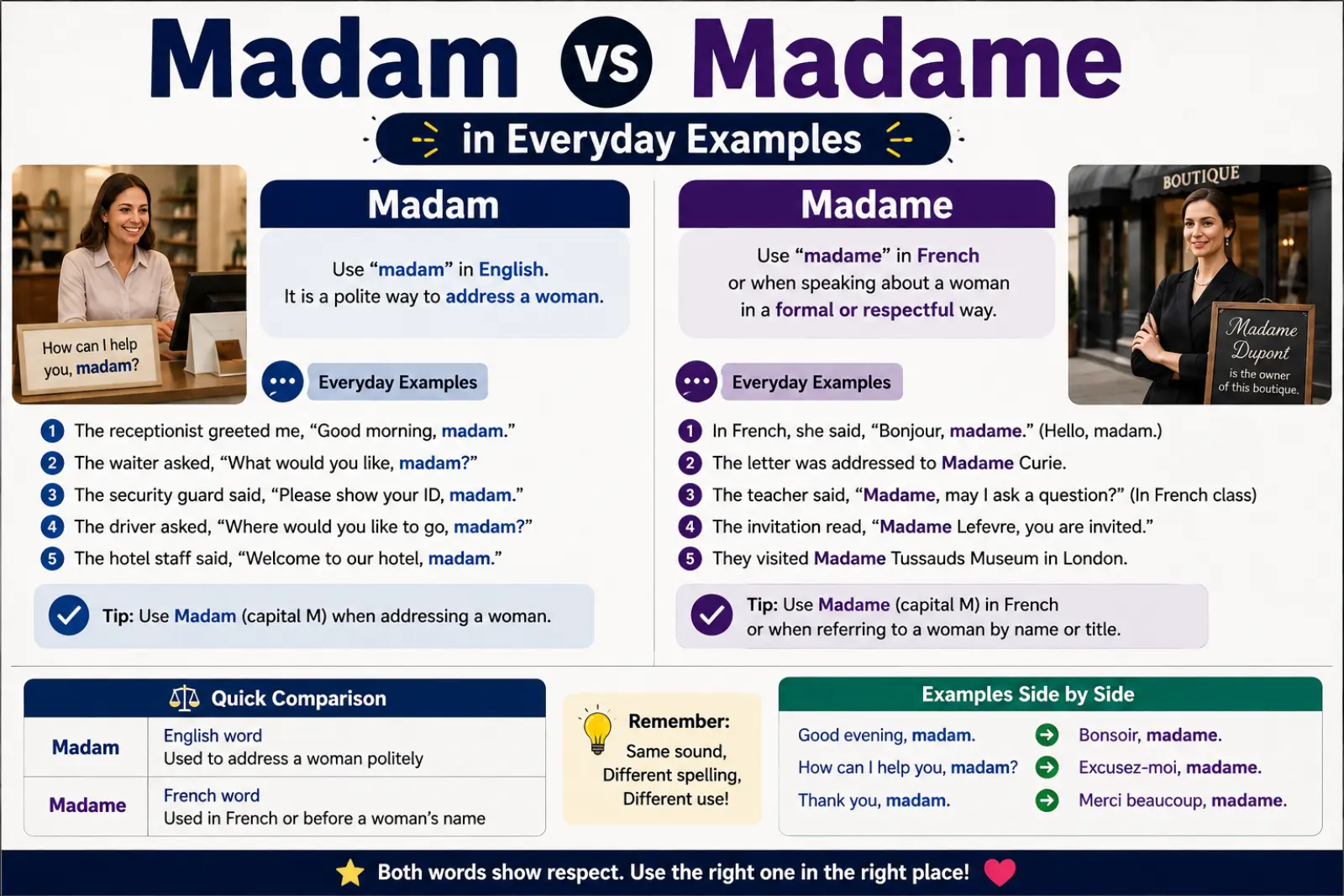
Madam vs Madame in Everyday Examples
Work
Madam, the meeting will begin shortly.
School
Good morning, Madam.
Social Media
“Madame, your outfit looks amazing!”
This may be playful or stylish depending on the context.
Daily Life
Excuse me, madam. You dropped your phone.
Dear Madam, I am writing regarding your application.
Text Message
In casual texting, people usually use the person’s name instead:
Hi Sarah, could you send me the file?
Online Content
You may see Madame in French-related articles, names, restaurants, fashion, or cultural content.
Conversation
Yes, madam. I understand.
Madam vs Madame in Different Contexts
Education
Madam may be used when students formally address a female teacher in some English-speaking cultures.
Good morning, Madam.
However, in many modern English-speaking schools, students simply use the teacher’s preferred title and name.
Business
Madam can appear in formal customer service:
How may I assist you, madam?
For everyday business communication, using someone’s name is often more natural.
French Language
Madame is the correct French form.
Madame Dupont
It is comparable to a respectful female title.
Writing
Dear Madam is a traditional formal-letter opening when the recipient’s name is unknown.
Social Media
Madame may be used humorously, stylishly, or dramatically online. Its meaning depends heavily on context.
Madam vs Madame Comparison Table
| Feature | Madam | Madame |
|---|---|---|
| Language | English | French |
| Basic meaning | Respectful address for a woman | Respectful French title |
| Correct spelling | ✅ Yes | ✅ Yes |
| Pronunciation | MAD-um | MAD-um / French ma-DAHM |
| Grammar role | Noun/title | Noun/title |
| Formal use | Common | French contexts |
| Academic use | Possible | French studies |
| Professional use | Possible | French/international contexts |
| Common mistake | Using it in French | Using it unnecessarily in English |
| Best memory | English | French |
Madam vs Madame in Professional Life
Choosing the right title can make communication sound more natural and respectful.
In a formal English letter, you might write:
Dear Madam,
But if you know the person’s name, it is usually better to use it:
Dear Ms. Johnson,
In French correspondence, Madame is appropriate:
Madame Dupont
In international business, always consider the person’s language, culture, and preferred title.
Madam vs Madame for Students and Beginners
The easiest way for beginners to remember the difference is to connect each word with its language.
MADAM → ENGLISH
MADAME → FRENCH
Then remember that they have a shared history.
If you are writing an English sentence and simply want to address a woman politely, madam is usually correct.
If you are using French or referring to a French title, choose madame.
Common Uses Related to Madam and Madame
You may see madam in:
- Formal letters
- Customer service
- Official speech
- Traditional polite language
- Workplace communication
- School settings
- Formal announcements
You may see madame in:
- French conversations
- French names and titles
- French literature
- French restaurants or businesses
- Fashion and culture
- International settings
- French-language documents
Simple Trick to Remember Madam vs Madame
Think of the final e as a French clue.
👉 Madam = English
👉 Madame = French
Think of It This Way
Imagine someone speaking English:
Excuse me, madam.
Now imagine someone speaking French:
Bonjour, Madame.
The extra e helps you remember the French form.
Expert Tips
- Look at the language first. English usually uses madam; French uses madame.
- Consider the setting. A French name or French sentence usually calls for Madame.
- Do not confuse titles. Madam, Mrs., Ms., and ma’am have different uses.
- Use a person’s preferred title when known.
- Use names when possible. Modern professional communication often sounds warmer with a person’s name.
- Remember the spelling: madam has no final e; madame does.
- Do not assume one is always more respectful. Context determines the appropriate form.
Related Searches People Also Ask
- Madam or Madame: which is correct? Both are correct, but madam is the normal English form and madame is French.
- What is the difference between madam and madame? The main difference is language and usage.
- Is madame English or French? Madame is a French word.
- Is madam a French word? Madam is the English form derived historically from French.
- How do you pronounce madam? Usually MAD-um.
- How do you pronounce madame? English often uses MAD-um, while French pronunciation is closer to ma-DAHM.
- Can I use madam in a letter? Yes. Dear Madam is a traditional formal opening.
- What does Madame mean? It is a respectful French title for a woman.
- Is madam formal? Yes, it is generally formal or polite.
- What is the French equivalent of madam? Madame.
FAQs
1. Is it madam or madame?
Both are correct. Madam is the standard English form, while madame is the French form.
2. Is madame more polite than madam?
No. Neither is automatically more polite. The correct word depends on the language and situation.
3. What does madam mean?
Madam is a formal or polite way to address a woman.
4. What does madame mean?
Madame is a French title used respectfully for a woman.
5. Can I use madame in English?
Yes, but usually when the context is French or when the person is specifically styled Madame.
6. How do you pronounce madam?
It is commonly pronounced MAD-um.
7. How do you pronounce madame?
In English it is often pronounced MAD-um; in French, the pronunciation is closer to ma-DAHM.
8. Is “Dear Madam” correct?
Yes. Dear Madam is a traditional formal greeting when you do not know the woman’s name.
9. Is madam still used today?
Yes. It is still used in formal speech, customer service, official communication, and some cultural settings.
10. What is the easiest way to remember madam vs madame?
Remember: madam = English; madame = French.
Final Verdict
👉 Madam = standard English
👉 Madame = French
Both words are correct, but they are not normally interchangeable in every situation.
Easy memory rule:
Madam has no final “e” → English.
Madame has an “e” → French.
Conclusion
The difference between madam vs madame is mainly about language and context. Madam is the normal English form used to politely address a woman, especially in formal situations. Madame is the French form and is commonly used in French-speaking or French-related settings.
You may see madam in formal letters, customer service, workplaces, and traditional speech. You may see madame before French names or in French conversations and cultural settings.
If you are unsure, ask yourself one simple question:
“Am I writing in English or French?”
For English, choose madam. For French, choose madame.
Final memory trick: English = MADAM, French = MADAME.

Camila Green is an English language writer who specializes in confusing word comparisons and spelling explanations. She creates simple, beginner-friendly guides on topics like “niece or neice” and other common English mistakes. Her writing focuses on clarity, real-life examples, and easy learning. At VerrsaPick, she helps readers improve their English with practical and engaging content.