Have you ever tried to write a sentence and suddenly stopped because you could not remember how to spell rhythm? You are not alone. “Rhythm” is one of those English words that looks simple when you read it but can be surprisingly difficult to spell.
The confusion usually comes from its unusual combination of letters. Many learners expect a word to contain a vowel such as a, e, i, o, or u, but rhythm has no traditional vowel letter. That makes it especially tricky for students and beginner English learners.
People usually search for “how do you spell rhythm” because they want the correct spelling, pronunciation, definition, examples, or an easy way to remember it. You may see the word in music lessons, poetry, dance, writing, sports, everyday conversations, school assignments, workplace writing, social media, and online searches.
The good news is that you only need one simple spelling to remember: R-H-Y-T-H-M.
In this guide, you’ll learn the meaning, pronunciation, examples, usage, grammar rules, common mistakes, expert tips, and simple explanations in easy English.
How Do You Spell Rhythm? Quick Answer
The correct spelling is:
👉 Rhythm = R-H-Y-T-H-M
Rhythm means a regular pattern of sounds, movements, beats, or events.
Examples:
- The song has a strong rhythm.
- I love the rhythm of this music.
- The poem has a beautiful rhythm.
- The dancers moved with the rhythm.
- Try to keep the same rhythm while running.
Simple Rule
👉 Remember RHY + THM.
A helpful trick is to think: “Rhythm has rhythm, but no regular vowel letter.”
The word contains y, which works as the vowel sound.
What Does Rhythm Mean?
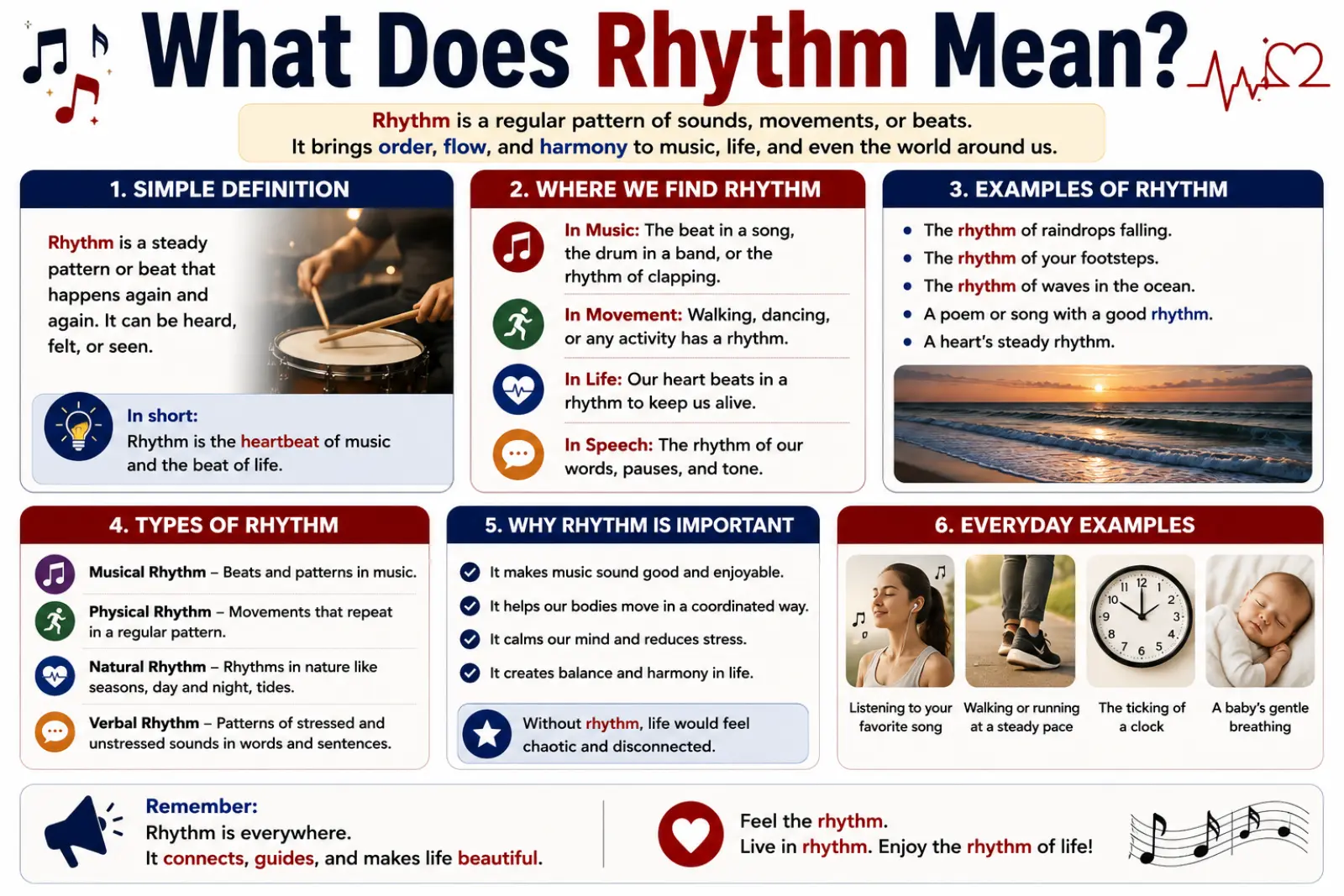
Rhythm is a repeated pattern of sounds, beats, movements, or actions.
Common meanings
- Music: a pattern of beats and sounds.
- Poetry: a pattern created by stressed and unstressed syllables.
- Dance: movement that follows a beat.
- Daily life: a repeated pattern or routine.
Synonyms
Depending on the context, related words include:
- beat
- pattern
- tempo
- flow
- cadence
- pulse
These words are related, but they do not always mean exactly the same thing.
Related Terms
You may also see:
- rhythmic
- rhythmically
- rhythm section
- rhythm guitar
- rhythm and blues
- natural rhythm
- musical rhythm
The Origin of Rhythm
The word rhythm comes from the Greek word rhythmos, referring to measured movement or a regular pattern.
It entered English through French and Latin forms before developing into the modern English spelling rhythm.
The unusual spelling has remained over time. That is one reason the word can feel difficult to spell, especially for people learning English.
How Do You Pronounce Rhythm?
Rhythm is usually pronounced:
👉 RITH-um
A simple phonetic guide is:
/ˈrɪð.əm/
It normally has two syllables:
RITH + um
The th sound is similar to the sound in this, although pronunciation can vary slightly by accent.
Common pronunciation mistake
Some learners try to pronounce every letter separately, which can make the word sound unnatural.
Instead, say it smoothly:
RITH-um
The spelling is harder than the pronunciation.
British English vs American English Usage
There is no major spelling difference between British and American English.
| Feature | British English | American English | Notes |
|---|---|---|---|
| Spelling | rhythm | rhythm | Same |
| Pronunciation | RITH-um | RITH-um | Very similar |
| Meaning | Pattern or beat | Pattern or beat | Same |
| Grammar | Noun | Noun | Same |
| Plural | rhythms | rhythms | Same |
So whether you are writing for readers in the UK, US, Canada, Australia, India, or Pakistan, the spelling rhythm is correct.
Which One Should You Use?
Use rhythm whenever you mean a regular pattern of beats, sounds, movements, or events.
Examples:
- Formal: The poem has a clear rhythm.
- Academic: The researcher studied the rhythm of speech.
- Workplace: We need to find a better rhythm for our weekly meetings.
- Music: The drummer created a powerful rhythm.
- Social media: I love the rhythm of this song.
There is only one standard spelling:
✅ rhythm
Common incorrect forms include:
❌ rythym
❌ rythm
❌ rhythum
❌ rhytm
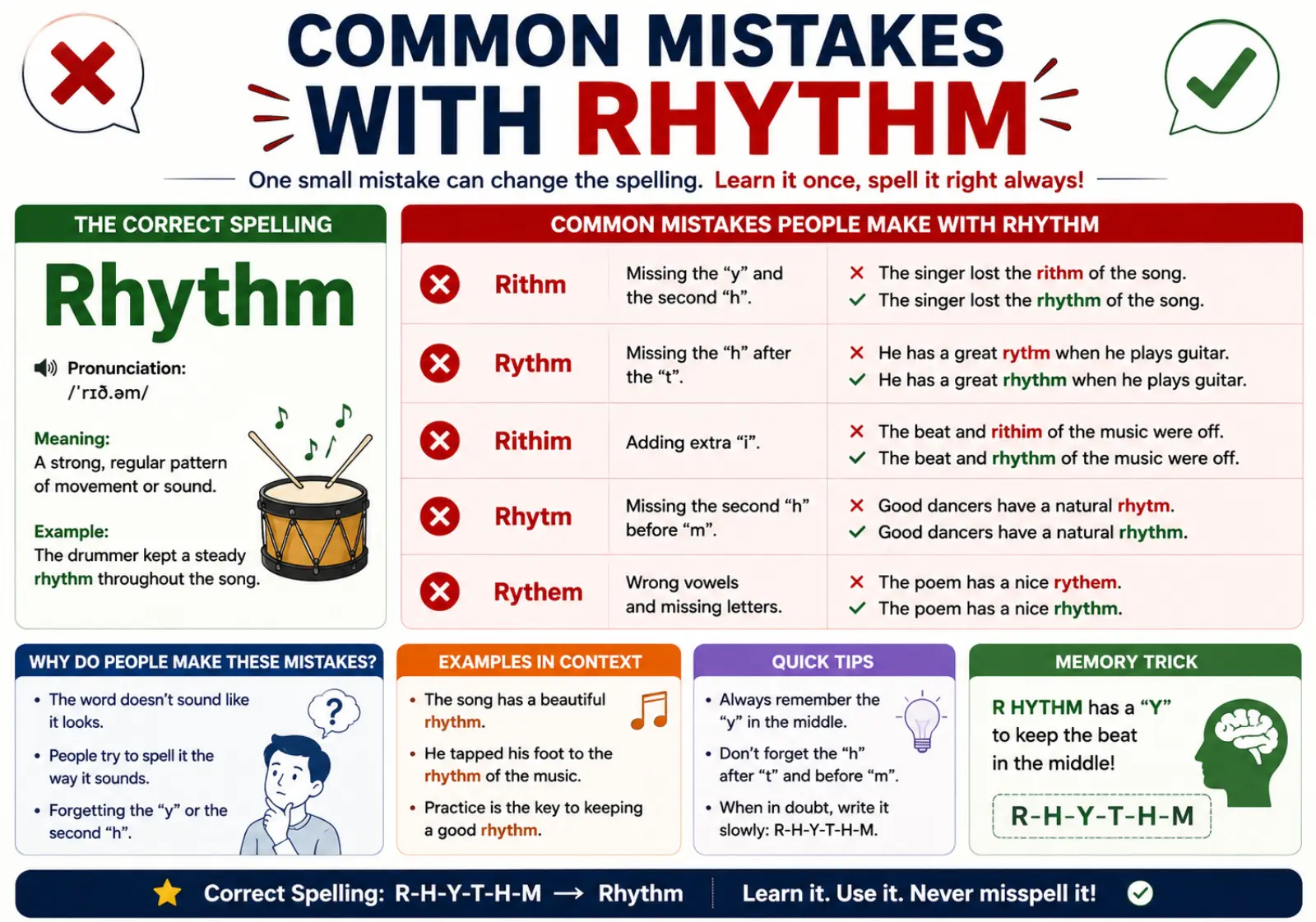
Common Mistakes With Rhythm
Mistake 1: Writing “rythym”
❌ The song has a strong rythym.
✔ The song has a strong rhythm.
People often swap the letters because the word does not follow a familiar spelling pattern.
Tip: Remember RHY-THM, not “RY-THYM.”
Mistake 2: Writing “rythm”
❌ I like the rythm of the music.
✔ I like the rhythm of the music.
The first part needs rh, and the word also contains y.
Mistake 3: Writing “rhythum”
❌ The dance has a fast rhythum.
✔ The dance has a fast rhythm.
The spelling does not contain u after rhyth.
Mistake 4: Adding an extra vowel
❌ Rhytham
✔ Rhythm
English learners often add a vowel because many English words are easier to pronounce with one. But rhythm keeps its unusual spelling.
Mistake 5: Confusing rhythm with tempo
❌ “Rhythm and tempo are exactly the same.”
✔ Rhythm refers to the pattern of beats, while tempo refers mainly to how fast or slow the music is.
Rhythm in Everyday Examples
Work:
“Our team has found a good rhythm for completing projects.”
School:
“The teacher explained the rhythm of the poem.”
Music:
“The rhythm makes the song exciting.”
Dance:
“She moved perfectly with the rhythm.”
Daily life:
“I am slowly getting back into a healthy rhythm.”
Email:
“We need to establish a regular rhythm for our meetings.”
Text message:
“I love the rhythm of this track!”
Conversation:
“Once you understand the rhythm, the dance becomes easier.”
Rhythm in Different Contexts
Rhythm in Music
Music is one of the most common contexts for this word. Rhythm organizes sounds into patterns of beats.
Example:
“The drummer kept a steady rhythm.”
Rhythm in Poetry
Poetry often uses rhythm to create a certain sound or flow.
Example:
“The rhythm of the poem makes it easy to read aloud.”
Rhythm in Dance
Dancers often follow the rhythm of music through repeated movements.
Example:
“The dancers stayed in rhythm with the music.”
Rhythm in Speech
Speech also has rhythm. The timing, stress, and pauses in spoken language can affect how natural a sentence sounds.
Example:
“English has a different speech rhythm from some other languages.”
Rhythm in Daily Life
The word can also describe a regular routine.
Example:
“After a busy week, I am trying to get back into my normal rhythm.”
Rhythm Comparison Table
| Feature | Rhythm |
|---|---|
| Correct spelling | Rhythm |
| Letters | R-H-Y-T-H-M |
| Syllables | Usually 2 |
| Pronunciation | RITH-um |
| Word type | Noun |
| Main meaning | A repeated pattern or beat |
| Music use | Very common |
| Poetry use | Very common |
| Dance use | Very common |
| Common error | Rythym |
| British spelling | Rhythm |
| American spelling | Rhythm |
Rhythm for Students and Beginners
Many beginners struggle with rhythm because the spelling is unusual.
The biggest problem is the lack of a normal vowel letter. Instead, y helps represent the vowel sound.
Try breaking it into two visual parts:
RHY + THM
Write it five times:
rhythm
rhythm
rhythm
rhythm
rhythm
Then use it in a sentence:
“I can feel the rhythm.”
Using the word in a real sentence makes it easier to remember than simply memorizing the letters.
Signs and Common Uses of Rhythm
You will commonly see rhythm when talking about:
- music and songs
- drums and beats
- dancing
- poetry
- speech
- exercise
- sports
- routines
- work patterns
- daily habits
- repeated movements
- natural patterns
It can describe both sound and movement, as well as a regular pattern in life.
Simple Trick to Remember Rhythm
Here is the easiest memory trick:
👉 RHY + THM = RHYTHM
Think of the word as two blocks:
RHY | THM
Do not try to spell it exactly as it sounds.
Think of it this way:
Rhythm has a beat, and the spelling has a pattern too.
If you remember RHY-THM, you are much less likely to write rythym or rhythum.
Another quick trick
Remember:
“Rhythm helps you move.”
Both rhythm and move relate to patterns and movement. Then picture the spelling:
R-H-Y-T-H-M
Expert Tips for Spelling Rhythm
Here are a few practical ways to avoid spelling mistakes:
- Memorize the letter pattern: RHYTHM.
- Break it visually: RHY + THM.
- Remember that Y helps provide the vowel sound.
- Do not spell it exactly as it sounds.
- Use the word in sentences.
- Read it regularly in music and poetry contexts.
- Add it to your personal spelling list if you often forget it.
A good proofreading habit is to pause whenever a word “looks strange.” Check the spelling rather than relying only on pronunciation.
Related Searches People Also Ask
People searching how do you spell rhythm may also wonder:
- How do you spell rhythm correctly?
The correct spelling is rhythm. - Why is rhythm so hard to spell?
Its unusual letter pattern and lack of a standard vowel make it tricky. - How do you pronounce rhythm?
It is commonly pronounced RITH-um. - Is rhythm spelled with a vowel?
It has no traditional vowel letter such as A, E, I, O, or U; Y helps represent the vowel sound. - Is “rythm” correct?
No. The correct spelling is rhythm. - Is “rythym” correct?
No. Rhythm is the standard spelling. - What does rhythm mean?
It means a repeated pattern of sounds, beats, movements, or events. - Is rhythm a noun?
Yes. Rhythm is commonly used as a noun. - What is the plural of rhythm?
The plural is rhythms. - What is rhythmic?
Rhythmic is an adjective meaning related to or having rhythm.
FAQs About How Do You Spell Rhythm
How do you spell rhythm?
The correct spelling is rhythm: R-H-Y-T-H-M.
What is the easiest way to remember rhythm?
Break it into RHY + THM. Remember the unusual Y and the final THM.
Is “rythym” a correct spelling?
No. Rythym is a common misspelling. The correct spelling is rhythm.
Does rhythm have a vowel?
The word does not contain the traditional vowel letters A, E, I, O, or U. The letter Y helps represent the vowel sound.
How do you pronounce rhythm?
It is commonly pronounced RITH-um, with two syllables.
What does rhythm mean?
Rhythm means a repeated pattern of beats, sounds, movements, or events.
Is rhythm a noun?
Yes. For example: “The music has a strong rhythm.”
What is the plural of rhythm?
The plural is rhythms.
Is rhythm spelled differently in British English?
No. Rhythm is the standard spelling in both British and American English.
What is the difference between rhythm and tempo?
Rhythm is the pattern of beats, while tempo describes how fast or slow the music is played.
Final Verdict: How Do You Spell Rhythm?
The correct spelling is:
👉 RHYTHM
Not rythm, rythym, or rhythum.
The easiest memory trick is:
RHY + THM = RHYTHM
Remember that Y helps provide the vowel sound, even though the word contains no traditional vowel letter.
Conclusion
If you have ever wondered how do you spell rhythm, the answer is simple once you learn the pattern: R-H-Y-T-H-M.
The word refers to a repeated pattern of beats, sounds, movements, or events. You will commonly see it in music, poetry, dance, speech, exercise, and everyday descriptions of routines.
The spelling may look strange at first, but you do not need to guess it from pronunciation. Just remember the visual pattern:
RHY + THM = RHYTHM.
One final trick: “Rhythm has a beat, and RHYTHM has a pattern.” That small connection can make this difficult spelling much easier to remember.

Camila Green is an English language writer who specializes in confusing word comparisons and spelling explanations. She creates simple, beginner-friendly guides on topics like “niece or neice” and other common English mistakes. Her writing focuses on clarity, real-life examples, and easy learning. At VerrsaPick, she helps readers improve their English with practical and engaging content.