Have you ever stopped while writing a sentence and wondered, “Should I use were or was?” You are not alone. This is one of the most common English grammar questions, especially for beginners and English learners.
Both was and were are past forms of the verb be, but they are not used in exactly the same way. The correct choice depends mainly on the subject of the sentence. It can also depend on the type of sentence, especially when talking about imaginary, unreal, or hypothetical situations.
You may see were or was in school assignments, emails, workplace writing, books, social media posts, text messages, and everyday conversations. A small grammar mistake can sometimes make a sentence sound unnatural, so learning this simple rule can make your English clearer and more confident.
People usually search for: were or was meaning, were or was grammar, were or was difference, were or was examples, was vs were usage, were pronunciation, was pronunciation, and when to use was or were.
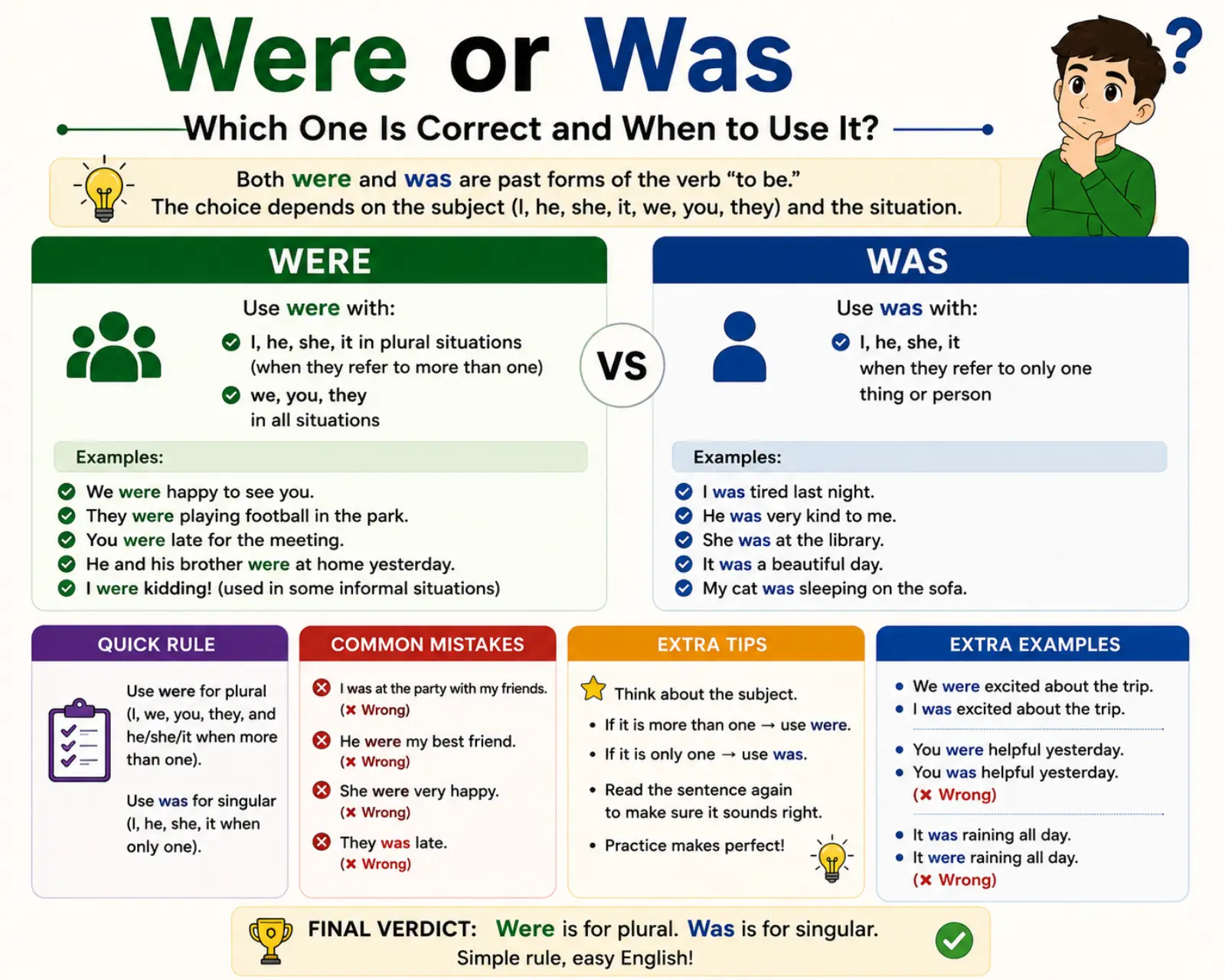
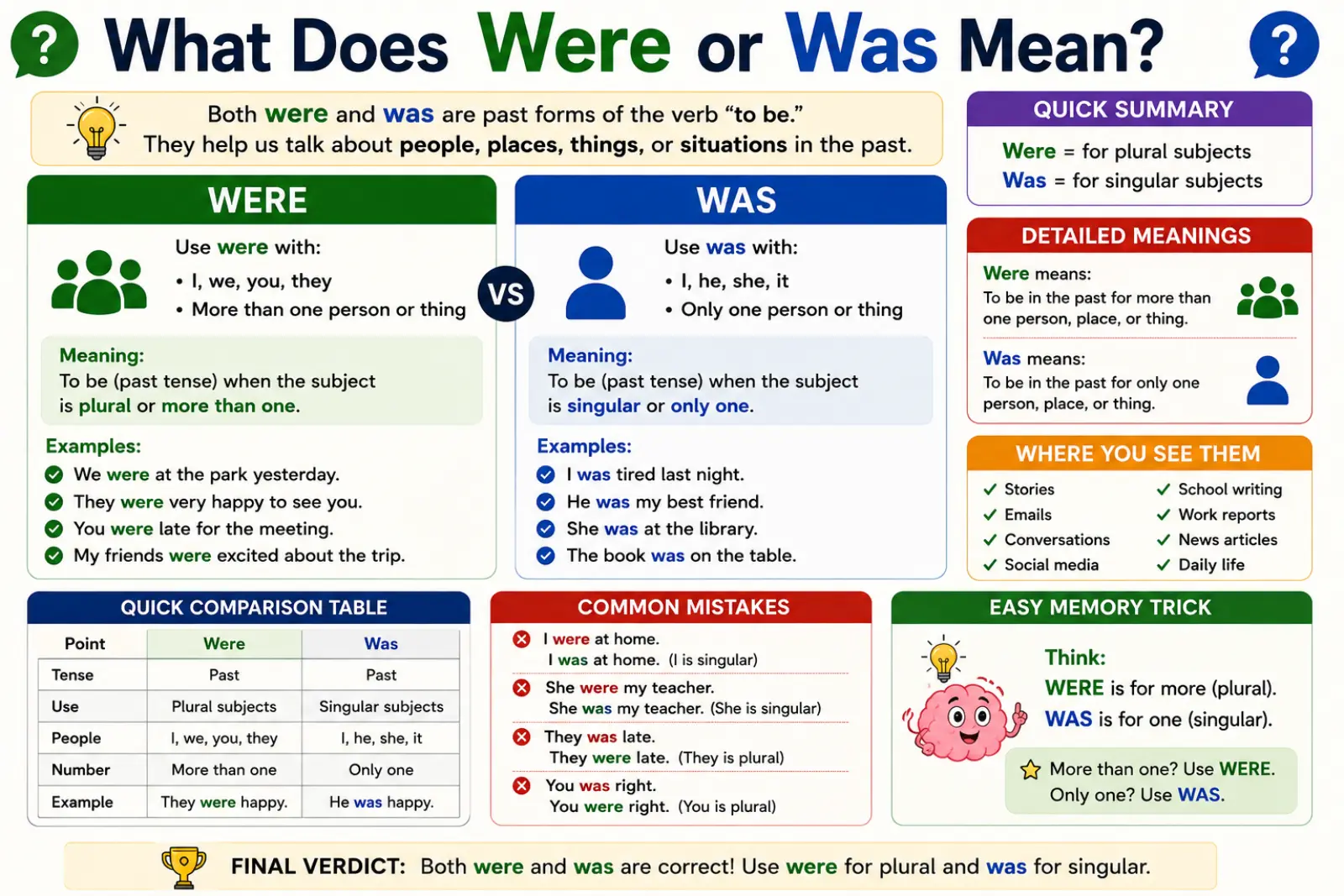
The good news is that the basic rule is easy. Was usually goes with singular subjects such as I, he, she, and it. Were usually goes with plural subjects such as you, we, and they. There is one important special case: were can be used with singular subjects in unreal or hypothetical situations.
In this guide, you’ll learn the meaning, pronunciation, examples, usage, grammar rules, common mistakes, expert tips, and simple explanations in easy English.
Were or Was Quick Answer
👉 Was = the past form of be normally used with I, he, she, and it.
👉 Were = the past form of be normally used with you, we, and they.
Examples
- I was tired yesterday. ✅
- She was at school. ✅
- He was happy. ✅
- We were late. ✅
- They were busy. ✅
- You were right. ✅
The Special Rule
Use were with I, he, or she when talking about an unreal or imaginary situation.
- If I were rich, I would travel the world.
- If she were here, she would help us.
- I wish I were taller.
Easy Memory Trick
One person = usually WAS.
More than one person = usually WERE.
But remember:
Imaginary or unreal “if” situations often use WERE.
What Does Were or Was Mean?
Was and were are past-tense forms of the verb be. They describe a past state, condition, location, identity, or situation.
For example:
- He was tired.
- She was a teacher.
- I was at home.
- They were excited.
- We were in New York.
The difference is mainly connected to the subject.
Was
Use was with:
- I
- he
- she
- it
- singular nouns
Examples:
I was hungry.
The dog was outside.
Sarah was happy.
Were
Use were with:
- you
- we
- they
- plural nouns
Examples:
You were early.
We were ready.
The children were outside.
Synonyms and Related Terms
Was and were do not have exact synonyms because they are forms of the verb be. Related grammar terms include:
- past tense
- verb
- subject
- singular
- plural
- past continuous
- past simple
- subjunctive mood
- hypothetical situation
The Origin of Were or Was
The words was and were come from the very old English verb be. Forms of this verb have existed in English for many centuries.
Modern English has several forms of be, including:
- am
- is
- are
- was
- were
- be
- been
- being
Over time, English developed different forms to show tense and subject. Today, was and were are mainly used to talk about the past.
The special use of were in sentences such as “If I were you” comes from an older grammar pattern called the subjunctive mood.
How to Pronounce Were or Was
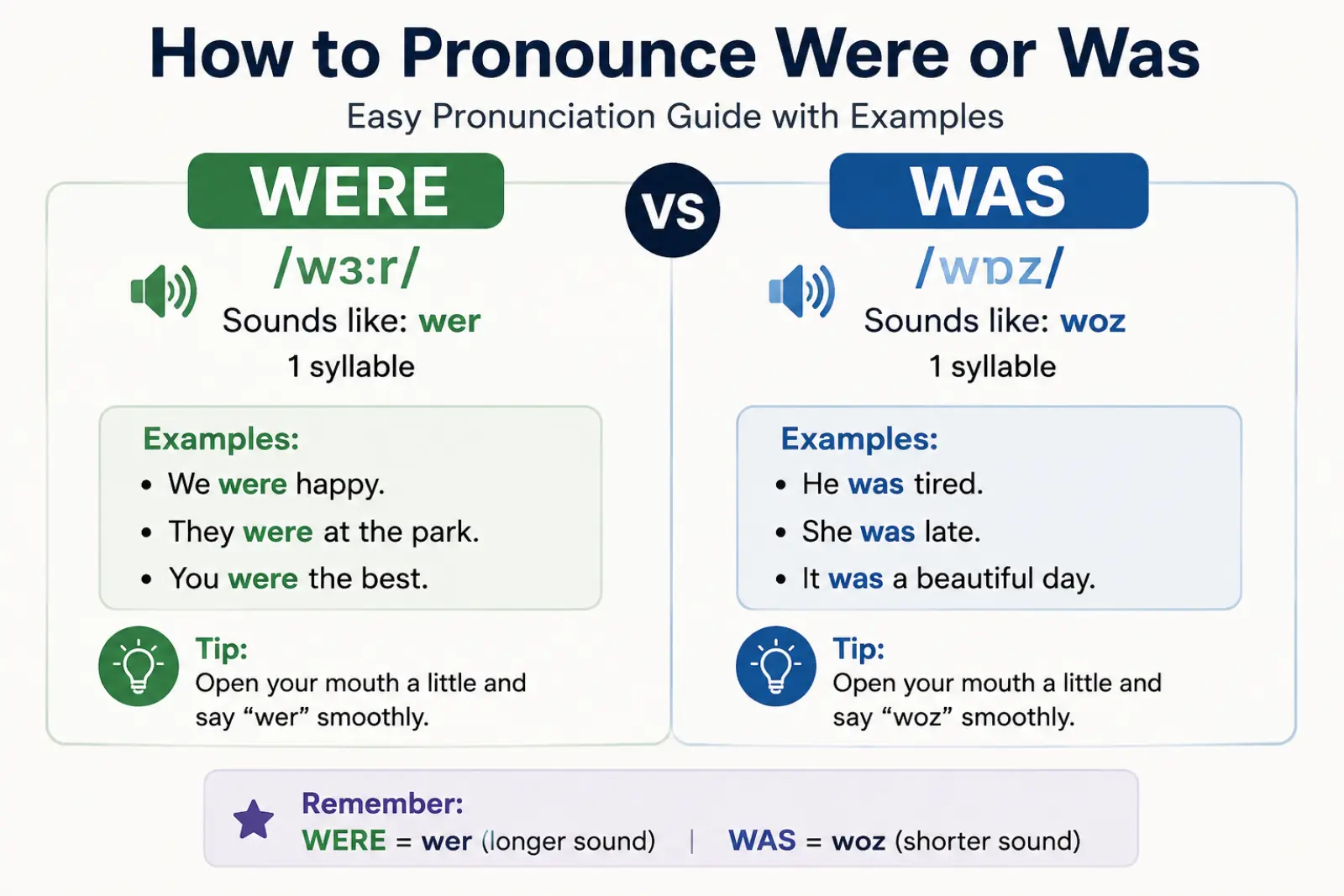
The pronunciation is simple, but were can be confusing for learners.
Was
Was sounds roughly like:
wuz
Example:
She was happy.
Were
Were sounds roughly like:
wur
Example:
They were ready.
In some accents, the exact sound can change slightly. The important point is that was and were have different vowel sounds.
A common mistake is trying to pronounce were like “where.” They may sound similar in some accents, but they are different words with different meanings.
British English vs American English Usage
The basic rules for were or was are the same in British English and American English.
| Feature | British English | American English | Notes |
|---|---|---|---|
| Was with I | Correct | Correct | “I was” |
| Was with he/she/it | Correct | Correct | “She was” |
| Were with you/we/they | Correct | Correct | “They were” |
| Unreal “I were” | Correct | Correct | “If I were…” |
| Basic past grammar | Same | Same | Rules are largely identical |
The main difference is not British versus American English. The important difference is the type of sentence.
Which One Should You Use?
Use was when the subject is normally singular:
- I was
- He was
- She was
- It was
Use were with:
- You were
- We were
- They were
Mini Usage Table
| Subject | Correct Form | Example |
| I | was | I was tired. |
| He | was | He was late. |
| She | was | She was busy. |
| It | was | It was cold. |
| You | were | You were right. |
| We | were | We were ready. |
| They | were | They were happy. |
Important Exception
Use were for many unreal or hypothetical situations.
If I were you, I would apologize.
Here, the speaker is not actually the other person. It is an imaginary situation.
Common Mistakes With Were or Was
Mistake 1: Using Was With They
❌ They was tired.
✔ They were tired.
Why? “They” takes were in standard English.
Tip: Remember: they were.
Mistake 2: Using Were With He
❌ He were at home.
✔ He was at home.
Why? “He” is singular.
Tip: Think he was, just like she was.
Mistake 3: Using Were With I in a Normal Past Statement
❌ I were sick yesterday.
✔ I was sick yesterday.
Why? A normal past statement with “I” uses was.
Mistake 4: Using Was in an Unreal Situation
❌ If I was you, I would wait.
✔ If I were you, I would wait.
Why? This is an imaginary or hypothetical situation.
Mistake 5: Forgetting That You Takes Were
❌ You was very helpful.
✔ You were very helpful.
Even when “you” means one person, standard English uses were.
Mistake 6: Confusing Plural Nouns
❌ The students was ready.
✔ The students were ready.
“Students” is plural, so use were.
Were or Was in Everyday Examples
Work
I was busy during the meeting.
We were discussing the new project.
School
She was absent yesterday.
The students were ready for the test.
Social Media
I was surprised by the comments.
They were talking about the new trend.
Daily Life
He was tired after work.
We were at the grocery store.
Emails
I was happy to receive your message.
We were pleased with the results.
Text Messages
I was just thinking about you.
You were right!
Conversations
“Where were you?”
“I was at home.”
Were or Was in Different Contexts
Grammar Learning
For basic English grammar, start with the subject rule:
I, he, she, it → was
you, we, they → were
This rule handles most everyday sentences.
Professional Writing
Correct use matters in emails, reports, resumes, and business documents.
For example:
The team was ready.
The employees were ready.
Notice that “team” is treated as a singular noun in this sentence, while “employees” is plural.
Hypothetical Situations
The special were rule is important in formal English.
If I were the manager, I would change the schedule.
If he were here, we could ask him.
This form clearly shows that the situation is unreal or imagined.
Were or Was Google Trends and Usage Data
People search for were or was because the two words look very similar and both describe past situations. The confusion becomes stronger when learners encounter phrases such as “If I were” and “I was.”
Common long-tail searches include:
- was or were grammar
- were or was difference
- when to use was or were
- was vs were examples
- should I say was or were
- is it was or were
- if I was or if I were
- I was or I were
- you was or you were
- they was or they were
Search interest can come from English learners and students in the US, UK, India, Pakistan, Canada, and Australia. The question is especially common in online grammar searches because learners often want a quick answer with examples.
Comparison Table: Were or Was
| Feature | Was | Were |
| Main use | Past singular subjects | Past plural subjects |
| I | Correct | Usually incorrect in normal past statements |
| He | Correct | Incorrect in normal past statements |
| She | Correct | Incorrect in normal past statements |
| It | Correct | Incorrect in normal past statements |
| You | Incorrect | Correct |
| We | Incorrect | Correct |
| They | Incorrect | Correct |
| Unreal situations | Sometimes possible in informal speech | Preferred in formal standard English |
| Example | She was tired. | They were tired. |
Were or Was in Professional Life
Grammar matters at work because clear writing helps people understand your message quickly.
Consider these examples:
I was available yesterday.
We were available yesterday.
The manager was in the office.
The managers were in the office.
Using the wrong form can make professional writing look less polished. In formal emails, reports, applications, and academic writing, follow standard subject and verb agreement.
Were or Was for Students and Beginners
Beginners often struggle because English does not use one past form for every subject.
The best approach is to memorize small groups instead of trying to learn everything at once.
Group One
I, he, she, it → WAS
Group Two
you, we, they → WERE
Then learn the special pattern:
If I were…
For example:
If I were rich, I would buy a house.
This is easier to remember after you understand the basic rule.
Common Patterns to Watch For
Look for these patterns when checking your writing:
- I was tired.
- He was late.
- She was happy.
- It was cold.
- You were helpful.
- We were ready.
- They were excited.
- If I were you…
- I wish I were there.
These patterns cover many everyday situations.
Simple Trick to Remember Were or Was
Think of was as the main singular past form.
I + was
He + was
She + was
It + was
Think of were as the plural and “you” past form.
You + were
We + were
They + were
Then remember one special phrase:
If I were you…
Think of It This Way
Imagine a small group standing together.
One person → WAS
A group → WERE
But an imaginary situation gets the special WERE form.
If I were a bird, I would fly.
You are not really a bird. The sentence describes an imagined situation.
Expert Tips for Using Were or Was
Here are a few simple proofreading tricks:
- Find the subject first.
Ask who or what the sentence is about. - Check if the sentence describes the past.
If it does, you may need was or were. - Match the subject and verb.
Singular subjects normally take was. Plural subjects take were. - Look for “if” and “wish.”
These can introduce unreal situations where were is preferred. - Memorize common phrases.
“I was,” “they were,” and “if I were you” are useful patterns. - Read the sentence aloud.
Hearing the sentence can help you notice an incorrect form.
Related Searches People Also Ask
Is it “I was” or “I were”?
For a normal past statement, use I was. Use I were in many hypothetical or unreal statements.
Is it “you was” or “you were”?
Standard English uses you were, even when “you” refers to one person.
Is it “they was” or “they were”?
Use they were in standard English.
Is it “if I was” or “if I were”?
For an unreal or hypothetical situation, if I were is the traditional standard form.
Is “I wish I were” correct?
Yes. I wish I were is a standard way to talk about an unreal or desired situation.
Is “she was” correct?
Yes. She was is the normal past form.
Is “we was” correct?
No, not in standard English. Use we were.
What is the easiest way to remember was and were?
Remember: I, he, she, it = was. You, we, they = were.
Can “were” be used with one person?
Yes. It can be used in hypothetical or unreal expressions such as “If I were you.”
Are the rules different in British and American English?
The basic rules are the same in both varieties of English.
FAQs About Were or Was
What is the main difference between were or was?
Was is normally used with I, he, she, and it. Were is normally used with you, we, and they.
Which is correct, “I was” or “I were”?
I was is correct for a normal past statement. I were can be correct in an unreal or hypothetical statement.
Which is correct, “he was” or “he were”?
He was is correct for a normal past sentence.
Which is correct, “they was” or “they were”?
They were is correct in standard English.
Why do we say “If I were you”?
Because the speaker is describing an unreal or hypothetical situation. Were is the traditional subjunctive form here.
Can I say “I was” in an if sentence?
Yes. “If I was…” can be correct when referring to a real or possible past situation. “If I were…” is used for an unreal or hypothetical situation.
What does “were” mean?
Were is a past form of the verb be. It is normally used with you, we, and they.
What does “was” mean?
Was is a past form of be. It is normally used with I, he, she, and it.
Are was and were past tense verbs?
Yes. They are past-tense forms of the verb be.
Final Verdict
The easiest rule for were or was is:
I, he, she, it → WAS
You, we, they → WERE
Examples:
I was tired.
She was happy.
They were ready.
We were late.
For imaginary or hypothetical situations, remember:
If I were you…
This one phrase is a powerful memory shortcut.
Conclusion
Understanding were or was does not have to be difficult. Both words are past forms of be, but they work with different subjects.
Use was with I, he, she, and it in normal past statements. Use were with you, we, and they. When you talk about an unreal or hypothetical situation, were can also be used with a singular subject.
The best memory trick is simple: I, he, she, it = was; you, we, they = were. If the situation is imaginary, remember “If I were you.”
With these few rules, you can use were or was more naturally in school, work, conversations, emails, and everyday English.

Camila Green is an English language writer who specializes in confusing word comparisons and spelling explanations. She creates simple, beginner-friendly guides on topics like “niece or neice” and other common English mistakes. Her writing focuses on clarity, real-life examples, and easy learning. At VerrsaPick, she helps readers improve their English with practical and engaging content.