If you are studying molecular polarity, you may have come across the question: Is CS2 polar or nonpolar? At first, this question can feel confusing because carbon disulfide contains two C=S bonds, and sulfur is slightly different from carbon in electronegativity.
So, does that make CS₂ a polar molecule?
No. CS₂ is a nonpolar molecule.
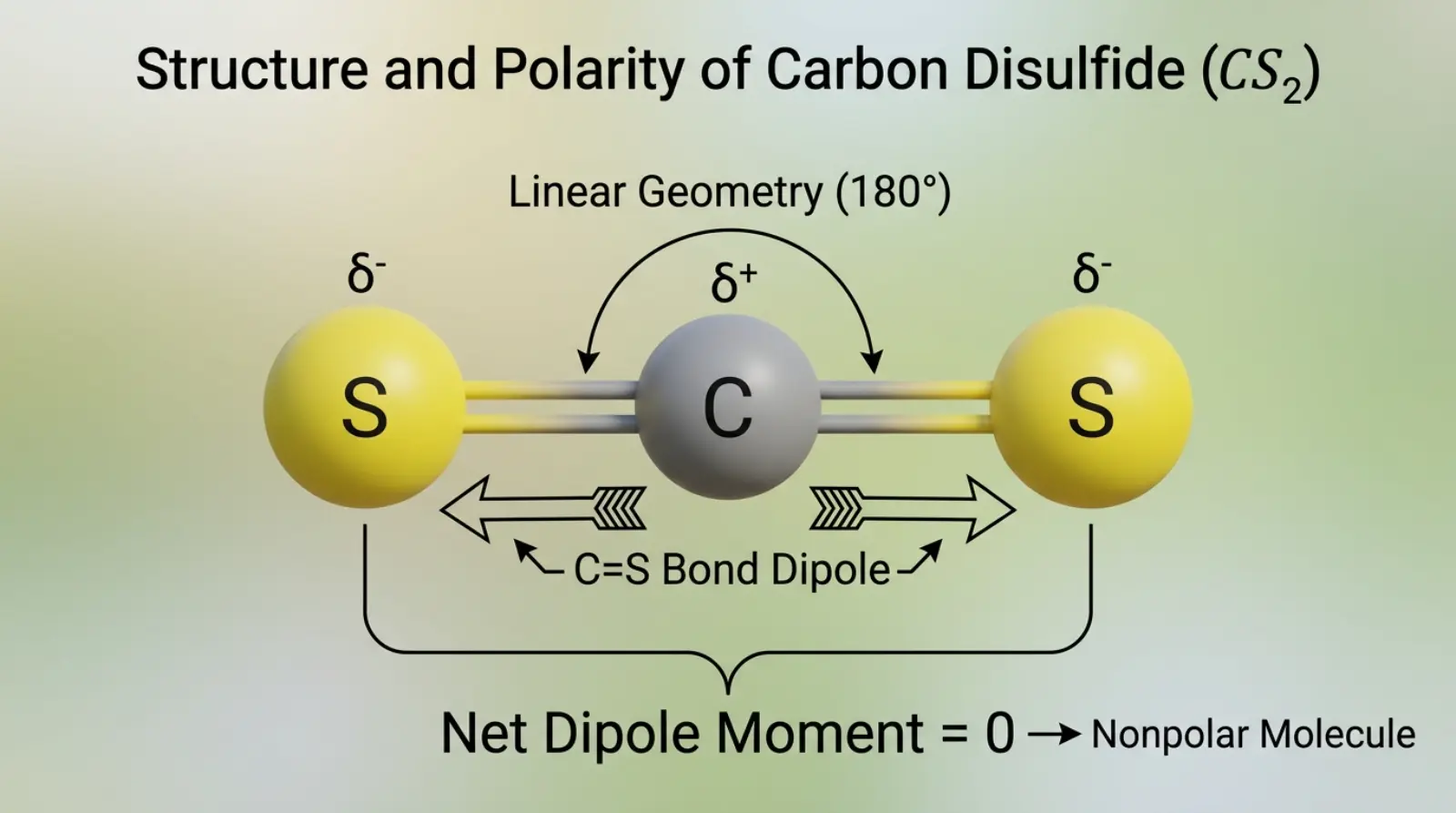
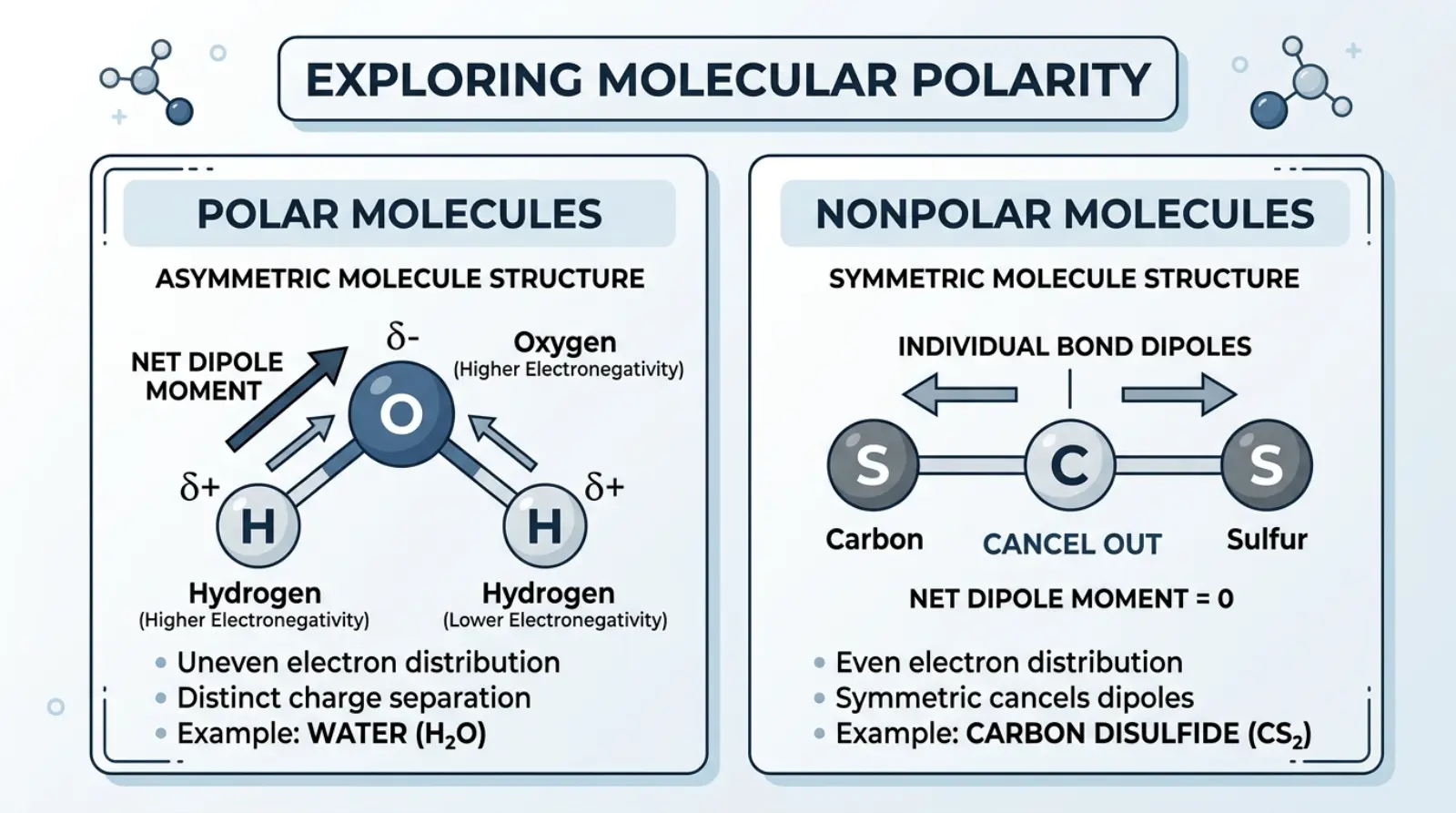
The reason is not simply that its bonds are nonpolar. The most important factor is its molecular geometry. CS₂ has a linear shape, with carbon in the center and sulfur atoms on opposite sides. The two bond dipoles point in opposite directions and cancel each other.
This is an important chemistry lesson: you cannot always decide molecular polarity by looking only at individual bonds. You must also look at the molecule’s shape.
Students commonly search for CS2 polar or nonpolar, CS₂ Lewis structure, CS₂ molecular geometry, CS₂ bond angle, carbon disulfide polarity, and whether CS₂ has a dipole moment.
People usually search for:
- CS2 polar or nonpolar meaning
- CS₂ Lewis structure
- CS₂ molecular geometry
- CS₂ bond angle
- Is carbon disulfide polar?
- Why is CS₂ nonpolar?
- Does CS₂ have a dipole moment?
- Are C=S bonds polar?
In this guide, you’ll learn the meaning, pronunciation, examples, usage, grammar rules, common mistakes, expert tips, and simple explanations in easy English.
CS2 Polar or Nonpolar – Quick Answer
👉 CS₂ = nonpolar molecule
👉 Molecular shape = linear
👉 Bond angle = 180°
👉 Lewis structure = S=C=S
CS₂, or carbon disulfide, is nonpolar because its two C=S bond dipoles cancel each other.
The carbon atom is in the center. The two sulfur atoms are positioned directly opposite each other:
S = C = S
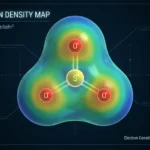
Because the molecule is linear, the bond dipoles point in opposite directions. Their effects cancel, giving CS₂ no overall molecular dipole.
Simple Rule:
👉 Symmetrical linear CS₂ → bond dipoles cancel → nonpolar molecule.
What Does CS2 Polar or Nonpolar Mean?
The question “CS2 polar or nonpolar?” asks whether carbon disulfide has an overall uneven distribution of electrical charge.
A polar molecule has a net dipole moment because its charge is unevenly distributed.
A nonpolar molecule has no overall dipole because its bond dipoles cancel or because its bonds do not create a significant separation of charge.
CS₂ is made of:
- 1 carbon atom
- 2 sulfur atoms
- Two C=S double bonds
Its Lewis structure is:
S=C=S
The carbon atom has two electron-density regions around it. According to VSEPR theory, these regions arrange themselves 180° apart, producing a linear molecule.
Synonyms
Depending on the context, you may see:
- Carbon disulfide
- Carbon bisulfide
- CS₂
- Carbon sulfide
Related Terms
Important terms connected with CS₂ polarity include:
- Lewis structure
- VSEPR theory
- molecular geometry
- bond dipole
- electronegativity
- dipole moment
- covalent bond
- linear geometry
- nonpolar molecule
The Origin of CS₂
CS₂ is the chemical formula for carbon disulfide.
The prefix di- means two, so carbon disulfide contains two sulfur atoms for every carbon atom.
Carbon disulfide is a molecular compound made from carbon and sulfur. In chemistry lessons, it is often used to explain Lewis structures, molecular geometry, covalent bonding, and polarity.
The compound is especially useful for teaching why molecular shape matters when deciding whether a molecule is polar or nonpolar.
How to Pronounce CS₂
CS₂ is commonly read as:
“C-S-two”
The full name, carbon disulfide, is pronounced approximately:
CAR-bon dye-SUL-fide
The chemical symbol should not be pronounced like a normal English word.
British English vs American English Usage
There is no meaningful polarity difference between British and American English. The chemistry is the same worldwide.
| Feature | British English | American English | Notes |
|---|---|---|---|
| Chemical formula | CS₂ | CS₂ | Same |
| Compound name | carbon disulfide | carbon disulfide | Same |
| Molecular shape | linear | linear | Same |
| Bond angle | 180° | 180° | Same |
| Polarity | nonpolar | nonpolar | Same |
| VSEPR explanation | Same | Same | Same chemistry |
Which One Should You Use: Polar or Nonpolar for CS₂?
The correct answer is:
CS₂ is nonpolar.
Use nonpolar when answering a chemistry question about the overall molecule.
For example:
Question: Is CS₂ polar or nonpolar?
Answer: CS₂ is nonpolar because it has a linear, symmetrical structure and its bond dipoles cancel.
For an exam, you can give a short answer:
CS₂ is nonpolar because its linear geometry causes the two C=S bond dipoles to cancel.
That explanation is stronger than simply writing “CS₂ is nonpolar.”
Why Is CS2 Nonpolar?
There are three main steps.
1. Draw the Lewis Structure
The Lewis structure is:
S=C=S
Carbon is the central atom, and each sulfur is double-bonded to carbon.
Each sulfur has lone pairs, while carbon has no lone pairs in this structure.
2. Determine the Molecular Shape
There are two electron-density regions around the central carbon.
VSEPR theory says that two electron groups arrange themselves as far apart as possible.
This produces a linear geometry with a 180° bond angle.
3. Look at the Bond Dipoles
The two C=S bonds point in opposite directions.
Because the molecule is symmetrical, the two bond-dipole effects cancel.
Therefore:
Net dipole moment = 0
So:
CS₂ = nonpolar molecule.
CS2 Polar or Nonpolar: Common Mistakes
Mistake 1: “CS₂ is polar because sulfur is different from carbon.”
❌ Incorrect: CS₂ must be polar because it contains two different elements.
✔ Correct: The molecule is nonpolar because its symmetrical linear shape cancels the bond dipoles.
Tip: Always check molecular geometry.
Mistake 2: Looking only at the bonds
❌ Incorrect: Decide polarity only from whether the C=S bond is polar.
✔ Correct: Check both bond polarity and molecular shape.
A molecule can contain polar bonds and still be nonpolar if the bond dipoles cancel. This is a standard principle of molecular polarity.
Mistake 3: Thinking two bonds automatically make a molecule polar
❌ Incorrect: Two bonds mean there must be a net dipole.
✔ Correct: The arrangement of those bonds determines whether their dipoles cancel.
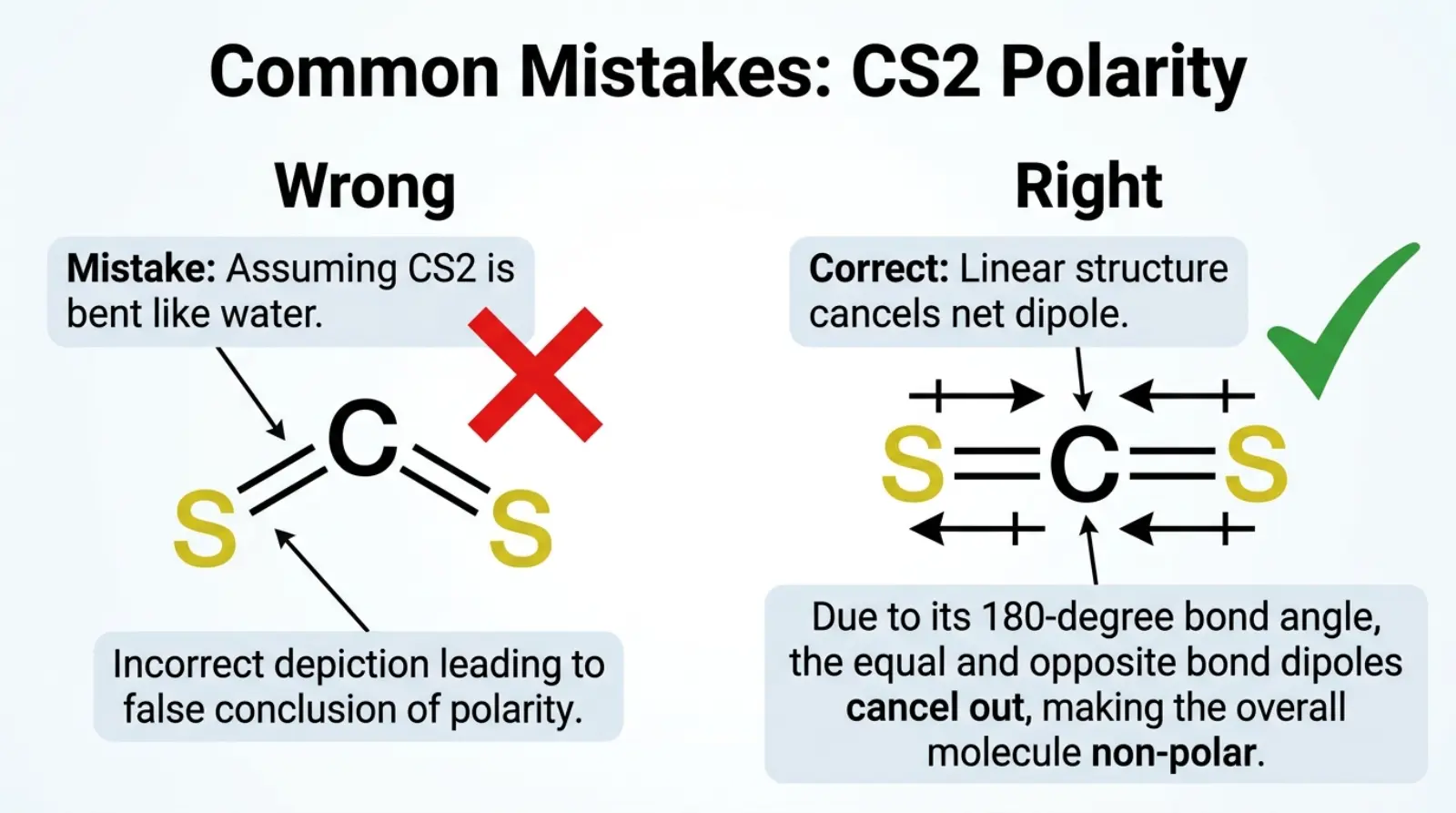
Mistake 4: Calling CS₂ bent
❌ Incorrect: CS₂ has a bent molecular shape.
✔ Correct: CS₂ is linear with a 180° bond angle.
Mistake 5: Confusing CS₂ with H₂O
Water is bent, so its bond dipoles do not cancel.
CS₂ is linear, so its two bond dipoles cancel.
That difference in geometry is extremely important.
CS2 Polar or Nonpolar in Everyday Chemistry Examples
In School
A teacher may ask:
“Is CS₂ polar or nonpolar?”
A good answer is:
“CS₂ is nonpolar because it has a linear shape and the bond dipoles cancel.”
In Chemistry Exams
You may need to identify:
- Lewis structure
- electron geometry
- molecular geometry
- bond angle
- polarity
The answers are:
| Property | CS₂ |
|---|---|
| Lewis structure | S=C=S |
| Central atom | Carbon |
| Electron groups | 2 |
| Molecular geometry | Linear |
| Bond angle | 180° |
| Overall polarity | Nonpolar |
| Net dipole | 0 |
In Online Chemistry Questions
You may see variations such as:
- Is CS2 polar or nonpolar?
- Is carbon disulfide polar?
- Why is CS₂ nonpolar?
- What is the shape of CS₂?
- Does CS₂ have a dipole moment?
- What is the bond angle of CS₂?
These are all asking about the same basic chemistry concepts.
CS2 Polar or Nonpolar in Different Contexts
Lewis Structure
The Lewis structure is:
S=C=S
The two sulfur atoms are attached to the central carbon by double bonds.
VSEPR Theory
VSEPR predicts a linear arrangement because carbon has two electron-density regions.
Molecular Geometry
The molecular geometry is linear.
Bond Angle
The S–C–S bond angle is:
180°
Molecular Polarity
The two bond dipoles cancel because they point in opposite directions.
Therefore, the entire molecule is nonpolar.
CS2 Polar or Nonpolar – Comparison Table
| Feature | CS₂ |
|---|---|
| Chemical name | Carbon disulfide |
| Formula | CS₂ |
| Central atom | Carbon |
| Number of sulfur atoms | 2 |
| Lewis structure | S=C=S |
| C=S bonds | Double bonds |
| Molecular geometry | Linear |
| Bond angle | 180° |
| Symmetry | Symmetrical |
| Net dipole | 0 |
| Overall polarity | Nonpolar |
CS₂ for Students and Beginners
The easiest way for beginners to solve polarity questions is to follow this order:
Step 1: Draw the Lewis structure.
Step 2: Find the molecular geometry.
Check whether the bonds are polar.
Step 4: Look at the direction of the bond dipoles.
Decide whether the dipoles cancel.
For CS₂, the process is:
S=C=S → linear → 180° → dipoles cancel → nonpolar
This method can also help with molecules such as CO₂.
Signs and Characteristics of a Nonpolar CS₂ Molecule
CS₂ has several important characteristics:
- It has a linear molecular structure.
- Its bond angle is 180°.
- The molecule is symmetrical.
- The two sulfur atoms are positioned on opposite sides of carbon.
- The bond-dipole effects cancel.
- Its overall dipole moment is zero.
- The molecule is classified as nonpolar.
The important lesson is that molecular symmetry can cancel bond polarity.
Simple Trick to Remember CS2 Polar or Nonpolar
Here is an easy memory trick:
CS₂ looks like a straight line.
Think of it as:
S ← C → S
The two sides are balanced.
Think of it this way:
If two equal pushes happen in exactly opposite directions, they cancel.
CS₂ works the same way. Its two bond-dipole effects point in opposite directions, so the overall effect is zero.
Straight and symmetrical = nonpolar.
Expert Tips for Identifying CS₂ Polarity
- Do not stop at electronegativity.
Molecular shape is just as important. - Learn VSEPR basics.
Two electron groups around a central atom usually give linear geometry. - Remember that polar bonds do not always mean a polar molecule.
Bond polarity and molecular polarity are related but different ideas. - Look for symmetry.
A symmetrical structure often allows dipoles to cancel. - Memorize the CS₂ pattern:
S=C=S → linear → 180° → cancellation → nonpolar.
Related Searches People Also Ask
Is CS2 polar or nonpolar?
CS₂ is nonpolar because its linear structure causes the two bond dipoles to cancel.
Is CS₂ a polar molecule?
No. CS₂ has no overall molecular dipole, so it is classified as nonpolar.
What is the shape of CS₂?
CS₂ has a linear molecular geometry with a 180° bond angle.
What is the Lewis structure of CS₂?
The basic Lewis structure is S=C=S, with carbon in the center.
What is the bond angle of CS₂?
The bond angle is 180°.
Does CS₂ have a dipole moment?
The overall dipole moment is zero because the bond-dipole effects cancel.
Are the C=S bonds polar?
The C=S bonds can be described as having only a very small polarity because carbon and sulfur have similar electronegativities. More importantly for the molecular classification, their effects cancel in the linear structure.
Why does CS₂ have a linear shape?
Carbon has two electron-density regions around it and no lone pairs in the basic Lewis structure. VSEPR theory places the two bonding regions 180° apart.
Is CS₂ similar to CO₂?
Yes, both have a linear X=C=X-type arrangement and can have bond-dipole cancellation. The key point is that molecular geometry determines whether the individual bond dipoles cancel.
How do you quickly determine if CS₂ is polar?
Remember:
Linear + symmetrical + opposite bond dipoles = nonpolar.
Final Verdict
CS₂ is nonpolar.
Its Lewis structure is S=C=S, and its molecular geometry is linear with a 180° bond angle. Because the two bond-dipole effects point in opposite directions, they cancel.
The easiest rule:
👉 CS₂ → linear → symmetrical → dipoles cancel → nonpolar
Conclusion
So, is CS2 polar or nonpolar?
The answer is nonpolar.
The most important reason is its linear and symmetrical molecular geometry. Carbon sits between two sulfur atoms, creating a straight S=C=S structure with a 180° bond angle. The two bond-dipole effects cancel, leaving no overall molecular dipole.
If you are preparing for a chemistry test, do not memorize only the word “nonpolar.” Learn the reasoning:
Lewis structure → linear shape → 180° angle → dipoles cancel → nonpolar.
Final memory trick:
“CS₂ is straight, so its dipoles cancel.”

Camila Green is an English language writer who specializes in confusing word comparisons and spelling explanations. She creates simple, beginner-friendly guides on topics like “niece or neice” and other common English mistakes. Her writing focuses on clarity, real-life examples, and easy learning. At VerrsaPick, she helps readers improve their English with practical and engaging content.