Imagine you are doing a math worksheet and suddenly see the question, “Is 13 prime or composite?” It looks simple, but if you are still learning about factors and divisibility, it can be confusing. You may wonder if 13 can be divided evenly by numbers other than 1 and itself.
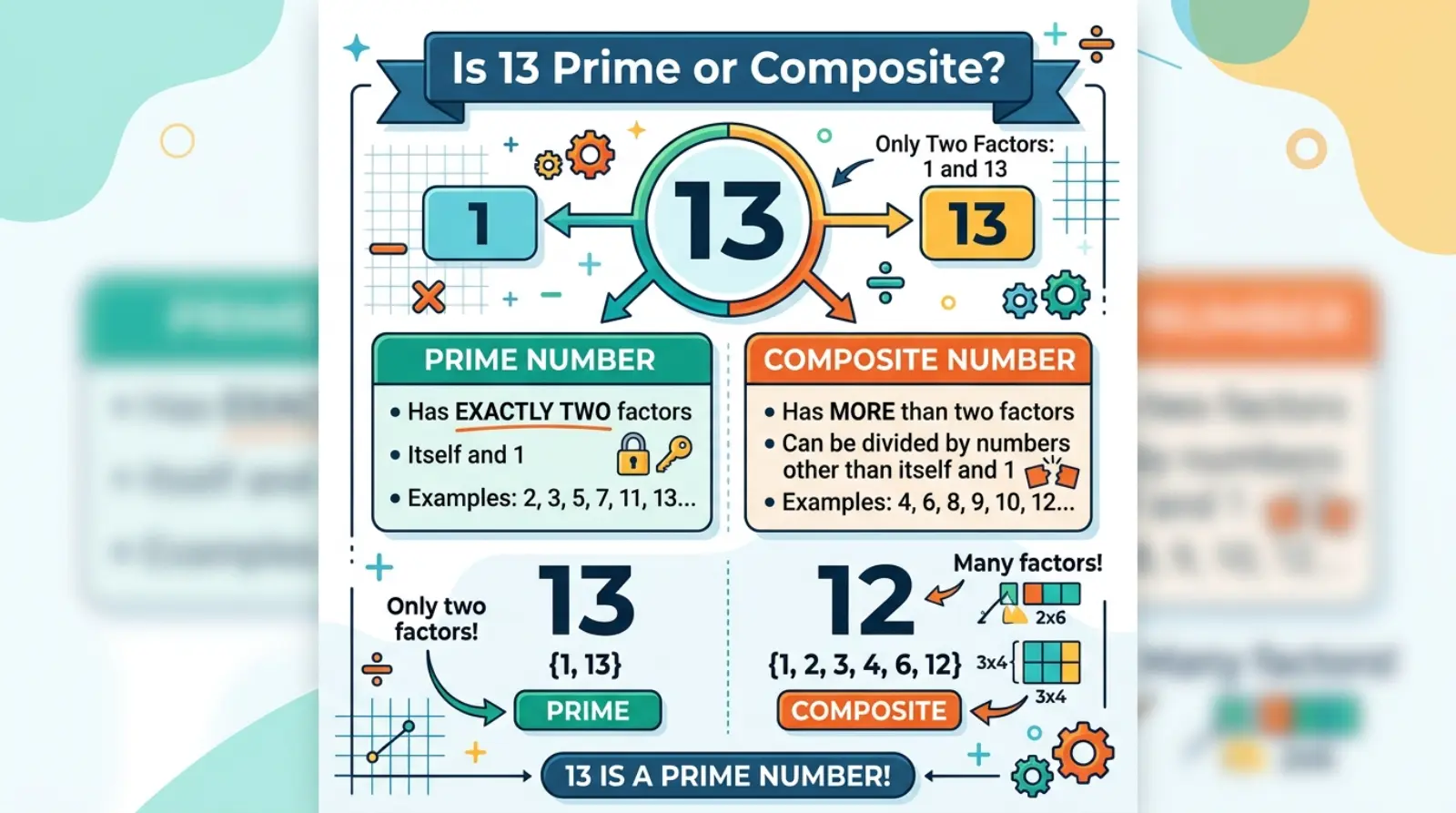
The answer is clear: 13 is a prime number. It has exactly two positive factors: 1 and 13. Because no other whole number divides 13 evenly, it is not composite.
Understanding whether a number is prime or composite is an important basic math skill. You may see this topic at school, in homework, online math lessons, exams, quizzes, and everyday number problems.
People usually search for is 13 prime or composite because they want the answer, factors of 13, divisibility rules, prime number definition, or an easy way to check the number.
The good news is that checking 13 is very easy. You only need to test whether any whole number between 1 and 13 can divide it evenly. Numbers such as 2, 3, 4, 5, and 6 do not divide 13 without a remainder.
In this guide, you’ll learn the meaning, pronunciation, examples, usage, grammar rules, common mistakes, expert tips, and simple explanations in easy English.
Is 13 Prime or Composite? Quick Answer
👉 13 is a prime number.
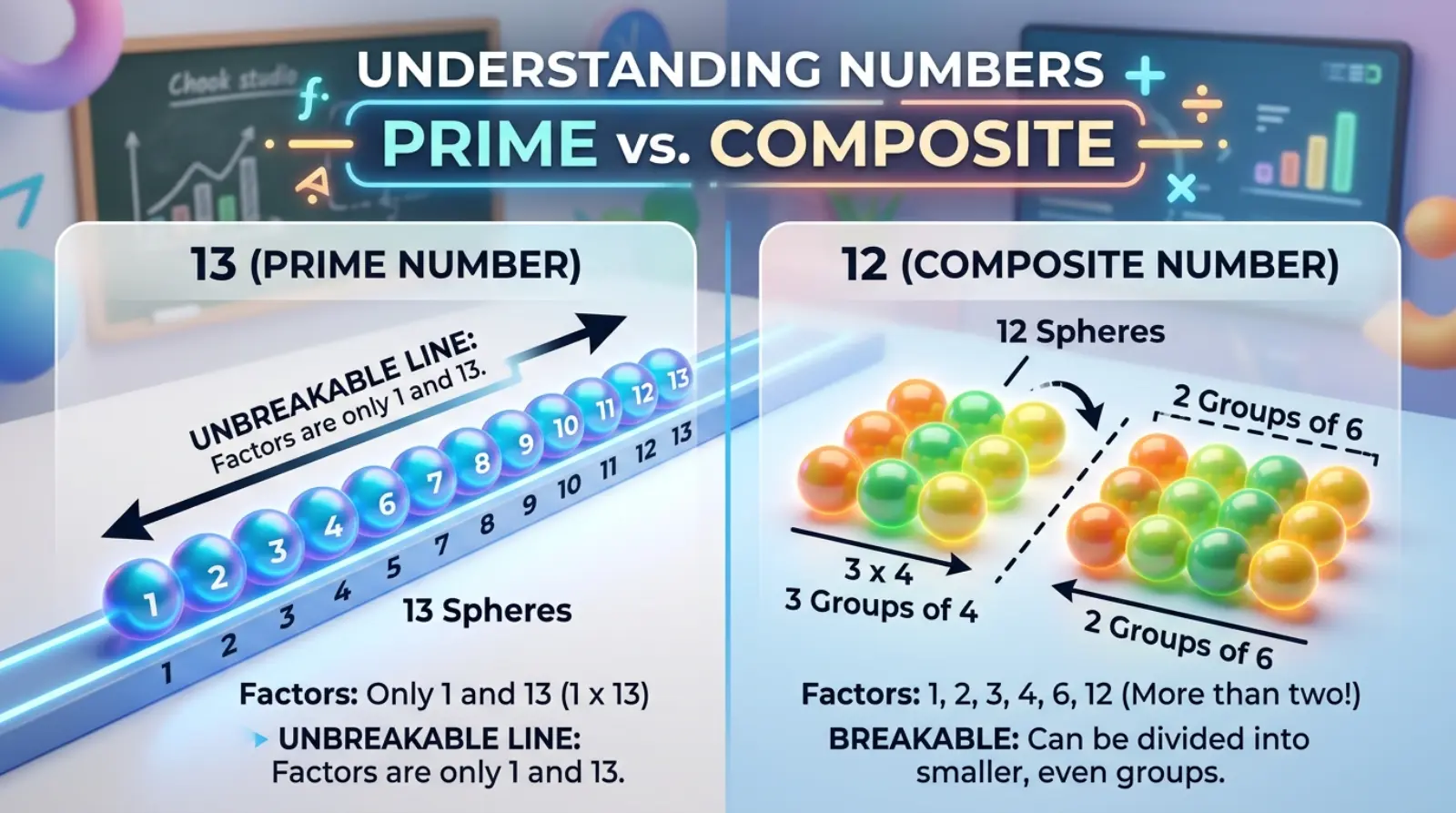
A prime number is a whole number greater than 1 that has exactly two positive factors: 1 and itself.
For 13:
13 ÷ 1 = 13 ✅
13 ÷ 13 = 1 ✅
But:
13 ÷ 2 = 6.5
13 ÷ 3 = 4.333…
13 ÷ 4 = 3.25
So, the only factors of 13 are:
1 and 13
Simple Rule
👉 If a number has exactly two factors, it is prime.
👉 If a number greater than 1 has more than two factors, it is composite.
Therefore:
13 = Prime ✅
13 = Not Composite ❌
What Does Is 13 Prime or Composite Mean?
The question “is 13 prime or composite?” asks you to classify the number 13.
There are two important categories:
Prime Number
A prime number has exactly two positive factors.
Examples:
- 2
- 3
- 5
- 7
- 11
- 13
- 17
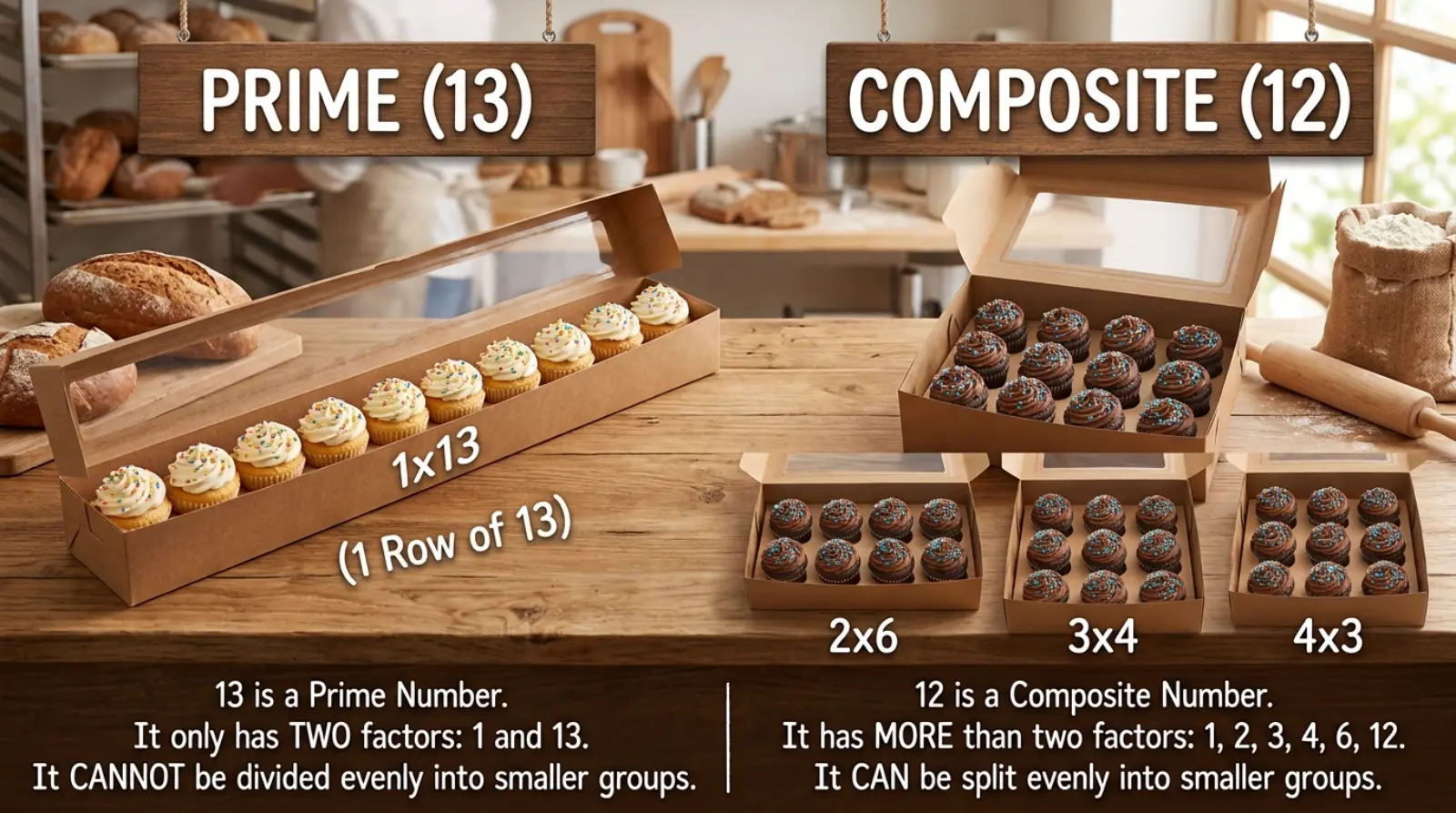
For example, 13 can only be divided evenly by 1 and 13.
Composite Number
A composite number has more than two positive factors.
For example, 12 is composite because its factors include:
1, 2, 3, 4, 6, and 12
So, 12 has more than two factors.
Related Terms
- Factor
- Multiple
- Divisor
- Prime number
- Composite number
- Whole number
- Divisibility
- Remainder
- Prime factorization
Opposite Classification
The opposite of prime in this classification is composite, but remember that 1 is neither prime nor composite.
The Origin of Prime and Composite Numbers
The idea of prime numbers goes back thousands of years. Ancient mathematicians studied numbers and their factors long before modern mathematics existed.
The word prime comes from a Latin word meaning first or chief. In mathematics, prime numbers are important because many whole numbers can be built by multiplying prime numbers together.
The word composite means something made from several parts. In mathematics, a composite number can be divided into smaller positive factors.
For example:
12 = 2 × 2 × 3
This shows that 12 is composite.
How to Pronounce Is 13 Prime or Composite?
The number 13 is pronounced:
thirteen → thur-TEEN
The question can be spoken as:
“Is thirteen prime or composite?”
Important words:
- Prime → pryme
- Composite → kuhm-PAH-zit
- Factor → FAK-ter
- Thirteen → thur-TEEN
A common mistake is confusing thirteen with thirty.
Remember:
13 = thirteen
30 = thirty
British English vs American English Usage
There is no mathematical difference between British and American English when classifying 13.
| Feature | British English | American English | Notes |
|---|---|---|---|
| Number | Thirteen | Thirteen | Same |
| Prime | Prime | Prime | Same meaning |
| Composite | Composite | Composite | Same meaning |
| Factors | Factors | Factors | Same |
| Answer | 13 is prime | 13 is prime | Same mathematical result |
The mathematical answer is the same worldwide.
Which One Should You Choose: Prime or Composite?
For the question “is 13 prime or composite?”, choose:
👉 Prime
Why?
Because 13 has exactly two positive factors:
1 and 13
Quick Check
| Number | Factors | Classification |
|---|---|---|
| 2 | 1, 2 | Prime |
| 3 | 1, 3 | Prime |
| 11 | 1, 11 | Prime |
| 13 | 1, 13 | Prime |
| 15 | 1, 3, 5, 15 | Composite |
| 16 | 1, 2, 4, 8, 16 | Composite |
Common Mistakes With Is 13 Prime or Composite
Mistake 1: Thinking every odd number is prime
❌ 15 is prime because it is odd.
✔ 15 is composite because 15 = 3 × 5.
Being odd does not automatically make a number prime.
Mistake 2: Forgetting that 1 is a factor
Some students may think 13 has only one factor.
✔ 13 has two factors: 1 and 13.
Mistake 3: Calling 13 composite
❌ 13 is composite because it can be divided by 13.
✔ 13 is prime because every number can be divided by itself, and 13 has no other positive factors.
Mistake 4: Thinking prime means divisible by only one number
A prime number is divisible evenly by two positive numbers: 1 and itself.
Mistake 5: Thinking 1 is prime
❌ 1 is prime.
✔ 1 is neither prime nor composite because it has only one positive factor.
Is 13 Prime or Composite in Everyday Examples?
School
“The teacher asked us if 13 is prime or composite.”
Answer: 13 is prime.
Homework
“Find the factors of 13.”
Answer: 1 and 13.
Math Quiz
“Classify 13.”
Answer: Prime number.
Online Learning
A student may search:
“Is 13 a prime number?”
The answer is yes.
Conversation
Student: “Is 13 prime?”
Teacher: “Yes. Its only positive factors are 1 and 13.”
Is 13 Prime or Composite in Different Math Contexts?
Factors
The factors of 13 are:
1 and 13
There are no other positive factors.
Divisibility
13 is not evenly divisible by 2, 3, 4, 5, or other smaller whole numbers.
That makes it prime.
Multiplication
The only positive multiplication fact that gives 13 is:
1 × 13 = 13
Prime Factorization
Because 13 is already prime, its prime factorization is simply:
13
You do not need to break it into smaller prime factors.
Number Theory
In number theory, 13 is classified as a prime number. It is also the sixth prime number:
2, 3, 5, 7, 11, 13
Is 13 Prime or Composite? Usage and Math Facts
People often search this question because they are learning how to classify whole numbers.
Some useful facts are:
- 13 is a positive integer.
- 13 is greater than 1.
- 13 is odd.
- 13 has exactly two positive factors.
- 13 is prime.
- 13 is not composite.
- 13 is the sixth prime number.
- 13 has no positive factor between 1 and 13.
A useful long-tail question is:
“Is 13 a prime number or a composite number?”
The answer is:
13 is prime.
Comparison Table: Is 13 Prime or Composite?
| Feature | 13 |
|---|---|
| Number type | Whole number |
| Positive factors | 1, 13 |
| Number of positive factors | 2 |
| Even or odd | Odd |
| Prime? | Yes |
| Composite? | No |
| Prime factorization | 13 |
| Divisible by 2 | No |
| Divisible by 3 | No |
| Divisible by 5 | No |
| Sixth prime number? | Yes |
Is 13 Prime or Composite in Professional and Academic Life?
Prime and composite numbers are basic mathematical ideas used in education and more advanced areas of mathematics.
Students may use prime numbers when learning:
- factors
- multiples
- divisibility
- fractions
- greatest common factors
- least common multiples
- prime factorization
- number theory
Prime numbers also have important applications in areas such as computer science and cryptography.
For basic schoolwork, however, you mainly need to remember the factor rule.
Is 13 Prime or Composite for Students and Beginners?
If you are a beginner, do not make the process harder than it needs to be.
Ask:
“Can I find any factor besides 1 and the number itself?”
For 13, the answer is no.
Try smaller whole numbers:
- 2 does not divide 13 evenly.
- 3 does not divide 13 evenly.
- 4 does not divide 13 evenly.
- 5 does not divide 13 evenly.
So 13 has only:
1 and 13
Therefore, it is prime.
Signs and Characteristics of 13
Here are the key characteristics:
- It is greater than 1.
- It is an odd number.
- It has exactly two positive factors.
- It cannot be divided evenly by 2.
- It cannot be divided evenly by 3.
- It cannot be divided evenly by 5.
- It is a prime number.
- It is not a composite number.
Simple Trick to Remember Is 13 Prime or Composite
Use this easy rule:
👉 Prime = exactly 2 factors
👉 Composite = more than 2 factors
Now check 13:
1 and 13
That gives exactly two factors.
Therefore:
13 = PRIME ✅
Think of it this way:
Imagine 13 as a locked door.
Only two keys work:
1 and 13
No other positive whole number opens the door evenly.
That means 13 is prime.
Expert Tips for Checking Prime Numbers
- Start with the factor rule.
A prime number greater than 1 has exactly two positive factors. - Check small divisors first.
For 13, checking 2 and 3 is enough to see that it has no smaller factor. - Do not assume odd means prime.
Numbers like 9, 15, and 21 are odd but composite. - Remember that 1 is special.
One is neither prime nor composite. - Check the remainder.
If division leaves a remainder, that number is not a factor. - Learn small prime numbers.
Memorizing primes such as 2, 3, 5, 7, 11, and 13 makes math much easier.
Related Searches People Also Ask
Is 13 a prime number?
Yes. 13 is a prime number because it has exactly two positive factors: 1 and 13.
Is 13 composite?
No. A composite number has more than two positive factors, while 13 has only two.
What are the factors of 13?
The positive factors of 13 are 1 and 13.
Is 13 divisible by 2?
No. 13 is odd, so it is not evenly divisible by 2.
Is 13 divisible by 3?
No. 13 divided by 3 leaves a remainder.
What is the prime factorization of 13?
The prime factorization of 13 is simply 13, because 13 is already prime.
Is 13 an odd number?
Yes. 13 is an odd number.
What is the sixth prime number?
13 is the sixth prime number: 2, 3, 5, 7, 11, 13.
Is 1 prime or composite?
1 is neither prime nor composite because it has only one positive factor.
Is 13 a perfect square?
No. There is no whole number that multiplied by itself equals 13.
FAQs About Is 13 Prime or Composite
Is 13 prime or composite?
13 is prime. Its only positive factors are 1 and 13.
Why is 13 a prime number?
13 is prime because no whole number other than 1 and 13 divides it evenly.
What are the factors of 13?
The factors are 1 and 13.
Is 13 an odd or even number?
13 is odd because it cannot be divided evenly by 2.
Can 13 be divided by 3?
No. 13 ÷ 3 does not produce a whole number.
Is 13 divisible by 5?
No. A number divisible by 5 normally ends in 0 or 5. 13 does not.
What is 13’s prime factorization?
It is simply 13.
Is 13 the sixth prime number?
Yes. The first six prime numbers are 2, 3, 5, 7, 11, and 13.
Is 13 composite because 13 can divide itself?
No. Every number greater than 1 can be divided by itself. A prime number has exactly two factors: 1 and itself.
How can I quickly tell if 13 is prime?
Check whether any positive whole number other than 1 and 13 divides it evenly. None does, so 13 is prime.
Final Verdict
13 is a prime number, not a composite number.
Its only positive factors are:
1 and 13
Because it has exactly two positive factors, it meets the definition of a prime number.
Easy Rule
2 factors = Prime
More than 2 factors = Composite
For 13:
1, 13 → exactly 2 factors → Prime ✅
Conclusion
The answer to “is 13 prime or composite?” is simple: 13 is prime.
It has exactly two positive factors, 1 and 13, and no other whole number divides it evenly. Although 13 is odd, remember that being odd alone does not make a number prime.
The easiest way to remember it is:
13 has two factors → 1 and 13 → therefore, 13 is PRIME.
Once you understand this rule, you can use the same method to classify many other numbers as prime or composite.

Camila Green is an English language writer who specializes in confusing word comparisons and spelling explanations. She creates simple, beginner-friendly guides on topics like “niece or neice” and other common English mistakes. Her writing focuses on clarity, real-life examples, and easy learning. At VerrsaPick, she helps readers improve their English with practical and engaging content.