Have you ever typed totalling or totaling and stopped to wonder which spelling is right? You are not alone. This small spelling difference can be confusing, especially when you are writing for school, work, business, or an international audience.
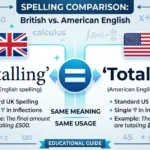
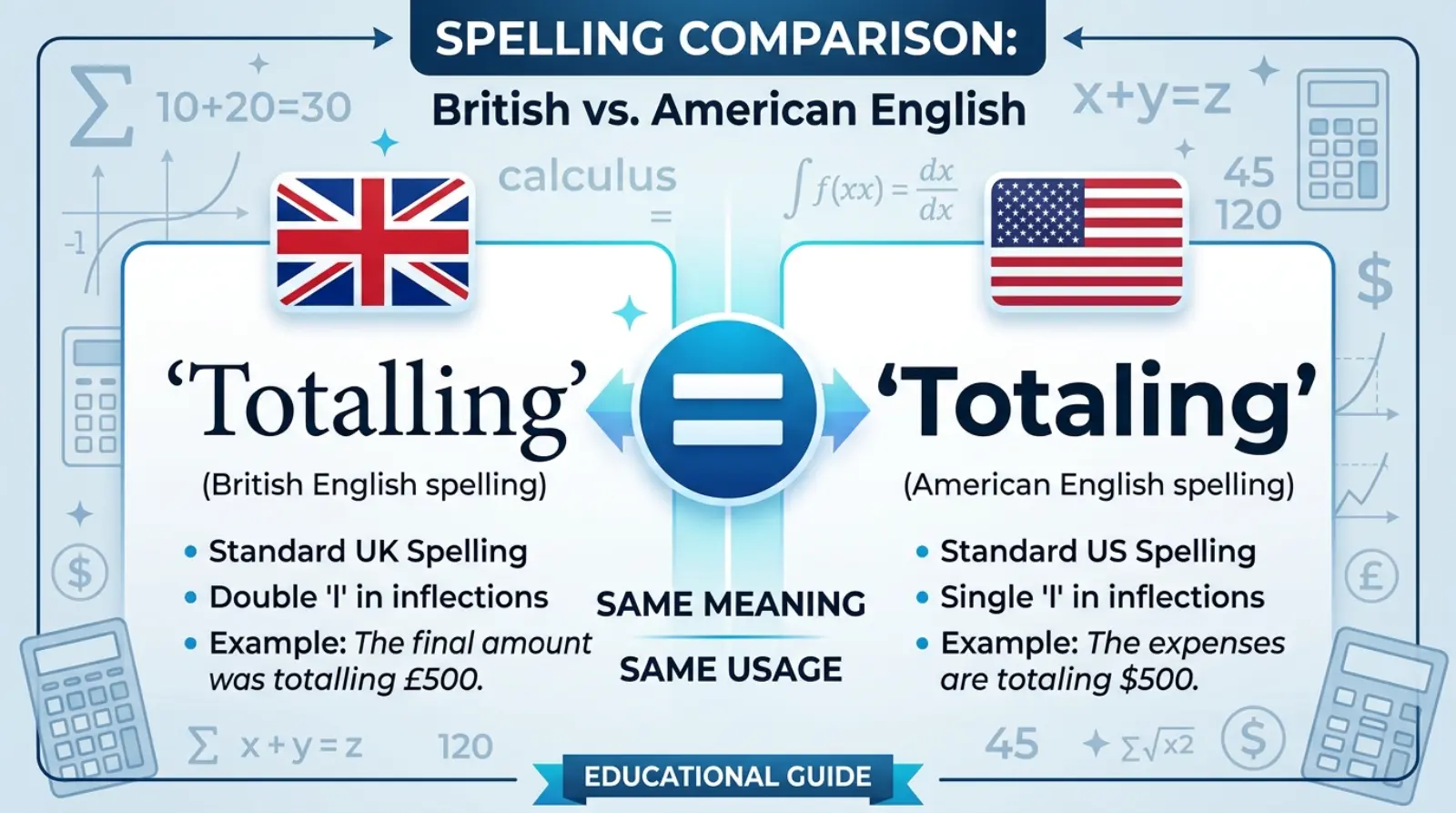
The good news is simple: both “totalling” and “totaling” are correct. The main difference is the variety of English you are using. Totalling is the standard British English spelling, while totaling is the standard American English spelling. Both forms come from the verb total, and both mean adding amounts together or reaching a total.
You may see these words in invoices, financial reports, school assignments, spreadsheets, emails, shopping calculations, business documents, and online content. For example, someone might write, “The expenses are totalling £2,000” in British English, while an American writer may write, “The expenses are totaling $2,000.”
People usually search for the totalling or totaling meaning, correct spelling, pronunciation, examples, usage, definition, and grammar difference. The confusion often comes from the extra l in the British form.
The important thing is not to think of one spelling as a simple typo. Instead, think about your audience and keep your English style consistent throughout the document.
In this guide, you’ll learn the meaning, pronunciation, examples, usage, grammar rules, common mistakes, expert tips, and simple explanations in easy English.
Totalling or Totaling – Quick Answer
👉 Totalling = British English spelling
👉 Totaling = American English spelling
Both mean adding numbers, amounts, or quantities together to find a total.
British English:
The expenses are totalling £3,500.
American English:
The expenses are totaling $3,500.
British English:
The three bills are totalling £750.
American English:
The three bills are totaling $750.
Simple Rule:
👉 UK = totalling
👉 US = totaling
A useful memory trick is: British English often keeps the double “l,” while American English uses one “l” in this form.
This difference also appears in related forms:
| British English | American English |
|---|---|
| totalled | totaled |
| totalling | totaling |
So if your document uses travelled, labelled, cancelled, and totalling, you are generally following British spelling patterns. If it uses traveled, labeled, canceled, and totaling, you are generally following American spelling patterns.
What Does Totalling or Totaling Mean?
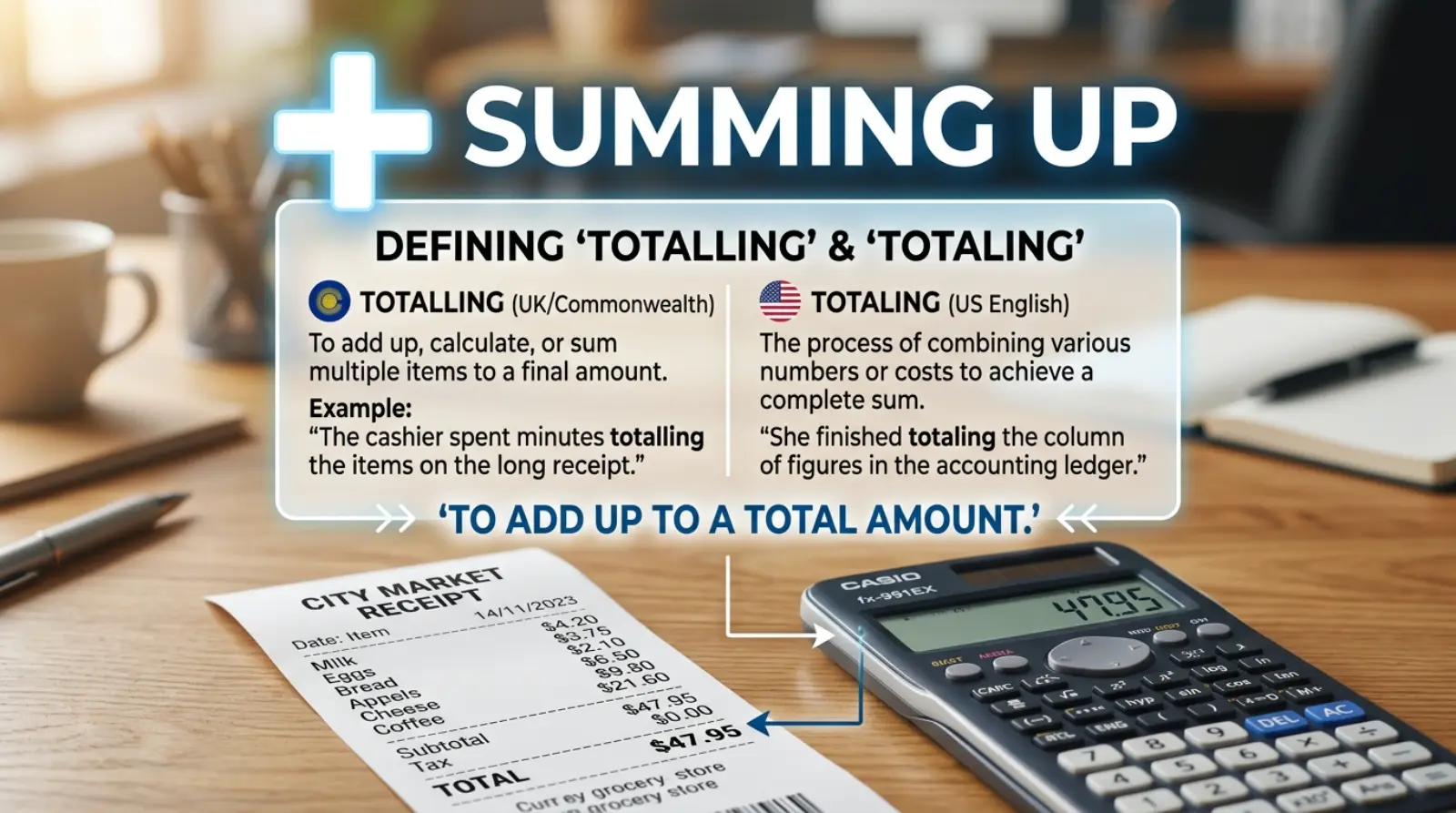
Totalling or totaling is the -ing form of the verb “total.” It usually means adding separate numbers or amounts together to reach a final amount.
For example:
The bills are totalling £1,200.
This means the bills add up to £1,200.
Another example is:
The sales are totaling $50,000.
This means the sales amount comes to $50,000.
The word total can also be a noun or adjective:
- Noun: The total is $500.
- Adjective: The total cost is $500.
- Verb: The costs total $500.
- -ing form: The costs are totaling $500.
Synonyms
Depending on the sentence, related words include:
- adding
- adding up
- summing
- calculating
- amounting to
- counting
- combining
Opposites
Possible contrasting ideas include:
- subtracting
- reducing
- deducting
- decreasing
- separating
Related Terms
You may also see:
- total
- totalled
- totaled
- totalling
- totaling
- subtotal
- grand total
- sum
- amount
- final total
The Origin of Totalling or Totaling
The spelling difference is modern, but the word total has a much older history.
The English word total came through Old French from Medieval Latin totalis, meaning “entire” or “total.” The Latin form is related to totus, meaning “all” or “whole.”
English later developed total as a noun and verb. The verb meaning “bring to a total” is recorded from the early 18th century.
The British and American spelling difference developed as English spelling conventions became more distinct. British English commonly keeps the doubled l in totalling, while American English commonly uses totaling.
So the extra l does not change the meaning. It mainly signals a regional spelling preference.
How to Pronounce Totalling or Totaling
Both spellings are normally pronounced the same way.
A simple pronunciation is:
totalling: TOT-uh-ling
totaling: TOT-uh-ling
The word has three syllable parts:
to-tal-ing
The spelling changes, but the pronunciation does not normally change because of the extra l.
Common Pronunciation Mistake
Some learners may try to pronounce the double l in totalling as a longer or separate sound. You do not need to do this.
Think:
👉 totalling = totaling = TOT-uh-ling
British English vs American English Usage
The main difference is spelling rather than meaning or grammar.
| Feature | British English | American English | Notes |
|---|---|---|---|
| Present participle | totalling | totaling | Same meaning |
| Past tense | totalled | totaled | Same meaning |
| Pronunciation | Similar | Similar | Extra “l” is not normally pronounced separately |
| Meaning | Add up/reach a total | Add up/reach a total | No major meaning difference |
| Formal writing | Totalling | Totaling | Follow local style |
| Academic writing | Totalling | Totaling | Be consistent |
| Business writing | Totalling | Totaling | Match your audience |
Reference dictionaries and language resources list totalling as the British form and totaling as the American form.
Which One Should You Use?
Choose the spelling based on the English variety used by your audience.
Use totalling when:
- Writing mainly for a UK audience
- Following British English
- Writing for many British-style publications
- Using British spelling throughout a document
- Working with a UK organization or institution
Example:
The expenses are totalling £4,800.
Use totaling when:
- Writing for a US audience
- Following American English
- Writing for an American company
- Using American spelling throughout your document
- Creating content specifically for American readers
Example:
The expenses are totaling $4,800.
Quick Usage Table
| Audience | Preferred spelling |
|---|---|
| United States | totaling |
| United Kingdom | totalling |
| British-style writing | totalling |
| American-style writing | totaling |
| International audience | Choose one style and stay consistent |
The most important rule is consistency. Do not switch randomly between British and American spelling in the same document.
Common Mistakes With Totalling or Totaling
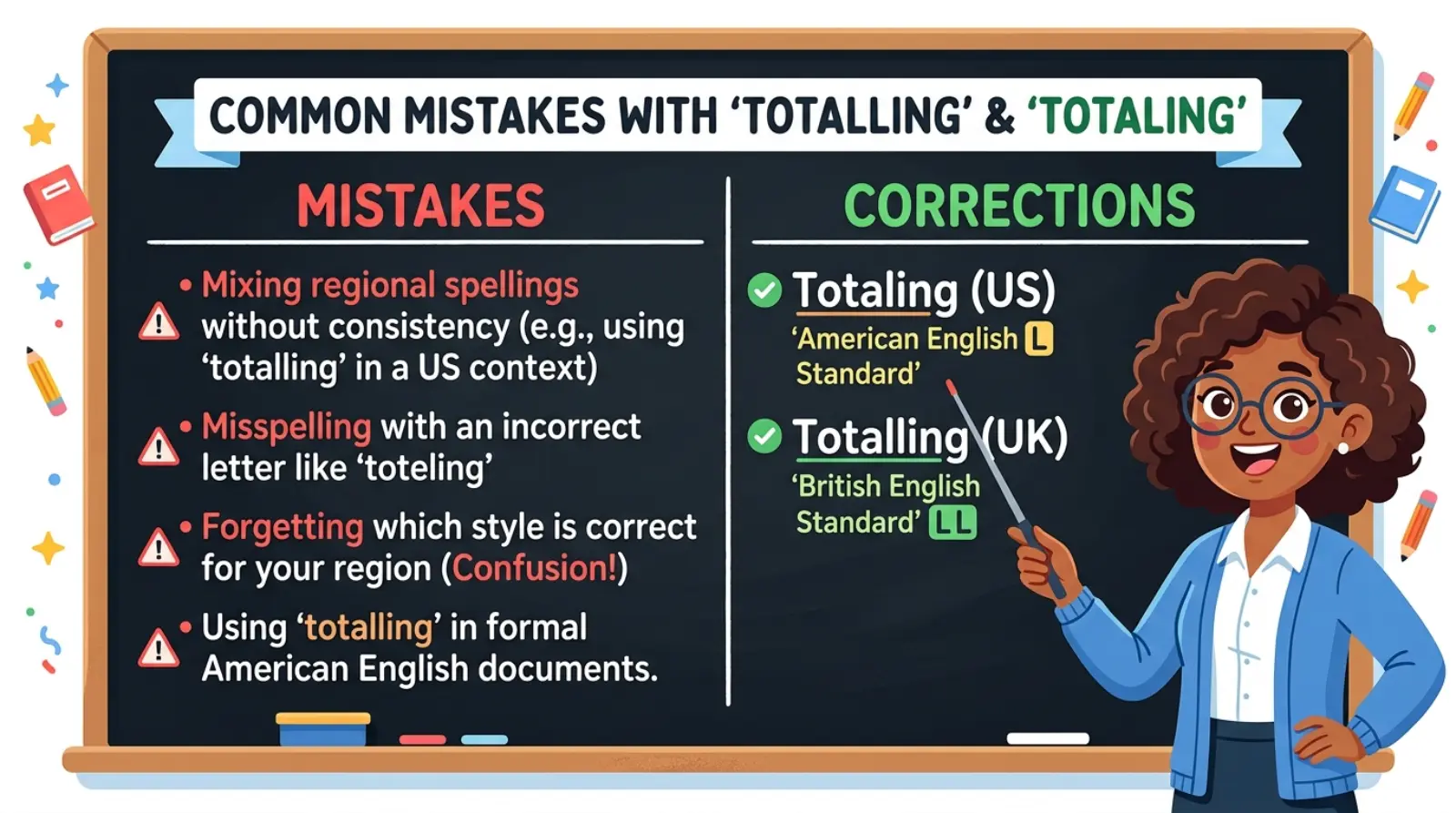
Mistake 1: Thinking One Spelling Is Always Wrong
❌ Totalling is wrong.
✔ Totalling is correct in British English, while totaling is standard in American English.
People often see one form more frequently and assume the other is a spelling mistake. It is usually a regional spelling difference.
Mistake 2: Using Both Styles Randomly
❌ The report says the costs are totalling $5,000, but later says the costs are totaling $7,000.
✔ Choose one spelling style for the document.
Tip: Check other words such as color/colour and center/centre to identify which English style you are using.
Mistake 3: Writing “Totaling” With the Wrong Meaning
❌ The total amount is totaling because I like the number.
✔ The expenses are totaling $2,500.
Tip: The verb usually relates to adding amounts or reaching a total.
Mistake 4: Confusing “Total” With “Totaling”
❌ The totaling is $500.
✔ The total is $500.
Tip: Use total as the noun when you mean the final amount.
Mistake 5: Changing the Pronunciation
❌ Pronouncing the two spellings as completely different words.
✔ Totalling and totaling are normally pronounced the same.
Mistake 6: Mixing “Totalled” and “Totaling” Styles
British English commonly uses:
✔ totalled
✔ totalling
American English commonly uses:
✔ totaled
✔ totaling
Keeping the same spelling system makes your writing cleaner.
Totalling or Totaling in Everyday Examples
Work
British:
The department’s expenses are totalling £12,000.
American:
The department’s expenses are totaling $12,000.
School
The five test scores are totaling 425 points.
In British-style writing, you could write:
The five test scores are totalling 425 points.
Social Media
My food orders this month are totaling almost $200.
Daily Life
The grocery bills are totalling £150 this week.
Emails
British:
The attached invoices are totalling £6,750.
American:
The attached invoices are totaling $6,750.
Text Messages
“I checked everything. It’s totaling about $80.”
Online Content
The project costs are totaling more than $10,000.
Conversations
“The three items are totaling around $45.”
Totalling or Totaling in Different Contexts
Education
Students may encounter totalling or totaling when working with grades, points, scores, or statistics.
Example:
The four assignments are totaling 80 points.
The spelling depends on the English style being taught.
Business
The word is common in invoices, budgets, financial reports, sales figures, and expense records.
Example:
The quarterly expenses are totaling $125,000.
Accounting
Accountants may use the word when discussing the combined value of several entries.
Example:
The transactions are totaling $18,450.
Writing and Grammar Learning
For English learners, this word is useful because it demonstrates a common British-American spelling difference.
Compare:
British: totalling
American: totaling
Online Content
Websites may use either spelling depending on their target audience. A US-focused website will generally favor totaling, while a UK-focused website may use totalling.
Professional Communication
When writing a business email, report, invoice, or proposal, use the spelling that matches your company’s English style.
Totalling or Totaling – Google Trends & Usage Data
Searches for totalling or totaling are mainly driven by spelling confusion and regional English differences. People often want to know whether the extra l is required, which spelling is American, which is British, and how to use the word in a sentence.
Search intent commonly includes questions such as:
- Is totalling spelled with two l’s?
- Is totaling correct?
- Is totalling British English?
- Is totaling American English?
- How do you spell totaling?
- What does totalling mean?
- How do you pronounce totaling?
- What is the difference between totaling and totalling?
These searches can come from learners and writers in the US, UK, India, Pakistan, Canada, and Australia, especially when they are writing for an international audience.
The key point is that search popularity does not change the grammar rule: both spellings can be correct, but regional style determines which form is preferred.
Comparison Table: Totalling or Totaling
| Feature | Totalling | Totaling |
|---|---|---|
| English variety | British English | American English |
| Meaning | Adding/reaching a total | Adding/reaching a total |
| Correct spelling | Yes | Yes |
| Pronunciation | Similar | Similar |
| Grammar role | -ing form of total | -ing form of total |
| Professional use | Yes | Yes |
| Academic use | Yes | Yes |
| Online use | Common | Common |
| Main difference | Double l | Single l |
| Best approach | Use with British spelling | Use with American spelling |
Totalling or Totaling in Professional Life
Spelling can matter in professional communication because readers expect consistency.
Imagine preparing a financial report for a British company. Using totalling fits naturally with other British spellings.
For an American company, totaling is the expected choice.
For example:
British:
The project expenses are totalling £85,000.
American:
The project expenses are totaling $85,000.
Neither sentence is wrong simply because of the spelling difference.
Totalling or Totaling for Students and Beginners
This word can be confusing because students may learn one English variety at school and then see another variety online.
The easiest thing to remember is:
UK → totalling
US → totaling
Do not spend too much time trying to decide which one is universally correct. There is no need to change a British spelling into an American spelling unless your audience or style guide requires it.
If you are writing an English assignment, follow the spelling system your teacher or school expects.
Signs, Characteristics, or Common Uses Related to Totalling or Totaling
You will often see totalling/totaling when:
- Several numbers are being added together.
- Expenses are being combined.
- Sales figures are being calculated.
- Scores are being added.
- Costs are being reported.
- An invoice contains several charges.
- A budget is being calculated.
- A final amount is being discussed.
- A report summarizes several financial figures.
- Someone says how much several items cost together.
Common patterns include:
totalling + amount
Expenses totalling £2,000
totaling + amount
Expenses totaling $2,000
be + totalling/totaling
The costs are totaling $5,000.
Simple Trick to Remember Totalling or Totaling
Think of the country first.
👉 UK = double L = totalling
👉 US = single L = totaling
Think of it this way:
Imagine the extra L wearing a British hat.
British → totalling → two Ls
American → totaling → one L
This is not a grammar difference in meaning. It is mainly a spelling-style difference.
Another useful trick is to remember the related forms:
British:
totalled → totalling
American:
totaled → totaling
Expert Tips for Using Totalling or Totaling
- Know your audience. Decide whether you are writing in British or American English.
- Stay consistent. Do not switch spelling styles without a reason.
- Check related words. Words like colour/color and travelled/traveled can help identify your overall style.
- Do not change the pronunciation. The spelling difference does not normally create a different spoken word.
- Use “total” when you mean the final amount.
Example: “The total is $500.” - Use “totaling/totalling” when describing an amount being added or reached.
Example: “The costs are totaling $500.” - Follow a company’s style guide. Professional organizations may have their own preferred English variety.
Related Searches People Also Ask
Is totalling or totaling correct?
Both are correct. Totalling is the British spelling, while totaling is the American spelling.
Is totalling British English?
Yes. Totalling is commonly used in British English.
Is totaling American English?
Yes. Totaling is the standard American spelling.
Does totalling mean adding?
Yes. It can mean adding several amounts together or reaching a particular total.
Is there a difference in meaning?
No major meaning difference exists. The main difference is regional spelling.
Is “totaling” spelled with one L?
Yes. Totaling has one l before -ing in American English.
Is “totalling” spelled with two Ls?
Yes. Totalling has two l letters and is commonly used in British English.
Do totalling and totaling sound different?
They are normally pronounced the same.
Which should I use in American English?
Use totaling.
Which should I use in British English?
Use totalling.
Can I use both spellings in one article?
It is better to choose one spelling style and use it consistently unless you are specifically comparing British and American English.
Is totalled also different in British and American English?
Yes. British English commonly uses totalled, while American English commonly uses totaled.
FAQs About Totalling or Totaling
Is “totalling” grammatically correct?
Yes. Totalling is grammatically correct and is commonly used in British English.
Is “totaling” grammatically correct?
Yes. Totaling is grammatically correct and is commonly used in American English.
What does totaling mean in a sentence?
It means adding amounts together or reaching a particular total.
What does totalling mean in British English?
It has the same basic meaning as totaling in American English: adding amounts or reaching a total.
Which is more correct, totaling or totalling?
Neither is universally more correct. The appropriate spelling depends on the English variety you are using.
How do you remember the spelling?
Remember: UK = totalling and US = totaling.
Can I use totaling in the UK?
It may be understood, but totalling is the usual British spelling.
Can I use totalling in the US?
American readers will understand it, but totaling is the standard American form.
What is the past tense of total?
British English commonly uses totalled. American English commonly uses totaled.
Final Verdict
Totalling and totaling are both correct.
The simple difference is:
👉 Totalling = British English
👉 Totaling = American English
Both words mean adding amounts together or reaching a total. The pronunciation and basic meaning remain the same.
Conclusion
The totalling or totaling question is much easier once you know that English has different regional spelling systems.
If you are writing in British English, choose totalling. If you are writing in American English, choose totaling. Neither spelling should automatically be treated as a mistake.
The biggest writing tip is to stay consistent. If the rest of your document follows British spelling, use totalling. If it follows American spelling, use totaling.
Easy memory trick:
UK keeps the double L: totalling.
US uses one L: totaling.
That one simple rule will help you choose the right spelling with confidence.

Camila Green is an English language writer who specializes in confusing word comparisons and spelling explanations. She creates simple, beginner-friendly guides on topics like “niece or neice” and other common English mistakes. Her writing focuses on clarity, real-life examples, and easy learning. At VerrsaPick, she helps readers improve their English with practical and engaging content.