Waking up with a small, swollen bump on your eyelid can be worrying. You may look in the mirror and wonder, “Is this a stye or chalazion?” Both can look similar, especially when the eyelid is red or puffy, but they are not exactly the same.
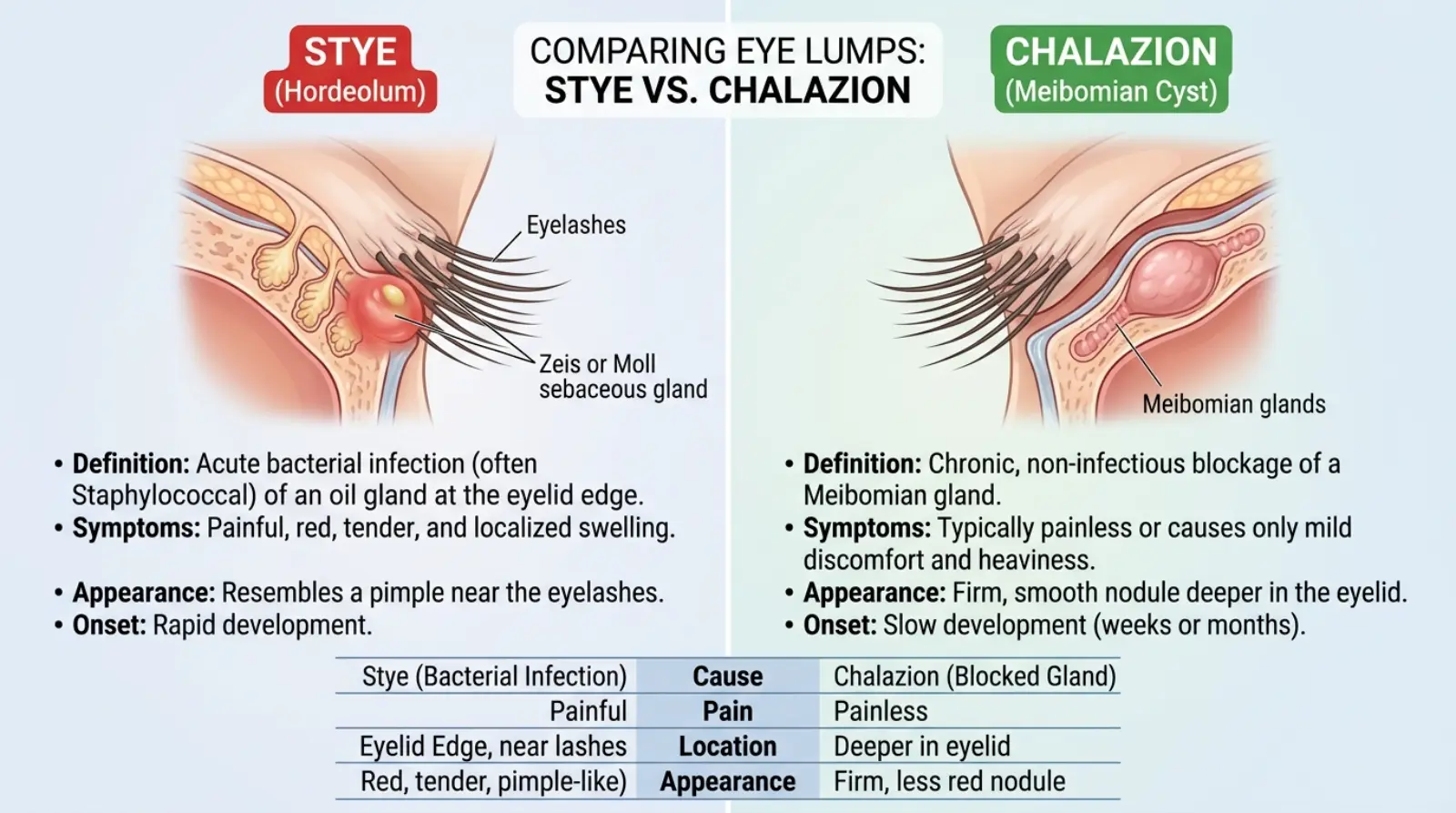
A stye is usually a painful, tender lump caused by an infection involving an eyelash follicle or an oil gland near the eyelid. A chalazion is usually a firmer, less painful lump caused by a blocked oil gland. Knowing the difference can help you understand what may be happening and when it is a good idea to see an eye-care professional.
People often search for stye or chalazion symptoms, stye vs chalazion, how to tell a stye from a chalazion, stye or chalazion treatment, what does a chalazion look like, and how long a stye lasts.
You may see these terms in medical articles, online searches, health websites, conversations with family members, or advice from an eye doctor. Although the conditions are often minor, eye problems deserve care because the eyes are sensitive and important.
People usually search for:
- stye or chalazion meaning
- correct medical term
- pronunciation
- symptoms
- causes
- treatment
- differences
- pictures and appearance
- how long they last
- when to see a doctor
In this guide, you’ll learn the meaning, pronunciation, examples, usage, grammar rules, common mistakes, expert tips, and simple explanations in easy English.
STYE OR CHALAZION – QUICK ANSWER
👉 Stye = a usually painful, tender bump on or near the eyelid, often related to infection or inflammation around an eyelash follicle or oil gland.
👉 Chalazion = a usually firm, less painful eyelid lump caused by a blocked oil gland.
Simple example
Stye: “My eyelid is red, swollen, and painful when I touch the bump.”
Chalazion: “I have a small, firm lump in my eyelid, but it does not hurt much.”
The easiest difference
| Stye | Chalazion |
|---|---|
| Often painful | Often painless or mildly uncomfortable |
| Usually tender | Usually firm |
| May look red | May have less redness |
| Often develops more suddenly | May develop gradually |
| Can involve infection | Usually caused by a blocked oil gland |
👉 Easy memory trick: Think “stye = sore” and “chalazion = blocked gland lump.”
However, appearance alone cannot always tell you which one you have. A healthcare professional can make the diagnosis if the lump is unusual, persistent, severe, or affecting your vision.
WHAT DOES STYE OR CHALAZION MEAN?
The phrase “stye or chalazion” is usually used when someone is trying to identify or compare two common eyelid problems.
What is a stye?
A stye, also called a hordeolum, is a painful, tender lump that usually develops along the eyelid edge. It can be associated with infection and inflammation involving an eyelash follicle or an oil-producing gland.
A stye may cause:
- redness
- swelling
- tenderness
- pain
- watering of the eye
- a small bump near the eyelashes
Some styes develop a small pus-filled center.
What is a chalazion?
A chalazion is an eyelid lump caused by blockage of one of the eyelid’s oil glands, often called a meibomian gland.
It may begin with swelling and can later become a firm lump. Unlike a typical stye, a chalazion is usually not very painful.
Synonyms and related terms
Stye-related terms:
- hordeolum
- eyelid infection
- eyelid bump
- painful eyelid lump
Chalazion-related terms:
- meibomian gland blockage
- eyelid cyst-like lump
- eyelid bump
- blocked oil gland
These terms are related but should not automatically be treated as exact synonyms.
THE ORIGIN OF STYE OR CHALAZION
The word stye has been used in English for centuries to describe a small swelling or sore on the eyelid. The medical term hordeolum comes from Latin and is associated with the appearance of a small grain.
Chalazion comes from a Greek word associated with a small lump or hailstone-like swelling. In modern medicine, it refers specifically to a blocked eyelid oil gland that produces a lump.
The terms became more common in everyday health language as medical information became easier to access. Today, people frequently compare “stye vs chalazion” online because both conditions can produce an eyelid bump.
HOW TO PRONOUNCE STYE OR CHALAZION
Stye
Stye sounds like:
“sty”
It rhymes with words such as eye, fly, and sky.
Chalazion
Chalazion is commonly pronounced approximately:
“kuh-LAY-zee-un”
The pronunciation may vary slightly depending on accent and medical setting.
Common pronunciation mistake
Some beginners may try to pronounce every letter in chalazion exactly as it is written. It is easier to learn the word in parts:
kuh – LAY – zee – un
BRITISH ENGLISH VS AMERICAN ENGLISH USAGE
There is no major British-versus-American spelling difference for stye or chalazion.
| Feature | British English | American English | Notes |
|---|---|---|---|
| Stye | Stye | Stye | Same spelling |
| Chalazion | Chalazion | Chalazion | Same spelling |
| Meaning | Same | Same | Medical meaning is essentially the same |
| Pronunciation | Slight variation possible | Slight variation possible | Accent can change sound |
| Medical usage | Common | Common | Both terms are used |
So whether you are reading a health article in the UK, US, Canada, Australia, India, or Pakistan, the basic distinction remains the same.
WHICH ONE SHOULD YOU USE?
This is not really a spelling choice. Stye and chalazion are two different medical terms.
Use stye when describing a painful, tender eyelid bump that may involve infection or inflammation.
Use chalazion when describing a lump caused by a blocked eyelid oil gland.
Quick usage guide
| Situation | Better term |
|---|---|
| Painful eyelid bump | Stye |
| Firm, usually painless lump | Chalazion |
| Blocked meibomian gland | Chalazion |
| Inflamed eyelash-area bump | Often stye |
| Unsure what the bump is | Ask a healthcare professional |
In casual conversation, people sometimes call any eyelid bump a “stye.” That does not always mean the condition is actually a stye.
COMMON MISTAKES WITH STYE OR CHALAZION
Mistake 1: Treating them as exactly the same
❌ “A stye and a chalazion are the same thing.”
✔ They can look similar, but they have different typical causes and symptoms.
Correction tip: Remember that a stye is commonly painful, while a chalazion is usually a blocked-gland lump.
Mistake 2: Assuming every eyelid bump is a stye
❌ “I have an eyelid bump, so it must be a stye.”
✔ Several conditions can cause eyelid bumps.
Why people make this mistake: “Stye” is a familiar everyday word.
Mistake 3: Assuming a chalazion must hurt
❌ “If it doesn’t hurt, it cannot be a chalazion.”
✔ A chalazion is often painless or only mildly uncomfortable.
Mistake 4: Trying to squeeze the lump
❌ “I’ll pop it like a pimple.”
✔ Avoid squeezing or puncturing an eyelid lump.
Correction tip: The eyelid is delicate. Follow appropriate eye-care advice instead.
Mistake 5: Ignoring vision changes
❌ “It’s only an eyelid bump, so vision changes don’t matter.”
✔ Changes in vision should be taken seriously.
Correction tip: Seek professional medical advice when an eye problem affects vision.
Mistake 6: Using antibiotics without professional advice
❌ “Every eyelid bump needs antibiotic medicine.”
✔ Treatment depends on the cause and severity.
A healthcare professional can determine whether treatment is needed.
STYE OR CHALAZION IN EVERYDAY EXAMPLES
At work
“I have a swollen eyelid today, so I may need to visit an eye doctor.”
At school
“My teacher noticed the bump on my eyelid and suggested I tell my parents.”
Social media
“Is this a stye or chalazion? My eyelid has been swollen for two days.”
Daily life
“I woke up with a painful bump near my eyelashes.”
“I may need to leave early for an eye appointment because of an eyelid problem.”
Text message
“Think I have a stye 😭 My eyelid is really sore.”
Online content
“Stye vs chalazion: Learn how these two eyelid conditions differ.”
Conversation
Person A: “Does your eyelid hurt?”
Person B: “Yes, the bump is pretty tender.”
“It could be a stye, but a doctor can tell you for sure.”
STYE OR CHALAZION IN DIFFERENT CONTEXTS
Health education
Medical education often compares the conditions by looking at pain, redness, location, cause, and duration.
The key point is that these signs overlap. A person should not rely only on an internet description to diagnose an eye problem.
Eye care
Eye-care professionals may examine the eyelid and surrounding tissues to determine whether the problem looks like a stye, chalazion, or another condition.
Workplace communication
If an eyelid problem causes discomfort, it is reasonable to explain that you have an eye issue without trying to give yourself a medical diagnosis.
Social media and online searches
People often post questions such as:
- “Is this a stye or chalazion?”
- “Why is my eyelid swollen?”
- “How long does a chalazion last?”
- “How do I get rid of a stye?”
These questions show why simple explanations are useful, but online information should not replace professional evaluation when symptoms are concerning.
STYE OR CHALAZION – GOOGLE TRENDS & USAGE DATA
Searches around “stye or chalazion” are usually driven by symptom confusion rather than spelling confusion. People often notice an eyelid bump and want to know what it means.
Common long-tail searches include:
- “stye or chalazion which is worse”
- “stye or chalazion symptoms”
- “difference between stye and chalazion”
- “how to tell if you have a stye or chalazion”
- “stye or chalazion treatment”
- “can a chalazion hurt”
- “how long does a stye last”
- “how long does a chalazion last”
- “when should I see a doctor for a chalazion”
These searches can appear across the US, UK, India, Pakistan, Canada, and Australia, because eyelid problems are a common health-information topic.
Voice searches are often even more conversational:
“How can I tell if I have a stye or chalazion?”
“What is the difference between a stye and a chalazion?”
“Why do I have a bump on my eyelid?”
COMPARISON TABLE: STYE OR CHALAZION
| Feature | Stye | Chalazion |
|---|---|---|
| Basic meaning | Inflamed/infected eyelid bump | Blocked oil-gland lump |
| Typical pain | Often painful | Usually little or no pain |
| Tenderness | Common | Less common |
| Redness | Often present | May be limited |
| Main location | Often near eyelid edge | Often within eyelid |
| Common cause | Infection/inflammation | Blocked oil gland |
| Medical term | Hordeolum | Chalazion |
| Appearance | Red, swollen bump | Firm lump |
| Can affect vision? | Usually not, but swelling can interfere | A large one can sometimes affect vision |
| Treatment | Often supportive care; professional advice when needed | Often supportive care; persistent cases may need treatment |
| Squeezing recommended? | No | No |
| Professional evaluation | Needed for concerning or persistent symptoms | Needed for concerning or persistent symptoms |
STYE OR CHALAZION IN PROFESSIONAL LIFE
You generally do not need medical terminology in everyday workplace communication.
For example:
Simple: “I have an eyelid problem and need an appointment.”
More specific: “I think I may have a stye and would like to get it checked.”
In professional writing, avoid presenting a self-diagnosis as a confirmed medical fact.
Instead of:
❌ “I definitely have a chalazion.”
Consider:
✔ “I have an eyelid lump that may be a chalazion, and I plan to have it checked.”
That wording is more careful and medically responsible.
STYE OR CHALAZION FOR STUDENTS OR BEGINNERS
The biggest beginner problem is remembering which word refers to which condition.
Start with just two ideas:
Stye → usually sore and tender.
Chalazion → usually a firm blocked-gland lump.
You do not need to memorize every medical detail at once.
Beginner shortcut
Ask two simple questions:
- Is the bump painful and tender?
- Does it seem like a firm lump with little pain?
These clues can help you understand the general difference, but they cannot confirm a diagnosis.
SIGNS AND CHARACTERISTICS RELATED TO STYE OR CHALAZION
Common stye features
- eyelid tenderness
- redness
- swelling
- painful bump
- irritation
- watering
- bump near eyelashes
Common chalazion features
- firm eyelid lump
- little or no pain
- localized swelling
- gradual development
- possible pressure or irritation
When to seek medical advice
Get professional medical advice if the problem is severe, keeps returning, does not improve, affects vision, or causes significant swelling or pain.
Urgent assessment is especially important for serious symptoms such as significant vision changes, severe eye pain, major swelling around the eye, fever with worsening eye symptoms, or trouble moving the eye.
SIMPLE TRICK TO REMEMBER STYE OR CHALAZION
Here is the easiest memory trick:
👉 STYE = SORE
👉 CHALAZION = CLOGGED
The words are not exact definitions, but they give beginners a useful mental shortcut.
Think of it this way:
Imagine two eyelid bumps.
One is sore and tender → think stye.
The other is a firm lump from a blocked oil gland → think chalazion.
This shortcut can help you remember the difference, but do not use it as a medical diagnosis.
EXPERT TIPS FOR UNDERSTANDING STYE OR CHALAZION
- Do not squeeze an eyelid bump. The area around the eye is delicate.
- Use clean hands before touching your eyes or applying anything around them.
- Avoid sharing eye makeup or eye products.
- Do not assume every bump is a stye.
- Pay attention to vision changes.
- Get professional advice for persistent or unusual lumps.
- Avoid self-prescribing antibiotics. The correct treatment depends on the condition.
- Remember that symptoms can overlap. A healthcare professional may need to examine the eyelid.
RELATED SEARCHES PEOPLE ALSO ASK
What is the difference between a stye and a chalazion?
A stye is typically a painful, tender eyelid bump, while a chalazion is usually a firmer, less painful lump caused by a blocked oil gland.
Can a chalazion be painful?
It can be uncomfortable, particularly when it first develops, but chalazia are usually less painful than typical styes.
Is a stye caused by an infection?
Many styes involve bacterial infection and inflammation, although the exact cause and type can vary.
Can a stye turn into a chalazion?
A stye and chalazion are different conditions, but inflammation or blockage involving an eyelid gland can sometimes result in a persistent lump that resembles or develops into a chalazion.
How long does a stye last?
Many uncomplicated styes improve within days to a couple of weeks, but persistent or worsening symptoms should be assessed by a healthcare professional.
How long does a chalazion last?
Chalazia can take weeks to resolve and sometimes persist longer. A persistent lump should be evaluated.
Is a chalazion contagious?
A typical chalazion itself is not considered contagious because it results from a blocked oil gland.
Should I pop a stye?
No. Do not squeeze or puncture it yourself.
Can a chalazion affect vision?
A large chalazion can sometimes press against the eye and temporarily affect vision.
Can you prevent styes and chalazia?
Good eyelid hygiene and avoiding contaminated or shared eye products may reduce risk, but they cannot prevent every case.
When should I see an eye doctor?
Seek professional advice if symptoms are severe, persistent, recurrent, unusual, or affecting your vision.
FAQs ABOUT STYE OR CHALAZION
Is “stye or chalazion” grammatically correct?
Yes. It is a normal way to compare or ask about two medical conditions.
Which is more painful, a stye or chalazion?
A stye is usually more painful and tender. A chalazion is generally less painful.
Are stye and chalazion the same?
No. They can look similar but usually have different underlying causes.
Can I tell the difference by looking?
Sometimes the general pattern gives clues, but appearance alone cannot reliably confirm the diagnosis.
What is another name for a stye?
A stye is medically called a hordeolum.
What causes a chalazion?
A chalazion usually develops when an eyelid oil gland becomes blocked.
Should I squeeze a chalazion?
No. Avoid squeezing or puncturing it yourself.
Can children get styes or chalazia?
Yes. Children can develop both conditions.
Is a stye contagious?
A typical stye is not generally considered highly contagious, but good hand and eyelid hygiene is still important.
Is every eyelid bump a stye or chalazion?
No. Other eyelid or skin conditions can cause bumps, so persistent or unusual symptoms should be professionally assessed.
FINAL VERDICT
Stye and chalazion are not the same thing.
👉 Stye = usually painful, tender, red eyelid bump.
👉 Chalazion = usually firmer, less painful lump caused by a blocked oil gland.
The easiest beginner rule is:
STYE = SORE.
CHALAZION = CLOGGED.
Remember that this is a learning shortcut, not a way to diagnose yourself.
CONCLUSION
When you notice a bump on your eyelid, it is completely understandable to wonder whether it is a stye or chalazion. The two conditions can look alike, but their typical patterns are different.
A stye is generally more painful and tender and may involve infection or inflammation. A chalazion is usually a firmer, less painful lump caused by a blocked eyelid oil gland.
The most useful thing to remember is not just the names but the basic difference: stye usually means sore and tender, while chalazion usually means a blocked-gland lump.
If an eyelid problem is severe, persistent, recurrent, unusual, or affecting your vision, do not rely only on an online comparison. Getting advice from an appropriate healthcare professional is the safest choice.
Final memory trick: Stye = sore; chalazion = clogged.

Camila Green is an English language writer who specializes in confusing word comparisons and spelling explanations. She creates simple, beginner-friendly guides on topics like “niece or neice” and other common English mistakes. Her writing focuses on clarity, real-life examples, and easy learning. At VerrsaPick, she helps readers improve their English with practical and engaging content.