Have you ever written a sentence and suddenly wondered, “Is it leach or leech?” These two words sound almost identical, but they have different meanings and are used in very different situations.
This is a common spelling and vocabulary confusion because leach and leech are homophones in many varieties of English. A homophone is a word that sounds the same as another word but has a different spelling and meaning.
You might see leach in science, gardening, farming, chemistry, or environmental writing. For example, water can leach minerals from soil. You might see leech when talking about the blood-feeding animal. The word can also describe a person who takes advantage of others, such as someone who constantly borrows money without giving anything back.
The confusion can become especially noticeable in school assignments, workplace writing, online content, emails, and everyday conversations. Someone may know what they want to say but choose the wrong spelling because both words sound alike.
People usually search for: leach or leech meaning, leach vs leech, how to spell leach, how to spell leech, leach definition, leech definition, leach examples, leech examples, leach pronunciation, and the difference between leach and leech.
In this guide, you’ll learn the meaning, pronunciation, examples, usage, grammar rules, common mistakes, expert tips, and simple explanations in easy English.
Leach or Leech – Quick Answer
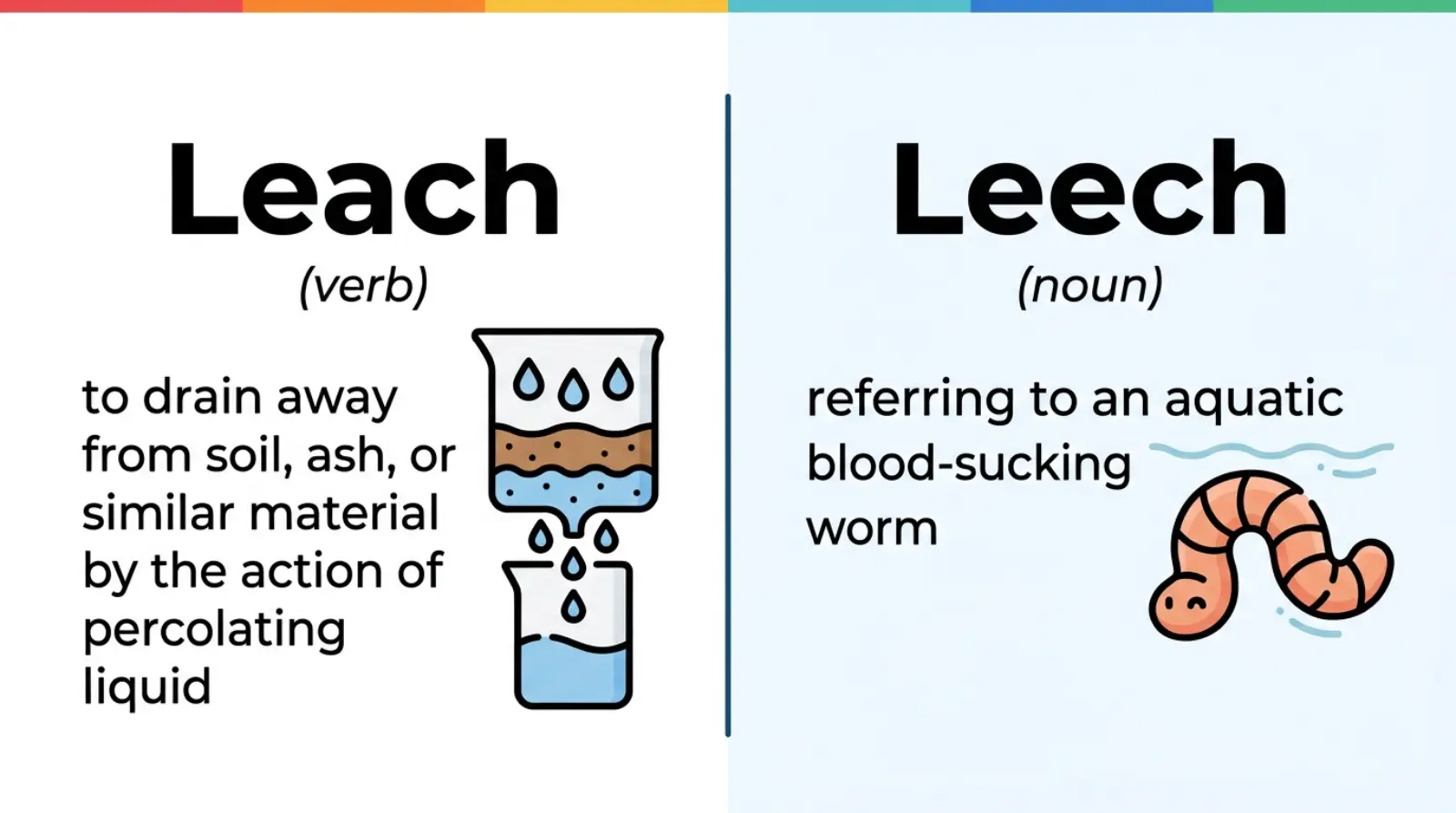
👉 Leach = to remove or wash a substance out of something, usually by using liquid.
👉 Leech = a blood-feeding animal, or a person who takes advantage of others.
Examples:
- Rain can leach nutrients from the soil. ✅
- Some chemicals may leach into groundwater. ✅
- A leech attached itself to the swimmer’s leg. ✅
- He is acting like a leech and never pays for anything. ✅
Simple Rule:
👉 Leach = liquid removes something.
👉 Leech = animal or person who takes.
A useful memory trick is to connect leach with liquid because leaching often involves water or another liquid.
What Does Leach or Leech Mean?
Although leach and leech sound alike, they are not interchangeable.
What Does Leach Mean?
Leach is mainly a verb. It means to remove a soluble substance from a material by passing liquid through it.
For example:
Heavy rain can leach nutrients from the soil.
In this sentence, water moves through the soil and carries some nutrients away.
Leach can also be used as a noun in technical contexts, especially in environmental science. Leachate is liquid that has passed through material and picked up dissolved substances.
Common uses include:
- Leach nutrients from soil
- Leach chemicals into water
- Leach minerals from rock
- Leach salt from soil
- Prevent chemicals from leaching into groundwater
What Does Leech Mean?
A leech is a small, soft-bodied animal related to worms. Some species feed on blood by attaching themselves to animals or humans.
The word also has a figurative meaning.
A leech can describe a person who constantly takes money, help, resources, or attention from someone without giving much in return.
Example:
He keeps borrowing money and never helps anyone. He is a real leech.
Synonyms
Leach: wash out, drain, extract, remove, dissolve out.
Leech: bloodsucker, parasite, hanger-on, taker.
Opposites
For leach, possible opposite ideas include retain, hold, or keep.
For leech, an opposite idea could be someone who contributes, helps, or gives rather than constantly takes.
Related Terms
- Leaching
- Leachate
- Soil leaching
- Chemical leaching
- Groundwater contamination
- Leech
- Blood-feeding organism
- Parasite
- Bloodsucker
The Origin of Leach or Leech
The words have different histories even though they sound similar today.
Leech is an old English word connected with the animal. Historically, leeches were used in medicine because people believed that removing blood could help treat certain illnesses.
Leach developed from an older word meaning to wash or filter through. Its modern use is strongly connected with water moving through soil, minerals, waste, and other materials.
Over time, both words kept their different meanings while their pronunciations became very similar.
The important point for modern English is simple: they are different words with different meanings.
How to Pronounce Leach or Leech
Both leach and leech are usually pronounced the same way.
Leach: /liːtʃ/ — sounds like leech
Leech: /liːtʃ/ — sounds like leach
They rhyme with words such as:
- Teach
- Reach
- Beach
- Peach
- Each
Because the pronunciation is the same, spelling is the main challenge.
Common Pronunciation Mistake
There is generally no major pronunciation difference between the two. The mistake happens when people hear one word and automatically write the other.
British English vs American English Usage
There is no important British-versus-American spelling difference between leach and leech.
| Feature | British English | American English | Notes |
|---|---|---|---|
| Leach | Leach | Leach | Same spelling |
| Leech | Leech | Leech | Same spelling |
| Pronunciation | Usually /liːtʃ/ | Usually /liːtʃ/ | Essentially the same |
| Meaning | Same | Same | Context determines the word |
| Scientific use | Common | Common | Especially “leach” |
| Animal meaning | Common | Common | “Leech” |
So whether you are writing in the UK, US, Canada, Australia, India, or Pakistan, the basic distinction remains the same.
Which One Should You Use?
Choose the word based on what you mean.
Use leach when you are talking about something being removed or washed out by liquid.
- Water can leach salt from the soil.
- Rain may leach chemicals into groundwater.
- The process can leach minerals from rocks.
leech when you mean the animal.
- A leech was found in the pond.
- The doctor discussed the historical use of leeches.
leech figuratively when describing someone who constantly takes from others.
- He is a leech who depends on his friends.
- Don’t let someone leech off you.
Mini Usage Table
| If you mean… | Use |
|---|---|
| Remove something with liquid | Leach |
| A blood-feeding animal | Leech |
| A person who takes advantage of others | Leech |
| Chemicals moving through soil | Leach |
| Nutrients being washed away | Leach |
Common Mistakes With Leach or Leech
Mistake 1: Using “leech” for soil
❌ Water can leech nutrients from the soil.
✔ Water can leach nutrients from the soil.
Why? The sentence describes liquid removing nutrients.
Tip: Think leach = liquid.
Mistake 2: Using “leach” for the animal
❌ A leach attached to his leg.
✔ A leech attached to his leg.
Why? The animal is spelled leech.
Tip: The animal has ee in its spelling.
Mistake 3: Confusing “leech off” with “leach off”
❌ He always leaches off his parents.
✔ He always leeches off his parents.
Why? The figurative meaning comes from the animal that takes blood.
Mistake 4: Assuming they have different sounds
❌ “Leach” and “leech” have completely different pronunciations.
✔ They are normally pronounced the same.
Tip: Listen for the meaning, not just the sound.
Mistake 5: Writing “leach” when discussing a parasite
❌ The leach is a blood-feeding organism.
✔ The leech is a blood-feeding organism.
Why? The animal is always leech.
Leach or Leech in Everyday Examples
Work
The report explains how chemicals can leach into groundwater.
School
Rainwater can leach minerals from the soil.
Science
Researchers studied how metals leach from rocks.
Daily Life
I saw a leech near the edge of the pond.
Please explain whether the material could leach harmful chemicals into water.
Text Message
“I think there was a leech in the lake!”
Social Media
“I went hiking and found a leech on my shoe!”
Conversation
“Don’t be a leech. You always ask everyone else to pay.”
Leach or Leech in Different Contexts
Education
In biology and environmental science, leach is often used when discussing water, soil, minerals, and chemicals.
Example:
Fertilizers can leach into nearby water sources.
Leech may appear in biology when students study the animal and its behavior.
Agriculture
Farmers and soil scientists may discuss nutrient leaching. Too much water can move certain nutrients deeper into the soil or away from plant roots.
Example:
Heavy rainfall increased nutrient leaching.
Environmental Science
The word leach is important when discussing groundwater and pollution.
Example:
Chemicals may leach from waste into surrounding soil.
Relationships and Social Life
The figurative noun leech can describe someone who takes advantage of another person.
Example:
She felt that her roommate was becoming a leech because he never paid his share.
This use is informal and can sound insulting, so choose it carefully.
Leach or Leech – Google Trends & Search Intent
People searching “leach or leech” are usually trying to solve a spelling or vocabulary problem.
Common long-tail searches include:
- Is it leach or leech?
- Leach vs leech meaning
- What does leach mean?
- What does leech mean?
- How do you spell leech?
- How do you spell leach?
- Is leach a word?
- Is leech a verb?
- What is leaching?
- What is a leech?
- Leech off or leach off?
- Leach meaning in science
The confusion can appear among English learners in the US, UK, India, Pakistan, Canada, and Australia, especially because the words sound the same.
For voice search, people may ask:
“What is the difference between leach and leech?”
The easiest answer is: leach means to wash or remove something with liquid; leech means the animal or a person who constantly takes from others.
Comparison Table: Leach or Leech
| Feature | Leach | Leech |
|---|---|---|
| Spelling | L-E-A-C-H | L-E-E-C-H |
| Pronunciation | /liːtʃ/ | /liːtʃ/ |
| Main meaning | Remove through liquid | Blood-feeding animal |
| Grammar | Usually verb | Noun; can also be a verb |
| Science usage | Very common | Biology |
| Agriculture | Very common | Rare |
| Environmental writing | Very common | Rare |
| Figurative meaning | Limited | Common |
| Common phrase | Leach into soil | Leech off someone |
| Main confusion | Sounds like “leech” | Sounds like “leach” |
Leach or Leech in Professional Life
Choosing the correct word matters in professional and academic writing.
In environmental reports, scientific papers, farming documents, and technical writing, leach is the correct word when discussing substances moving out through liquid.
Example:
The study examined whether heavy metals could leach into groundwater.
Using leech in this context would look like a spelling error.
In informal workplace conversations, leech can describe someone who takes advantage of others, but it should be used carefully because it can sound rude.
Leach or Leech for Students and Beginners
Students often confuse these words because they hear the same sound.
The best approach is to learn them as separate vocabulary items rather than trying to hear a spelling difference.
Remember these two examples:
Water leaches nutrients from soil.
A leech feeds on blood.
If you remember those sentences, you can apply the words to many situations.
Common Uses Related to Leach or Leech
Uses of “Leach”
- Leach nutrients from soil
- Leach chemicals into water
- Leach minerals from rocks
- Leach salt from soil
- Chemical leaching
- Nutrient leaching
- Soil leaching
Uses of “Leech”
- A leech in a pond
- Leeches feeding on blood
- A leech in historical medicine
- A person who leeches off others
- Someone described as a social leech
Simple Trick to Remember Leach or Leech
Here is the easiest memory trick:
👉 LEACH = LIQUID
Both start with L, but connect leach with liquid.
Water leaches something away.
👉 LEECH = LIVING ANIMAL
A leech is the creature.
A leech can attach to an animal or person.
Think of it this way:
💧 Leach → liquid moves something away.
🪱 Leech → living creature.
For the figurative meaning:
🧍 Leech → someone who keeps taking.
Expert Tips
- Learn the words with examples, not isolated spellings.
- When you see soil, rain, water, minerals, or chemicals, think leach.
- When you see animal, blood, pond, parasite, or someone taking advantage, think leech.
- Remember that they normally sound the same.
- In scientific writing, double-check the spelling because leech would change the meaning.
- Use a dictionary if you are unsure about a technical sentence.
- Remember the phrase “leech off someone” for the figurative meaning.
Related Searches People Also Ask
Is leach and leech the same thing?
No. They sound alike but have different meanings and spellings.
Is it leach or leech nutrients?
It is leach nutrients because nutrients can be removed by water.
Is it leach or leech off someone?
It is leech off someone when describing a person who constantly takes advantage of another person.
Is a leech an animal?
Yes. A leech is a soft-bodied animal related to worms, and some species feed on blood.
What does leach mean in science?
It means a liquid removes dissolved substances from a material.
What is leaching in soil?
Leaching occurs when water moves through soil and carries soluble substances with it.
Are leach and leech pronounced the same?
Yes, they are normally pronounced the same: /liːtʃ/.
What is the plural of leech?
The plural is leeches.
Can leech be used as a verb?
Yes. For example, “He keeps leeching off his friends.”
Which spelling is used for the animal?
The animal is spelled leech.
FAQs
Is “leach” a correct English word?
Yes. Leach is a correct word commonly used for removing or washing substances out with liquid.
What is the difference between leach and leech?
Leach relates mainly to liquid removing substances. Leech means the animal or, informally, a person who takes advantage of others.
Is “leach” or “leech” used for soil?
Use leach. For example: “Rainwater can leach nutrients from soil.”
Is a leech a parasite?
Some leeches are parasitic and feed on the blood of other animals.
What does “leech off someone” mean?
It means to depend on someone or take their money, resources, or help without giving much back.
Do leach and leech sound the same?
Yes. They are normally pronounced /liːtʃ/.
What is the easiest way to remember leach?
Connect leach with liquid. Water can leach substances from soil.
What is the easiest way to remember leech?
Think of the leech animal. Then remember that “leech off someone” comes from the idea of taking from someone.
Which word should I use in academic writing?
Use leach for scientific processes involving substances being removed by liquid, and leech when referring to the animal.
Final Verdict
Leach or leech?
👉 Leach = to remove or wash something out with liquid.
👉 Leech = a blood-feeding animal or, informally, a person who takes advantage of others.
Easy rule:
💧 Liquid → LEACH
🪱 Animal/taker → LEECH
Conclusion
The difference between leach or leech is simple once you connect each spelling with its meaning.
Use leach when talking about water or another liquid removing something from soil, rock, waste, or another material. Use leech for the blood-feeding animal and for the informal idea of someone who constantly takes from others.
The biggest reason people confuse these words is pronunciation: they normally sound exactly the same. So you cannot depend on hearing the word. You have to look at the meaning.
The easiest memory trick is:
💧 LEACH = LIQUID
🪱 LEECH = LIVING ANIMAL
Remember that pair, and you will have a much easier time choosing the correct spelling in school, work, science writing, emails, and everyday English.

Camila Green is an English language writer who specializes in confusing word comparisons and spelling explanations. She creates simple, beginner-friendly guides on topics like “niece or neice” and other common English mistakes. Her writing focuses on clarity, real-life examples, and easy learning. At VerrsaPick, she helps readers improve their English with practical and engaging content.