Imagine you are looking at a drop of pond water under a microscope. You might see tiny bacteria moving around, but then a basic science question comes up: is bacteria biotic or abiotic? This can be confusing at first, especially for students learning about ecosystems, living organisms, and environmental science.
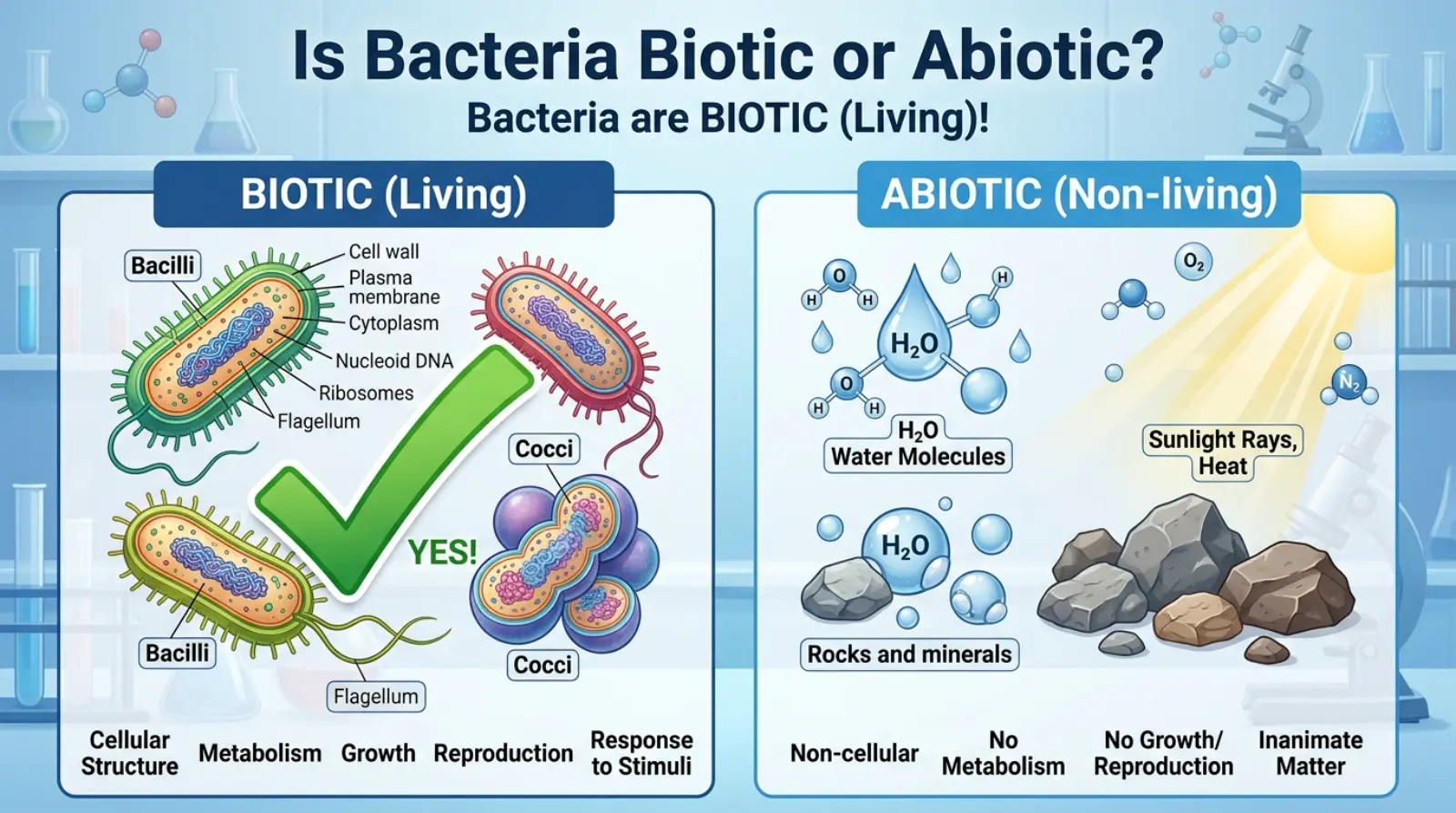
The short answer is simple: bacteria are biotic because bacteria are living organisms. They are made of cells, use energy, grow, reproduce, respond to their surroundings, and carry genetic material. These are key characteristics of life.
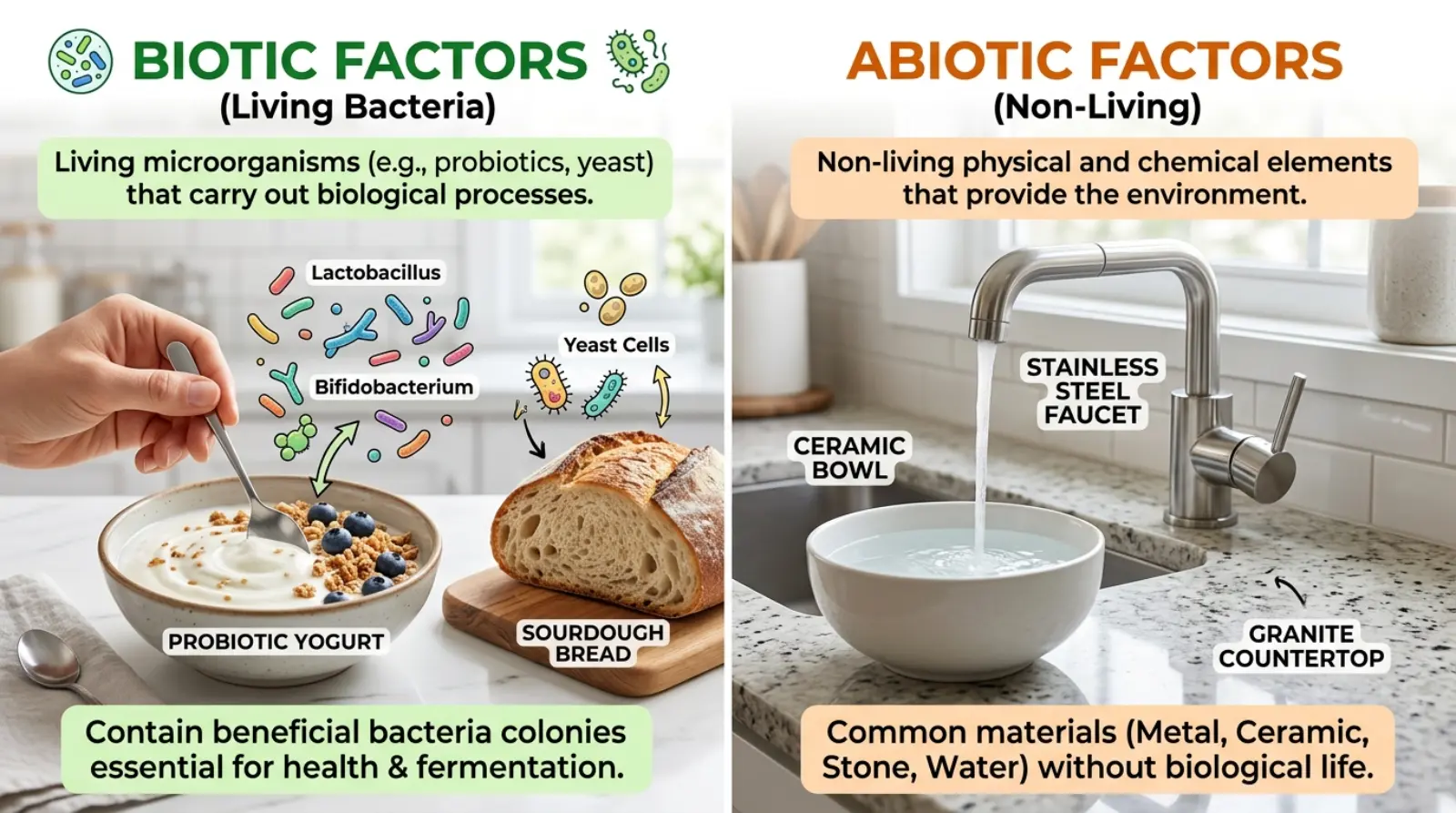
The confusion often happens because the words biotic and abiotic sound similar. In biology and ecology, however, they describe two very different things. Biotic factors are living or once-living components of an ecosystem, while abiotic factors are nonliving physical or chemical components, such as water, sunlight, temperature, air, rocks, and minerals.
People usually search for “is bacteria biotic or abiotic” because they want the correct definition, a simple explanation, examples, or help with a school science question. You may see this question in biology lessons, environmental science, ecology worksheets, homework, online quizzes, and classroom discussions.
It is also important to understand that bacteria can interact with abiotic factors. For example, bacteria are biotic, while the water they live in is abiotic. Temperature, oxygen, pH, and nutrients in their environment can affect bacterial growth.
In this guide, you’ll learn the meaning, pronunciation, examples, usage, grammar rules, common mistakes, expert tips, and simple explanations in easy English.
Is Bacteria Biotic or Abiotic – Quick Answer
Bacteria are biotic. They are living organisms, so they are classified as biotic factors when discussing an ecosystem.
👉 Biotic = living or once-living components
👉 Abiotic = nonliving components
Examples
Bacteria are biotic because they are living cells.
Plants are biotic because they are living organisms.
Animals are biotic because they are alive.
Water is abiotic because it is nonliving.
Sunlight is abiotic because it is a nonliving environmental factor.
Simple Rule
👉 If it is alive or comes from something that was alive, think “biotic.”
👉 If it is nonliving, think “abiotic.”
A useful memory trick is:
BIO = life
So, biotic = related to life.
What Does Is Bacteria Biotic or Abiotic Mean?
The question “is bacteria biotic or abiotic?” asks whether bacteria belong to the living or nonliving parts of an ecosystem.
Bacteria are biotic because they are living organisms. Although they are extremely small, they perform biological processes that show characteristics of life.
Most bacteria are single-celled organisms, meaning one cell performs all the functions needed to keep the organism alive.
Bacteria can:
- Obtain and use energy
- Grow
- Reproduce
- Respond to their environment
- Maintain internal conditions
- Carry DNA
- Interact with other organisms
- Take part in ecosystems
This makes bacteria clearly different from abiotic factors.
What Are Biotic Factors?
Biotic factors are the living parts of an ecosystem.
Examples include:
- Bacteria
- Plants
- Animals
- Fungi
- Algae
- Protists
- Other microorganisms
In some ecological contexts, dead organic matter and materials produced by living organisms can also be discussed as biotic components, depending on the classification being used.
What Are Abiotic Factors?
Abiotic factors are nonliving physical and chemical parts of an environment.
Examples include:
- Water
- Sunlight
- Temperature
- Soil minerals
- Rocks
- Air
- pH
- Salinity
- Humidity
For example, in a pond ecosystem, bacteria are biotic, while the water temperature and sunlight are abiotic.
Synonyms and Related Terms
There is no perfect synonym for biotic, but related expressions include:
- living component
- biological factor
- living organism
- biological part of an ecosystem
For abiotic, related expressions include:
- nonliving factor
- physical factor
- chemical factor
- environmental condition
Common Variations
You may see this question written as:
- Is bacteria biotic or abiotic?
- Are bacteria biotic or abiotic?
- Is a bacterium biotic or abiotic?
- Are microorganisms biotic or abiotic?
- Are bacteria living or nonliving?
- Are bacteria a biotic factor?
- Is bacteria considered a biotic component?
All of these questions are basically asking about the same biological classification.
The Origin of Biotic and Abiotic
The word biotic comes from a Greek root connected with life. The term is used in biology and ecology to describe things related to living organisms.
The prefix a- in abiotic means “not” or “without.” Therefore, abiotic literally points to something that is not living.
This gives you a useful language clue:
biotic → life
abiotic → not living
The terms became especially useful as scientists developed modern ideas about ecosystems, where living organisms interact with physical and chemical conditions.
Today, biotic and abiotic factors are basic concepts in ecology and environmental science.
How to Pronounce Is Bacteria Biotic or Abiotic
The individual science terms are pronounced approximately like this:
Bacteria: bak-TEER-ee-uh
Biotic: bye-OT-ik
Abiotic: ay-bye-OT-ik
The key difference is the beginning:
- Biotic → “bye-OT-ik”
- Abiotic → “ay-bye-OT-ik”
A simple speaking trick is to remember:
BIO sounds like “life.”
When you hear biotic, think about living things.
When you hear abiotic, think about nonliving environmental factors.
British English vs American English Usage
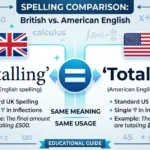
There is no important British-American spelling difference in biotic or abiotic.
| Feature | British English | American English | Notes |
|---|---|---|---|
| Biotic | Biotic | Biotic | Same spelling |
| Abiotic | Abiotic | Abiotic | Same spelling |
| Bacteria | Bacteria | Bacteria | Same spelling |
| Bacterium | Bacterium | Bacterium | Singular form |
| Biology | Biology | Biology | Same |
| Ecosystem | Ecosystem | Ecosystem | Same |
The scientific meaning is essentially the same in both British and American English.
One small grammar point is worth remembering: bacteria is traditionally the plural form of bacterium.
For example:
✔ “These bacteria are living organisms.”
✔ “This bacterium is living.”
In everyday English, however, bacteria is commonly used as a general mass noun.
Which One Should You Use?
If the question is “Is bacteria biotic or abiotic?”, the correct answer is:
Bacteria are biotic.
Use biotic when discussing:
- Living organisms
- Ecosystems
- Food chains
- Biological communities
- Ecology
- Environmental science
Use abiotic when discussing:
- Water
- Temperature
- Sunlight
- Rocks
- Minerals
- pH
- Air
- Salinity
Quick examples
| Example | Classification |
|---|---|
| Bacteria | Biotic |
| Tree | Biotic |
| Fish | Biotic |
| Fungus | Biotic |
| Water | Abiotic |
| Sunlight | Abiotic |
| Temperature | Abiotic |
| Rock | Abiotic |
Common Mistakes With Is Bacteria Biotic or Abiotic
Mistake 1: Calling bacteria abiotic
❌ “Bacteria are abiotic because they are microscopic.”
✔ Correct: “Bacteria are biotic because they are living organisms.”
Why do people make this mistake?
They may associate tiny or invisible things with nonliving matter.
Correction tip:
Size does not determine whether something is alive.
Mistake 2: Thinking only plants and animals are biotic
❌ “Only plants and animals are biotic.”
✔ Correct: “Bacteria, fungi, plants, animals, and many other organisms are biotic.”
Why?
Biotic means related to living components, not just large organisms.
Mistake 3: Confusing bacteria with water
❌ “Bacteria are abiotic because they live in water.”
✔ Correct: “Bacteria are biotic, while water is abiotic.”
Correction tip:
Ask what you are classifying. The organism and its environment are not the same thing.
Mistake 4: Thinking microorganisms are nonliving
❌ “Microorganisms are abiotic because they cannot be seen easily.”
✔ Correct: “Many microorganisms, including bacteria, are living organisms.”
Microscopic does not mean nonliving.
Mistake 5: Saying biotic means “good” and abiotic means “bad”
❌ “Biotic factors are good for an ecosystem.”
✔ Correct: “Biotic and abiotic simply describe types of ecosystem components.”
Both can be helpful, harmful, or neutral depending on the situation.
Mistake 6: Confusing bacteria with viruses
❌ “Bacteria and viruses are both exactly the same type of living organism.”
✔ Correct: “Bacteria are cellular organisms, while viruses are acellular infectious agents and are not generally classified as living organisms.”
This is an important distinction in biology.
Is Bacteria Biotic or Abiotic in Everyday Examples?
School
Question: Is bacteria biotic or abiotic?
Answer: Bacteria are biotic because they are living organisms.
Science experiment
If students grow bacteria on a culture medium, the bacteria are the biotic component, while factors such as temperature and moisture are abiotic conditions.
Pond ecosystem
A pond can contain:
- Bacteria → biotic
- Fish → biotic
- Algae → biotic
- Water → abiotic
- Sunlight → abiotic
- Temperature → abiotic
Soil
Soil contains both living and nonliving components.
Bacteria and fungi → biotic
Minerals, water, and temperature → abiotic
Text message
Friend: “Are bacteria biotic or abiotic?”
You: “Biotic. They’re living organisms.”
Online homework
A student might ask:
“Is bacteria a biotic or abiotic factor?”
The answer is biotic factor.
Is Bacteria Biotic or Abiotic in Different Contexts?
Ecology
In ecology, bacteria are important biotic components of ecosystems. They interact with plants, animals, fungi, and other microorganisms.
Many bacteria are also decomposers, helping break down organic material and return nutrients to ecosystems.
Food Chains
Bacteria can play several ecological roles.
Some bacteria help break down dead material. Others form relationships with plants or animals. Certain bacteria also serve as food for microscopic organisms.
So, bacteria can influence energy flow and nutrient cycling.
Nutrient Cycling
Bacteria are especially important in processes involving nutrients such as nitrogen and carbon.
For example, certain bacteria participate in the nitrogen cycle by changing nitrogen-containing compounds into forms that other organisms can use.
Soil Science
Healthy soil contains many microorganisms, including bacteria.
These organisms interact with minerals, organic matter, plant roots, water, and other parts of the soil environment.
Here again:
Bacteria = biotic
Minerals and water = abiotic
Environmental Science
Environmental scientists study how bacterial communities respond to factors such as:
- Temperature
- pH
- Oxygen
- Moisture
- Salinity
- Nutrient availability
The bacteria themselves are biotic, while these environmental conditions are abiotic.
Google Trends & Usage Data for Is Bacteria Biotic or Abiotic
The question “is bacteria biotic or abiotic” has a clear educational search intent. People generally search it because they need a quick answer for biology, ecology, environmental science, homework, or exam preparation.
Related long-tail searches include:
- Are bacteria biotic factors?
- Is bacteria a living organism?
- Are microorganisms biotic or abiotic?
- Is a bacterium biotic or abiotic?
- What are examples of biotic factors?
- What are examples of abiotic factors?
- Are bacteria living or nonliving?
- Are bacteria considered living things?
- Difference between biotic and abiotic factors
- Is bacteria a biotic component of an ecosystem?
This topic can appear in searches from students in the US, UK, India, Pakistan, Canada, and Australia, because biotic and abiotic factors are common concepts in school-level biology and environmental science.
Voice-search versions are especially natural:
“Are bacteria biotic or abiotic?”
“Is bacteria a biotic factor?”
“Are microorganisms biotic?”
Comparison Table: Is Bacteria Biotic or Abiotic?
| Feature | Bacteria | Biotic Factors | Abiotic Factors |
|---|---|---|---|
| Living? | Yes | Yes or once-living | No |
| Cellular? | Yes | Usually living organisms | No |
| Contains DNA? | Yes | Living organisms contain genetic material | Not an organism |
| Reproduces biologically? | Yes | Living organisms can reproduce | No |
| Example | Bacterium | Plant, animal, bacteria | Water, sunlight |
| Ecosystem role | Living component | Living component | Nonliving component |
| Affects other organisms? | Yes | Yes | Yes |
| Classification | Biotic | Biotic | Abiotic |
The most important row is the first one:
Bacteria are living organisms, so they are biotic.
Bacteria and Abiotic Factors: Why the Difference Matters
One reason students get confused is that bacteria are strongly affected by abiotic factors.
For example, bacteria need suitable environmental conditions to grow. Temperature, pH, water availability, oxygen levels, and nutrients can all affect bacterial activity.
That does not make bacteria abiotic.
Think of it like this:
Fish are biotic. Water is abiotic.
The fish depend on the water, but the fish do not become abiotic because they live in a nonliving environment.
The same idea applies to bacteria.
Bacteria = living organism
Environment around bacteria = may contain biotic and abiotic factors
Bacteria as a Biotic Factor in an Ecosystem
Bacteria can have major effects on ecosystems despite being microscopic.
They can:
- Decompose organic matter
- Recycle nutrients
- Interact with plant roots
- Help move nutrients through ecosystems
- Form relationships with animals
- Compete with other microorganisms
- Influence soil health
- Participate in aquatic ecosystems
This is why biotic does not mean “large” or “visible.”
A tiny bacterium can have a major ecological role.
Bacteria vs Abiotic Factors: A Simple Example
Imagine a garden.
You might find:
Biotic factors:
- Grass
- Flowers
- Worms
- Insects
- Bacteria
- Fungi
Abiotic factors:
- Sunlight
- Soil minerals
- Water
- Temperature
- Air
- pH
The ecosystem works because these components interact.
For example, bacteria can break down organic material, while water and temperature affect how active those bacteria are.
Signs and Characteristics of Biotic Components
A component is generally considered biotic when it is associated with life.
Common characteristics include:
- It is living or derived from living organisms.
- It can participate in biological processes.
- It may grow or reproduce.
- It can interact with other organisms.
- It can respond to environmental conditions.
- It may contain genetic material if it is a living organism.
Bacteria fit these characteristics.
Simple Trick to Remember Is Bacteria Biotic or Abiotic
Here is the easiest trick:
BIO = LIFE
You see BIO inside BIOTIC.
So:
👉 Biotic = life
👉 Abiotic = not living
Think of it this way:
A bacterium is alive.
Therefore:
Bacterium → biotic
A rock is not alive.
Therefore:
Rock → abiotic
A plant is alive.
Therefore:
Plant → biotic
Water is not alive.
Therefore:
Water → abiotic
That simple test can solve many biology questions.
Expert Tips for Students
Tip 1: Don’t use size as your test.
A bacterium can be microscopic and still be alive.
Tip 2: Look for BIO.
“Bio” is associated with life, making “biotic” easier to remember.
Tip 3: Separate organisms from their surroundings.
The organism may be biotic while its environment contains abiotic factors.
Tip 4: Learn examples in pairs.
Bacteria → biotic. Water → abiotic.
Tip 5: Remember that abiotic does not mean unimportant.
Sunlight, temperature, water, and minerals are essential to ecosystems even though they are nonliving.
Tip 6: Know the singular and plural forms.
One is a bacterium; more than one are bacteria.
Related Searches People Also Ask
Are bacteria biotic factors?
Yes. Bacteria are living organisms and therefore are biotic components of ecosystems.
Are microorganisms biotic or abiotic?
Living microorganisms, such as bacteria, are biotic.
Is a bacterium biotic or abiotic?
A bacterium is biotic because it is a living cellular organism.
Are bacteria living things?
Yes. Bacteria are living organisms made of cells.
What are examples of biotic factors?
Examples include bacteria, plants, animals, fungi, and other living organisms.
What are examples of abiotic factors?
Examples include sunlight, water, temperature, rocks, minerals, and pH.
Why are bacteria considered biotic?
Because bacteria perform life processes such as using energy, growing, reproducing, and responding to their environment.
Can bacteria be found in abiotic environments?
Yes. Bacteria can live in environments containing nonliving factors such as water, soil, air, minerals, and different temperatures.
What is the difference between biotic and abiotic?
Biotic refers to living components, while abiotic refers to nonliving physical and chemical components.
FAQs
1. Is bacteria biotic or abiotic?
Bacteria are biotic. They are living organisms.
2. Why are bacteria biotic?
Bacteria are biotic because they are living cells that use energy, grow, reproduce, and respond to their environment.
3. Is a bacterium a biotic factor?
Yes. A bacterium is a living organism and can therefore be considered a biotic component of an ecosystem.
4. Are bacteria living or nonliving?
Bacteria are living organisms. They are single-celled organisms with their own biological processes.
5. Is water biotic or abiotic?
Water is abiotic because it is nonliving.
6. Is bacteria a biotic or abiotic factor?
Bacteria are a biotic factor because they are living organisms.
7. Are all microorganisms biotic?
Living microorganisms are biotic. However, not every microscopic particle or infectious agent should automatically be classified as a living organism.
8. Are bacteria plants or animals?
No. Bacteria are neither plants nor animals. They belong to the domain Bacteria and are prokaryotic organisms.
9. What is the easiest way to remember biotic and abiotic?
Remember BIO = life. Biotic relates to living things; abiotic refers to nonliving factors.
10. Can abiotic factors affect bacteria?
Yes. Temperature, pH, moisture, oxygen, salinity, and nutrient availability can strongly affect bacterial growth and activity.
Final Verdict
Is bacteria biotic or abiotic?
👉 Bacteria are biotic.
They are living, single-celled organisms and are therefore part of the biotic components of ecosystems.
The easiest rule is:
BIO = LIFE → BIOTIC = LIVING
Water, sunlight, temperature, rocks, and minerals are examples of abiotic factors.
So if you see bacteria on a biology test, remember:
Bacteria = biotic.
Conclusion
The answer to “is bacteria biotic or abiotic?” is clear: bacteria are biotic.
They are living organisms, even though they are microscopic. They can use energy, grow, reproduce, interact with their surroundings, and play important roles in ecosystems. Their small size does not make them abiotic.
The key is to separate the organism from its environment. Bacteria are biotic, while things such as water, sunlight, temperature, rocks, and minerals are abiotic.
When studying ecology, remember the easiest trick:
BIO = LIFE → BIOTIC
If it is alive, think biotic. If it is nonliving, think abiotic.

Camila Green is an English language writer who specializes in confusing word comparisons and spelling explanations. She creates simple, beginner-friendly guides on topics like “niece or neice” and other common English mistakes. Her writing focuses on clarity, real-life examples, and easy learning. At VerrsaPick, she helps readers improve their English with practical and engaging content.