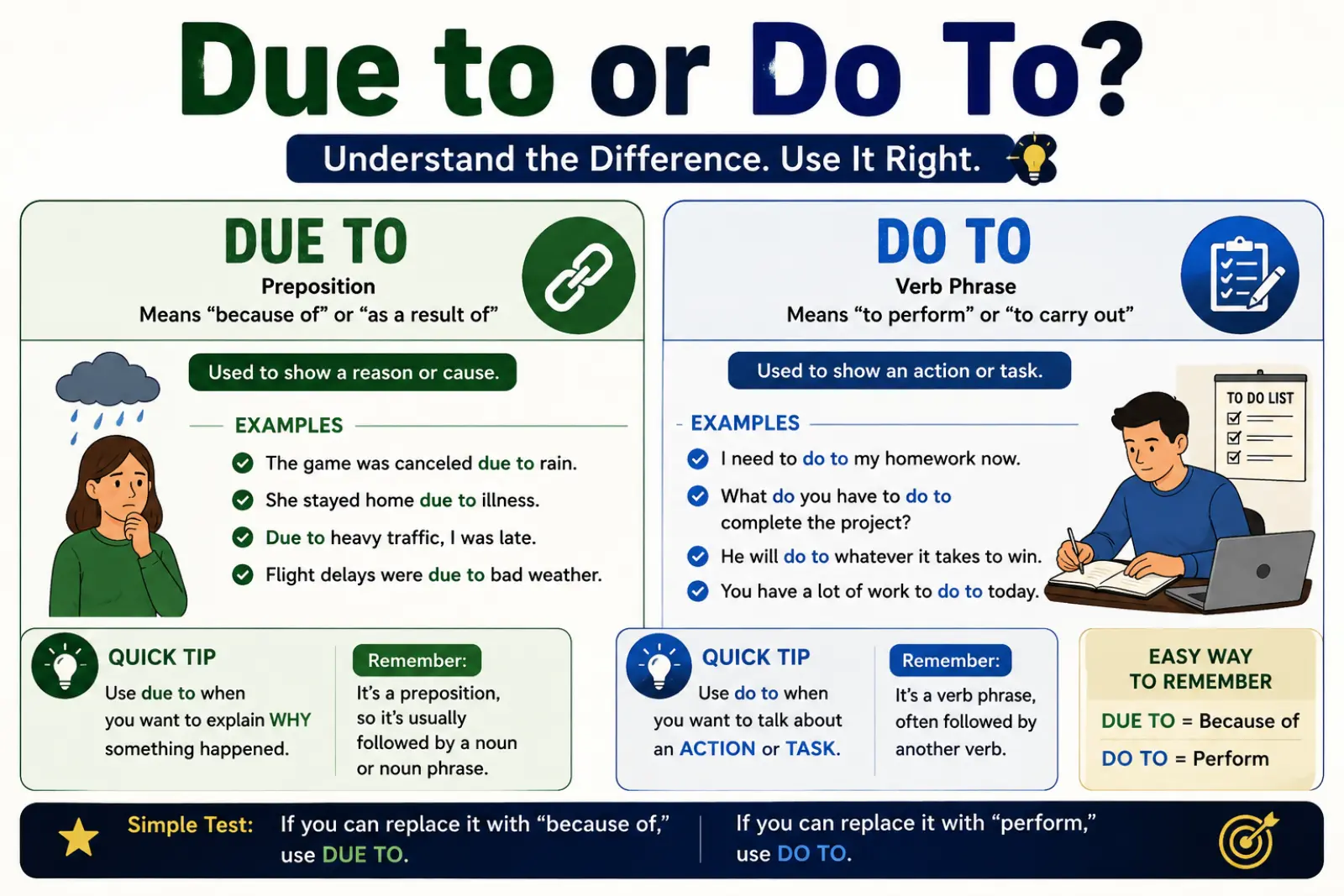
Have you ever typed a sentence like “The match was canceled due to bad weather” and then wondered whether it should be “due to” or “do to”? This is a very common English mistake, especially when writing quickly.
The confusion happens because due to and do to sound similar when spoken. However, they do completely different jobs. In most sentences where you want to explain a reason or cause, due to is the correct phrase. Do to is not a standard replacement for due to.
You may see this confusion in school assignments, workplace emails, social media posts, text messages, websites, business writing, and everyday conversations. Students often search for due to or do to, due to meaning, do to meaning, is it due to or do to, and how to use due to in a sentence because the two phrases can be easy to mix up.
The good news is that the rule is simple once you understand what each word does.
People usually search for: due to or do to meaning, correct usage, pronunciation, examples, definition, grammar difference, and when to use due to.
In this guide, you’ll learn the meaning, pronunciation, examples, usage, grammar rules, common mistakes, expert tips, and simple explanations in easy English.
Due to or Do To – Quick Answer
👉 Due to = caused by or because of
👉 Do to = usually incorrect when you mean “because of.” The words do and to can appear next to each other in other sentences, but they do not form the same phrase as due to.
Examples:
- The flight was delayed due to heavy rain. ✅
- The game was canceled due to bad weather. ✅
- She was absent due to illness. ✅
- The road closed due to flooding. ✅
- What do you want to do today? ✅
Simple Rule
👉 If you mean “because of”, use due to.
Easy memory trick:
Due to = because of.
If you can replace the phrase with because of and the sentence still makes sense, due to is probably the phrase you need.
What Does Due to or Do To Mean?
Due to
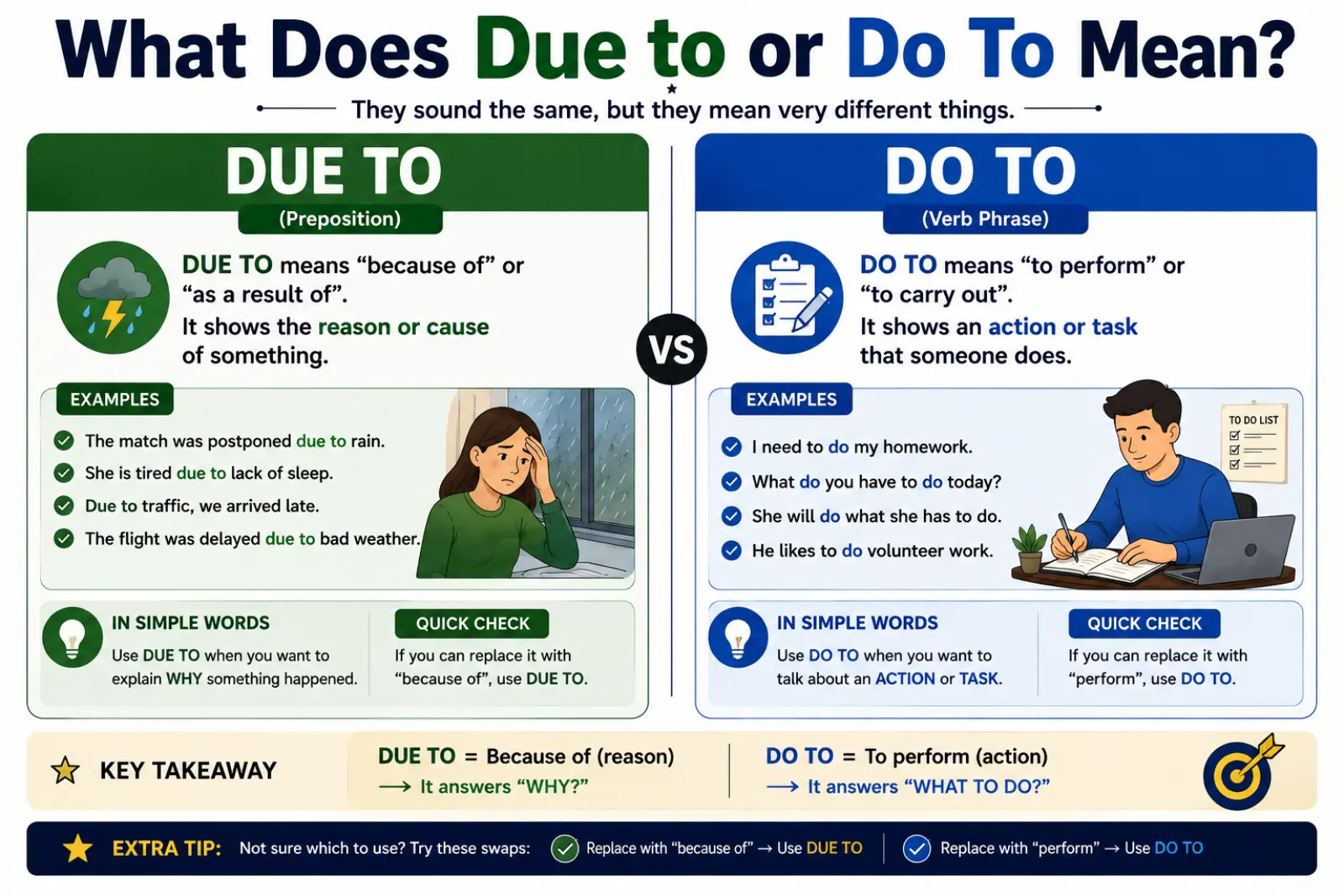
Due to means because of, as a result of, or caused by.
It introduces a reason or cause.
Examples:
- The school closed due to snow.
- The train arrived late due to a technical problem.
- The event was postponed due to safety concerns.
Here, due to tells us why something happened.
Do to
Do to does not normally work as a fixed phrase meaning “because of.”
However, do and to can appear next to each other naturally.
For example:
- What do you want to do?
- I have a lot to do today.
- What did the noise do to the baby?
Notice the difference. In “What did the noise do to the baby?”, do to is not a replacement for due to. The verb do and the preposition to simply happen to appear together.
Synonyms for Due To
Depending on the sentence, you can use:
- because of
- owing to
- as a result of
- on account of
- caused by
- thanks to
Opposites or Contrasting Ideas
There is no exact opposite phrase, but contrasting expressions include:
- despite
- regardless of
- in spite of
- even though
Example:
- The match was canceled due to rain.
- The match continued despite the rain.
Related Terms
- because
- because of
- owing to
- therefore
- consequently
- as a result
- cause
- reason
- effect
Common Variations
You may see:
- due to the weather
- due to illness
- due to traffic
- due to an error
- due to circumstances
- due to technical issues
- due to unforeseen circumstances
The Origin of Due To and Do To
The word due has a long history in English. It comes through Old French from Latin roots connected with the idea of being owed or being appropriate.
Over time, due developed several meanings. Something can be “due” when it is expected or owed, such as a payment is due.
The phrase due to developed into a common way of expressing cause or reason.
Do, on the other hand, is an old English verb meaning to perform, act, or carry out an action. It is unrelated to due.
That is why due to and do to should not be treated as spelling variations of the same expression.
How to Pronounce Due To or Do To
The pronunciation is one reason people confuse these expressions.
Due to
Due to is commonly pronounced approximately:
doo too
In some accents, the pronunciation of due may sound slightly different, but the important point is that due contains the sound associated with the word due.
Do to
Do to is pronounced approximately:
doo too
This is why listening alone may not help you decide which expression is correct.
Easy Speaking Trick
Do not try to identify the phrase only by sound.
Instead, ask:
Am I giving a reason?
If yes, write:
due to
Example:
The meeting was delayed due to traffic.
British English vs American English Usage
There is no major British-American spelling difference between due to and do to.
| Feature | British English | American English | Notes |
|---|---|---|---|
| Due to | Common | Common | Used to express cause |
| Do to | Not a substitute for due to | Not a substitute for due to | Can occur naturally as separate words |
| Meaning of due to | Because of | Because of | Same basic meaning |
| Formal writing | Common | Common | Useful in professional writing |
| Casual writing | Common | Common | Often replaced by “because of” |
Both British and American English speakers use due to.
Which One Should You Use?
Use due to when you want to explain a cause or reason.
Formal writing
The delay was due to a technical problem.
Academic writing
The change was due to increased demand.
Workplace communication
The meeting was postponed due to scheduling issues.
Emails
The shipment arrived late due to bad weather.
Social media
The event was canceled due to rain.
Texting
Sorry, I’m late due to traffic.
For very casual writing, because of can sometimes sound more natural.
Due to traffic, I’m late.
I’m late because of traffic.
Both communicate the reason, although traditional grammar guidance has sometimes distinguished the contexts where due to and because of are preferred.
Common Mistakes With Due to or Do To
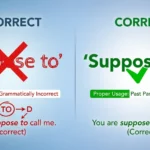
Mistake 1: Writing “do to” when you mean “because of”
❌ The flight was canceled do to rain.
✔ The flight was canceled due to rain.
Explanation: You are giving the reason for the cancellation.
Correction tip: Replace the phrase with because of. If that works, use due to.
Mistake 2: Using “due too”
❌ The school closed due too snow.
✔ The school closed due to snow.
Explanation: To is the correct word here. Too means “also” or “more than needed.”
Mistake 3: Confusing “due” with “do”
❌ The delay was do to traffic.
✔ The delay was due to traffic.
Why it happens: The two words can sound similar in quick speech.
Mistake 4: Using “due too” for emphasis
❌ The problem happened due too many errors.
✔ The problem happened due to many errors.
Remember:
- to = used in many grammatical structures
- too = also or excessively
- due to = because of
Mistake 5: Thinking “due to” always means “owed”
The word due has other meanings.
The payment is due tomorrow.
Here, due means expected or required, not “because of.”
Due to or Do To in Everyday Examples
At Work
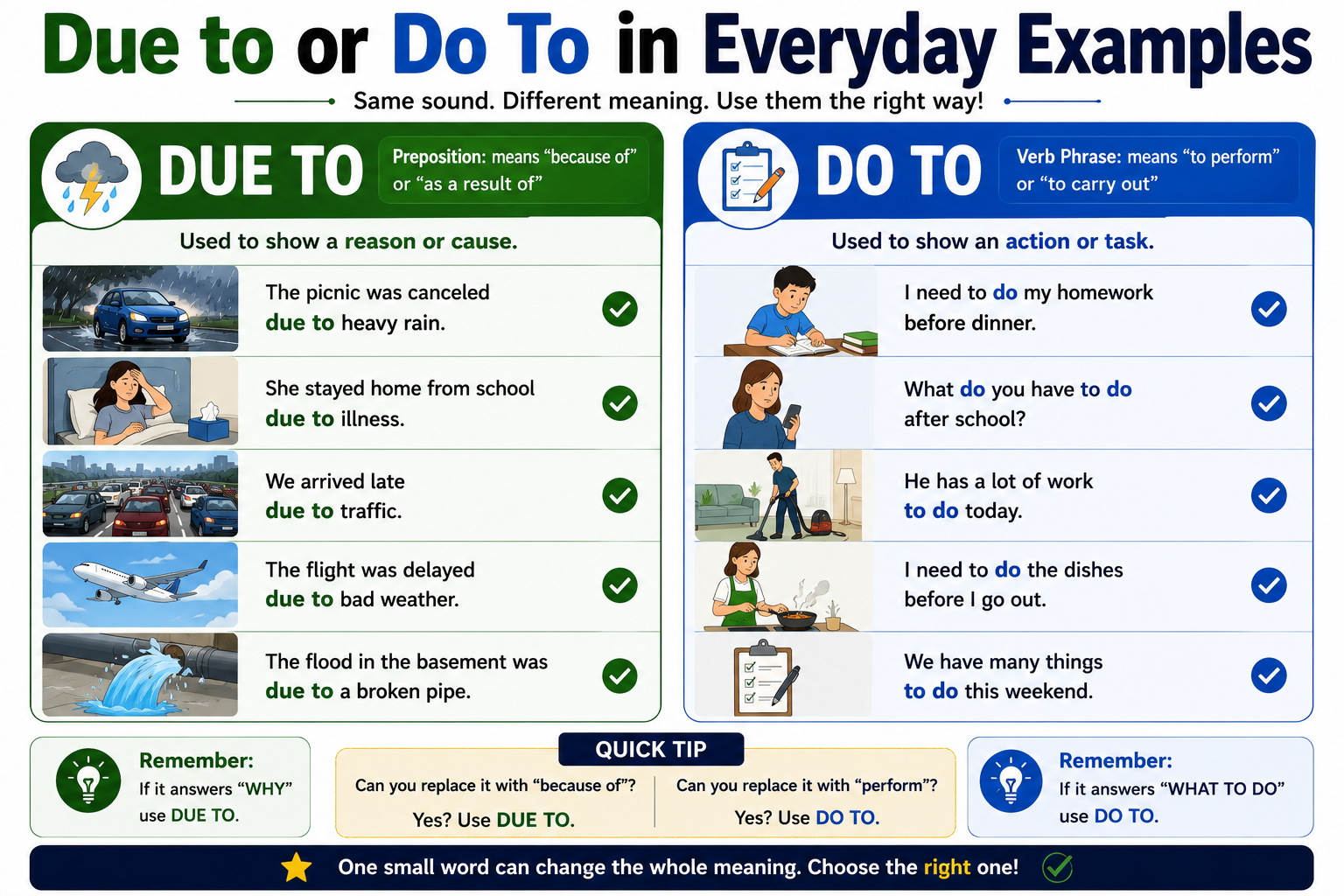
The meeting was delayed due to a technical issue.
At School
The class was canceled due to heavy snowfall.
On Social Media
The concert was postponed due to bad weather.
In Daily Life
The store closed early due to a power outage.
In an Email
The delivery may arrive late due to traffic conditions.
In a Text Message
I’ll be late due to traffic.
In Online Content
The website was temporarily unavailable due to maintenance.
In Conversation
We stayed home due to the rain.
These examples all use due to because they explain a cause.
Due to or Do To in Different Contexts
Education
Students commonly use due to when explaining why something happened.
Example:
“The experiment failed due to incorrect measurements.”
Business
Businesses often use due to in notices and customer messages.
Example:
“Orders may be delayed due to high demand.”
Workplace Communication
Due to can make explanations short and clear.
Example:
“Due to a scheduling conflict, I cannot attend the meeting.”
Writing
In formal writing, due to is useful when connecting an outcome with its cause.
Example:
“The project succeeded due to careful planning.”
Technology
Technical explanations often use the phrase.
Example:
“The system stopped working due to a server error.”
Social Media
Users may write due to when explaining an unexpected change.
Example:
“Posting late today due to a busy schedule!”
Google Trends and Usage Behavior
The search “due to or do to” is a classic spelling and grammar confusion. People often type the incorrect-looking version into search engines because they have heard both words in conversation but are unsure which spelling belongs in writing.
This type of query is especially common among English learners, students, workplace writers, and people proofreading emails or assignments.
Searches can include variations such as:
- due to or do to which is correct
- do to vs due to
- is it due to or do to
- due to meaning
- how to use due to
- due to examples
- due to pronunciation
- due to grammar rule
- what does due to mean
- due to sentence examples
English learners in countries such as the US, UK, India, Pakistan, Canada, and Australia may encounter the same confusion because the pronunciation can be very similar across accents.
Due to or Do To Comparison Table
| Feature | Due to | Do to |
|---|---|---|
| Standard fixed phrase? | Yes | No |
| Means “because of”? | Yes | No |
| Used for causes? | Yes | No |
| Common in formal writing? | Yes | Not as a fixed phrase |
| Common in academic writing? | Yes | No |
| Can appear naturally in a sentence? | Yes | Yes, but as separate words |
| Example | Delay due to rain | What did it do to you? |
| Common mistake | — | Used instead of “due to” |
Due to in Professional Life
Using the correct phrase matters in professional communication because small spelling mistakes can make an email or notice look careless.
Compare:
❌ The meeting was canceled do to illness.
✔ The meeting was canceled due to illness.
The second sentence looks polished and professional.
You may use due to in:
- business emails
- customer notices
- company announcements
- reports
- academic papers
- workplace messages
- technical documentation
- formal letters
When you want a more conversational tone, because of is also an excellent choice.
Due to for Students and Beginners
Beginners often struggle with this phrase because due and do are short words with similar sounds.
The easiest method is not to memorize a complicated grammar rule.
Just remember:
Due to = because of.
Then practice a few common combinations:
- due to rain
- due to traffic
- due to illness
- due to an error
- due to bad weather
- due to technical problems
- due to high demand
Once you recognize these patterns, choosing due to becomes much easier.
Signs You Need Due To
Use due to when:
- you are explaining a reason
- you are identifying a cause
- something happened because of something else
- you are writing a formal notice
- you are explaining a delay
- you are explaining a cancellation
- you are describing why an event happened
Pattern:
Result + due to + cause
Example:
The flight was delayed + due to + fog.
Simple Trick to Remember Due To or Do To
Here is the easiest memory trick:
Think: Due to = Because of
If you can say:
because of
then due to is usually the phrase you want.
The game was canceled because of rain.
Therefore:
The game was canceled due to rain.
Think of due to as a small bridge connecting an event to its reason.
Event → due to → reason
School closed → due to → snow
Flight delayed → due to → weather
Meeting canceled → due to → illness
Expert Tips for Remembering Due To
Tip 1: Use the “because of” test.
If “because of” fits, think about using due to.
Tip 2: Watch the spelling.
The correct phrase is D-U-E T-O.
Tip 3: Remember that “do” is a verb.
Examples include “do homework,” “do work,” and “do something.”
Tip 4: Do not confuse “to” with “too.”
The phrase is due to, not due too.
Tip 5: Proofread cause-and-effect sentences.
Whenever you explain why something happened, check whether you accidentally typed do to.
Tip 6: Use “because of” when you feel unsure.
It is often a clear and natural alternative.
Related Searches People Also Ask
How do you spell due to?
It is spelled due to when you mean “because of.”
Is “do to” ever correct?
Yes, the words can appear together as separate grammatical words, such as “What did it do to you?” But do to is not the standard phrase meaning “because of.”
Is due to formal?
Yes. Due to is common in formal, academic, workplace, and professional writing.
Can I use because of instead of due to?
Yes. In many sentences, because of is a natural and easy alternative.
What is the difference between due to and because of?
Both can express cause, although traditional grammar rules sometimes distinguish their grammatical roles. In everyday modern English, they are often used in similar ways.
What does due to mean in a sentence?
It usually means because of or as a result of.
How do you pronounce due to?
It is commonly pronounced approximately “doo too.”
Why do people write do to instead of due to?
The words can sound very similar when spoken, so people may spell the phrase based on what they hear.
Is “due too” correct?
Not when you mean “because of.” The correct phrase is due to.
Can due to start a sentence?
Yes. For example: “Due to heavy rain, the event was canceled.”
Final Verdict
Due to is the correct phrase when you mean because of or as a result of.
Do to is not the correct replacement for due to.
Easiest memory rule:
👉 Due to = because of
Correct: The flight was delayed due to rain. ✅
Incorrect: The flight was delayed do to rain. ❌
If you remember only one thing, remember the word DUE in DUE TO.
Conclusion
The difference between due to or do to is much easier than it first appears.
When you are explaining a reason or cause, use due to. It works in everyday conversations, school writing, workplace emails, professional documents, and online content.
Do to can appear when do and to happen to be next to each other grammatically, but it does not mean “because of.”
So the next time you want to write “because of,” pause for one second and remember:
Because of = Due to.
That simple connection can help you avoid one of the most common English spelling and grammar mistakes.
Final memory trick: If you’re giving the reason, choose DUE TO.

Camila Green is an English language writer who specializes in confusing word comparisons and spelling explanations. She creates simple, beginner-friendly guides on topics like “niece or neice” and other common English mistakes. Her writing focuses on clarity, real-life examples, and easy learning. At VerrsaPick, she helps readers improve their English with practical and engaging content.