Have you ever wanted to write “cue or queue” and suddenly stopped because both words sounded almost the same? You are not alone. These two words are a classic English homophone problem: they can sound alike, but their meanings and uses are completely different.
You may see cue and queue in school, workplace writing, entertainment, technology, customer service, social media, and everyday conversations. A person may say, “That’s my cue,” while someone else says, “Please join the queue.” If you are learning English, it is easy to understand the sentence when you hear it but become unsure about the spelling when you write it.
People usually search for cue or queue meaning, cue vs queue, how to spell queue, cue meaning in English, queue meaning in English, cue pronunciation, queue pronunciation, and cue or queue examples.
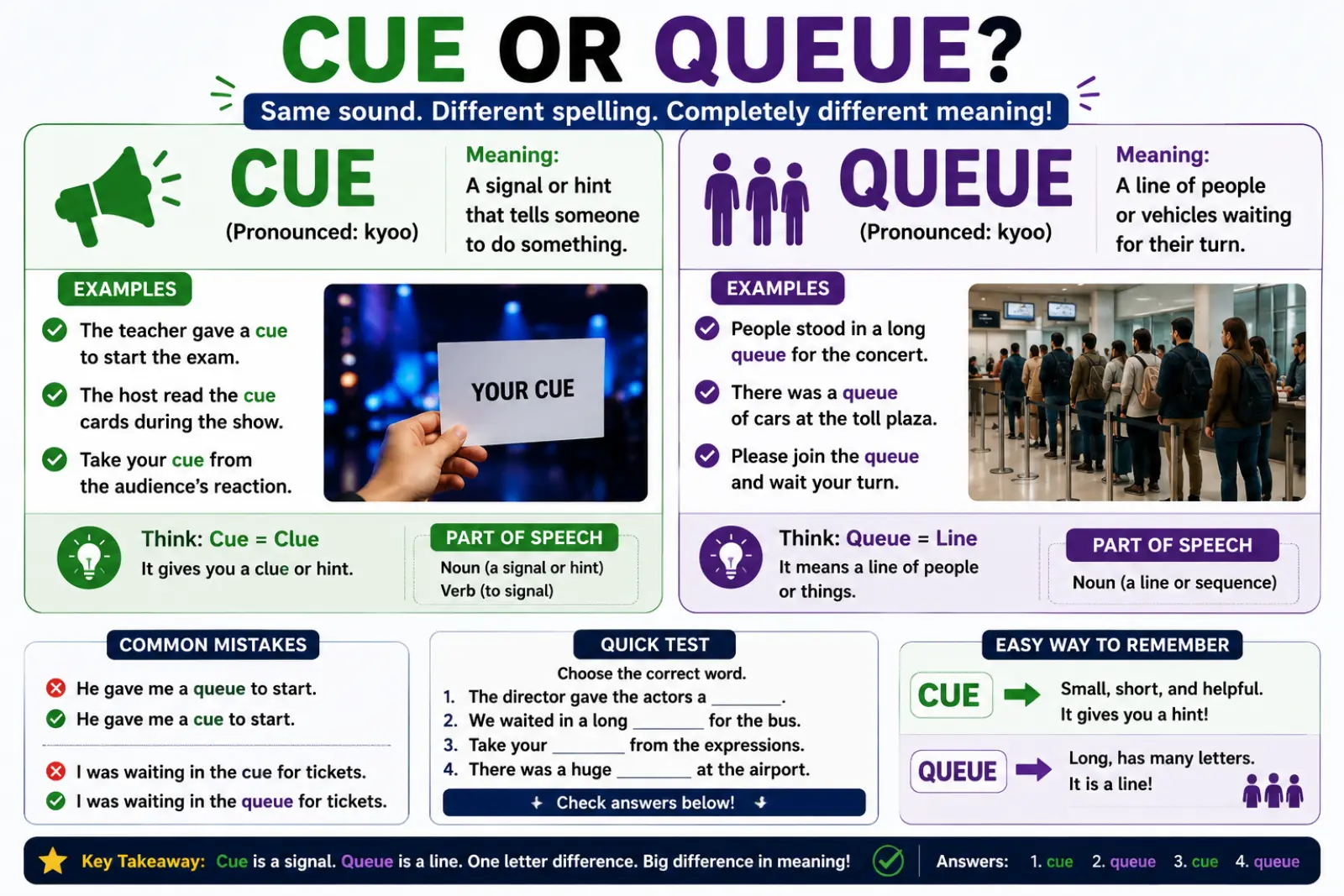
The good news is that the difference is simple. Cue usually means a signal or a hint that tells someone what to do. Queue usually means a line of people or things waiting for something. The two words sound alike, but their meanings are not alike.
In this guide, you’ll learn the meaning, pronunciation, examples, usage, grammar rules, common mistakes, expert tips, and simple explanations in easy English.
Cue or Queue – Quick Answer
👉 Cue = a signal, hint, or prompt that tells you when to act.
👉 Queue = a line of people or things waiting for their turn.
Examples:
- The actor waited for his cue to speak. ✅
- Her smile was a cue that she was ready. ✅
- We stood in a queue outside the store. ✅
- Please join the queue and wait your turn. ✅
- The computer placed my request in a queue. ✅
Simple Rule
👉 Cue = signal
👉 Queue = line
Memory trick: A cue tells you what to do; a queue tells you where to wait.
What Does Cue or Queue Mean?
Cue
A cue is a signal, sign, hint, or prompt that tells someone when or how to respond.
Examples:
- The music was his cue to start dancing.
- The teacher gave me a cue to answer.
- When she nodded, I knew it was my cue to leave.
Cue can also be used as a verb:
“Cue the music.”
This means to start or prepare the music at the right moment.
Queue
A queue is a line of people or things waiting for their turn.
Examples:
- We waited in a queue for tickets.
- There was a long queue outside the restaurant.
- My print job is in the queue.
In computing, a queue can also mean a list of tasks waiting to be processed.
Synonyms
Cue synonyms:
- signal
- hint
- prompt
- sign
- indication
Queue synonyms:
- line
- waiting line
- sequence
- list
- row
Opposites
There are no perfect opposites, but useful contrasting ideas include:
Cue: silence, lack of signal, uncertainty
Queue: immediate service, no waiting, empty line
Related Terms
- cue card
- cue sheet
- cue up
- cue someone
- queue up
- waiting line
- queue management
- virtual queue
- print queue
The Origin of Cue and Queue
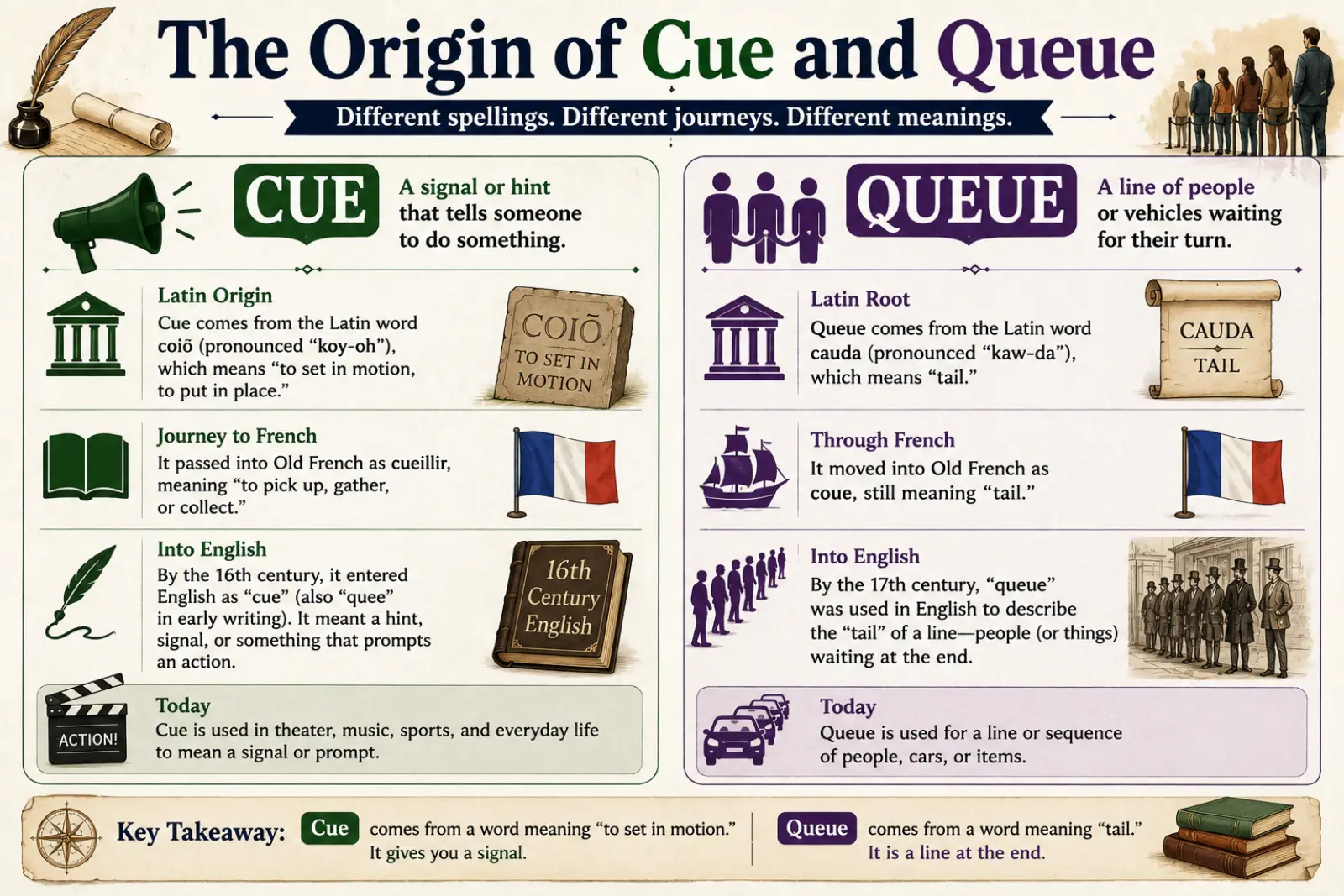
Cue has an interesting history. The modern noun developed from a word used in theater to mark an actor’s signal or entrance. It is also linked to an older form meaning a signal or indication.
Queue comes from French queue, meaning “tail.” The idea is easy to understand: a line of people or objects stretches out like a tail.
English later adopted queue for a line or sequence of people waiting.
Although the words have different histories and meanings, their pronunciation became very similar in modern English.
How to Pronounce Cue or Queue
The most important pronunciation fact is simple:
Cue → “kyoo”
Queue → “kyoo”
They are homophones, meaning they have the same pronunciation but different meanings and spellings.
Easy Speaking Trick
When you hear “kyoo,” you cannot know the spelling from sound alone. You need to understand the meaning.
Ask yourself:
Is it a signal? → cue
Is it a waiting line? → queue
For example:
“That was my cue.”
= That was my signal.
“I waited in the queue.”
= I waited in the line.
British English vs American English Usage
The biggest difference between British and American English is how commonly queue is used for a waiting line.
British English commonly uses queue.
American English often uses line instead.
| Feature | British English | American English | Notes |
|---|---|---|---|
| Cue | Common | Common | Means a signal or prompt |
| Queue | Very common | Used, but less common than “line” | Means a waiting line |
| Line | Also used | Very common | Often replaces “queue” in the US |
| Pronunciation | “kyoo” | “kyoo” | Same pronunciation |
| Theater use of cue | Common | Common | Same basic meaning |
For example:
British: “We stood in a queue.”
American: “We stood in line.”
However, cue keeps the same basic meaning in both varieties of English.
Which One Should You Use?
Choose the word based on meaning.
Use cue when:
- someone receives a signal
- an actor is told when to speak
- music should begin
- you receive a hint
- something tells you when to act
Example:
“That was my cue to leave.”
Use queue when:
- people are waiting
- customers are waiting for service
- tasks are waiting to be processed
- items are arranged in a waiting sequence
Example:
“My request is still in the queue.”
Quick Usage Table
| Meaning | Correct Word | Example |
|---|---|---|
| Signal | Cue | That was my cue. |
| Hint | Cue | Her expression was a cue. |
| Waiting line | Queue | We joined the queue. |
| Waiting tasks | Queue | The file is in the queue. |
Common Mistakes With Cue or Queue
Mistake 1: Using “queue” for a signal
❌ That was my queue to leave.
✔ That was my cue to leave.
Explanation: You mean a signal or indication, so use cue.
Tip: Signal = cue.
Mistake 2: Using “cue” for a waiting line
❌ We waited in a cue for an hour.
✔ We waited in a queue for an hour.
Explanation: You mean a line of people waiting.
Tip: Waiting line = queue.
Mistake 3: Assuming “queue” is pronounced differently
❌ Thinking queue has a long, complicated pronunciation.
✔ Queue = “kyoo.”
The spelling looks much longer than the sound.
Mistake 4: Confusing “cue” with “queue” in theater
❌ The actor missed his queue.
✔ The actor missed his cue.
A theater cue is a signal telling an actor when to speak, move, or enter.
Mistake 5: Forgetting the American word “line”
In American English, people often say:
“I stood in line.”
In British English, you are more likely to hear:
“I stood in the queue.”
Both refer to people waiting.
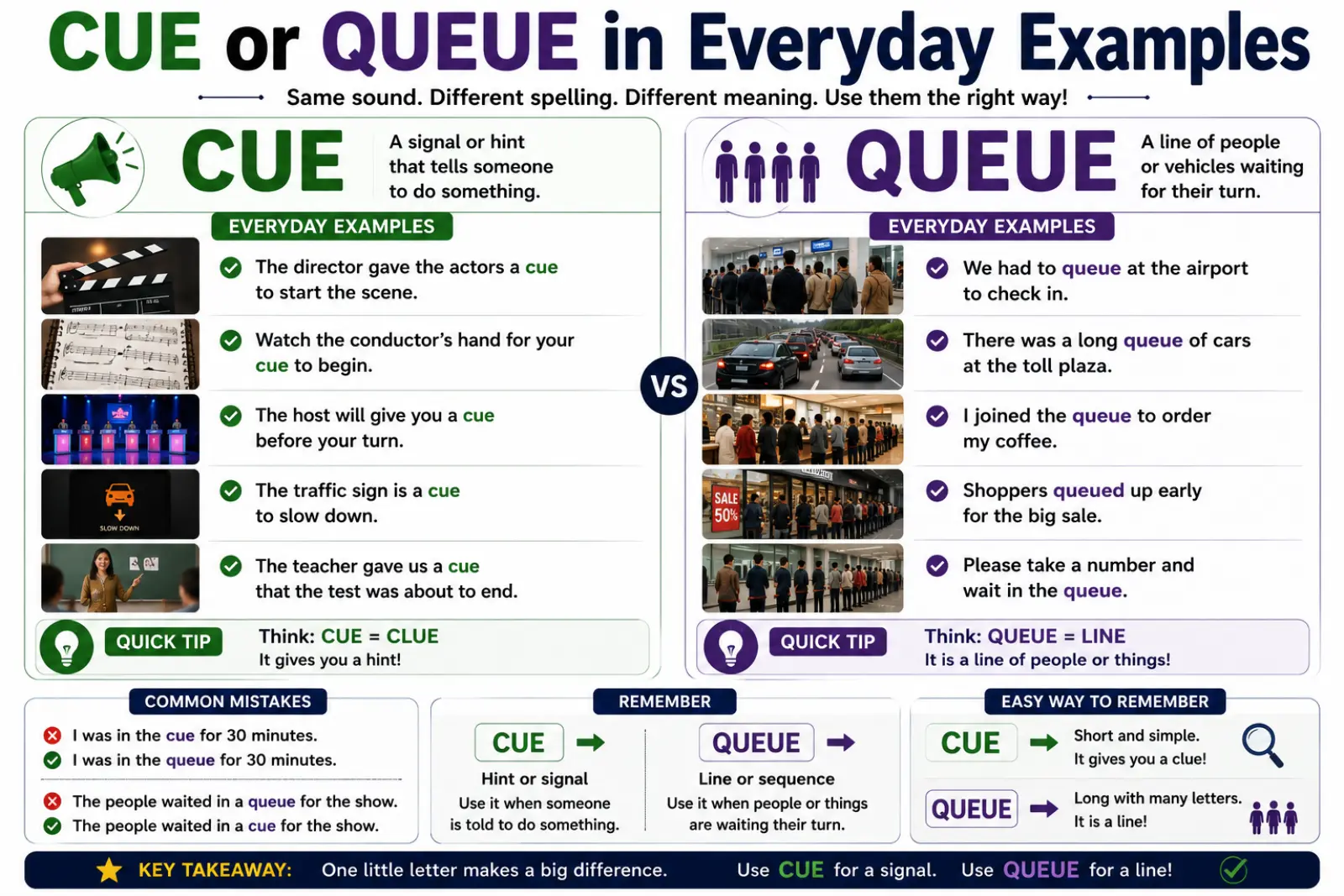
Cue or Queue in Everyday Examples
Work
The manager gave me a cue to begin the presentation.
School
The teacher’s gesture was a cue that I should start reading.
Social Media
That comment was my cue to stop arguing.
Daily Life
We stood in a queue at the supermarket.
Your request has been added to the support queue.
Text Message
When she says “go,” that’s my cue.
Online Content
Your video is now in the processing queue.
Conversation
His silence was a cue that he wanted to change the subject.
Cue or Queue in Different Contexts
Education
Teachers use cues to help students understand what to do next.
Example:
“The teacher gave students a visual cue to begin.”
Business
Businesses use queues when customers or requests must be handled in order.
Example:
“Your support request is in the queue.”
Workplace
A cue can signal that it is time for a presentation, meeting, speech, or action.
Example:
“The host gave me a cue to start speaking.”
Technology
Queue is especially common in computing. Tasks may wait in a processing queue.
Example:
“The download is in the queue.”
Entertainment
Cue is very common in theater, television, film, and live events.
Example:
“Wait for my cue before entering the stage.”
Communication
A facial expression, gesture, word, or action can serve as a cue.
Example:
“Her raised eyebrow was a cue that something was wrong.”
Cue or Queue: Comparison Table
| Feature | Cue | Queue |
|---|---|---|
| Pronunciation | “Kyoo” | “Kyoo” |
| Main meaning | Signal or prompt | Waiting line or sequence |
| Grammar | Noun or verb | Usually noun; also verb |
| People waiting? | No | Yes |
| Theater | Very common | Usually incorrect |
| Technology | Less common | Very common |
| British English | Common | Common |
| American English | Common | Often replaced by “line” |
| Example | Wait for your cue | Join the queue |
| Memory word | Signal | Line |
Cue or Queue in Professional Life
Knowing the difference can make workplace communication clearer.
Use cue when talking about timing, signals, presentations, meetings, or instructions.
Example:
“Please give me a cue when the presentation is ready.”
Use queue when discussing customers, requests, tickets, tasks, or computer processes.
Example:
“Your support ticket is currently in the queue.”
This distinction is especially useful in customer service, software development, event management, media production, and office communication.
Cue or Queue for Students and Beginners
The hardest part for beginners is that both words sound exactly alike.
Instead of trying to remember their spelling by sound, connect each word with a picture.
Cue
Imagine an actor standing backstage.
Someone says, “Go!”
That signal is a cue.
Queue
Imagine ten people standing outside a store.
That line is a queue.
This visual connection is much easier to remember than trying to memorize spelling alone.
Common Uses and Patterns
- give someone a cue
- take a cue
- miss a cue
- wait for a cue
- cue the music
- visual cue
- verbal cue
- social cue
Common uses of queue
- join a queue
- wait in a queue
- stand in a queue
- long queue
- queue up
- waiting queue
- support queue
- processing queue
- print queue
One useful clue is the phrase “cue the music.” Here, you are giving a signal.
Another is “join the queue.” Here, you are joining a waiting line.
Simple Trick to Remember Cue or Queue
Think of it this way:
CUE = Clue
Both cue and clue can help you know what to do.
QUEUE = line
A queue is a line where people or things wait.
Visual Memory
🎭 CUE → actor gets a signal
👥 QUEUE → people wait in a line
One-Line Memory Trick
👉 Cue gives you a clue. Queue is a line for you.
That simple rhyme can help you remember the difference quickly.
Expert Tips for Using Cue and Queue
1. Focus on meaning, not sound.
Because both words sound like “kyoo,” pronunciation will not tell you the spelling.
2. Connect cue with clue.
A cue can give you a clue about what to do next.
3. Connect queue with waiting.
If people or tasks are waiting, think queue.
4. Remember American English.
Americans commonly say line instead of queue.
5. Watch the phrase “cue up.”
To cue up something means to prepare it to start at the right time.
6. Do not be scared by “queue.”
It looks difficult, but it is pronounced simply: kyoo.
Related Searches People Also Ask
- Is it cue or queue?
It depends on meaning. A signal is a cue, while a waiting line is a queue. - How do you spell queue?
The correct spelling is queue. - How do you spell cue?
The correct spelling is cue when you mean a signal or prompt. - Are cue and queue pronounced the same?
Yes. Both are commonly pronounced “kyoo.” - What is the difference between cue and queue?
Cue means a signal; queue means a waiting line or sequence. - Is queue British or American?
Both varieties know the word, but British English uses queue much more often for a waiting line. American English commonly uses line. - What does cue mean in theater?
A cue is a signal telling an actor when to speak, move, enter, or perform. - What does queue mean in computing?
It can mean a list of tasks waiting to be processed. - Is “waiting in a cue” correct?
No. When you mean a waiting line, write “waiting in a queue.” - Is “my queue to leave” correct?
No. If you mean a signal to leave, write “my cue to leave.”
FAQs
Is cue or queue correct?
Both are correct words, but they have different meanings. Cue means a signal or prompt. Queue means a waiting line or sequence.
What is an easy way to remember cue vs queue?
Remember: Cue = clue or signal. Queue = line.
Is queue pronounced “kway”?
No. Queue is usually pronounced “kyoo.”
Is cue a noun or a verb?
It can be both. As a noun, it means a signal. As a verb, it can mean to give a signal or prepare something to happen.
Can queue be a verb?
Yes. For example, “Customers queued outside the store.”
Do Americans use the word queue?
Yes, but line is usually more common when Americans talk about people waiting.
What is a cue in acting?
A cue is a signal that tells an actor when to speak, move, enter, or perform.
What does queue mean in technology?
A queue is an ordered list of tasks or data waiting to be processed.
Are cue and queue homophones?
Yes. They are homophones because they have the same pronunciation but different meanings and spellings.
Which word means a waiting line?
Queue means a waiting line or an ordered group waiting for processing.
Final Verdict
Cue and queue are both correct, but they are used in different situations.
👉 Cue = signal, hint, or prompt
👉 Queue = waiting line or sequence
Cue: “That was my cue to speak.”
Queue: “We waited in the queue.”
The easiest memory rule:
Cue = clue. Queue = line.
Conclusion
The difference between cue or queue becomes easy when you focus on meaning instead of pronunciation.
Both words sound like “kyoo,” but cue is connected with a signal, hint, or prompt, while queue is connected with a line or a series of things waiting their turn.
If an actor is waiting for a signal, it is a cue. If customers are waiting outside a store, they are in a queue. In American English, you will often hear line instead of queue.
So whenever you are unsure, remember this simple trick:
👉 Cue gives you a clue. Queue is a line for you.
That one sentence can save you from mixing up these two commonly confused English words.

Camila Green is an English language writer who specializes in confusing word comparisons and spelling explanations. She creates simple, beginner-friendly guides on topics like “niece or neice” and other common English mistakes. Her writing focuses on clarity, real-life examples, and easy learning. At VerrsaPick, she helps readers improve their English with practical and engaging content.