
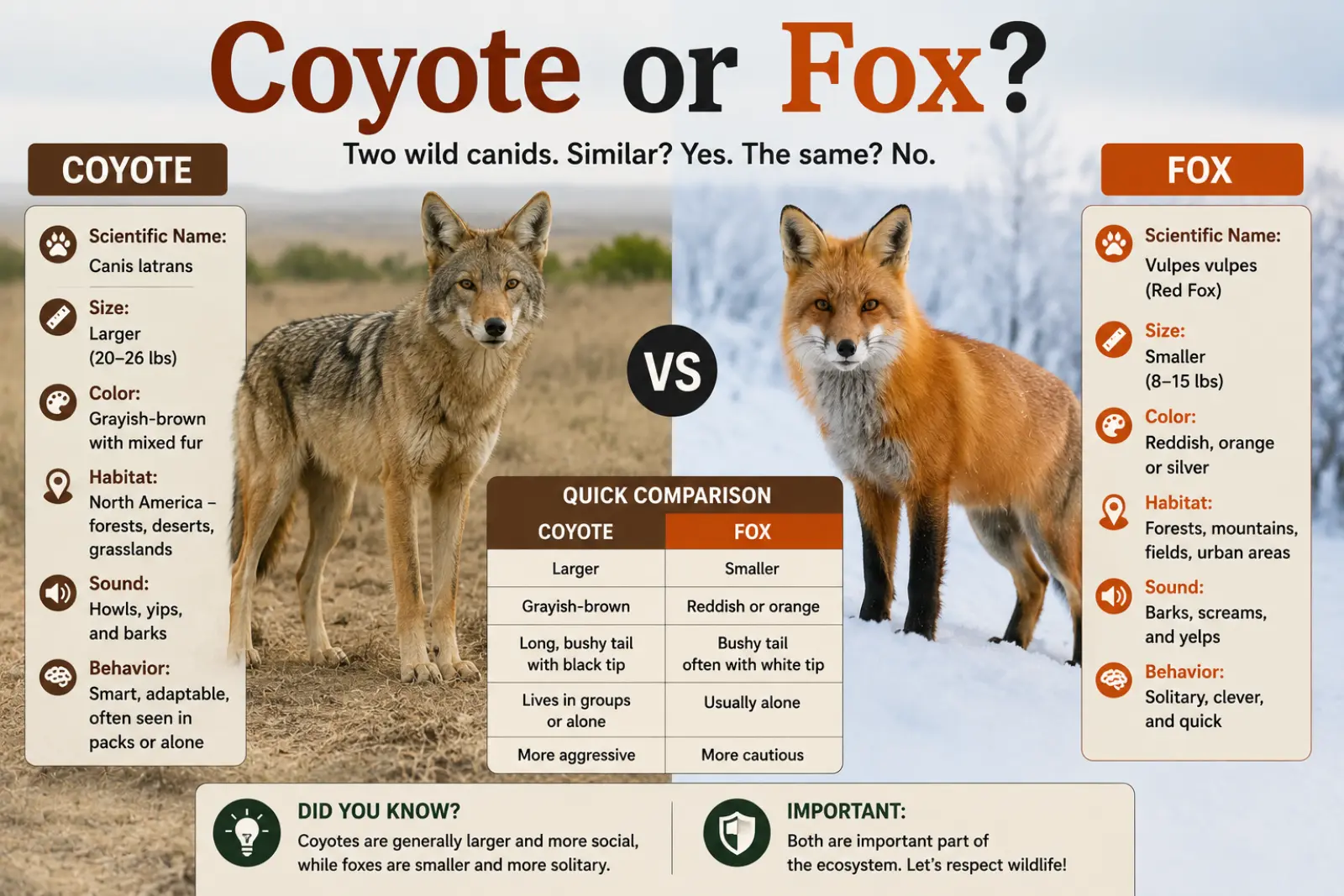
If you’ve ever spotted a wild animal with pointed ears and a bushy tail, you may have wondered whether it was a coyote or a fox. These two animals look similar at first glance, so it’s easy to confuse them. Many people search for coyote vs fox because they want to know how to tell them apart, where they live, which one is bigger, and whether they are dangerous.
This comparison is common among hikers, pet owners, wildlife lovers, students, photographers, and people living near forests or rural areas. You may also see discussions about coyotes and foxes on social media, nature documentaries, or wildlife websites.
People usually search for coyote vs fox size, appearance, behavior, diet, habitat, and which animal is more dangerous.
In this guide, you’ll learn the meaning, pronunciation, characteristics, differences, similarities, behavior, expert tips, and simple explanations in easy English.
Coyote vs Fox – Quick Answer
👉 Coyote = Larger wild canine
Coyotes are bigger, stronger, and usually hunt larger animals. They belong to the dog family and are common across North America.
👉 Fox = Smaller wild canine
Foxes are smaller, lighter, and known for their bushy tails and clever behavior. They mainly hunt small animals and insects.
Quick Examples
- ✅ A coyote crossed the road at night.
- ✅ A red fox ran across the field.
- ✅ Coyotes are generally larger than foxes.
- ✅ Foxes have shorter faces and bushier tails.
Simple Rule:
👉 Coyote = Bigger and taller.
👉 Fox = Smaller and bushier
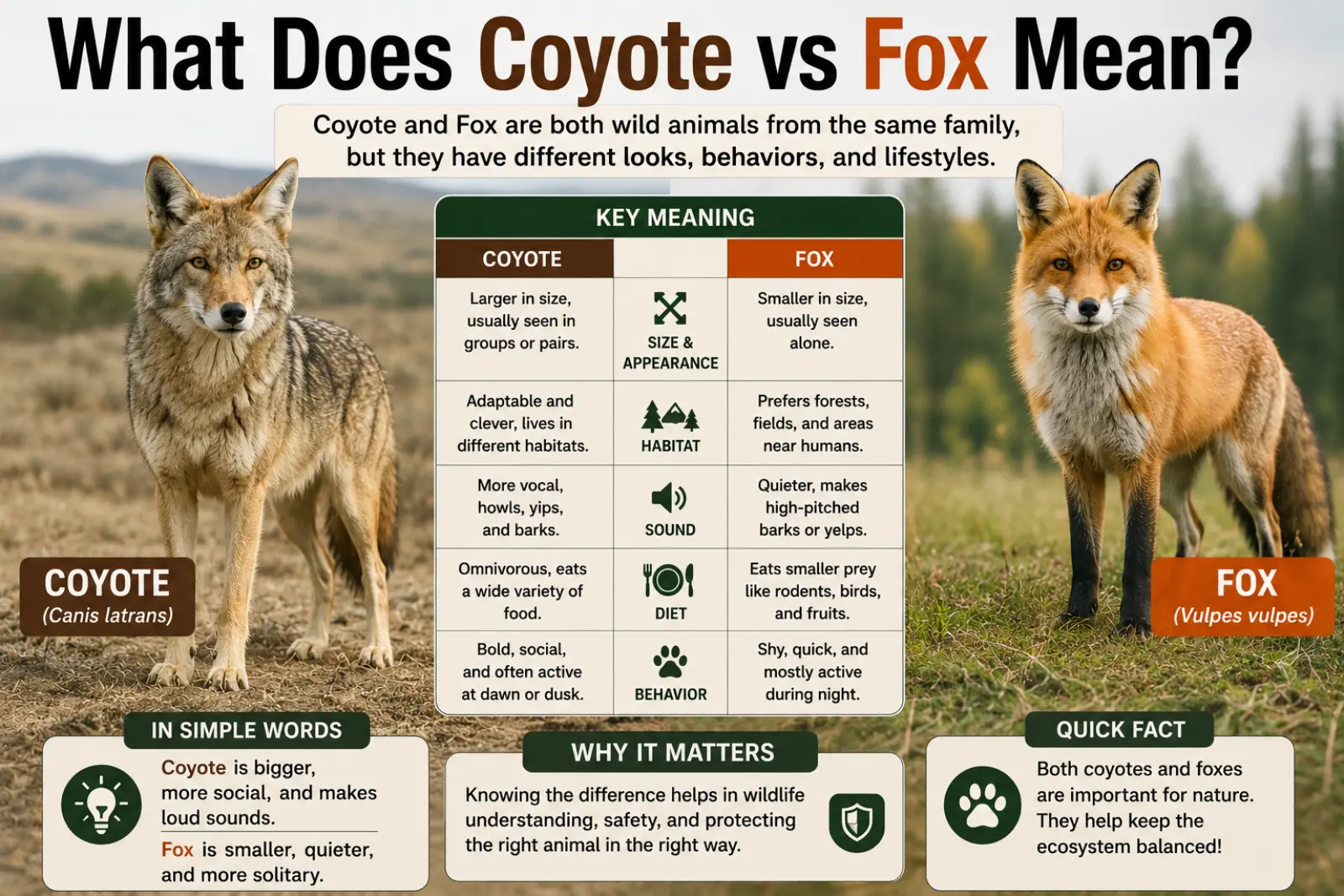
What Does Coyote vs Fox Mean?
Both coyotes and foxes are wild members of the dog family (Canidae), but they belong to different genera and have different physical features, behaviors, and habitats.
Coyote
- Larger body
- Long legs
- Narrow face
- Gray or brown fur
- Often hunts alone or in pairs
Fox
- Smaller body
- Thick, bushy tail
- Pointed face
- Red, gray, or white fur depending on species
- Usually hunts alone
Related Terms
- Wild canine
- Predator
- Mammal
- Red fox
- Gray fox
- Wildlife
The Origin of Coyotes and Foxes
The word coyote comes from the Aztec (Nahuatl) word coyotl. Coyotes have lived across North America for thousands of years.
The word fox comes from Old English fox, and foxes have appeared in stories, folklore, and myths across Europe, Asia, and North America for centuries.
How to Pronounce Coyote vs Fox
| Word | Pronunciation |
|---|---|
| Coyote | kai-OH-tee |
| Fox | foks |
Easy Tip
“Coyote” has three syllables, while “fox” has one syllable.
British English vs American English
| Feature | British English | American English | Notes |
|---|---|---|---|
| Coyote | Same | Same | Pronunciation may vary slightly |
| Fox | Same | Same | Same spelling worldwide |
Which One Should You Use?
Use coyote when referring to the larger North American wild canine.
Use fox when referring to the smaller animal with a bushy tail.
| Situation | Correct Animal |
|---|---|
| Larger wild canine | Coyote |
| Bushy-tailed animal | Fox |
| Common in fairy tales | Fox |
| Often heard howling | Coyote |
Common Mistakes with Coyote vs Fox
Mistake 1
❌ Every small wild canine is a fox.
✔ Some are actually young coyotes.
Mistake 2
❌ Coyotes and foxes are the same species.
✔ They are different species within the dog family.
Mistake 3
❌ Foxes are larger than coyotes.
✔ Coyotes are much larger.
Mistake 4
❌ Both animals hunt the same way.
✔ Coyotes often hunt larger prey, while foxes prefer smaller animals.
Mistake 5
❌ All foxes are red.
✔ Foxes come in several species and colors.
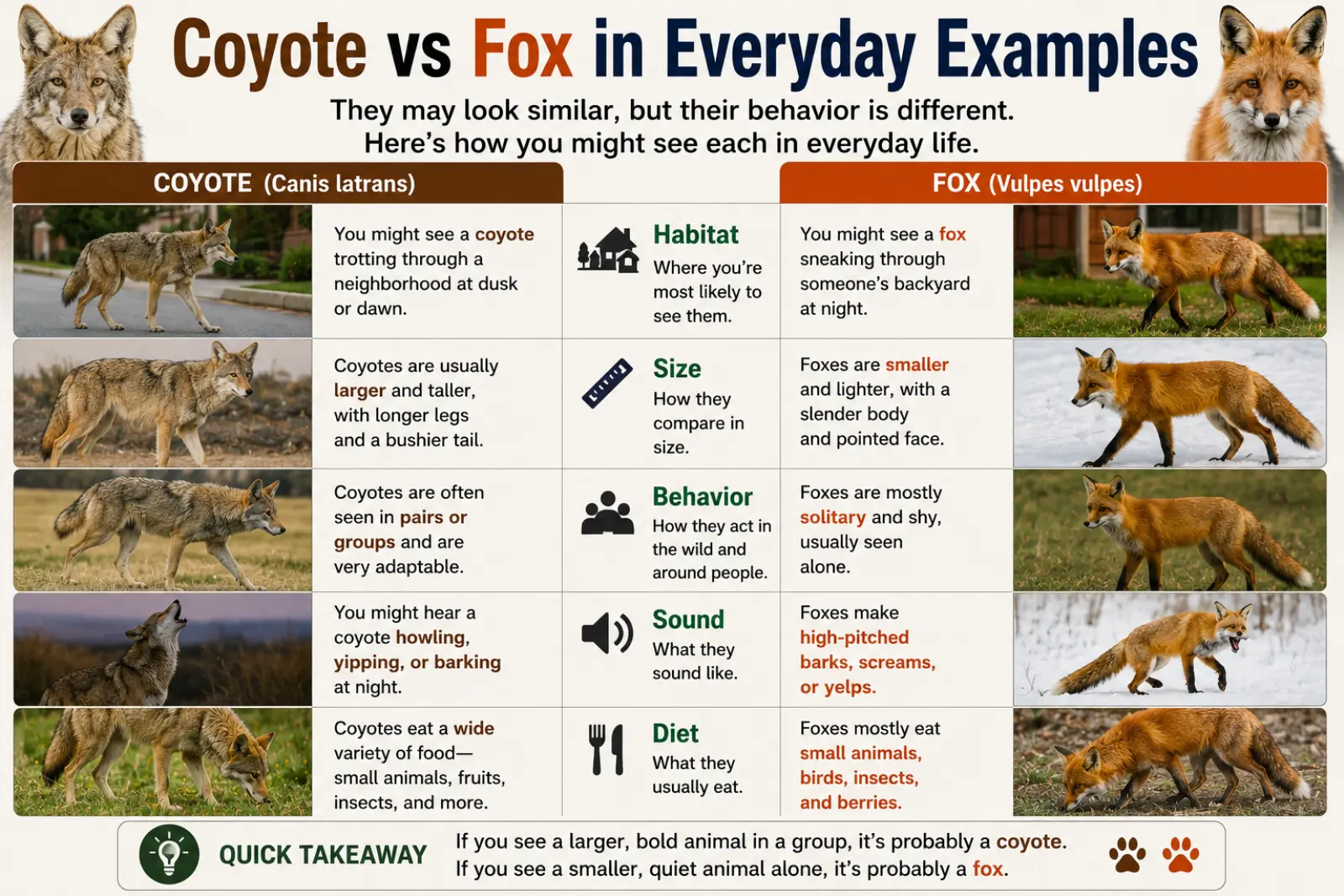
Coyote vs Fox in Everyday Examples
Nature
“We saw a coyote near the hiking trail.”
Neighborhood
“A fox was searching for food behind the houses.”
Wildlife Photography
“The photographer captured a beautiful red fox.”
Education
“Students compared coyotes and foxes in biology class.”
Coyote vs Fox in Different Contexts
Wildlife
Coyotes adapt well to cities and rural areas, while foxes prefer forests, fields, and quiet neighborhoods.
Farming
Coyotes may hunt livestock, while foxes usually target chickens, rabbits, and rodents.
Ecology
Both animals help control rodent populations and support healthy ecosystems.
Popular Culture
Foxes often symbolize intelligence, while coyotes are known for adaptability and survival.
Google Trends and Search Interest
Popular searches include:
- Coyote vs fox size
- Fox vs coyote differences
- Which is more dangerous?
- Coyote or fox identification
- Fox vs coyote tracks
- Coyote vs red fox
These searches are common in the United States, Canada, the United Kingdom, Australia, India, and Pakistan, especially among wildlife enthusiasts.
Comparison Table
| Feature | Coyote | Fox |
|---|---|---|
| Size | Larger | Smaller |
| Weight | 20–50 lbs | 6–20 lbs |
| Tail | Less bushy | Very bushy |
| Legs | Longer | Shorter |
| Diet | Rabbits, rodents, birds | Rodents, insects, fruit |
| Habitat | Forests, deserts, cities | Forests, grasslands, suburbs |
| Family | Canidae | Canidae |
Coyote vs Fox in Professional Life
Wildlife biologists, veterinarians, conservationists, and park rangers study both animals to understand ecosystems and protect native wildlife. Correct identification also helps farmers and homeowners respond appropriately to local wildlife.
Coyote vs Fox for Students
A quick way to tell them apart:
- Coyote = Bigger, taller, longer legs
- Fox = Smaller, bushier tail, shorter body
Simple Trick to Remember
Think of it this way:
A coyote looks like a slim wild dog, while a fox looks like a small dog with a fluffy tail.
Expert Tips
- Look at the tail first. Foxes usually have a much bushier tail.
- Compare body size. Coyotes are noticeably larger.
- Watch how they move. Coyotes have a longer stride.
- Never approach wild animals, even if they seem calm.
Related Searches People Also Ask
- Is a coyote bigger than a fox?
- Can coyotes and foxes live together?
- Which is more dangerous?
- What do coyotes eat?
- What do foxes eat?
- How can you tell a fox from a coyote?
- Do coyotes attack pets?
- Are foxes aggressive?
- Where do coyotes live?
- Where do foxes live?
FAQs
Is a coyote larger than a fox?
Yes. Coyotes are much larger and heavier.
Are coyotes and foxes related?
Yes. Both belong to the dog family, but they are different species.
Which animal is more dangerous?
Coyotes are generally stronger and can pose a greater risk to small pets.
Do foxes attack humans?
Healthy foxes rarely attack people.
Can both animals live near cities?
Yes. Both have adapted to urban and suburban environments.
Which has the bushier tail?
Foxes have much bushier tails than coyotes.
Are coyotes faster than foxes?
Yes. Coyotes can run faster over long distances.
Which is easier to recognize?
Look at the size and tail. Coyotes are bigger, while foxes are smaller with fluffy tails.
Final Verdict
Both coyotes and foxes are fascinating wild animals, but they are not the same. Coyotes are larger, stronger, and more dog-like, while foxes are smaller, lighter, and famous for their bushy tails.
Conclusion
Understanding coyote vs fox is easier once you compare their size, appearance, behavior, and habitat. If you remember one simple rule, you’ll rarely confuse them again.
Easy Memory Trick: Coyote = Bigger body. Fox = Fluffy tail.

Camila Green is an English language writer who specializes in confusing word comparisons and spelling explanations. She creates simple, beginner-friendly guides on topics like “niece or neice” and other common English mistakes. Her writing focuses on clarity, real-life examples, and easy learning. At VerrsaPick, she helps readers improve their English with practical and engaging content.