You are writing a sentence and suddenly stop at a punctuation mark. Should you use a colon (:) or a semicolon (;)? They look similar, but they do very different jobs.
This is a common problem for students, bloggers, email writers, and even people who use English every day. The confusion usually happens because both marks can connect ideas, but the relationship between those ideas is not the same.
People usually search for colon or semicolon to understand the meaning, correct usage, grammar difference, examples, and simple rules. You may see both marks in school assignments, workplace emails, articles, books, websites, and online writing.
The good news is that you do not need to memorize complicated grammar rules. Once you understand what each punctuation mark is trying to do, the difference becomes much easier.
In this guide, you’ll learn the meaning, pronunciation, examples, usage, grammar rules, common mistakes, expert tips, and simple explanations in easy English.
Colon or Semicolon – Quick Answer
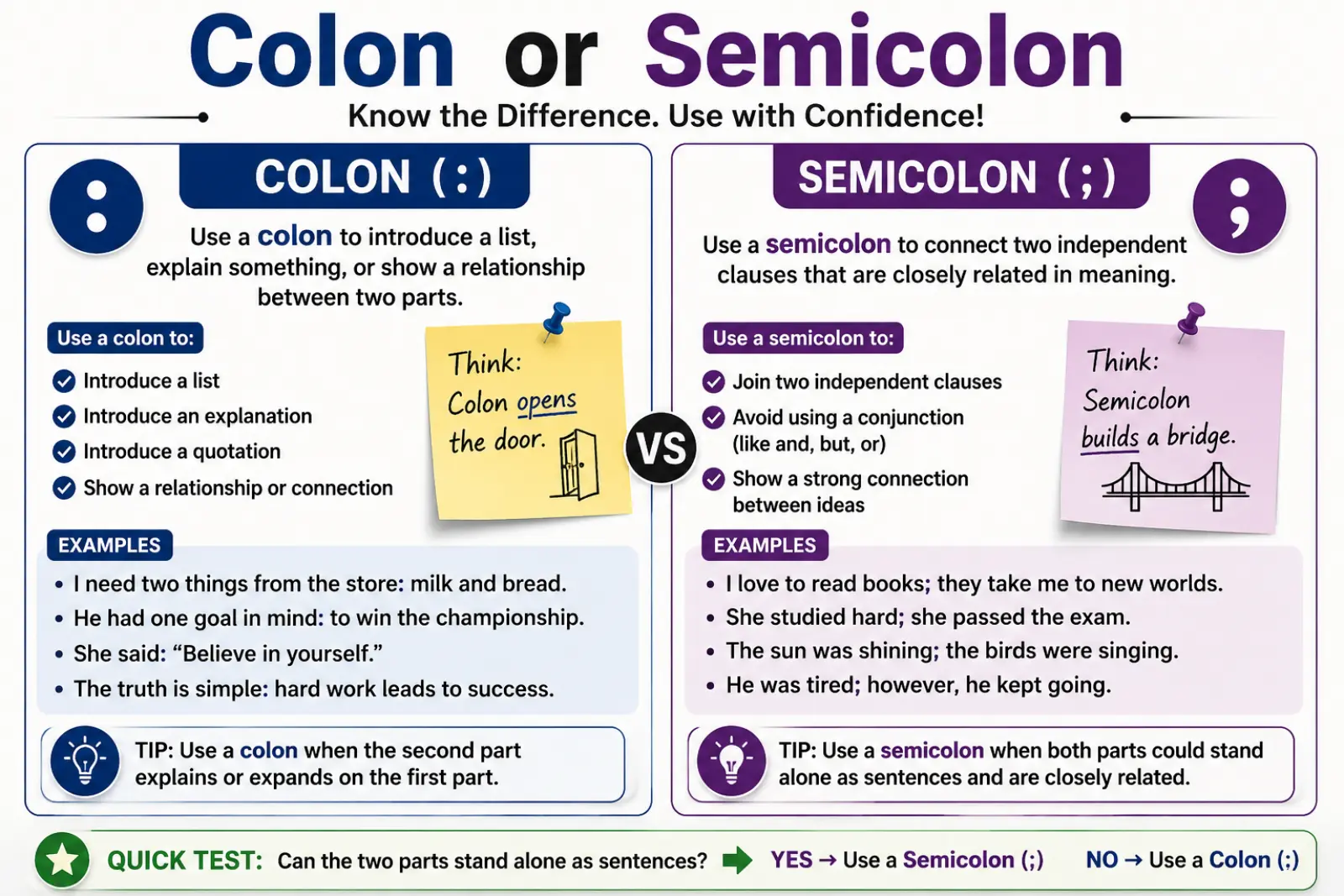
👉 Colon (:) = introduces something that explains, describes, or lists what came before it.
👉 Semicolon (;) = connects two closely related complete sentences.
Examples
Colon:
I need three things: a pen, paper, and a notebook.
Semicolon:
I was tired; I finished my homework anyway.
Colon:
She had one goal: to win.
Semicolon:
The weather was cold; we still went outside.
Simple Rule
👉 Colon = “Here comes an explanation or list.”
👉 Semicolon = “These two complete thoughts belong together.”
What Does Colon or Semicolon Mean?
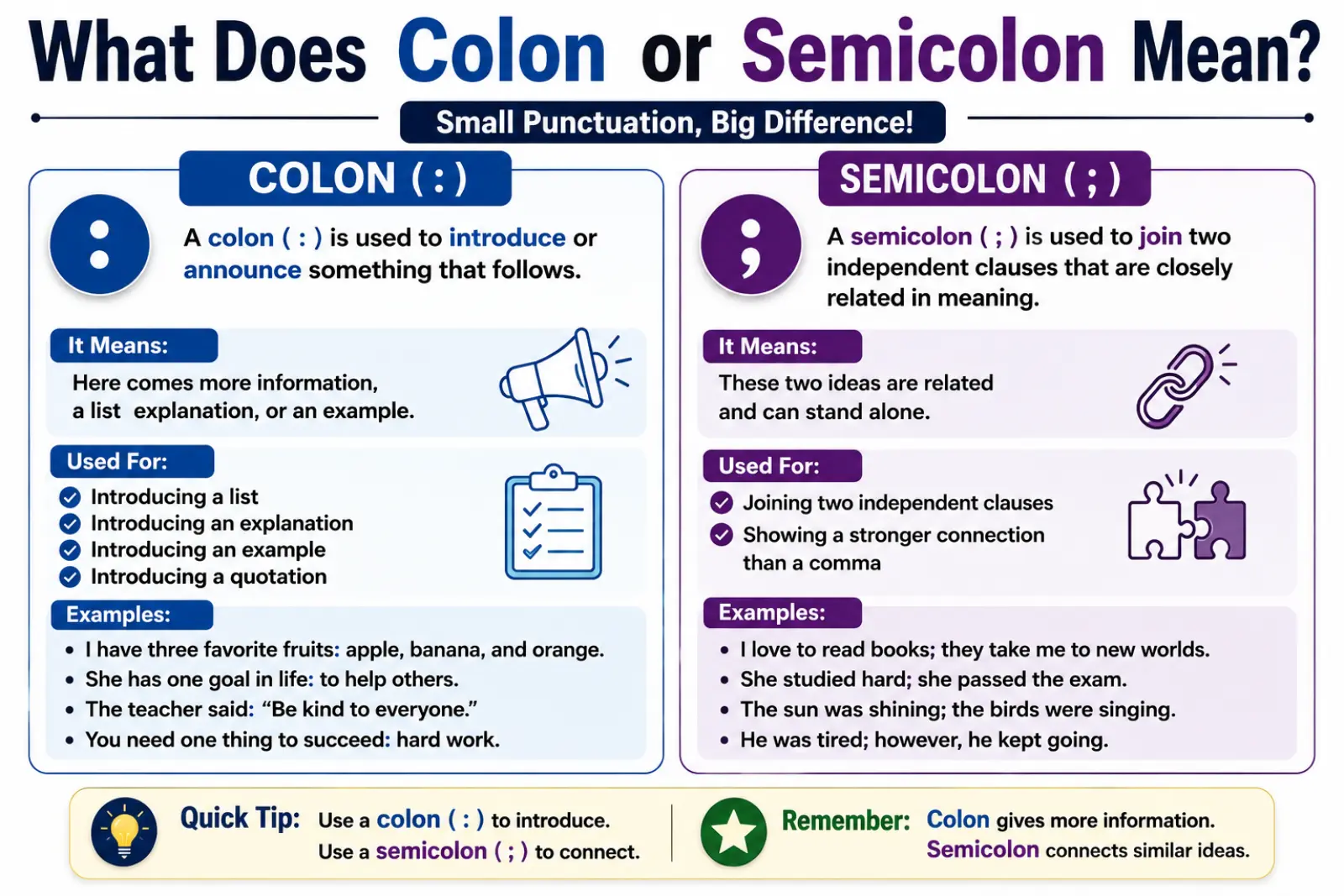
A colon (:) is punctuation used to introduce information that follows from the first part of a sentence. It often introduces a list, explanation, example, or important detail.
A semicolon (;) is punctuation used mainly to connect two closely related independent clauses.
Colon Examples
- Bring these items: water, food, and a jacket.
- She knew one thing: she had to try.
- There is one reason I stayed: my family needed me.
Semicolon Examples
- I wanted to call you; my phone was dead.
- He studied hard; he passed the exam.
- The store was closed; we went home.
Related Terms
- punctuation
- sentence structure
- independent clause
- dependent clause
- list
- explanation
- complete sentence
- grammar
The Origin of Colon and Semicolon
The colon and semicolon have a long history in written language. They developed as punctuation marks to help readers understand pauses and relationships between ideas.
The colon has traditionally been used to introduce or explain something that follows.
The semicolon developed as a middle point between a comma and a full stop. It allows writers to connect closely related ideas without making them separate sentences.
Today, both marks are common in English writing, including academic work, business communication, books, journalism, websites, and professional documents.
How to Pronounce Colon or Semicolon
The word colon is pronounced:
KOH-lun
It has two syllables: co-lon.
The word semicolon is pronounced:
SEM-ee-KOH-lun
It has four syllables: sem-i-co-lon.
The punctuation marks themselves are:
- Colon: :
- Semicolon: ;
British English vs American English Usage
There is very little difference between British and American English when it comes to the basic grammar rules for colons and semicolons.
| Feature | British English | American English | Notes |
|---|---|---|---|
| Colon | : | : | Same basic use |
| Semicolon | ; | ; | Same basic use |
| Lists | Common | Common | Rules can vary by style |
| Formal writing | Common | Common | Both are accepted |
| Grammar role | Similar | Similar | No major difference |
The key rules are generally the same in the US, UK, Canada, Australia, India, and Pakistan.
Which One Should You Use?
Use a colon when the second part explains, expands, or lists something from the first part.
Example:
I bought four things: milk, bread, eggs, and rice.
Use a semicolon when you have two complete and closely related sentences.
Example:
I bought the groceries; my brother cooked dinner.
Quick Usage Table
| Use | Punctuation | Example |
|---|---|---|
| Introduce a list | Colon | I need three things: paper, pens, and books. |
| Introduce an explanation | Colon | She had one plan: leave early. |
| Connect related sentences | Semicolon | It was late; we went home. |
| Separate complex list items | Semicolon | We visited Paris, France; Rome, Italy; and Madrid, Spain. |
Common Mistakes With Colon or Semicolon
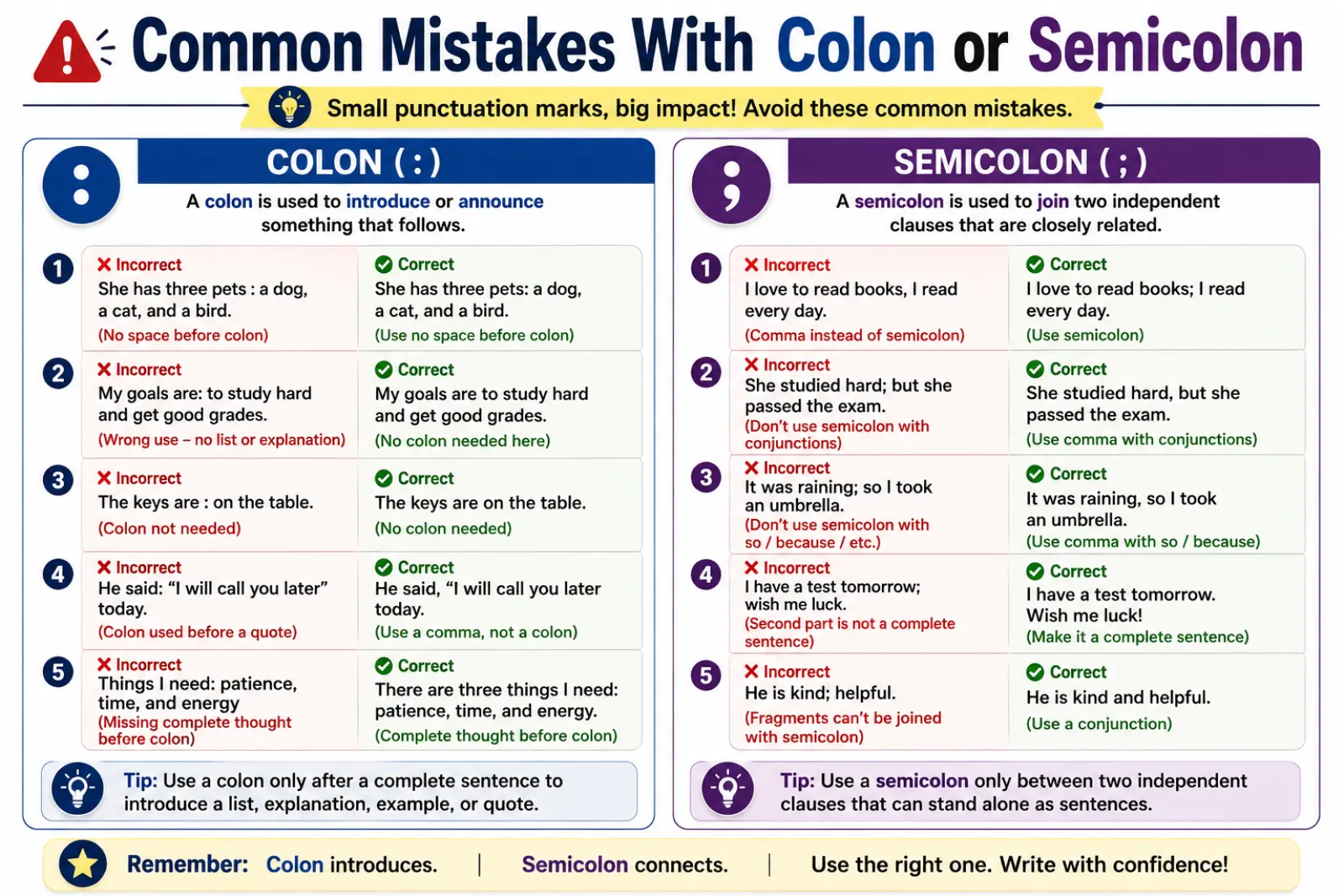
Mistake 1: Using a semicolon before a simple list
❌ I bought three things; bread, milk, and eggs.
✔ I bought three things: bread, milk, and eggs.
The colon introduces the list.
Mistake 2: Using a colon between two normal sentences
❌ I was tired: I went to bed.
✔ I was tired; I went to bed.
A semicolon works because both sides are complete thoughts.
Mistake 3: Using a semicolon after a dependent clause
❌ Because I was tired; I went home.
✔ Because I was tired, I went home.
The first part cannot stand alone as a complete sentence.
Mistake 4: Using a comma where a semicolon is needed
❌ I finished my work, I went home.
✔ I finished my work; I went home.
The semicolon correctly joins the two complete thoughts.
Mistake 5: Using both marks randomly
❌ My plan is simple; to study every day.
✔ My plan is simple: to study every day.
The second part explains the first, so a colon is better.
Colon or Semicolon in Everyday Examples
Work:
The meeting has one goal: finish the project plan.
School:
I studied three subjects: English, science, and history.
Email:
Please bring the following items: your ID, notebook, and laptop.
Daily Life:
I had one problem: my car would not start.
Conversation:
I knew what I had to do: stay calm.
Online Content:
Here are five useful tips: plan, write, edit, check, and publish.
Complex List:
We visited Lahore, Pakistan; London, UK; and Toronto, Canada.
Colon or Semicolon in Different Contexts
Academic Writing
Colons are useful for introducing examples, explanations, and lists.
Semicolons help connect related academic ideas.
Example:
The study found one clear result: regular practice improves writing.
Business Writing
A colon can make emails and reports easier to scan.
Example:
Please complete these tasks: review the report, check the figures, and send the final copy.
A semicolon can connect closely related business statements.
Example:
The deadline is tomorrow; please send your work today.
Grammar Learning
For beginners, remember the basic difference:
Colon = introduce.
Semicolon = connect.
That simple idea will solve many punctuation problems.
Colon vs Semicolon Comparison Table
| Feature | Colon (:) | Semicolon (;) |
|---|---|---|
| Main job | Introduces information | Connects related ideas |
| Common use | Lists and explanations | Two complete sentences |
| Connects two clauses | Sometimes | Yes |
| Introduces a list | Yes | Sometimes in complex lists |
| Needs complete sentence before it? | Usually | Yes |
| Example | I need one thing: help. | I need help; I am confused. |
Colon or Semicolon in Professional Life
Good punctuation can make business writing clearer and easier to understand.
Use a colon when introducing important information:
Project goals: improve quality, reduce delays, and increase customer satisfaction.
Use a semicolon to connect related professional ideas:
The report is ready; the manager will review it today.
In professional writing, clarity matters more than trying to sound complicated. A simple punctuation rule can make your message much easier to read.
Colon or Semicolon for Students and Beginners
Students often confuse these marks because both can create a pause in a sentence.
Do not choose punctuation based only on how long the pause sounds.
Instead, look at the grammar.
Ask:
Am I introducing something?
Use a colon.
Am I connecting two complete, related sentences?
Use a semicolon.
Example
I have one wish: to travel the world.
The first part introduces the information after the colon.
I wanted to travel; I had no money.
Both sides can stand as complete sentences, so the semicolon works.
Signs, Characteristics, and Common Uses of Colon and Semicolon
Colon is commonly used for:
- lists
- explanations
- examples
- definitions
- quotations in some contexts
- subtitles
- introducing important details
Semicolon is commonly used for:
- connecting related independent clauses
- replacing a conjunction in some sentences
- separating complicated list items
- showing a strong connection between ideas
Simple Trick to Remember Colon or Semicolon
Think of a colon as a pointing finger.
It says:
👉 “Look at what comes next.”
Example:
I need one thing: sleep.
The colon points toward the explanation.
Now think of a semicolon as a bridge.
It connects two complete thoughts:
I was tired; I kept working.
Memory Shortcut
Colon = introduce.
Semicolon = connect.
If you remember those two words, you can usually choose the correct mark.
Expert Tips for Using Colon or Semicolon
- Check what comes before the punctuation.
- Use a colon to introduce a list or explanation.
- Use a semicolon between two closely related complete sentences.
- Do not use a semicolon after a dependent clause.
- Avoid using punctuation only because you want a longer pause.
- Read the sentence aloud, then check its grammar.
- When unsure, two simple sentences are often better than a complicated one.
Related Searches People Also Ask
- What is the difference between a colon and semicolon?
A colon introduces information, while a semicolon connects closely related complete thoughts. - When should I use a colon?
Use a colon before a list, explanation, or important detail. - When should I use a semicolon?
Use it mainly between two closely related independent clauses. - Can a semicolon replace a comma?
Sometimes, especially when joining two independent clauses. - Can a colon join two sentences?
It can introduce an explanation or result, but it does not work exactly like a semicolon. - What is the easiest way to remember colon vs semicolon?
Think colon = introduce and semicolon = connect.
FAQs About Colon or Semicolon
What is the main difference between a colon and semicolon?
A colon introduces information. A semicolon connects two closely related complete thoughts.
Is a colon stronger than a comma?
A colon has a specific grammar job. It is often used to introduce information that follows.
Can I use a semicolon before a list?
Usually, a colon is better for a simple list. Semicolons can separate items in a complicated list when the items already contain commas.
Do I capitalize after a colon?
Usually, no. However, capitalization can depend on the sentence structure and style guide.
Do I capitalize after a semicolon?
Normally, no. The word after a semicolon is usually lowercase unless it is a proper noun.
Is a semicolon a full stop?
No. A semicolon creates a stronger break than a comma but keeps closely related ideas connected.
Can a colon introduce an example?
Yes. A colon can introduce an example, explanation, or list.
Why do people confuse colon and semicolon?
Both marks show a pause and connect parts of writing, but their grammar roles are different.
Final Verdict
Colon (:) and semicolon (;) are both useful punctuation marks, but they have different jobs.
👉 Colon = introduces a list, explanation, or important detail.
👉 Semicolon = connects two closely related complete sentences.
Example:
I packed three things: food, water, and a jacket.
Example:
It was raining; we stayed inside.
Conclusion
Understanding colon or semicolon does not have to be difficult. You simply need to focus on the relationship between the ideas in your sentence.
When the second part gives a list, explanation, or detail, a colon is usually the right choice. When two complete and closely related thoughts need to stay connected, a semicolon is usually better.
The easiest memory trick is simple:
Colon = introduce. Semicolon = connect.
Once that rule becomes familiar, choosing between these two punctuation marks will feel much more natural.

Camila Green is an English language writer who specializes in confusing word comparisons and spelling explanations. She creates simple, beginner-friendly guides on topics like “niece or neice” and other common English mistakes. Her writing focuses on clarity, real-life examples, and easy learning. At VerrsaPick, she helps readers improve their English with practical and engaging content.