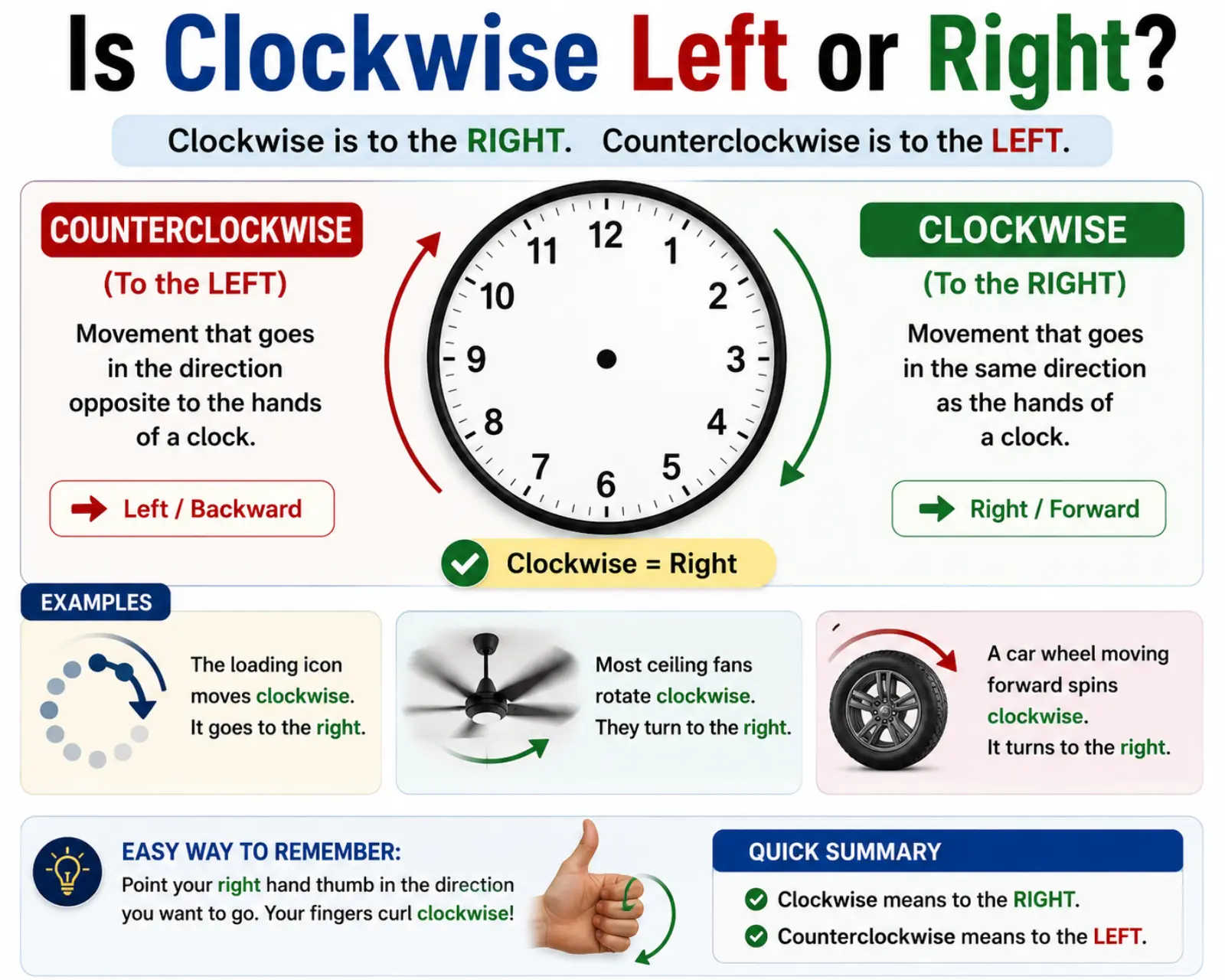
Have you ever looked at a clock, turned a knob, or followed a direction and suddenly wondered, is clockwise left or right? This is a very common question, especially for beginners learning directions, maps, machines, and everyday instructions.
The confusion usually happens because clockwise does not simply mean left or right. It describes the direction something moves around a fixed center, based on the numbers on a traditional clock. If you watch the hands of a clock, they move from 12 to 1, then 2, 3, 4, and so on. That movement is called clockwise.
People usually search for this topic because they want the simple meaning, a clear visual explanation, real-life examples, or an easy way to remember the difference between clockwise and counterclockwise.
You may see these directions in school, sports, fitness, construction, technology, gaming, cooking instructions, machinery, maps, and daily conversations. Understanding them correctly can prevent mistakes when someone tells you to turn, rotate, twist, or move something.
The good news is that the rule is very easy once you connect it to a clock.
In this guide, you’ll learn the meaning, pronunciation, examples, usage, grammar rules, common mistakes, expert tips, and simple explanations in easy English.
Is Clockwise Left or Right? Quick Answer
Clockwise usually means moving to the right around a center point, following the direction of a clock’s hands.
👉 Clockwise = the same direction as clock hands
👉 Counterclockwise = the opposite direction of clock hands
For example:
- A clock hand moves from 12 → 1 → 2 → 3. That is clockwise.
- Turning a bottle cap in that same circular direction is clockwise.
- Turning a dial from 12 toward 1 is clockwise.
- Moving from 6 toward 7 on a clock face is clockwise.
Simple Rule
👉 Clockwise follows the clock.
Think about the numbers on a clock. Start at 12 and move toward 1. You are moving around the circle in the clockwise direction.
What Does Clockwise Mean?
Clockwise describes circular movement in the same direction as the hands of a traditional clock.
It does not always mean simply “right.” Instead, it describes movement around a central point.
For example, if you stand in front of a round dial, clockwise movement goes from the top toward the right side, then down, then toward the left, and finally back to the top.
The opposite direction is called counterclockwise or anticlockwise.
Clockwise vs Counterclockwise
| Direction | Meaning | Easy Example |
|---|---|---|
| Clockwise | Same direction as clock hands | 12 → 1 → 2 |
| Counterclockwise | Opposite direction | 12 → 11 → 10 |
| Right | A side or direction | Your right hand |
| Left | A side or direction | Your left hand |
This is why saying “clockwise means right” is only a useful shortcut. It is more accurate to say that clockwise follows the circular path of a clock’s hands.
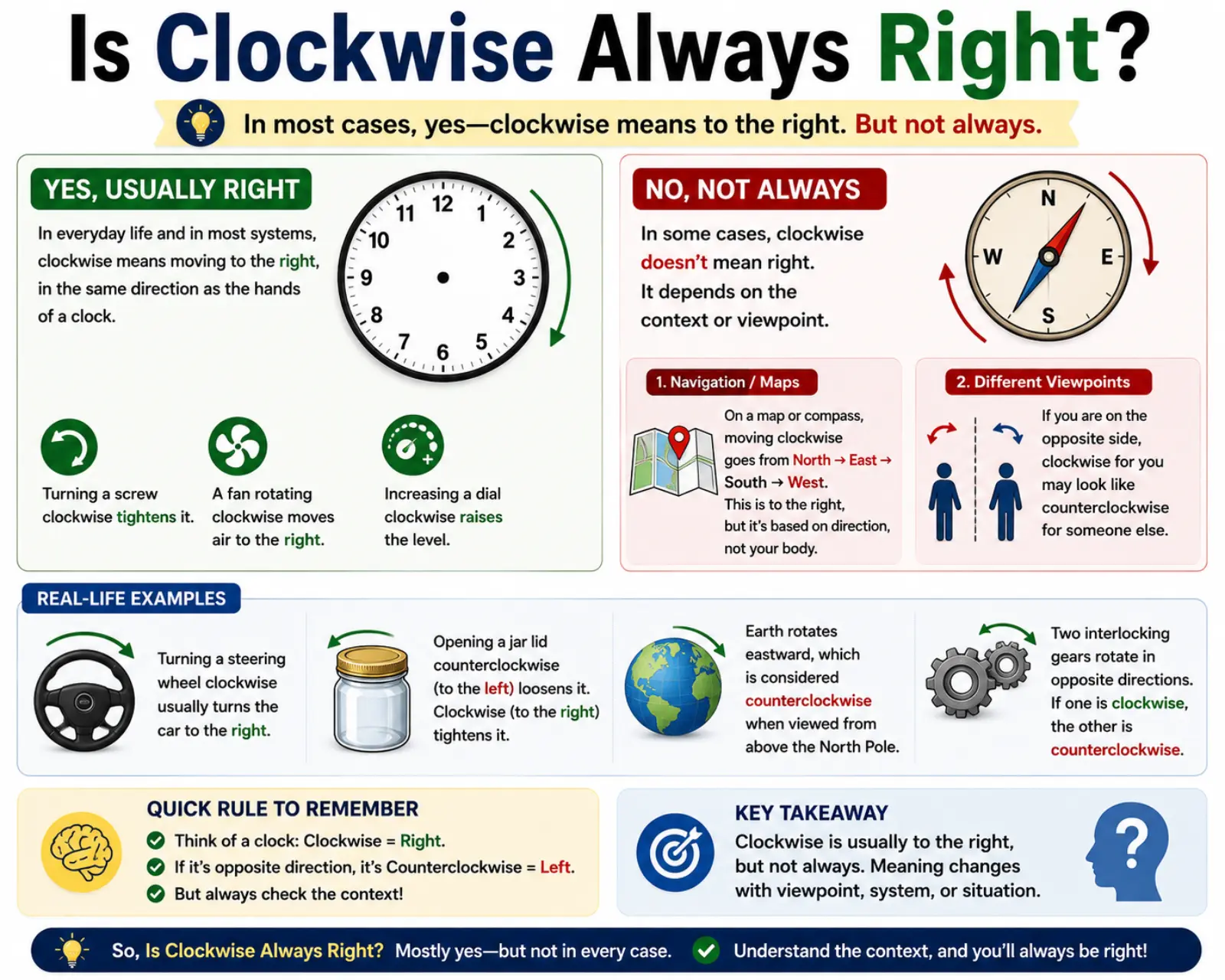
Is Clockwise Always Right?
Not exactly.
At the top of a clock, clockwise movement initially goes toward the right. At the bottom, however, the same circular movement goes toward the left.
For example:
12 → 1 → 2 → 3 → 4 → 5 → 6
The movement begins toward the right side but eventually moves downward.
So, if someone asks, “Is clockwise left or right?” the safest answer is:
Clockwise is the direction that follows a clock’s hands. At the top of a clock, this movement goes toward the right.
This explanation works better than simply memorizing “clockwise equals right.”
How to Remember Clockwise Easily
Use a real clock or imagine one.
Start at 12.
Now move:
12 → 1 → 2 → 3 → 4 → 5 → 6
That is clockwise.
For the opposite direction:
12 → 11 → 10 → 9 → 8 → 7 → 6
That is counterclockwise.
Think of it this way:
Clock = clockwise.
If your movement follows the hands of a clock, it is clockwise.
If your movement goes against the hands, it is counterclockwise.
Clockwise and Counterclockwise in Everyday Examples
Clockwise directions appear in many everyday situations.
Turning a Doorknob
Someone may tell you to turn a knob clockwise. Look at the knob from your position and rotate it in the same circular direction as a clock hand.
Opening or Closing a Lid
Many lids and caps use circular movements. Instructions may say:
Turn clockwise to tighten.
Turn counterclockwise to loosen.
This is common with bottles, jars, containers, and equipment.
Turning a Dial
A volume knob or control dial may increase when turned clockwise.
For example:
Turn the dial clockwise to increase the temperature.
Using a Screw
Many screws are tightened by turning them clockwise.
A common memory phrase is:
Righty-tighty, lefty-loosey.
However, this is a general rule, not a replacement for checking the instructions for special cases.
Clockwise in School and Learning
Students often meet clockwise and counterclockwise in mathematics, science, geography, and physical activities.
Teachers may ask students to:
- Rotate an object clockwise.
- Draw a clockwise arrow.
- Move around a circle clockwise.
- Turn a shape clockwise.
- Identify clockwise rotation.
- Compare clockwise and counterclockwise movement.
For young learners, using a clock face is one of the easiest teaching methods.
For example:
Rotate the triangle 90 degrees clockwise.
This means rotate the triangle in the same direction as the hands of a clock.
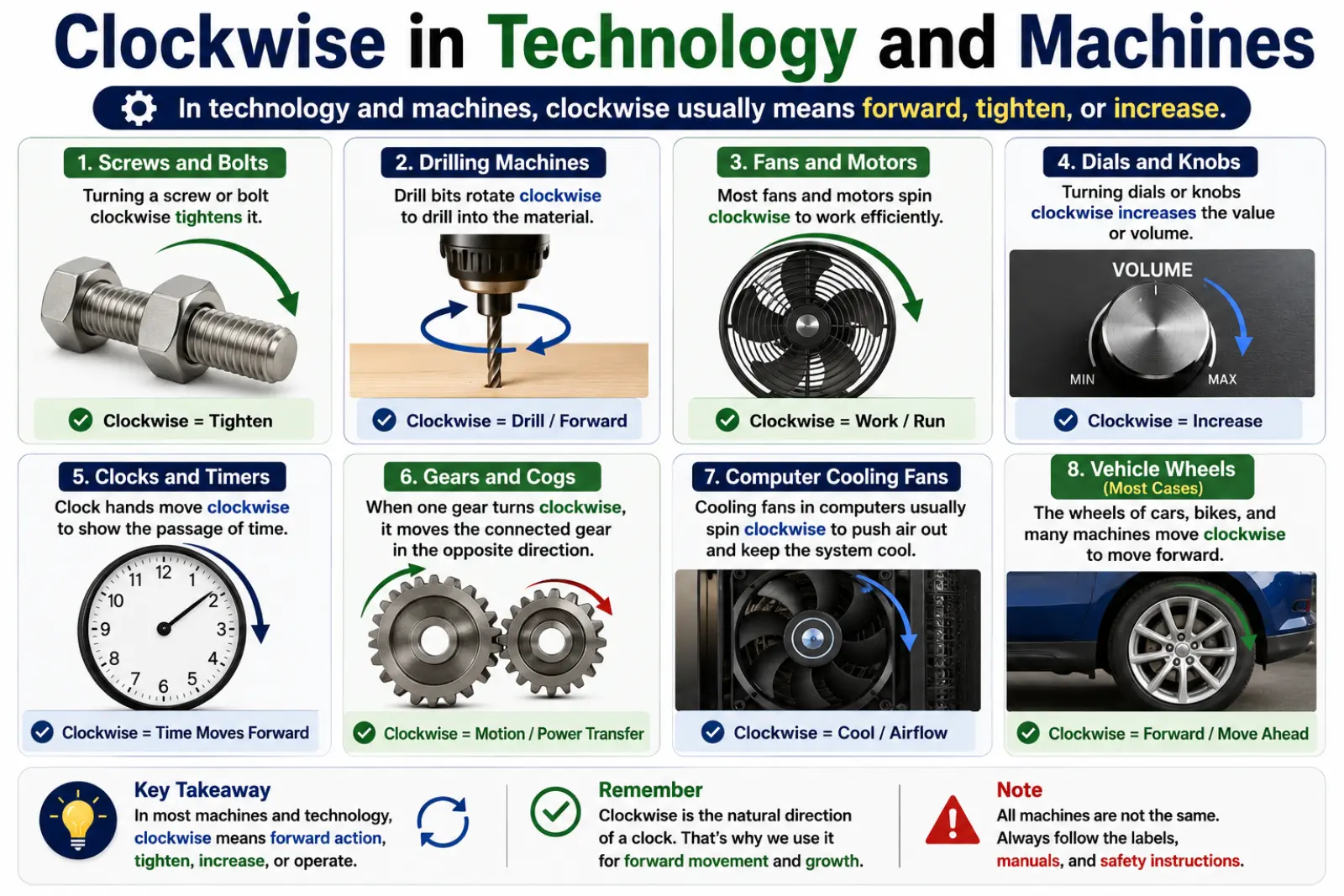
Clockwise in Technology and Machines
The word is also common in technology and mechanical instructions.
You may see it when using:
- Knobs
- Valves
- Gears
- Dials
- Screws
- Fans
- Mechanical controls
- Camera controls
- Industrial equipment
A machine might say:
Turn the control clockwise to increase the setting.
The exact result can vary by device, so users should follow the product instructions instead of assuming that clockwise always means increase.
British English vs American English Usage
There is no major difference in the basic meaning of clockwise in British and American English.
| Feature | British English | American English | Notes |
|---|---|---|---|
| Clockwise | Clockwise | Clockwise | Same meaning |
| Opposite direction | Anticlockwise | Counterclockwise | Both forms are understood |
| Pronunciation | Similar | Similar | Minor accent differences |
| Formal writing | Common | Common | Widely accepted |
| Everyday speech | Common | Common | Very natural |
The biggest vocabulary difference is usually anticlockwise versus counterclockwise.
Both describe movement opposite to the direction of a clock.
Common Mistakes With Clockwise
Mistake 1: Thinking clockwise always means moving right
❌ Clockwise always means move right.
✔ Clockwise means move in the same direction as a clock’s hands.
Tip: Think about the complete circle, not only one side of it.
Mistake 2: Confusing clockwise with counterclockwise
❌ Moving from 12 to 11 is clockwise.
✔ Moving from 12 to 11 is counterclockwise.
Tip: Clockwise from 12 goes toward 1.
Mistake 3: Using your own body as the reference
People sometimes decide clockwise based on their left or right hand.
✔ Use the clock face as the main reference.
This makes the direction much easier to understand.
Mistake 4: Assuming clockwise always means turning something right
Clockwise describes circular movement. The correct physical action can depend on where you are standing and what object you are looking at.
Mistake 5: Forgetting the starting point
When following directions, identify the object and viewpoint first.
For example, “turn clockwise” means rotate around the object’s center in the clock-hand direction.
Clockwise or Counterclockwise Comparison
| Feature | Clockwise | Counterclockwise |
|---|---|---|
| Follows clock hands | Yes | No |
| Starts from 12 | Toward 1 | Toward 11 |
| Circular direction | Clock-hand direction | Opposite direction |
| Common use | Turning, rotating, directions | Reverse rotation |
| Easy memory | Follow the clock | Go against the clock |
Is Clockwise Left or Right in Different Contexts?
The answer can feel different depending on the situation.
On a Clock Face
Clockwise from 12 moves toward the right.
When Rotating an Object
Clockwise means the object follows the same circular direction as a clock.
In Mathematics
Clockwise describes the direction of rotation around a point.
In Sports
An instructor may tell players to move around a circle clockwise. This means follow the direction of clock hands.
In Gaming
Games may use clockwise rotation for wheels, maps, controls, or circular menus.
In Technology
Clockwise can describe turning buttons, dials, knobs, or mechanical parts.
Why Do People Search “Is Clockwise Left or Right?”
This question is popular because left and right are not the same type of direction as clockwise and counterclockwise.
Left and right normally depend on a person’s viewpoint.
Clockwise depends on a circular reference.
That difference causes confusion for children, English learners, drivers, students, gamers, and people following instructions.
Related searches often include:
- Is clockwise right or left?
- Which way is clockwise?
- What direction is clockwise?
- Is clockwise to the right?
- What does clockwise mean?
- Which way do you turn clockwise?
- What is the opposite of clockwise?
- Is anticlockwise the same as counterclockwise?
- How do I remember clockwise?
- Does clockwise mean right?
Expert Tips for Remembering Clockwise
Here are three simple tricks.
1. Follow the clock
Imagine the second hand moving around a clock.
2. Start at 12
If you move from 12 toward 1, you are going clockwise.
3. Use the word itself
The word clockwise contains clock.
So remember:
Clock → clock hands → clockwise.
For the opposite direction, think:
Against the clock → counterclockwise.
FAQs About Is Clockwise Left or Right
Is clockwise left or right?
Clockwise follows the direction of clock hands. At the top of a clock, it moves toward the right.
Which way does clockwise go?
Starting at 12, clockwise goes toward 1, then 2, 3, 4, and so on.
Is counterclockwise the opposite of clockwise?
Yes. Counterclockwise moves opposite to the direction of traditional clock hands.
Is clockwise always to the right?
No. Clockwise is a circular direction. It is not simply the same thing as right.
How can I remember clockwise?
Imagine a clock. Start at 12 and follow the numbers toward 1. That movement is clockwise.
What is another word for counterclockwise?
Anticlockwise is commonly used, especially in British English. Counterclockwise is common in American English.
Is clockwise the same everywhere?
Yes. The basic meaning of clockwise is the same across countries and English varieties.
Does clockwise mean turn right?
It can describe a turning motion that begins toward the right from the top of a circular object, but clockwise itself means following the clock-hand direction.
Final Verdict: Is Clockwise Left or Right?
Clockwise is not simply left or right. It means moving in the same direction as the hands of a clock.
The easiest rule is:
👉 12 → 1 → 2 → 3 = clockwise
👉 12 → 11 → 10 → 9 = counterclockwise
So, if you ever forget, picture a clock. Follow the clock hands, and you are going clockwise.
Conclusion
The question is clockwise left or right becomes much easier when you stop thinking only about left and right.
Clockwise is a circular direction. It follows the movement of a traditional clock’s hands. Starting at 12, clockwise moves toward 1, 2, and 3. Counterclockwise moves toward 11, 10, and 9.
You can use this simple idea when reading instructions, turning a dial, studying math, operating equipment, playing games, or giving directions.
Final memory trick: Clockwise follows the clock. Start at 12 and go toward 1.

Camila Green is an English language writer who specializes in confusing word comparisons and spelling explanations. She creates simple, beginner-friendly guides on topics like “niece or neice” and other common English mistakes. Her writing focuses on clarity, real-life examples, and easy learning. At VerrsaPick, she helps readers improve their English with practical and engaging content.