Have you ever written a sentence about an injury, a cut, or something that happened earlier and wondered about the past tense of bleed? This is a common question for English learners because bleed does not follow the usual “add ed” pattern.
The good news is that the answer is simple. The past tense of bleed is bled. You do not say “bleeded” in standard English.
For example, you can say, “The cut bled for several minutes.” You can also use bled when talking about past events in stories, school writing, medical descriptions, everyday conversations, and online content.
People usually search for the past tense of bleed, its meaning, pronunciation, examples, usage, definition, and grammar difference. They may also ask, “Is bleed a regular or irregular verb?” or “Is it bleed, bled, or bleeded?”
In this guide, you’ll learn the meaning, pronunciation, examples, usage, grammar rules, common mistakes, expert tips, and simple explanations in easy English.
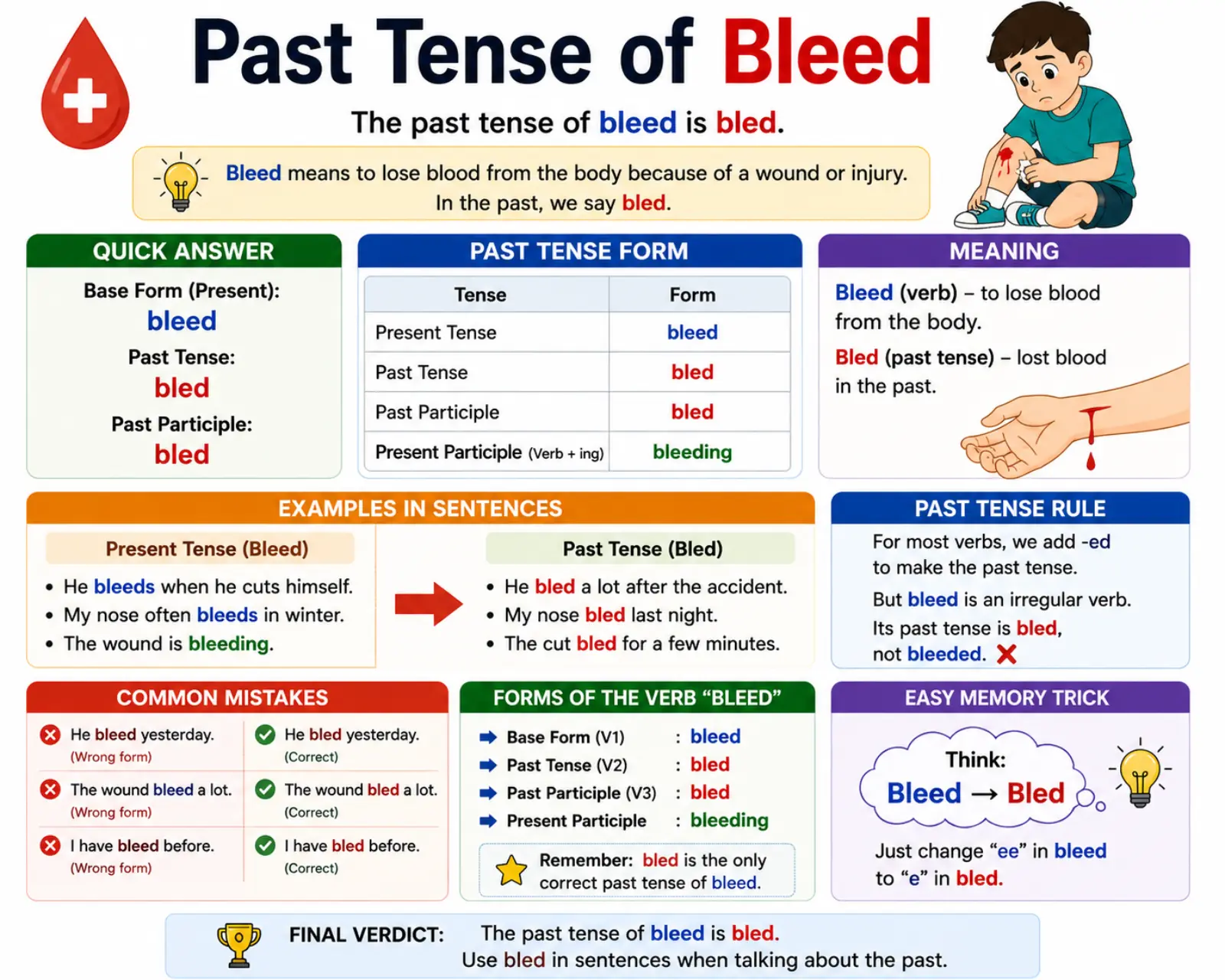
Past Tense of Bleed Quick Answer
Bleed = the present form of the verb.
Bled = the simple past tense and past participle of bleed.
Bleeded = incorrect in standard English.
Examples
- My finger bled after I cut it.
- His nose bled yesterday.
- The wound bled for a few minutes.
- She had bled before the doctor arrived.
- The plant had bled sap from its stem.
Simple Rule
👉 Bleed → Bled
Do not add ed to make “bleeded.” The verb bleed is irregular.
What Does the Past Tense of Bleed Mean?
The past tense of bleed is bled. It describes bleeding that happened in the past.
Bleed means to lose blood from the body. It can also describe liquid flowing from something, such as a tree releasing sap.
Present Tense
The wound bleeds easily.
Past Tense
The wound bled yesterday.
Past Participle
The wound has bled several times.
The word bled can therefore appear with different helping verbs.
- I bled after the accident.
- I have bled before.
- She had bled heavily.
- The cut was bleeding.
Related Terms
Some related words include:
- blood
- bleeding
- wound
- injury
- cut
- hemorrhage
- blood loss
- bled
Common Variations
You may see these forms:
| Verb Form | Word | Example |
|---|---|---|
| Base form | bleed | I bleed easily. |
| Third person | bleeds | His nose bleeds. |
| Past tense | bled | His nose bled yesterday. |
| Past participle | bled | His nose has bled before. |
| Present participle | bleeding | His nose is bleeding. |
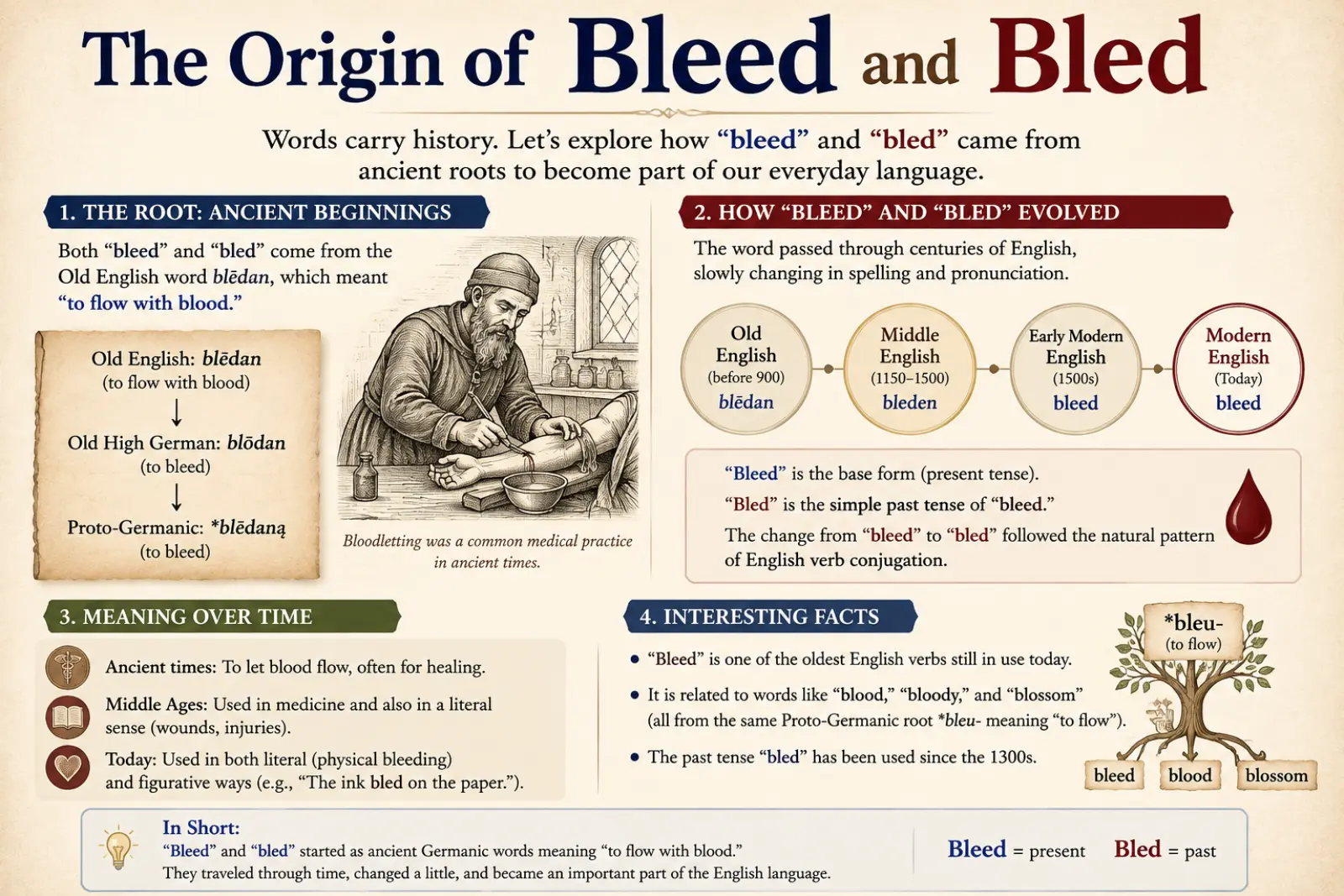
The Origin of Bleed and Bled
Bleed is an old English verb with roots that go back many centuries. It developed from older Germanic forms related to blood and the act of losing blood.
Like many old English verbs, bleed did not form its past tense by simply adding ed.
Instead, its vowel changed:
bleed → bled
This type of verb is called an irregular verb.
Other common irregular verbs include:
- feed → fed
- meet → met
- keep → kept
- sleep → slept
- feel → felt
Learning these patterns can make irregular verbs easier to remember.
How to Pronounce Bleed and Bled
It has one syllable.
Example:
The wound may bleed.
It also has one syllable.
Example:
The wound bled yesterday.
Do not pronounce bled as “bleed-ed.” There is no extra syllable.
British English vs American English Usage
The spelling and basic grammar of bleed and bled are the same in British and American English.
| Feature | British English | American English | Notes |
| Present form | bleed | bleed | Same |
| Past form | bled | bled | Same |
| Past participle | bled | bled | Same |
| “Bleeded” | Incorrect | Incorrect | Not standard English |
| Pronunciation | Similar | Similar | Accent may change the sound |
So, English speakers in the US, UK, Canada, Australia, India, and other English speaking regions normally use bled as the past form.
Which One Should You Use?
Some injuries bleed a lot.
The injury bled yesterday.
Use has bled or had bled when the grammar requires a past participle.
The wound has bled several times.
The wound had bled before help arrived.
Quick Usage Table
| Situation | Correct Form | Example |
| Present | bleed | I may bleed. |
| Present with he/she/it | bleeds | His nose bleeds. |
| Simple past | bled | His nose bled. |
| Present perfect | has/have bled | It has bled. |
| Past perfect | had bled | It had bled. |
| Ongoing action | bleeding | It is bleeding. |
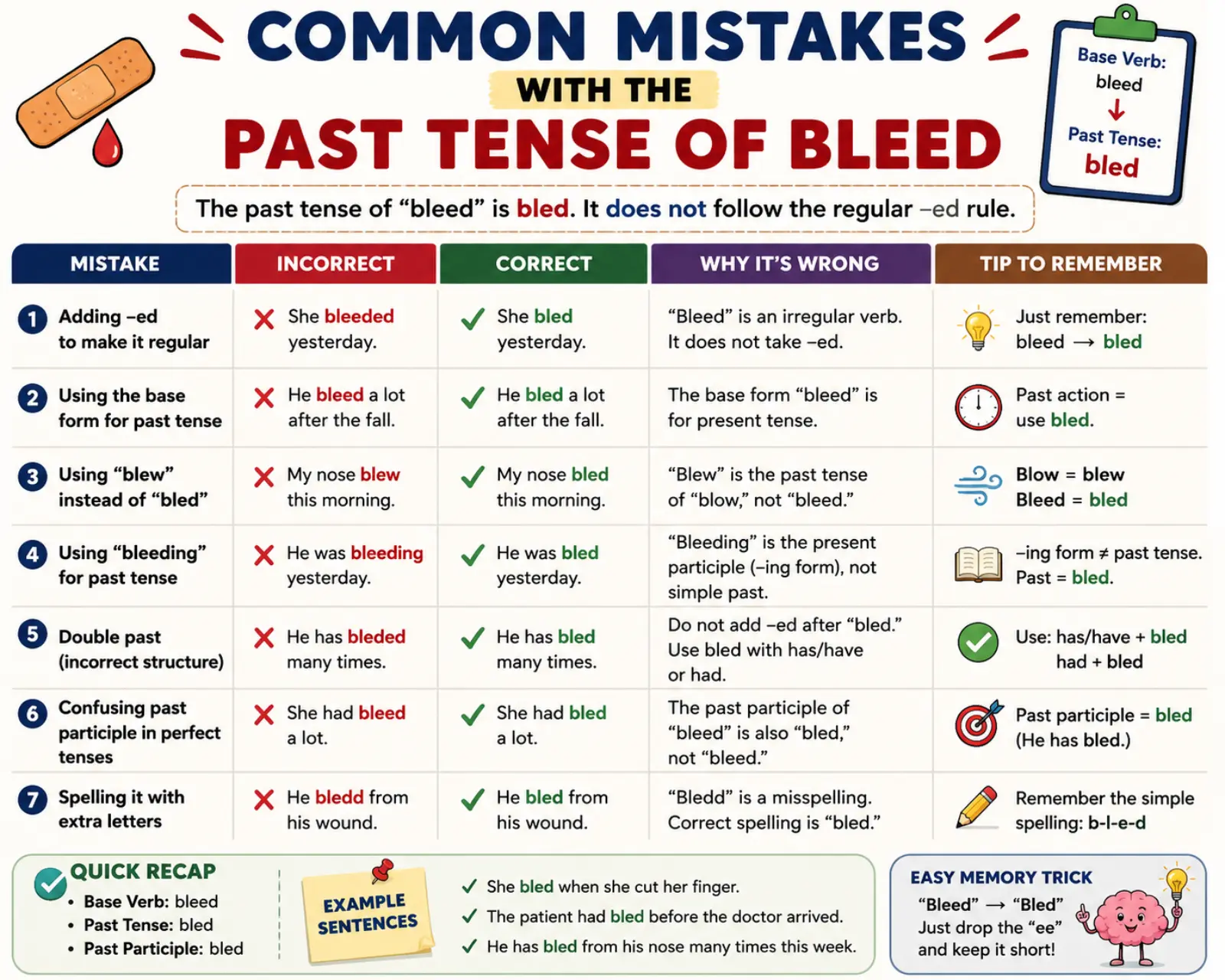
Common Mistakes With the Past Tense of Bleed
Mistake 1: Saying “Bleeded”
❌ The cut bleeded yesterday.
✔ The cut bled yesterday.
Why? Bleed is an irregular verb.
Tip: Memorize the pair bleed → bled.
Mistake 2: Using Bleed for a Finished Past Event
❌ Yesterday, my finger bleed.
✔ Yesterday, my finger bled.
Why? “Yesterday” tells us the action happened in the past.
Mistake 3: Confusing Bled and Bleeding
❌ My finger bled right now.
✔ My finger is bleeding right now.
Why? “Bled” describes the past. “Bleeding” describes an action happening now.
Mistake 4: Using Bled After “Will”
❌ My finger will bled.
✔ My finger will bleed.
Why? After “will,” use the base form of the verb.
Mistake 5: Confusing Bled With Blood
❌ The wound blood yesterday.
✔ The wound bled yesterday.
Why? Blood is mainly a noun, while bled is the past form of the verb bleed.
The Past Tense of Bleed in Everyday Examples
Work
His finger bled after he accidentally cut it while working.
School
The teacher explained why the small wound bled.
Daily Life
My nose bled during the night.
Text Messages
My nose bled again this morning.
Online Content
The character bled after being injured in the scene.
Conversations
“What happened?”
“I cut my hand, and it bled for a few minutes.”
The Past Tense of Bleed in Different Contexts
Grammar Learning
The main grammar lesson is simple:
bleed → bled
It is an irregular verb, so do not use the regular ed ending.
Medical Writing
In health related writing, bled can describe a past event.
The patient’s wound bled after the procedure.
Real medical situations can require professional care, but grammatically, bled is the correct past form.
Stories and Literature
Writers often use bled when describing past events.
The hero bled after the battle.
Plants and Trees
Bleed can also describe sap coming from a plant.
The tree bled sap after the branch was cut.
This shows that the word is not limited to human or animal blood.
Past Tense of Bleed Comparison Table
| Form | Correct? | Meaning | Example |
| bleed | Yes | Present/base form | I may bleed. |
| bleeds | Yes | Present with singular subject | It bleeds. |
| bled | Yes | Simple past | It bled yesterday. |
| bled | Yes | Past participle | It has bled. |
| bleeding | Yes | Continuous form | It is bleeding. |
| bleeded | No | Incorrect standard form | Do not use it. |
| blood | Not as the verb form | Usually a noun | There was blood. |
The Past Tense of Bleed for Students and Beginners
Beginners often make this mistake because many English verbs use ed in the past.
For example:
- walk → walked
- jump → jumped
- clean → cleaned
So it feels natural to say:
❌ bleed → bleeded
But English has many irregular verbs.
For bleed, remember:
Bleed today → bled yesterday.
That short sentence can help you remember the correct form.
Simple Trick to Remember the Past Tense of Bleed
Think of the vowel change:
EE → E
BLEED → BLED
Compare:
- bleed → bled
- feed → fed
- meet → met
Think of It This Way
Imagine the word getting shorter in the past:
BLEED
↓
BLED
There is no ed ending.
Your quick memory sentence is:
Yesterday, I bled.
Expert Tips for Using Bleed Correctly
- Memorize bleed → bled, not “bleed → bleeded.”
- Use bled for a simple completed past action.
- Use bleeding for an action happening now.
- Use has bled or had bled when a helping verb requires the past participle.
- Remember that blood and bled are different words.
- Watch for time words such as yesterday, last night, earlier, and before.
- Read your sentence aloud to check if the verb form sounds natural.
Related Searches About the Past Tense of Bleed
People often ask several questions around this grammar topic:
- What is the past tense of bleed? The answer is bled.
- Is bled the past tense of bleed? Yes.
- Is bleeded a word? It is not the standard past form of bleed.
- What is the past participle of bleed? It is bled.
- What is the present participle of bleed? It is bleeding.
- Is bleed an irregular verb? Yes.
- How do you use bled in a sentence? For example, “The cut bled yesterday.”
- What is the difference between bleed and bled? Bleed is the base form, while bled is the past form.
- What is the difference between bled and bleeding? Bled describes a past action, while bleeding often describes an action in progress.
- Can you say bleeded? Not in standard English.
- Is blood the past tense of bleed? No. The past tense is bled.
- How do you pronounce bled? It rhymes closely with words such as “said” and “red.”
FAQs About the Past Tense of Bleed
What is the past tense of bleed?
The past tense of bleed is bled.
Is “bleeded” the past tense of bleed?
No. Bleeded is not the standard English past tense. Use bled.
Is bleed a regular or irregular verb?
Bleed is an irregular verb because its past form is bled, not “bleeded.”
What is the past participle of bleed?
The past participle is also bled.
Example: “The wound has bled before.”
What is the present participle of bleed?
The present participle is bleeding.
Example: “The wound is bleeding.”
Can I say “The wound bled”?
Yes. The wound bled is grammatically correct when describing a past event.
What is the difference between bleed and bled?
Bleed is the base or present form. Bled is the simple past and past participle.
Is “blood” the past tense of bleed?
No. Blood is normally a noun. The correct past tense is bled.
How do you remember bleed and bled?
Use the simple pattern bleed → bled. Think of EE changing to E.
Is the past tense of bleed the same in British and American English?
Yes. Both use bled.
Final Verdict
The correct past tense of bleed is bled.
👉 Bleed → Bled
Examples:
I bleed easily.
I bled yesterday.
The wound is bleeding now.
The wound has bled before.
The biggest mistake to avoid is bleeded. It may seem logical, but it is not the standard past form.
Conclusion
The past tense of bleed is bled, and this rule is the same in standard British and American English. Since bleed is an irregular verb, you cannot simply add ed.
Use bleed for the base form, bled for the past tense and past participle, and bleeding for the continuous form.
The easiest memory trick is:
BLEED → BLED
Think of EE changing to E. Once you remember that small change, you can confidently use the correct form in school, work, conversations, stories, and everyday writing.

Camila Green is an English language writer who specializes in confusing word comparisons and spelling explanations. She creates simple, beginner-friendly guides on topics like “niece or neice” and other common English mistakes. Her writing focuses on clarity, real-life examples, and easy learning. At VerrsaPick, she helps readers improve their English with practical and engaging content.