Imagine you are working on a math problem and see a phrase like “more than or equal to 10.” You understand that the number cannot be smaller than 10, but you may wonder what the phrase really means.
This is a common point of confusion for students and beginner English learners. The phrase more than or equal to is used in mathematics, school assignments, science, business, statistics, programming, and everyday instructions.
The good news is that the idea is simple. It means a value can be greater than a number or exactly the same as that number.
For example, if a rule says you need more than or equal to 18 points, then 18 is acceptable. So are 19, 20, 21, and higher numbers.
People usually search for:
- more than or equal to meaning
- more than or equal to symbol
- more than or equal to examples
- how to write more than or equal to
- greater than or equal to meaning
- more than or equal to in math
- more than or equal to vs greater than
- what does ≥ mean?
In this guide, you’ll learn the meaning, pronunciation, examples, usage, grammar rules, common mistakes, expert tips, and simple explanations in easy English.
More Than or Equal To – Quick Answer
👉 More than or equal to = greater than or exactly the same as a given number.
The mathematical symbol is:
👉 ≥
For example:
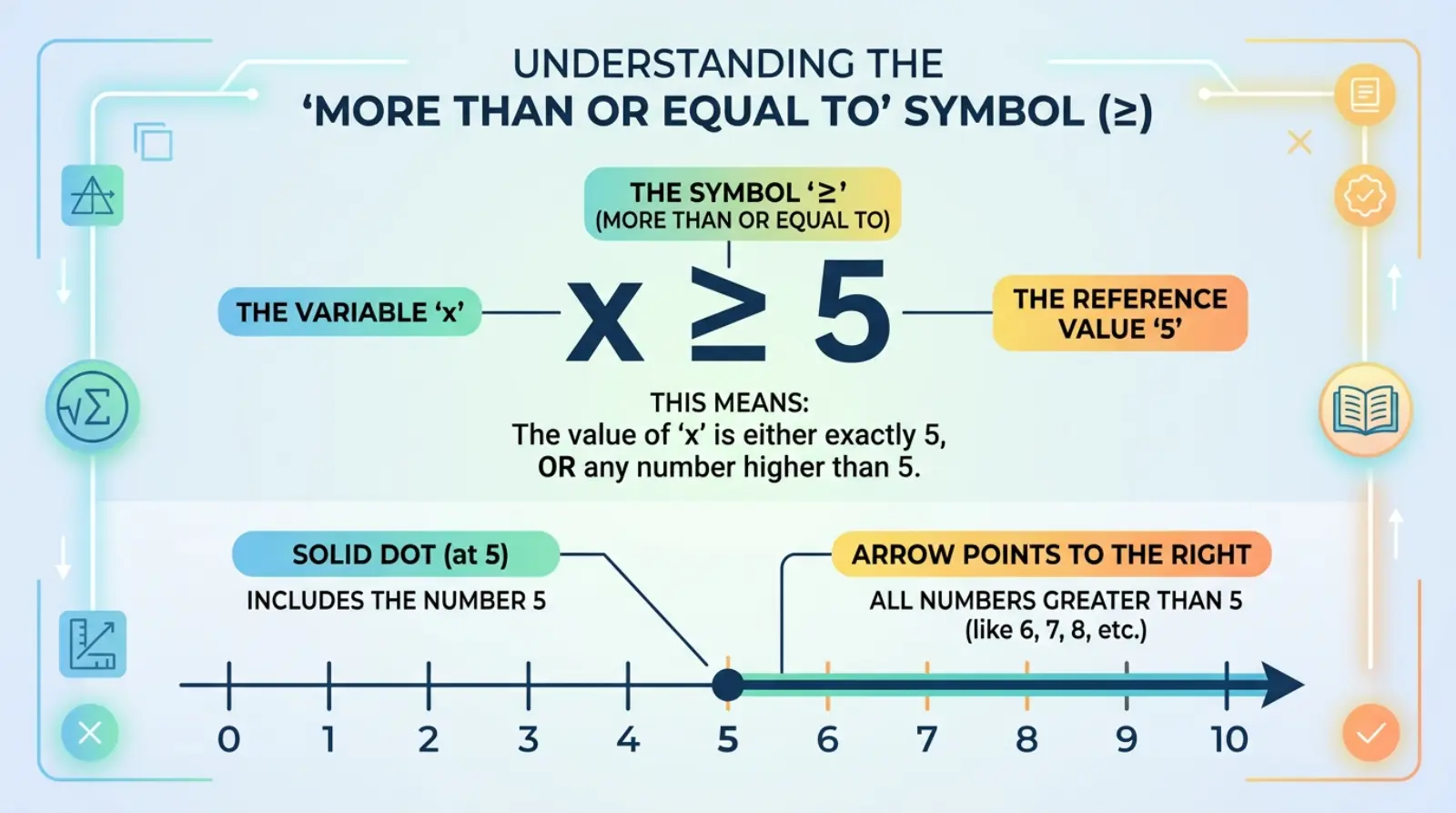
x ≥ 5
This means x can be 5 or any number greater than 5.
Examples
- 10 ≥ 5 ✅
- 5 ≥ 5 ✅
- 4 ≥ 5 ❌
- 20 ≥ 15 ✅
- 15 ≥ 15 ✅
Simple Rule
“More than” means the value must be bigger.
“Equal to” means the value can be exactly the same.
Put them together:
More than or equal to = bigger than OR exactly the same.
A quick memory trick is:
≥ means “at least.”
So x ≥ 10 means x is at least 10.
What Does More Than or Equal To Mean?
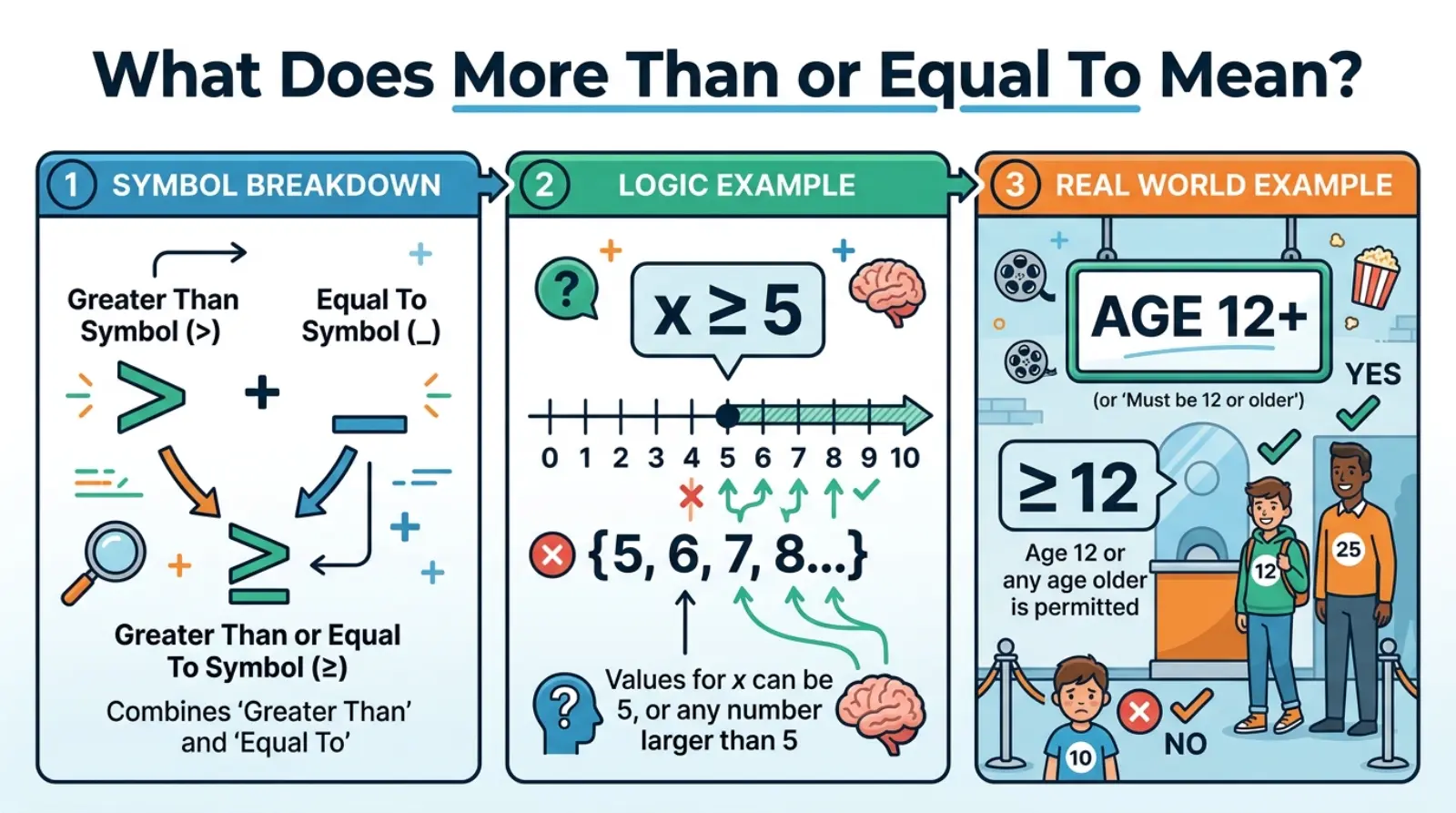
More than or equal to is a mathematical comparison phrase.
It tells us that one value is greater than another value or equal to it.
For example:
You must be more than or equal to 18 years old.
This means your age can be:
- 18
- 19
- 20
- 21
- or any higher age.
But 17 would not meet the requirement.
More Than
More than means greater than.
8 is more than 5.
Symbol:
8 > 5
Equal To
Equal to means the two values have the same amount.
5 is equal to 5.
Symbol:
5 = 5
More Than or Equal To
Combining both ideas gives:
5 is more than or equal to 5.
That statement is true because 5 is equal to 5.
Related Terms
You may also see:
- greater than or equal to
- at least
- no less than
- minimum
- equal to or greater than
- ≥ symbol
- inequality
- comparison
Opposite
The opposite idea is:
less than or equal to (≤)
For example:
x ≤ 10
means x can be 10 or any number below 10.
The Origin of More Than or Equal To
The phrase comes from ordinary English words used to compare quantities.
More has long been used to describe a larger amount. Equal describes two things having the same value.
Mathematics later developed symbols to express these ideas quickly.
The symbol ≥ combines the meaning of greater than and equal to.
Today, it is widely used in algebra, geometry, statistics, economics, science, computer programming, and data analysis.
How to Pronounce More Than or Equal To
The phrase is pronounced:
more than or equal to
A simple breakdown is:
more → mor
than → than
or → or
equal → EE-kwuhl
to → too
You can also read ≥ as:
greater than or equal to
For example:
x ≥ 7
can be read:
“x is greater than or equal to seven.”
A shorter everyday expression is:
“x is at least seven.”
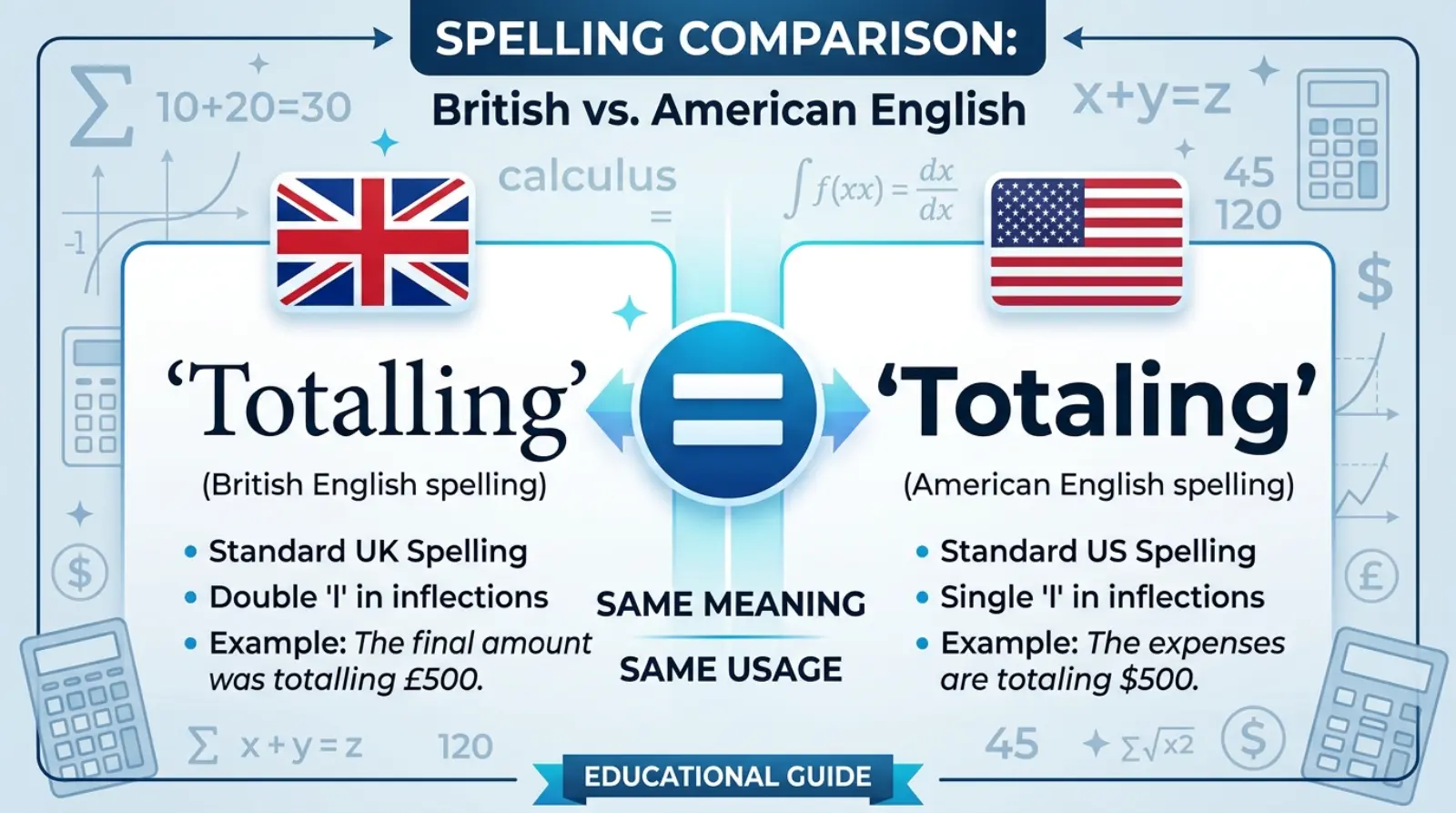
British English vs American English Usage
There is no important difference between British and American English when using more than or equal to in mathematics.
| Feature | British English | American English | Notes |
|---|---|---|---|
| Phrase | more than or equal to | more than or equal to | Same |
| Symbol | ≥ | ≥ | Same |
| Alternative | greater than or equal to | greater than or equal to | Same |
| Short form | at least | at least | Same |
| Mathematical meaning | Same | Same | No difference |
The phrase works the same way in schools, textbooks, workplaces, and technical writing in both forms of English.
Which One Should You Use?
In mathematics, greater than or equal to is often the clearest formal expression.
You can use:
- more than or equal to — natural and easy to understand
- greater than or equal to — common mathematical wording
- at least — short and conversational
- ≥ — standard mathematical symbol
| Situation | Good choice |
|---|---|
| Math homework | ≥ or greater than or equal to |
| Academic writing | greater than or equal to |
| Everyday instructions | at least |
| Text message | ≥ or at least |
| Business requirement | at least |
| Technical document | greater than or equal to |
For example:
Applicants must have at least three years of experience.
This means:
Applicants must have three years or more of experience.
Common Mistakes With More Than or Equal To
Mistake 1: Thinking the number must be bigger
❌ x ≥ 10 means x must be greater than 10.
✔ x ≥ 10 means x can be 10 or greater.
The equal part is important.
Mistake 2: Confusing ≥ with >
❌ x > 10 includes 10.
✔ x ≥ 10 includes 10.
The symbol > does not include the number itself.
Mistake 3: Forgetting the equal part
❌ A minimum age of 18 means you must be older than 18.
✔ A minimum age of 18 means you can be 18 or older.
Mistake 4: Confusing ≥ with ≤
❌ x ≥ 20 means x is 20 or below.
✔ x ≥ 20 means x is 20 or above.
Remember that the wide side of the symbol faces the larger value.
Mistake 5: Reading the symbol backward
❌ 5 ≥ 10 means 5 is greater than 10.
✔ 5 ≥ 10 is false because 5 is less than 10.
Read the symbol from left to right.
Mistake 6: Thinking “or equal” means two answers only
❌ x ≥ 5 means x is either 5 or 6.
✔ x ≥ 5 means x can be 5, 6, 7, 8, 9, 10, or any larger value.
More Than or Equal To in Everyday Examples
Work
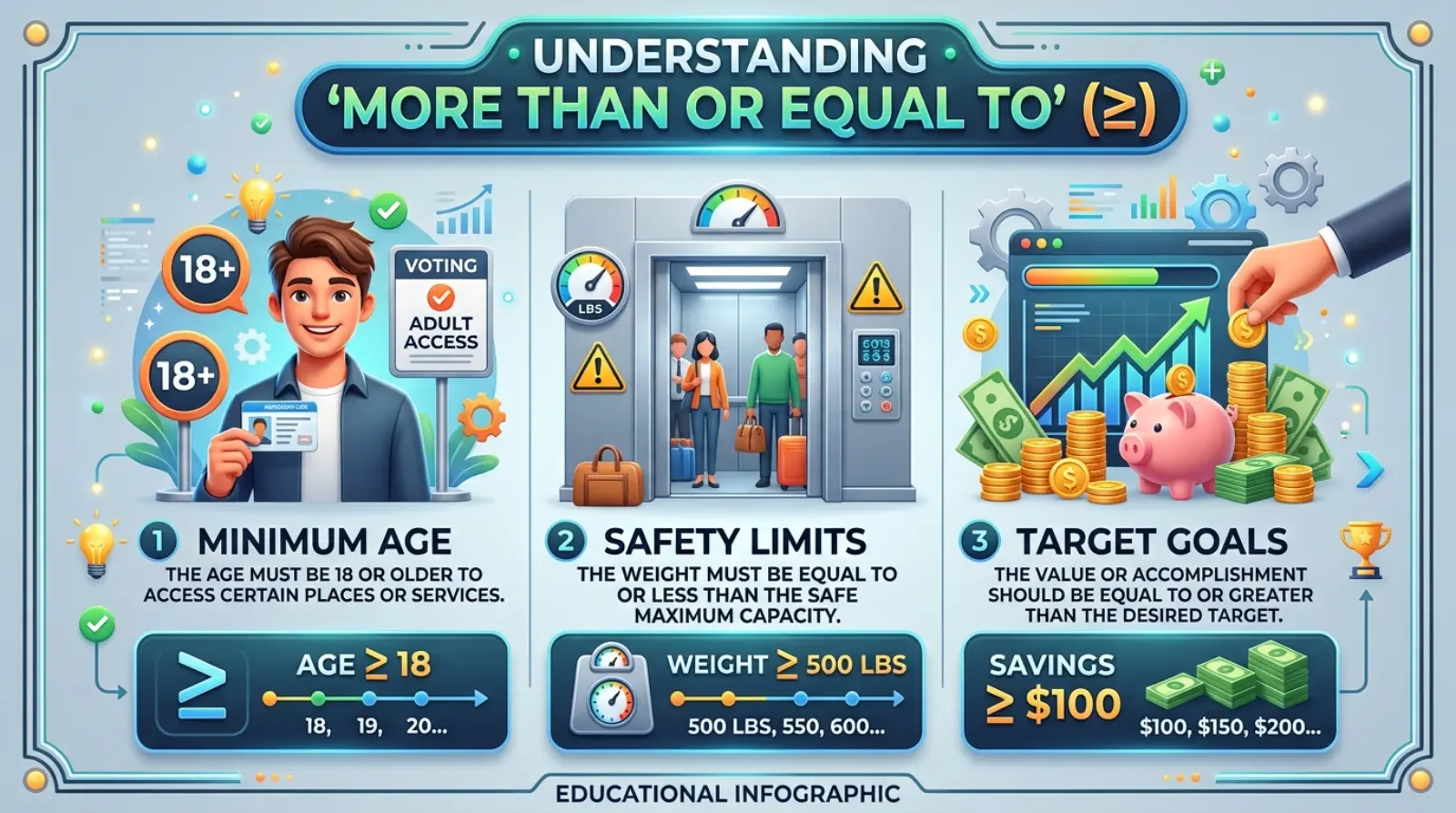
Employees must work more than or equal to 40 hours per week.
A clearer version is:
Employees must work at least 40 hours per week.
School
Students need a score greater than or equal to 70% to pass.
This means 70% is enough.
Business
Orders of 100 units or more receive a discount.
This means the order must contain at least 100 units.
Social Media
A platform might say:
Your video must be more than or equal to 60 seconds long.
The exact wording may vary, but the mathematical idea remains the same.
Daily Life
You need to be at least 18 years old to apply.
“At least 18” means 18 or older.
Text Messages
You need ≥ 5 people to join.
This means five people or more.
Online Content
Choose a password with 8 or more characters.
Mathematically:
characters ≥ 8
Conversations
How many guests do we need?
At least 20.
That means 20 or more.
More Than or Equal To in Different Contexts
Education
Students regularly see ≥ in algebra and inequalities.
Example:
x ≥ 12
The possible whole-number values include:
12, 13, 14, 15, and so on.
Business
Companies use minimum requirements.
Revenue must be greater than or equal to $50,000.
This means $50,000 meets the requirement.
Technology
Programming uses comparison operators to test values.
A program may check whether a number meets a minimum value.
For example:
score ≥ 50
means the score must be 50 or higher.
Statistics
Researchers may describe measurements using minimum limits.
The sample must contain at least 100 participants.
This can be represented as:
n ≥ 100
Communication
In normal conversation, at least is usually easier than saying more than or equal to.
You need at least five tickets.
This sounds more natural than:
You need more than or equal to five tickets.
More Than or Equal To – Google Trends and Usage
People commonly search this phrase when they are learning inequalities, mathematical symbols, algebra, comparison signs, and minimum values.
Search intent often includes questions such as:
- What does ≥ mean?
- What is the meaning of more than or equal to?
- How do you write greater than or equal to?
- Is 5 greater than or equal to 5?
- What is the difference between > and ≥?
- How do I type the ≥ symbol?
These searches can come from students and English learners in countries such as the US, UK, India, Pakistan, Canada, and Australia.
The phrase also appears in online lessons, homework questions, calculators, spreadsheets, coding tutorials, and educational content.
Comparison Table: More Than or Equal To
| Expression | Meaning | Example | Is 10 included? |
|---|---|---|---|
| > | Greater than | x > 10 | No |
| ≥ | Greater than or equal to | x ≥ 10 | Yes |
| = | Equal to | x = 10 | Yes, exactly |
| < | Less than | x < 10 | No |
| ≤ | Less than or equal to | x ≤ 10 | Yes |
The most important comparison is:
> = bigger only
≥ = bigger or the same
More Than or Equal To in Professional Life
This concept is especially useful when writing rules and requirements.
For example:
Employees must have at least two years of experience.
This can be represented as:
experience ≥ 2 years
In business, the phrase helps define:
- minimum order quantities
- age requirements
- salary limits
- performance targets
- production levels
- customer requirements
- eligibility rules
- financial limits
Clear wording prevents misunderstandings.
More Than or Equal To for Students or Beginners
Students often struggle because the symbol looks confusing at first.
The easiest method is to remember that the open or wider side points toward the larger number.
For:
8 ≥ 5
the wide side faces 8 because 8 is larger.
The small point faces 5.
Beginner shortcut
Remember:
≥ means “at least.”
So:
x ≥ 10
becomes:
x is at least 10.
That is often the easiest way to understand it.
Common Uses and Patterns
You will commonly see more than or equal to when describing:
- minimum age
- minimum score
- minimum quantity
- minimum experience
- minimum temperature
- minimum speed
- minimum income
- minimum number of people
- minimum production
- minimum capacity
Common sentence patterns include:
You need at least 10 points.
The temperature must be 10°C or higher.
The value must be greater than or equal to 10.
All three express the same basic idea.
Simple Trick to Remember More Than or Equal To
Look at the symbol:
≥
The symbol has two ideas:
> = more than
= = equal to
Together:
≥ = more than or equal to
Think of it this way:
Imagine a school rule:
“You need at least 50 marks.”
If you score:
- 49 ❌
- 50 ✅
- 51 ✅
- 60 ✅
- 100 ✅
So at least 50 = ≥ 50.
That one example can help you remember the entire rule.
Expert Tips
1. Memorize “at least.”
It is the easiest everyday translation of ≥.
2. Watch the equal line.
The extra line means the starting number is included.
3. Test the boundary.
If the condition says x ≥ 10, always test 10. If 10 works, you understand the inequality.
4. Compare it with >.
Ask whether the exact number is allowed.
5. Use words when explaining.
For beginners, “10 or more” is often clearer than the symbol alone.
6. Do not confuse minimum and maximum.
Minimum usually connects with at least / ≥. Maximum usually connects with at most / ≤.
Related Searches People Also Ask
What does ≥ mean?
The symbol ≥ means greater than or equal to. It means the first value is larger than or exactly the same as the second.
Is “more than or equal to” the same as “at least”?
Yes. In most mathematical contexts, at least 10 means 10 or more, which is written x ≥ 10.
Does greater than or equal to include the number?
Yes. If x ≥ 10, then x can be exactly 10 or any number greater than 10.
What is the difference between > and ≥?
> means greater than only. ≥ means greater than or equal to.
What is the opposite of more than or equal to?
The opposite comparison is less than, depending on the logical context. The related opposite-direction symbol is ≤, meaning less than or equal to.
How do you type the greater than or equal symbol?
The exact keyboard method depends on your device and operating system. You can also copy ≥ when needed.
Is 10 more than or equal to 10?
Yes. 10 ≥ 10 is true because the two numbers are equal.
Is 9 more than or equal to 10?
No. 9 ≥ 10 is false because 9 is less than 10.
Does “at least 20” include 20?
Yes. At least 20 includes 20 and every larger number.
What is a simple way to remember ≥?
Think “at least.” If something is at least 10, it can be 10 or higher.
Final Verdict
More than or equal to means greater than or exactly equal to a particular value.
Its mathematical symbol is:
≥
The easiest memory rule is:
≥ = at least = that number or higher.
For example:
x ≥ 5
means:
x = 5, 6, 7, 8, 9, 10, or any higher value.
Conclusion
Understanding more than or equal to becomes easy once you focus on the two parts of the phrase.
More than means bigger.
Equal to means the same.
Together, more than or equal to means the same value or anything bigger.
The symbol ≥ is used in math, science, business, statistics, technology, and everyday rules.
Whenever you see “at least,” “or more,” “equal to or greater than,” or “greater than or equal to,” think about the same basic idea.
Final memory trick: ≥ means “at least” — the number itself counts, and bigger numbers count too.
FAQs About More Than or Equal To
What is the meaning of more than or equal to?
It means a value is greater than another value or exactly the same as it.
What is the symbol for more than or equal to?
The symbol is ≥.
Is more than or equal to the same as at least?
Yes. For example, at least 10 means 10 or more, or x ≥ 10.
Does more than or equal to include the number?
Yes. The number itself is included.
What does x ≥ 5 mean?
It means x is 5 or greater.
Is 5 ≥ 5 true?
Yes. Both numbers are equal, so the statement is true.
Is 4 ≥ 5 true?
No. Four is less than five.
What is the difference between > and ≥?
> does not include the number. ≥ does include it.
What phrase can replace ≥?
You can say greater than or equal to, more than or equal to, at least, or that number or higher, depending on the context.
What is an easy way for beginners to remember it?
Remember: ≥ means “at least.”

Camila Green is an English language writer who specializes in confusing word comparisons and spelling explanations. She creates simple, beginner-friendly guides on topics like “niece or neice” and other common English mistakes. Her writing focuses on clarity, real-life examples, and easy learning. At VerrsaPick, she helps readers improve their English with practical and engaging content.