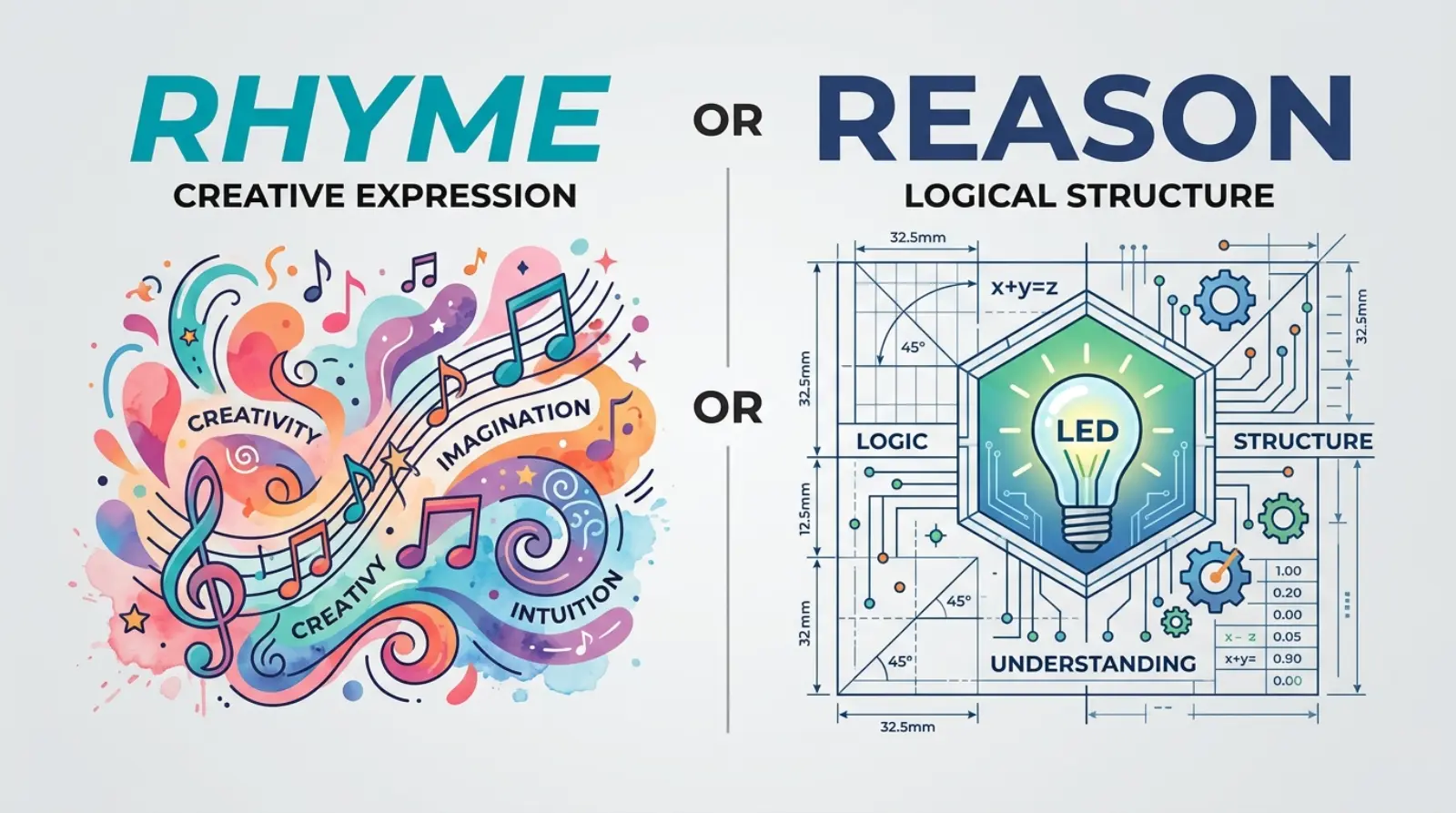
Have you ever watched someone make a strange decision and thought, “Why did they do that?” Maybe their actions seem random, confusing, or impossible to understand. In that situation, you might say, “There’s no rhyme or reason to it.”
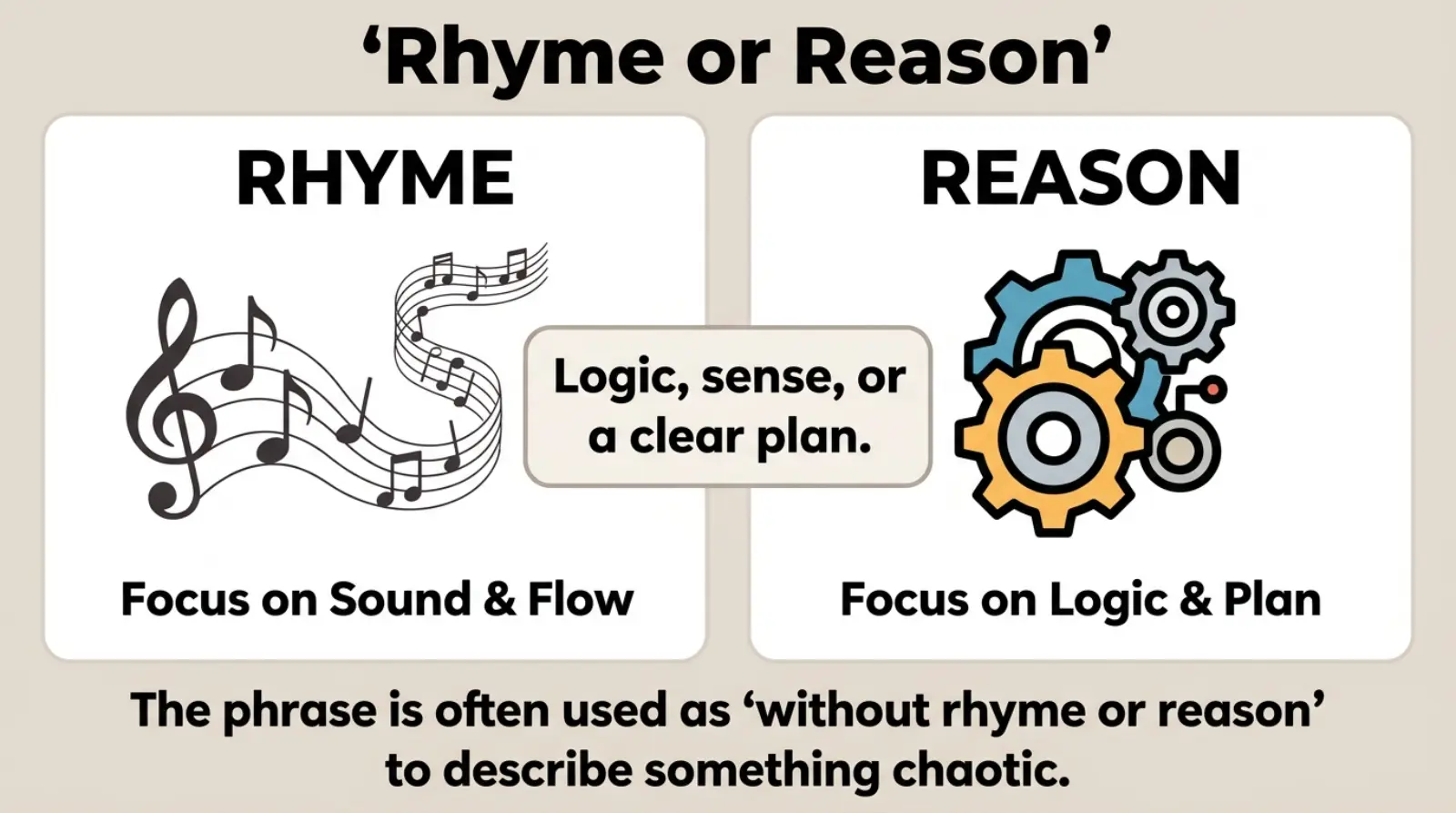
The phrase rhyme or reason is a common English idiom. It does not usually refer to poetry or actual rhyming. Instead, it means a clear reason, sensible plan, or logical explanation.
Beginners can find this phrase confusing because the words “rhyme” and “reason” seem unrelated. You may also wonder whether rhyme or reason is grammatically correct, what it means in a sentence, or when you should use it.
You can hear this expression in daily conversations, workplaces, schools, books, movies, social media, and online discussions. It is especially useful when describing something that looks random or has no clear pattern.
People usually search for:
- rhyme or reason meaning
- rhyme or reason definition
- rhyme or reason examples
- what does rhyme or reason mean?
- no rhyme or reason meaning
- rhyme or reason origin
- how to use rhyme or reason
- rhyme or reason pronunciation
In this guide, you’ll learn the meaning, pronunciation, examples, usage, grammar rules, common mistakes, expert tips, and simple explanations in easy English.
Rhyme or Reason – Quick Answer
👉 Rhyme or reason = a sensible explanation, purpose, or logical basis for something.
👉 No rhyme or reason = no obvious logic, order, or explanation.
The expression is usually used in the negative form: “There is no rhyme or reason to…”
Examples
- There seems to be no rhyme or reason to his decisions.
- I couldn’t find any rhyme or reason in the way the files were arranged.
- There is a rhyme or reason behind the company’s new policy.
- Her schedule looks random, but there is actually rhyme or reason to it.
Simple Rule
👉 When something has rhyme or reason, it has some sense, purpose, or logic.
👉 When something has no rhyme or reason, it seems random or meaningless.
What Does Rhyme or Reason Mean?
Rhyme or reason means a logical explanation, sensible purpose, or understandable pattern.
For example, imagine a teacher puts students into groups. At first, the groups look completely random. Later, you discover that the teacher grouped them according to their test scores.
You could say:
“There was a rhyme or reason behind the grouping.”
The phrase is often more common in its negative form:
“There was no rhyme or reason behind the grouping.”
This means you could not see any sensible pattern.
Synonyms
Depending on the sentence, similar expressions include:
- logic
- reason
- sense
- purpose
- explanation
- method
- order
- pattern
- justification
- sensible basis
Opposites
Possible opposites include:
- randomness
- confusion
- chaos
- nonsense
- disorder
- unpredictability
Related Terms
- make sense
- for a reason
- logical explanation
- method to the madness
- without explanation
- random behavior
The Origin of Rhyme or Reason
The exact history of rhyme or reason is old and not completely certain.
The expression has been used in English for centuries. It appears in older forms of English writing where rhyme could suggest order, arrangement, or a fitting pattern, while reason represented sensible thought or logic.
Over time, rhyme or reason became an idiomatic expression meaning a sensible explanation or orderly basis.
Today, the phrase has nothing to do with whether words actually rhyme.
The most familiar modern expression is:
“There is no rhyme or reason to it.”
This simply means:
“I cannot see any clear logic or pattern in it.”
How to Pronounce Rhyme or Reason
Rhyme or reason is pronounced:
rhyme or REE-zən
A simple breakdown:
- rhyme → rime
- or → er / or
- reason → REE-zən
The word rhyme sounds like “rime.”
Common Pronunciation Mistake
Do not pronounce the h in rhyme separately.
❌ “ree-hyme”
✔ “rime”
British English vs American English Usage
The phrase rhyme or reason has essentially the same meaning in British and American English.
| Feature | British English | American English | Notes |
|---|---|---|---|
| Phrase | rhyme or reason | rhyme or reason | Same |
| Meaning | Logic or sensible explanation | Logic or sensible explanation | Same |
| Common negative form | no rhyme or reason | no rhyme or reason | Very common |
| Pronunciation | Similar | Similar | Minor accent differences |
| Formal writing | Acceptable | Acceptable | Idiomatic expression |
There is no major grammar or spelling difference between British and American English.
Which One Should You Use?
Rhyme or reason is an established English idiom and can be used in both casual and professional communication.
Formal writing
It can work in articles, essays, reports, and opinion writing when the tone allows idiomatic language.
Example:
“There appears to be no rhyme or reason behind the changes.”
Everyday conversation
“There’s no rhyme or reason to this.”
Workplace communication
“I couldn’t see any rhyme or reason in the way these tasks were assigned.”
Social media
“This playlist has no rhyme or reason, but I love it.”
The expression is flexible, but very formal technical writing may benefit from clearer wording such as “no logical basis” or “no identifiable pattern.”
Common Mistakes With Rhyme or Reason
Mistake 1: Thinking it means poetry
❌ Incorrect idea: Rhyme or reason means two words that rhyme.
✔ Correct: It means logic, sense, or a sensible explanation.
Tip: Remember that this is an idiom.
Mistake 2: Using “rhyme” alone with the same meaning
❌ “There is no rhyme to his decision.”
✔ “There is no rhyme or reason to his decision.”
Why? The complete idiom is rhyme or reason.
Mistake 3: Assuming it always means “reason”
The phrase can suggest more than one simple reason. It can describe a pattern, method, purpose, or logical structure.
Mistake 4: Misunderstanding “no rhyme or reason”
❌ “There is no rhyme or reason” means something has no poetry.
✔ It means something appears to have no clear logic or pattern.
Mistake 5: Adding unnecessary words
❌ “There is no rhyme or reason logic to it.”
✔ “There is no rhyme or reason to it.”
Keep the idiom natural.
Rhyme or Reason in Everyday Examples
Work
“There seems to be no rhyme or reason to the new schedule.”
School
“I couldn’t understand the teacher’s grouping because there was no rhyme or reason to it.”
Social Media
“My photo collection has no rhyme or reason.”
Daily Life
“There’s no rhyme or reason to the way my dog chooses where to sleep.”
“I reviewed the records but could find no rhyme or reason behind the order.”
Text Message
“His playlist has no rhyme or reason 😂.”
Online Content
“The article jumps between topics with no rhyme or reason.”
Conversation
“Why are you changing the rules?”
“Honestly, there’s no rhyme or reason to it.”
Rhyme or Reason in Different Contexts
Education
Teachers and students may use the phrase when discussing an unclear system or pattern.
Example:
“There seems to be no rhyme or reason behind the way the questions were arranged.”
Business
The expression can describe decisions that appear inconsistent.
Example:
“The pricing changes seem to have no rhyme or reason.”
Writing
A writer might use it when a paragraph lacks organization.
Example:
“The ideas appear with no rhyme or reason.”
Relationships
It can describe confusing behavior.
Example:
“Sometimes his mood changes with no rhyme or reason.”
Technology
It can describe an unexpected system behavior.
Example:
“The app keeps closing with no rhyme or reason.”
Social Media
People often use the phrase humorously to describe random posts, playlists, photos, or habits.
Rhyme or Reason in Professional Life
In professional communication, rhyme or reason can make your writing sound natural and conversational.
For example:
“There appears to be no rhyme or reason behind the changes.”
However, if you are writing a highly technical report, you may prefer:
“No clear pattern or logical basis was identified.”
Use the idiom when you want a human, readable tone.
Rhyme or Reason for Students and Beginners
The phrase can be confusing because its literal words do not clearly explain its idiomatic meaning.
The easiest approach is to learn the entire expression instead of translating each word separately.
Remember:
Rhyme or reason → sense, logic, or purpose
No rhyme or reason → no obvious sense, logic, or purpose
Beginner shortcut
When you see:
“There is no rhyme or reason…”
Think:
“I can’t figure out why.”
That one sentence captures the basic meaning.
Common Uses of Rhyme or Reason
You will often see the phrase when someone describes:
- random decisions
- confusing behavior
- disorganized information
- unexplained changes
- unusual patterns
- inconsistent rules
- random arrangements
- unpredictable actions
- unclear plans
- strange systems
The phrase often carries a mild feeling of confusion or frustration.
Simple Trick to Remember Rhyme or Reason
Think of it this way:
Reason = logic.
Rhyme = pattern.
Together, rhyme or reason suggests that something should have some understandable pattern or logic.
So:
👉 No rhyme or reason = no understandable pattern or logic.
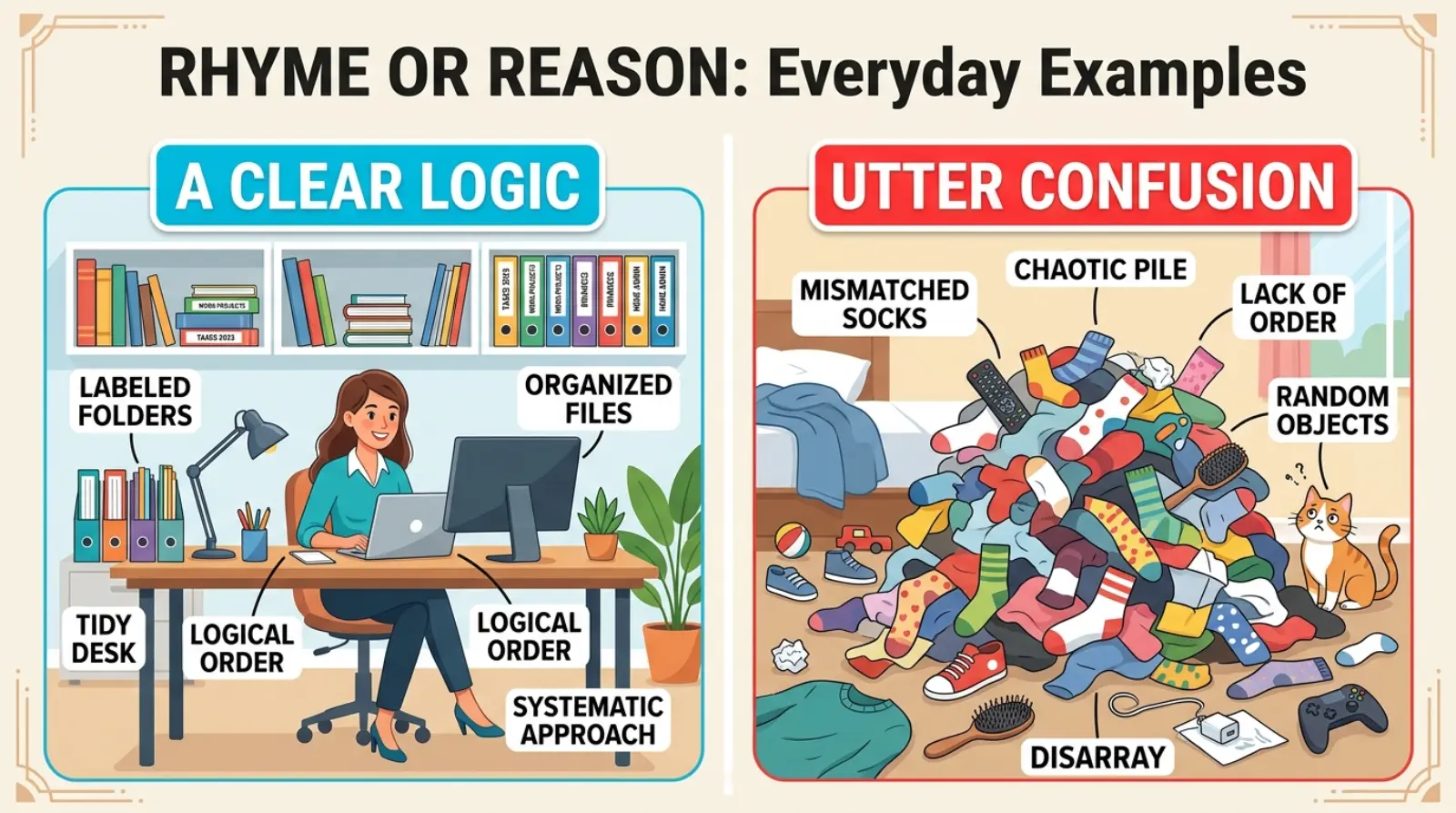
Imagine opening a messy drawer where everything is mixed together. Socks are beside batteries, keys are under papers, and nothing seems organized.
You might say:
“There is no rhyme or reason to this drawer!”
That is the memory trick.
Expert Tips
Here are a few useful ways to use the expression naturally:
- Learn “rhyme or reason” as one idiom.
- Pay special attention to “no rhyme or reason.”
- Do not interpret the words literally.
- Use it when describing a lack of logic, pattern, or purpose.
- In formal technical writing, consider alternatives like “no logical basis.”
- Listen for the phrase in conversations, books, films, and online writing.
- Notice whether the speaker sounds confused, frustrated, amused, or critical.
Related Searches People Also Ask
What does “rhyme or reason” mean?
It means a sensible explanation, purpose, pattern, or logical basis.
What does “no rhyme or reason” mean?
It means something appears to have no clear logic, order, or explanation.
Is “rhyme or reason” an idiom?
Yes. It is an English idiomatic expression.
Is there a rhyme or reason to something?
This asks whether there is a sensible pattern, purpose, or explanation behind it.
Is “rhyme or reason” formal?
It is acceptable in professional writing, but very technical writing may use more direct wording.
Can I use “rhyme or reason” in an email?
Yes. It works well in normal workplace emails when the tone is conversational.
What is another way to say “no rhyme or reason”?
You can say “no logical explanation,” “no clear pattern,” “no apparent reason,” or “completely random.”
Does rhyme or reason refer to poetry?
No. In this idiom, it normally refers to logic, sense, or an understandable pattern.
FAQs About Rhyme or Reason
Is “rhyme or reason” grammatically correct?
Yes. Rhyme or reason is a standard English idiom.
What is the meaning of “rhyme or reason”?
It means a logical explanation, sensible purpose, or understandable pattern.
What does “without rhyme or reason” mean?
It means something happens without any obvious logic, purpose, or pattern.
What is an example of “no rhyme or reason”?
“There was no rhyme or reason to the way the files were arranged.”
Is “no rhyme or reason” negative?
Usually, yes. It often suggests confusion, randomness, or a lack of logic.
How do you pronounce “rhyme or reason”?
It sounds roughly like “rime or REE-zən.”
What is a synonym for “rhyme or reason”?
Depending on context, you can use logic, sense, purpose, method, or explanation.
Can “rhyme or reason” describe a person?
Yes. It can describe someone’s actions or decisions when they seem difficult to understand.
Final Verdict
Rhyme or reason is an English idiom meaning logic, sense, purpose, or an understandable pattern.
The most common expression is:
👉 No rhyme or reason = no clear logic or explanation.
The phrase does not usually refer to poetry.
Conclusion
Understanding rhyme or reason is easier when you stop thinking about the literal meanings of the two words.
The phrase describes something that has a sensible pattern, purpose, or explanation. When someone says there is “no rhyme or reason,” they mean they cannot see any clear logic behind it.
You can use the expression in everyday conversations, schoolwork, workplace communication, emails, articles, and online discussions.
Just remember:
Rhyme or reason = sense or logic.
No rhyme or reason = no obvious sense or logic.
That simple rule will help you recognize and use this common English idiom with confidence.

Camila Green is an English language writer who specializes in confusing word comparisons and spelling explanations. She creates simple, beginner-friendly guides on topics like “niece or neice” and other common English mistakes. Her writing focuses on clarity, real-life examples, and easy learning. At VerrsaPick, she helps readers improve their English with practical and engaging content.