Have you ever finished an email and stopped at the sentence, “Please advise” or “Please advice”? Both look almost identical, so it is easy to understand why beginners get confused.
You may see this phrase in workplace emails, business messages, customer service conversations, school writing, and online communication. The problem is that advise and advice have different grammar roles.
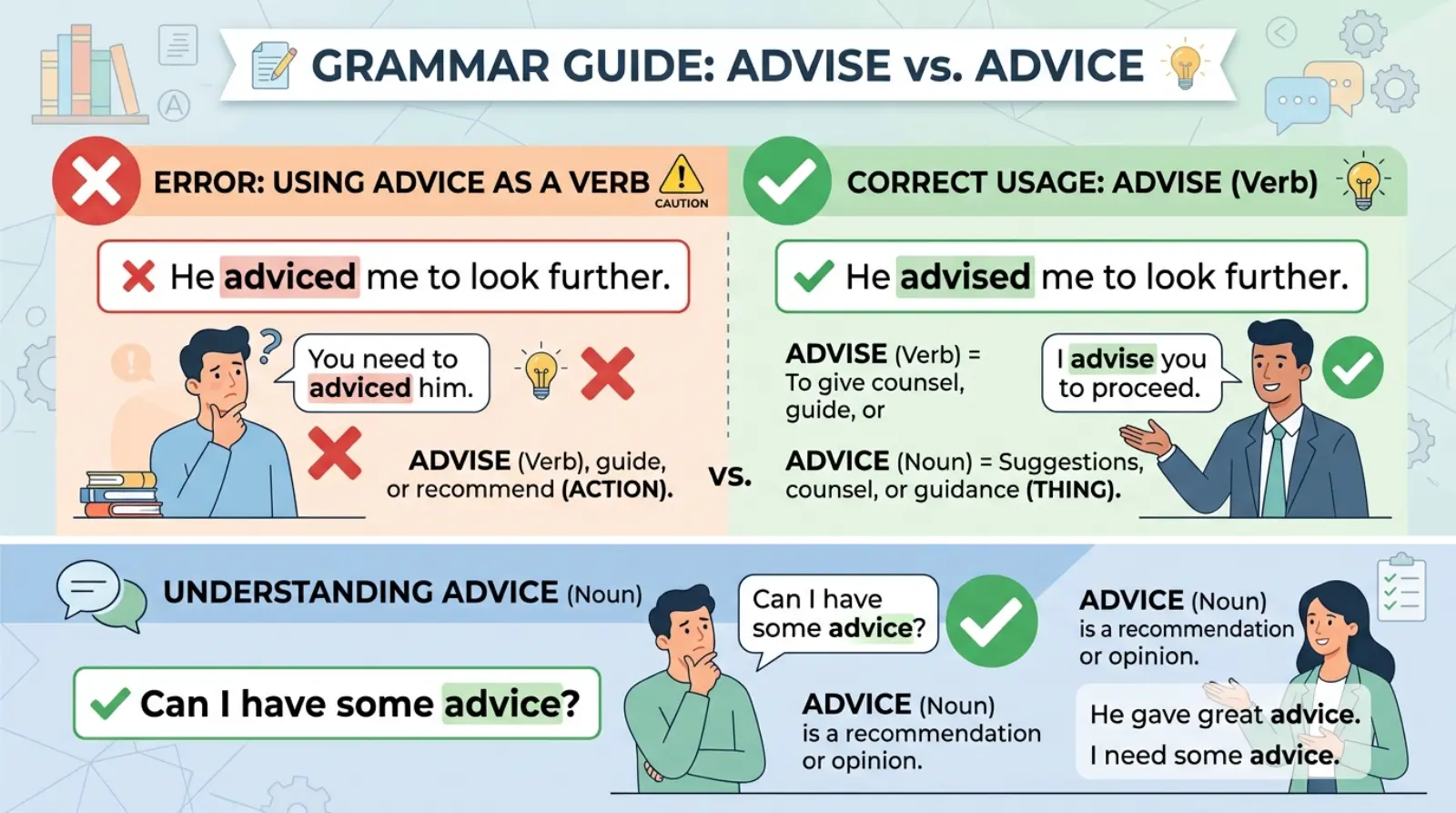
If you are asking someone to give you guidance, the correct phrase is “Please advise.” The word advise is a verb meaning “to give advice” or “to tell someone what they should do.” Advice is a noun meaning guidance or a recommendation.
People usually search for:
- please advise or please advice meaning
- please advise meaning
- please advice meaning
- is please advise correct
- is please advice grammatically correct
- please advise vs please advice
- please advise in an email
- how to use advise and advice
- advise or advice pronunciation
- correct grammar for please advise
The difference is small, but using the right word can make your emails and professional writing look much clearer.
In this guide, you’ll learn the meaning, pronunciation, examples, usage, grammar rules, common mistakes, expert tips, and simple explanations in easy English.
Please Advise or Please Advice: Quick Answer
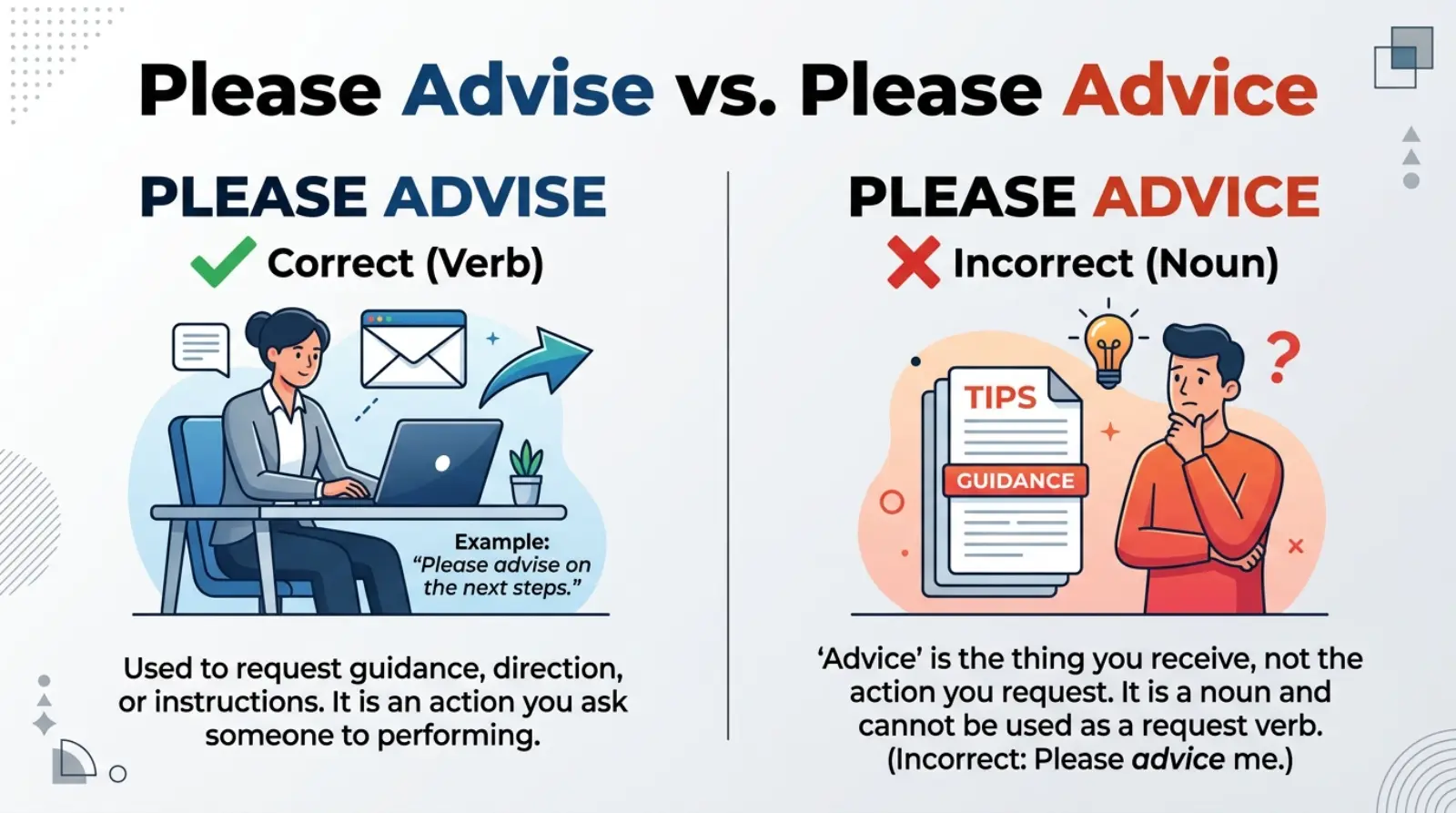
👉 Please advise = CORRECT when you are asking someone to give you information, guidance, or a recommendation.
👉 Please advice = INCORRECT in standard English because advice is a noun, not a verb.
Examples
Please advise me on what to do next.
Please advise if you need any additional information.
Please advise us of the next steps.
❌ Please advice me on what to do next.
❌ Please advice if you need anything else.
Simple Rule
Advise = verb = action
Advice = noun = thing
Think of it this way:
You advise someone, but you give someone advice.
A useful memory trick is:
S in advise = Say something helpful.
What Does Please Advise or Please Advice Mean?
Please advise
Please advise is a polite way to ask someone for information, guidance, or a decision.
For example:
Please advise me on the best option.
Here, advise is an action. You are asking the person to tell you what to do.
In professional emails, “Please advise” is common because it is short and polite.
Please advice
Please advice is generally incorrect when you mean “please give me guidance.”
The word advice is a noun.
For example:
Thank you for your advice.
You cannot normally replace advise with advice in “Please advise.”
Advise vs Advice
| Word | Grammar | Meaning | Example |
|---|---|---|---|
| Advise | Verb | To give guidance | Please advise me. |
| Advice | Noun | Guidance or recommendation | Thank you for your advice. |
Synonyms
Advise: recommend, suggest, guide, inform, counsel
Advice: guidance, recommendation, suggestion, opinion
Related Terms
- professional advice
- expert advice
- financial advice
- legal advice
- helpful advice
- advise someone
- advised decision
- advice column
The Origin of Advise and Advice
The two words are closely related.
Both come through French from Latin roots connected with the idea of considering or seeing something carefully.
Over time, English developed different forms for different grammar roles.
Advice became the noun for guidance or a recommendation.
Advise became the verb for the action of giving that guidance.
That is why the words look and sound similar but behave differently in a sentence.
How to Pronounce Please Advise or Please Advice
This is another reason learners become confused.
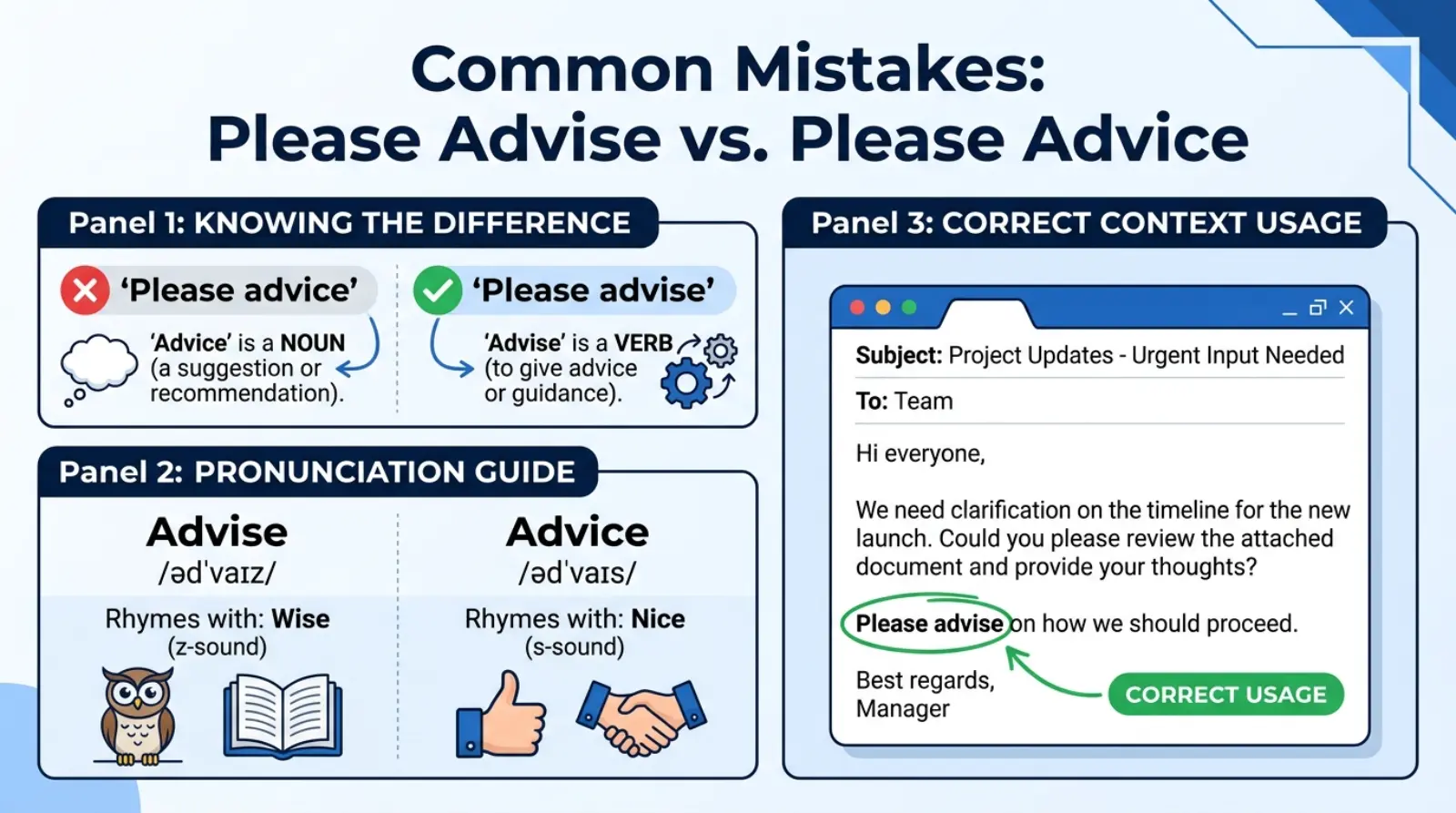
Advise
Advise → ad-VIZE
The final sound is like z.
Advice
Advice → ad-VICE
The final sound is like s.
So:
- advise → /ədˈvaɪz/
- advice → /ədˈvaɪs/
Easy pronunciation trick
Remember:
Advise = Z sound
Advice = S sound
The spelling also helps:
- advise → verb
- advice → noun
British English vs American English Usage
There is no major difference between British and American English in the basic grammar rule.
| Feature | British English | American English | Notes |
|---|---|---|---|
| Advise | Verb | Verb | Same meaning |
| Advice | Noun | Noun | Same meaning |
| Please advise | Correct | Correct | Common in professional writing |
| Please advice | Incorrect | Incorrect | Not standard usage |
| Pronunciation | Advise has /z/ | Advise has /z/ | Same basic distinction |
| Professional emails | Common | Common | Exact style may vary |
So whether you are writing in the UK, US, Canada, Australia, India, or Pakistan, the basic rule remains the same.
Which One Should You Use?
Use please advise when you want someone to respond with information, guidance, or a decision.
Formal emails
Please advise on the next steps.
Workplace communication
Please advise if the meeting time has changed.
Customer service
Please advise when my order will be delivered.
Academic communication
Please advise whether I should submit the revised paper.
Less formal communication
You can also write:
Please let me know what you think.
Could you let me know what I should do?
These alternatives can sound warmer and more natural than “Please advise,” especially in friendly emails.
| Situation | Best wording |
|---|---|
| Formal business email | Please advise. |
| Asking for information | Please advise me. |
| Friendly email | Please let me know. |
| Asking for an opinion | What do you recommend? |
| Asking for guidance | Could you advise me? |
| Referring to guidance received | Thank you for your advice. |
Common Mistakes With Please Advise or Please Advice
Mistake 1: Using advice as the verb
❌ Please advice me about the problem.
✔ Please advise me about the problem.
Why? “Advise” is the verb.
Tip: If you need an action word after “please,” use advise.
Mistake 2: Using advise as a noun
❌ Thank you for your advise.
✔ Thank you for your advice.
Why? You are talking about the guidance you received, so you need the noun advice.
Mistake 3: Confusing pronunciation
❌ Pronouncing “advise” with the final sound in “advice.”
✔ Say advise with a z sound.
Mistake 4: Writing “please advice” in business emails
❌ Please advice on this matter.
✔ Please advise on this matter.
This mistake often happens because “advice” is more familiar to many learners.
Mistake 5: Thinking both words are interchangeable
❌ “Advise” and “advice” can be used anywhere.
✔ They have different grammar roles.
Remember:
advise = action
advice = guidance
Mistake 6: Using “advise” when you mean “advice”
❌ She gave me good advise.
✔ She gave me good advice.
The verb is advise, but the noun is advice.
Please Advise or Please Advice in Everyday Examples
Work
✔ Please advise when the report is ready.
School
✔ Please advise me about the application process.
Social Media
✔ Can someone advise me on the best way to fix this?
Daily Life
✔ Could you advise me on which phone to buy?
✔ Please advise if any changes are required.
Text Message
✔ Can you advise me what I should do?
Online Content
✔ The website advises users to update their passwords.
Conversation
✔ My manager advised me to wait.
Notice that advice is used differently:
My manager gave me useful advice.
Please Advise in Different Contexts
Business
“Please advise” is often used when someone needs a decision or response.
Please advise whether we should continue with the order.
Workplace
It can ask for clarification.
Please advise which document I should complete.
Customer Service
Companies may use it when asking customers for information.
Please advise us of your preferred delivery date.
Education
Students can use advise when asking teachers for guidance.
Could you advise me on which course to choose?
Communication
In everyday English, “please let me know” may sound more natural.
Please let me know if you have any questions.
Google Trends and Search Behavior
People often search please advise or please advice because the two words have almost identical spelling and similar pronunciation.
The confusion can appear among English learners in the US, UK, India, Pakistan, Canada, and Australia.
Long-tail searches often focus on workplace communication, such as:
- Is “please advise” correct?
- Is “please advice” grammatically correct?
- Should I say please advise or please advice?
- What does please advise mean in an email?
- Is please advise rude?
- How do you use advise and advice?
This makes the topic especially useful for English learners and professionals who want their writing to sound accurate.
Comparison Table: Please Advise or Please Advice
| Feature | Please Advise | Please Advice |
|---|---|---|
| Standard English | ✅ Correct | ❌ Incorrect |
| Main word | Advise | Advice |
| Grammar role | Verb | Noun |
| Meaning | Ask someone to guide/inform you | Incorrect intended construction |
| Professional email | ✅ Yes | ❌ No |
| Academic writing | ✅ Yes | ❌ No |
| Texting | Possible | ❌ Avoid |
| Pronunciation of key word | /z/ sound | /s/ sound |
| Example | Please advise me. | Please advice me. ❌ |
Please Advise in Professional Life
Getting this small difference right can improve professional writing.
A sentence such as:
Please advise on the next steps.
is clear and grammatically correct.
However, professional communication does not always need to sound formal. Depending on the situation, these alternatives may feel more natural:
- Please let me know.
- Could you let me know?
- What do you recommend?
- Could you advise me?
- I would appreciate your guidance.
Is “Please advise” rude?
Usually, no. It is generally polite and professional.
However, it can sometimes sound brief or formal. If you are writing to a customer, colleague, or friend, “Please let me know” may sound warmer.
Please Advise for Students and Beginners
Beginners often struggle because advise and advice look nearly identical.
The easiest solution is to learn them as two separate grammar categories.
Advise = verb
Teachers advise students.
Advice = noun
Students receive advice.
Try creating your own pair:
My teacher advised me to study.
My teacher gave me good advice.
This simple comparison makes the difference much easier to remember.
Signs and Common Uses
You will usually see advise when:
- someone is asking for guidance
- someone is giving a recommendation
- someone is telling another person about something
- an organization needs information
- a professional is providing guidance
You will usually see advice when:
- someone receives guidance
- someone gives a recommendation
- you discuss useful information
- you refer to expert guidance
Examples:
The doctor advised him to rest.
The doctor gave him useful advice.
Simple Trick to Remember Please Advise or Please Advice
Think of the two words as an action and a thing.
🧠 Advise = action
🧠 Advice = thing
Think of it this way:
You advise someone.
You give someone advice.
So:
Please advise me. ✅
But:
Thank you for your advice. ✅
Quick memory sentence
I advise you. You receive my advice.
If you remember that one sentence, you can usually choose the correct word.
Expert Tips
- Check the grammar role first. Is the word doing an action? Use advise.
- Look for “give” or “receive.” These often take advice.
- Listen to the final sound. Advise ends with a /z/ sound.
- Read your email aloud. Hearing the sentence can help catch mistakes.
- Use “please let me know” when you want a friendlier business tone.
- Do not write “please advice” when asking someone for guidance.
- Practice both words together. This is easier than memorizing them separately.
Related Searches People Also Ask
Is “please advise” grammatically correct?
Yes. “Advise” is the correct verb when asking someone for guidance or information.
Is “please advice” ever correct?
Not in standard English when you mean “please give me guidance.”
What is the difference between advise and advice?
Advise is a verb. Advice is a noun.
Is please advise professional?
Yes. It is commonly used in formal and workplace communication.
Can I say please advise me?
Yes. “Please advise me” is grammatically correct.
Can I say please advice me?
No. Use “Please advise me.”
Is advice a verb or noun?
Advice is a noun.
Is advise a verb or noun?
Advise is a verb.
How do you pronounce advise?
It is pronounced roughly “ad-VIZE,” with a /z/ sound.
How do you pronounce advice?
It is pronounced roughly “ad-VICE,” with an /s/ sound.
Is “please advise” rude?
Usually not, but “please let me know” can sound friendlier.
Which is correct in an email, please advise or please advice?
“Please advise” is correct.
FAQs
Is “please advise or please advice” a grammar question?
Yes. The confusion is mainly about the different grammar roles of advise and advice.
Which is correct: please advise or please advice?
Please advise is correct when asking someone for guidance or information.
What does “please advise” mean?
It means “please give me information, guidance, or a recommendation.”
Why is “please advice” wrong?
Because advice is a noun. The verb you need is advise.
Can I use “please advise” in a formal email?
Yes. It is common in professional emails and business communication.
Is “please advise” better than “please let me know”?
Not always. “Please advise” is more formal, while “please let me know” can sound more natural and friendly.
What is an example of advice?
Thank you for your advice.
What is an example of advise?
My manager advised me to wait.
Does British English use “please advise”?
Yes. The same basic grammar rule applies in British and American English.
How can beginners remember the difference?
Remember: advise = verb, advice = noun.
Final Verdict
Please advise is correct when you are asking someone for guidance, information, or a recommendation.
Please advice is incorrect for this meaning.
The easiest rule is:
👉 Advise = action
👉 Advice = thing
Use “Please advise” in a professional email, or choose “Please let me know” if you want a warmer, more conversational tone.
Conclusion
The difference between please advise or please advice is simple once you understand the grammar.
Advise is a verb. It describes the action of giving guidance.
Advice is a noun. It describes the guidance itself.
So you can say:
Please advise me. ✅
And:
Thank you for your advice. ✅
But not:
Please advice me. ❌
When in doubt, remember the easiest sentence:
I advise you, and you receive my advice.
That one rule can help you choose the right word in emails, school writing, workplace messages, and everyday English.

Camila Green is an English language writer who specializes in confusing word comparisons and spelling explanations. She creates simple, beginner-friendly guides on topics like “niece or neice” and other common English mistakes. Her writing focuses on clarity, real-life examples, and easy learning. At VerrsaPick, she helps readers improve their English with practical and engaging content.