Imagine you are writing a sentence about something that caught fire. You type, “The toast was burned,” and then wonder, “Should it be burnt instead?” Both burned and burnt look correct, so this small grammar question can feel surprisingly confusing.
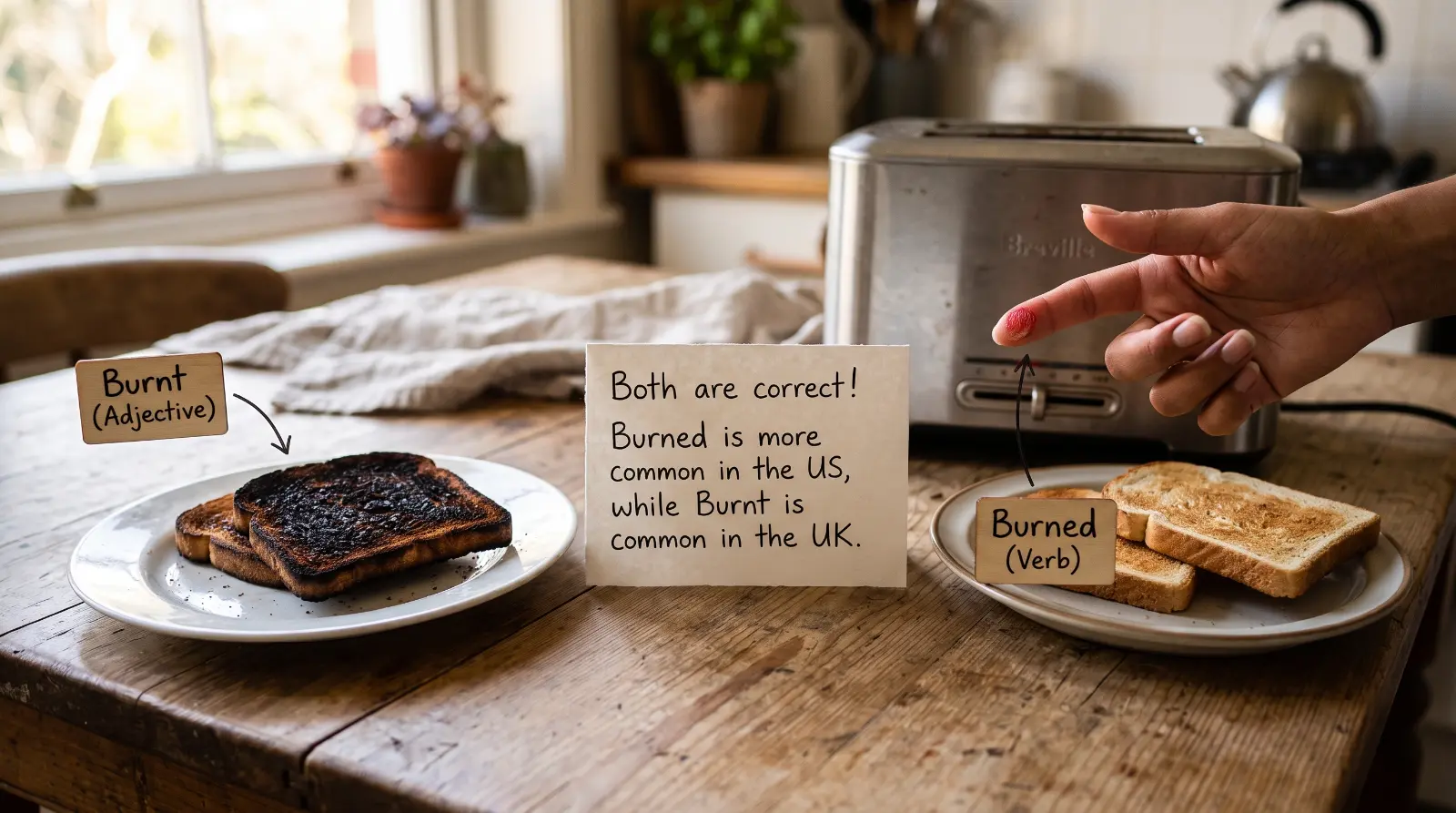
The good news is that both burned and burnt are correct forms of the verb burn. The main difference is often related to British and American English, as well as the way the word is used in a sentence. In American English, burned is generally more common, while British English commonly uses burnt, especially in certain expressions.
People usually search for: burned or burnt meaning, burned vs burnt, is burnt correct grammar, is burned correct, burnt pronunciation, burned pronunciation, burned or burnt past tense, and examples of burned and burnt.
You may see these words in school writing, workplace emails, books, news articles, cooking instructions, conversations, social media posts, and everyday English. Knowing the difference helps you choose the form that sounds natural for your audience.
In this guide, you’ll learn the meaning, pronunciation, examples, usage, grammar rules, common mistakes, expert tips, and simple explanations in easy English.
Burned or Burnt – Quick Answer
👉 Burned = past tense and past participle of “burn,” commonly used in American English.
Burnt = also a past tense and past participle of “burn,” especially common in British English.
Both are grammatically correct.
Examples
- The paper burned quickly.
- The paper burnt quickly.
- I burned the toast.
- I burnt the toast.
- She burned her hand.
- She burnt her hand.
Simple Rule
Burned and burnt can both describe something affected by fire or heat.
A useful shortcut is:
American English → burned is usually more common.
British English → burnt is often more common, especially as an adjective.
However, this is not an absolute rule. You can find both forms in different varieties of English.
What Does Burned or Burnt Mean?
Burned and burnt come from the verb burn, which means to damage, heat, or destroy something with fire or very high heat.
For example:
The cake was burned in the oven.
The sentence means that the cake was exposed to too much heat and became damaged.
Burnt can have the same meaning:
The cake was burnt in the oven.
Both sentences are understandable and grammatically acceptable.
Burned as a Verb
When burned acts as a verb, it describes an action.
He burned the old papers.
The candle burned all night.
Burnt as an Adjective
Burnt is also very common as an adjective describing something affected by fire or heat.
I don’t like the burnt taste.
The kitchen smelled of burnt toast.
This adjective use is especially common in British English.
Synonyms
Depending on context, synonyms can include:
- scorched
- charred
- singed
- damaged by fire
- heated
- consumed by fire
These words are not always exact replacements. For example, charred usually suggests something became blackened by strong heat.
Opposites
Possible opposites include:
- unburned
- unharmed
- untouched
- cool
- preserved
Related Terms
Some related forms are:
- burn
- burns
- burning
- burned
- burnt
- fire
- flame
- heat
- scorch
- char
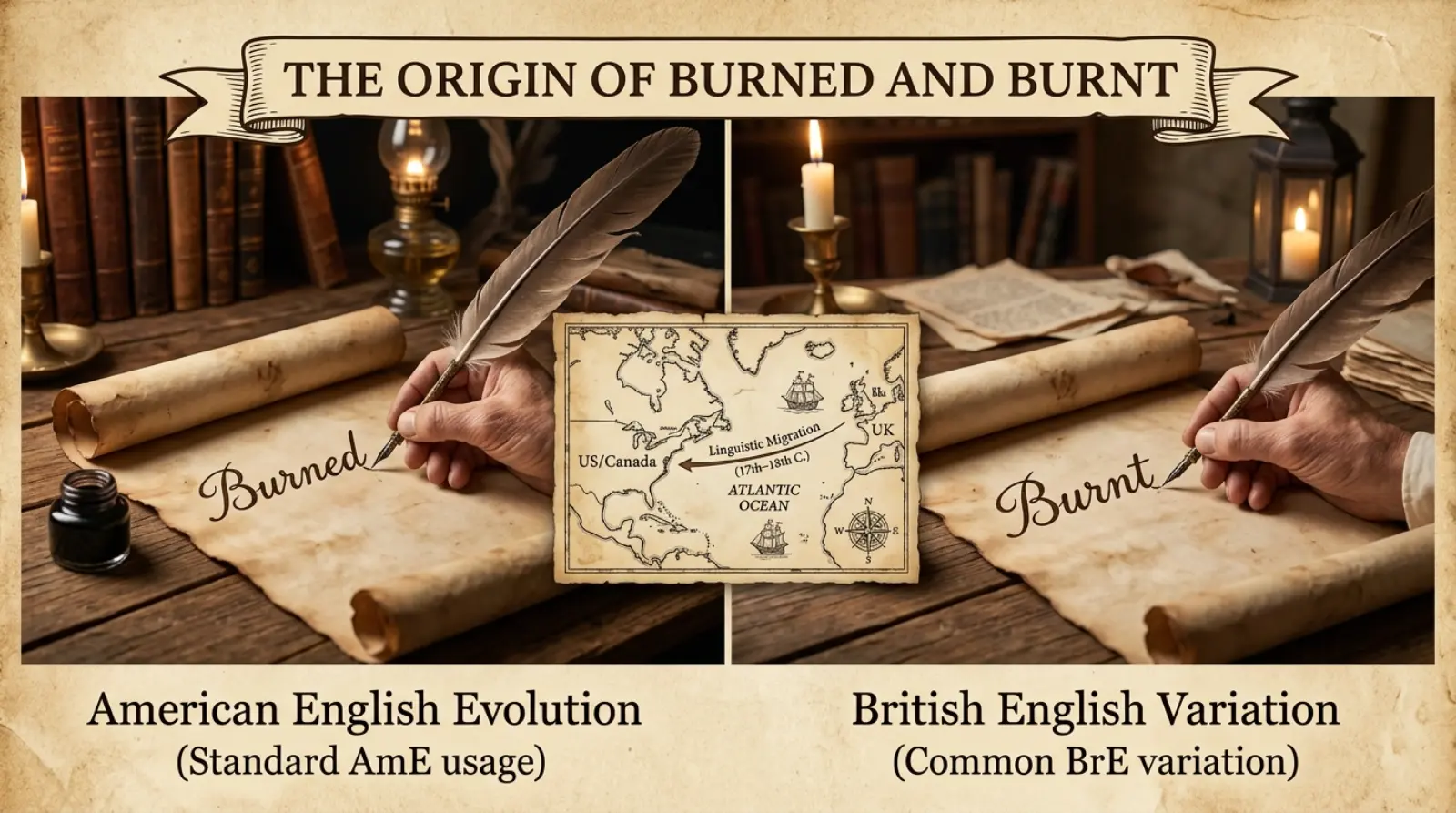
The Origin of Burned and Burnt
The words burned and burnt come from the old verb burn.
English has historically had different patterns for forming past-tense verbs. Some verbs developed regular -ed forms, while others kept older forms that resemble irregular verbs.
Over time, burned became the regular-looking form, while burnt remained an established alternative.
That is why modern English has both forms.
The difference is not that one word is “real” and the other is a mistake. Both have a long history in English.
Today, regional language habits help determine which form people prefer. American English tends to favor burned, while British English often uses burnt, particularly when describing the result of burning.
How to Pronounce Burned or Burnt
The pronunciation is simple.
Burned
Burned → /bɜːrnd/ in British pronunciation and approximately /bɝːnd/ in American pronunciation.
It sounds roughly like:
“bernd”
It is normally pronounced as one syllable.
Burnt
Burnt → /bɜːnt/ in British pronunciation and approximately /bɝːnt/ in American pronunciation.
It sounds roughly like:
“bernt”
It is also one syllable.
Common Pronunciation Mistake
Do not add an extra syllable:
❌ burn-ed
✔ burned
In normal speech, burned is generally one syllable.
British English vs American English Usage
The biggest difference between burned and burnt is regional preference.
| Feature | British English | American English | Notes |
|---|---|---|---|
| Burned | Correct | Correct | More common in American English |
| Burnt | Correct | Correct | Especially common in British English |
| Burned as verb | Common | Very common | Describes an action |
| Burnt as adjective | Very common | Used | Common in phrases such as burnt toast |
| Past tense | Burned/burnt | Usually burned | Both can occur |
| Past participle | Burned/burnt | Usually burned | Both are possible |
| Meaning | Same basic meaning | Same basic meaning | Context determines meaning |
Which One Should You Use?
Choose based on your audience and the type of writing.
- You are writing in American English.
- You want the regular -ed form.
- You are describing an action.
- Your audience normally uses American English.
Example:
The chef burned the vegetables.
- You are writing in British English.
- You are describing a burnt object or result.
- You are using an expression where burnt sounds natural.
Example:
The toast has a burnt smell.
Mini Usage Guide
| Sentence | Natural? |
|---|---|
| I burned the toast. | ✅ |
| I burnt the toast. | ✅ |
| The toast was burned. | ✅ |
| The toast was burnt. | ✅ |
| The burnt toast smelled awful. | ✅ |
| The burned toast smelled awful. | ✅ |
Common Mistakes With Burned or Burnt
Mistake 1: Thinking “burnt” is incorrect
❌ Burnt is wrong English.
✔ Burnt is a correct English word.
It is an accepted form of the past tense and past participle of burn.
Correction tip: Remember that English can have more than one accepted form of a verb.
Mistake 2: Thinking “burned” is only American
❌ Burned can only be used in American English.
Burned is also used in British English.
British English does not completely avoid burned.
Mistake 3: Treating “burnt” and “burned” as different meanings
Burnt means something different from burned in every sentence.
✔ They often have the same basic meaning.
The difference is usually style, regional preference, or grammatical context.
Mistake 4: Using “burning” for a completed action
❌ I am burning the toast yesterday.
✔ I burned the toast yesterday.
Use burning for an ongoing action and burned/burnt for a completed action.
Mistake 5: Adding an extra syllable to “burned”
❌ burn-ed
✔ burned
The word is normally pronounced as one syllable.
Mistake 6: Assuming every “burn” sentence needs “burnt”
❌ She burnt her hand is the only correct option.
She burned her hand is also correct.
The best choice depends partly on your variety of English.
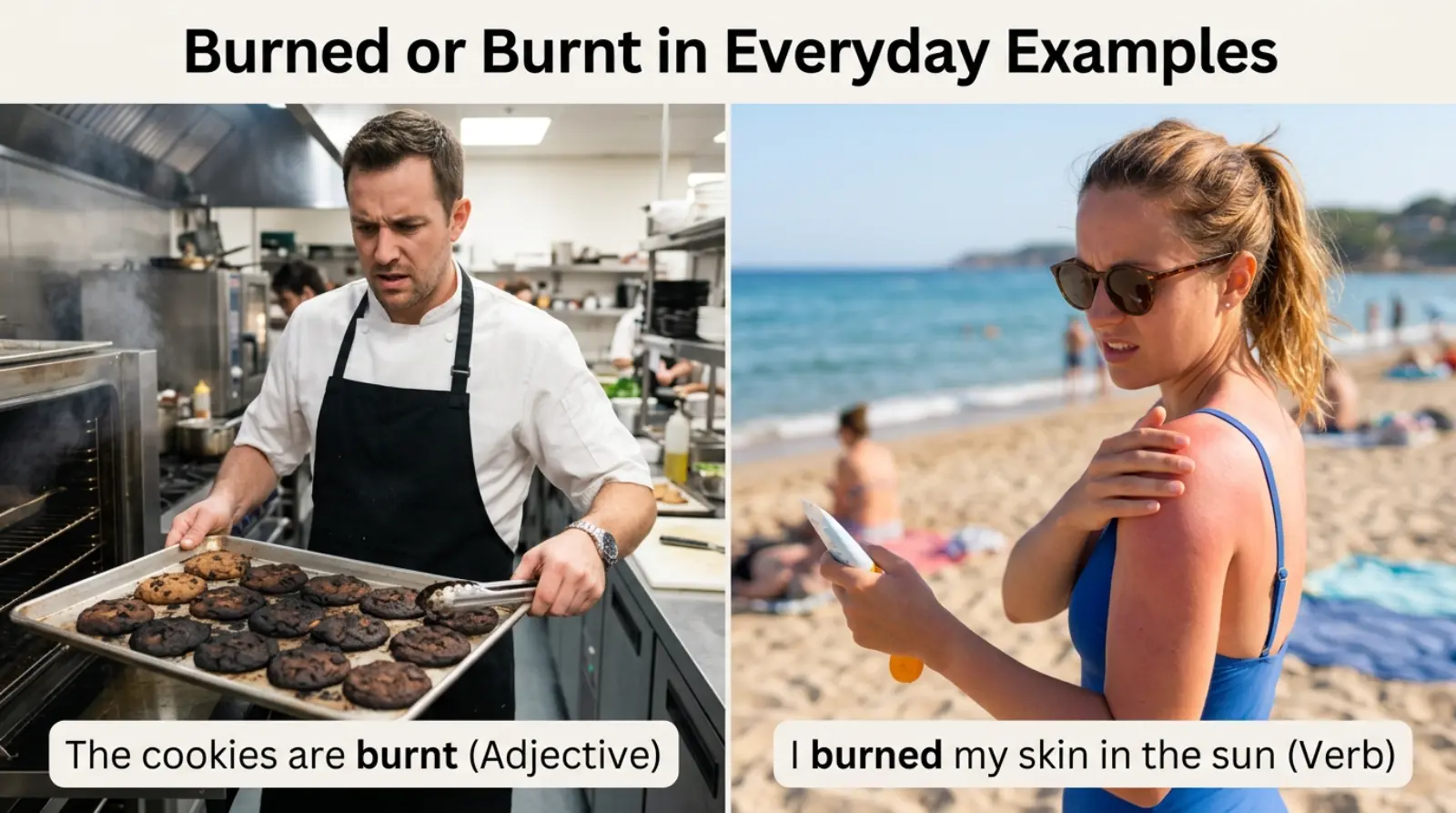
Burned or Burnt in Everyday Examples
Work
The documents were accidentally burned.
British English:
Some old documents were burnt.
School
The student wrote that the wood burned quickly.
Social Media
I burned my dinner again!
Daily Life
I burnt the toast this morning.
Emails
The paper was accidentally burned during the test.
Text Messages
I burnt the pizza 😭
Online Content
These vegetables taste better when they are not burnt.
Conversations
“Did you burn the cookies?”
“Unfortunately, yes!”
Burned or Burnt in Different Contexts
In Cooking
Both forms are common.
I burned the chicken.
I burnt the chicken.
As an adjective, burnt is particularly common in phrases such as:
burnt toast
burnt sugar
burnt food
In Workplace Writing
For American English business writing, burned is usually a safe choice.
The electrical fault caused the wire to become burned.
However, technical writing may use more precise words such as scorched, charred, damaged, or overheated, depending on the situation.
In Education
Students may encounter both forms in books and lessons.
The important point is not to mark burnt as automatically wrong. Instead, learn that burned and burnt are both accepted forms.
In British English
Burnt is very natural in everyday British usage:
The toast is burnt.
He burnt the old letter.
In American English
Burned is generally the more common choice:
The toast is burned.
He burned the old letter.
Burned or Burnt – Google Trends and Usage
People often search “burned or burnt” because both forms appear in real English. A learner may see burnt in a British book but learn burned in an American English class, creating confusion.
Searches also come from long-tail questions such as:
- Is burnt a correct word?
- Is burned or burnt correct?
- What is the past tense of burn?
- Is burnt British English?
- Is burned American English?
- Should I say burnt toast or burned toast?
- How do you pronounce burned?
- How do you pronounce burnt?
- Is burnt grammatically correct?
Interest can come from English learners and writers in the United States, United Kingdom, India, Pakistan, Canada, and Australia. These regions use English in slightly different ways, so learners may encounter both forms.
Rather than assuming that one form is always correct, it is better to understand regional preference and sentence context.
Comparison Table: Burned vs Burnt
| Feature | Burned | Burnt |
|---|---|---|
| Correct word? | ✅ Yes | ✅ Yes |
| Basic meaning | Affected by fire/heat | Affected by fire/heat |
| Past tense | Yes | Yes |
| Past participle | Yes | Yes |
| Common in American English | Very common | Less common |
| Common in British English | Common | Very common |
| Adjective use | Yes | Very common |
| Formal writing | Yes | Yes |
| Academic writing | Yes | Yes |
| Everyday speech | Very common | Very common |
| Incorrect? | No | No |
Burned or Burnt in Professional Life
In professional writing, consistency matters more than choosing one form as universally “correct.”
If your company follows American English, burned may fit better:
The circuit was burned during the test.
If your organization follows British English, burnt may sound more natural:
The material was burnt during the process.
For technical documents, always choose the word that communicates the exact condition. Sometimes scorched, charred, damaged, or overheated is more precise than either word.
Burned or Burnt for Students and Beginners
Beginners often struggle because English contains many verbs with more than one accepted form.
The easiest lesson is:
Burn → burned / burnt
You do not need to panic when you see either form.
Beginner Shortcut
Think about the English variety you are learning.
- American English → burned is usually the safest everyday choice.
- British English → burnt is often very natural.
- Mixed international English → both may be understood and accepted.
If your teacher, school, employer, or style guide prefers one variety, follow that standard consistently.
Common Uses of Burned and Burnt
You will commonly see these forms with:
- food
- wood
- paper
- buildings
- candles
- electrical wires
- skin
- clothing
- fuel
- cooking
- fire
- heat
- accidents
Common phrases include:
- burned food
- burnt toast
- burned hand
- burnt smell
- burned wood
- burnt sugar
- burned paper
- burnt offering
- burned-out light
- burning fire
Remember that some expressions have their own preferred wording, so context always matters.
Simple Trick to Remember Burned or Burnt
Think of burn as having two accepted past forms:
BURN → BURNED / BURNT
Think of it like two roads leading to the same destination. One road is more common in some English-speaking regions, while the other may be preferred elsewhere.
Think of it this way:
American English → burned
British English → burnt
For example:
American: I burned the toast.
British: I burnt the toast.
Both communicate the same basic idea.
Expert Tips for Choosing Burned or Burnt
Here are a few simple tips that can make your writing stronger:
- Know your audience. Use the form that matches your preferred English variety.
- Do not call “burnt” a spelling mistake. It is a legitimate English form.
- Do not assume “burned” is wrong in British English. It is still used.
- Watch the context. “Burnt toast” is a very familiar phrase.
- Be consistent. If you are following American English, favor American usage throughout your article.
- Use precise vocabulary when needed. “Charred” and “scorched” can be more specific than “burned.”
- Check your style guide. Academic, business, and publishing standards may have a preferred variety of English.
Related Searches People Also Ask
Is burnt a correct word?
Yes. Burnt is a correct form of the verb burn and is especially common in British English.
Is burned grammatically correct?
Yes. Burned is the regular past-tense and past-participle form of burn and is especially common in American English.
Is burnt British or American?
Burnt is strongly associated with British English, although it can also be found in American English.
Is burned American English?
Burned is especially common in American English, but it is not limited to the United States.
Should I say burned toast or burnt toast?
Both are correct. Burnt toast is particularly common in British English, while burned toast is very common in American English.
What is the past tense of burn?
The past tense can be burned or burnt.
What is the past participle of burn?
The past participle can also be burned or burnt.
Is “burnt” formal English?
Yes. Burnt is standard English, not slang. Its frequency depends on region and context.
Do burned and burnt mean the same thing?
Usually, yes. Both describe something that has been affected by fire or heat.
Which form should English learners use?
If learning American English, burned is a useful default. If learning British English, burnt is very common. Both should be recognized.
FAQs About Burned or Burnt
1. Is “burned or burnt” the correct grammar?
Yes. Both burned and burnt are accepted forms of the verb burn.
2. Which is more common, burned or burnt?
Burned is generally more common in American English, while burnt is especially common in British English.
3. Can I use burnt in American English?
Yes. Americans may use burnt, although burned is usually more common.
4. Can I use burned in British English?
Yes. British English also uses burned, although burnt is often preferred in everyday expressions.
5. Is “burnt” an adjective?
Yes. Burnt can work as an adjective.
The burnt toast smelled awful.
6. Is “burned” an adjective?
Yes. Burned can also describe a condition.
His burned hand needed care.
7. What is the easiest way to remember burned and burnt?
Remember: both are correct. Think burn → burned/burnt.
8. Are burned and burnt pronounced differently?
Yes. Burned ends with a d sound, while burnt ends with a t sound.
9. Should students avoid burnt?
No. Students should learn both forms and follow the English variety required by their school or writing style.
10. Is “burned” more formal than “burnt”?
Not necessarily. Neither is automatically more formal. Regional preference and context are more important.
Final Verdict: Burned or Burnt?
Burned and burnt are both correct.
The easiest rule is:
👉 Burned = more common in American English.
👉 Burnt = especially common in British English.
Both can be used as the past tense and past participle of burn, and both can describe something affected by fire or heat.
For most American English writing, burned is a safe choice. For British English, burnt is often the more natural choice.
Conclusion
The confusion between burned or burnt is understandable because English allows both forms. You do not need to treat one as a mistake.
The main difference is usage and regional preference, not basic meaning. American English generally favors burned, while British English frequently uses burnt. Still, both forms can appear in both varieties.
So if you write, “I burned the toast,” your sentence is correct. If you write, “I burnt the toast,” that can also be correct.
Final memory trick:
🔥 Burn → burned or burnt. Both work; choose the form that fits your English variety.

Camila Green is an English language writer who specializes in confusing word comparisons and spelling explanations. She creates simple, beginner-friendly guides on topics like “niece or neice” and other common English mistakes. Her writing focuses on clarity, real-life examples, and easy learning. At VerrsaPick, she helps readers improve their English with practical and engaging content.