Imagine you are studying chemistry and your teacher suddenly asks, “Is PCl3 polar or nonpolar?” You know that polarity has something to do with electronegativity, but the molecular shape can make the answer confusing.
This is a common question in chemistry classes, homework, quizzes, and online searches. Students often know that chlorine is more electronegative than phosphorus, but they are not always sure whether the bond differences cancel each other out.
The good news is that PCl3 is a polar molecule. Its polarity comes from both its polar P–Cl bonds and its molecular shape.
People usually search for: PCl3 polar or nonpolar, PCl3 polarity, is phosphorus trichloride polar, PCl3 Lewis structure, PCl3 molecular geometry, PCl3 bond angle, and why PCl3 is polar.
Understanding PCl3 is useful because it teaches an important chemistry rule: bond polarity and molecular polarity are not always the same thing.
In this guide, you’ll learn the meaning, pronunciation, examples, usage, grammar rules, common mistakes, expert tips, and simple explanations in easy English.
PCl3 Polar or Nonpolar – Quick Answer
👉 PCl3 = Polar molecule
👉 PCl3 = phosphorus trichloride
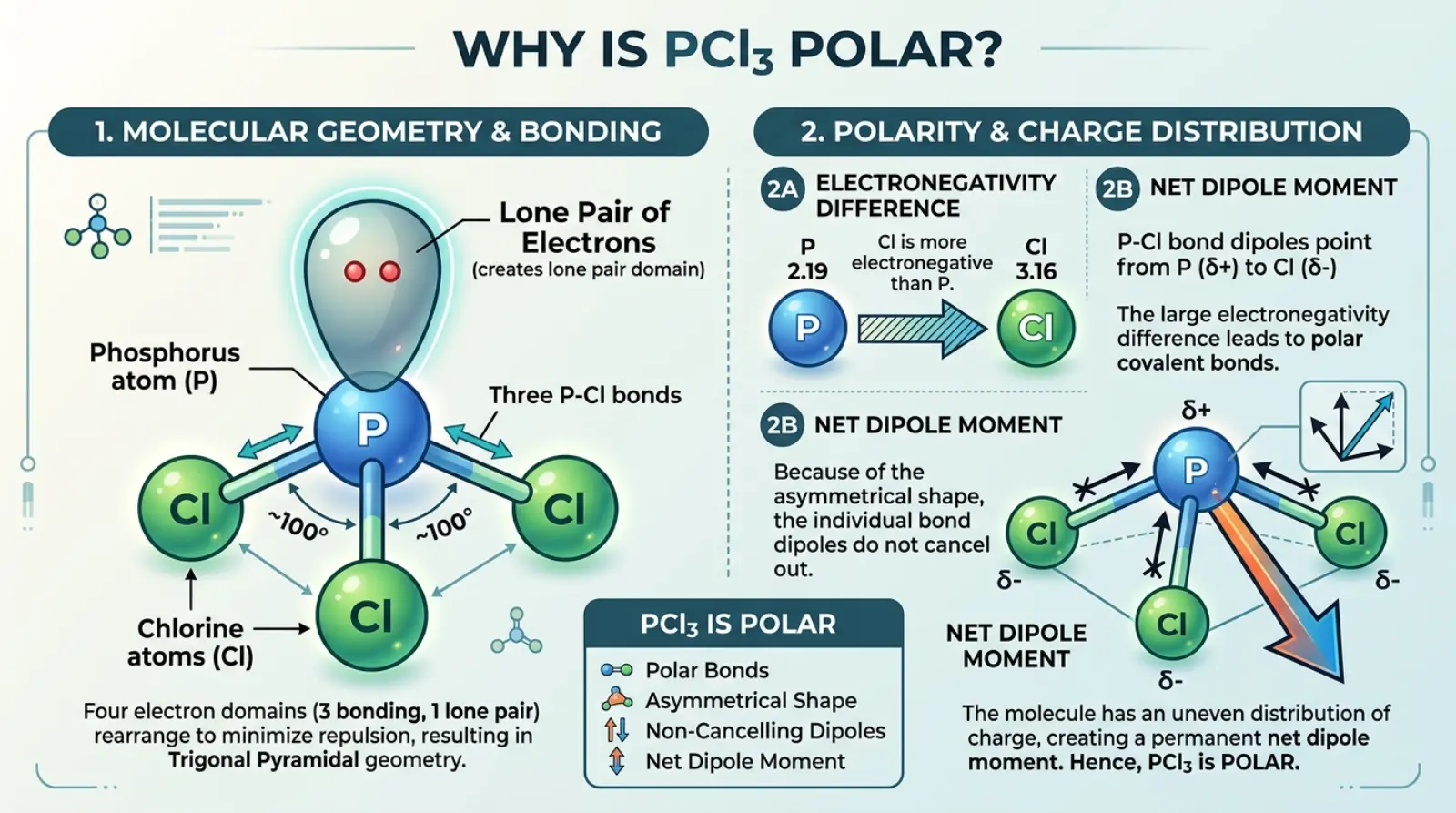
PCl3 is polar because it has three polar P–Cl bonds and a trigonal pyramidal molecular shape.
The chlorine atoms pull electrons more strongly than phosphorus. Because the molecule is not symmetrical enough to cancel these pulls, PCl3 has a net dipole moment.
Simple Rule
PCl3 is polar because its polar bonds do not cancel.
Why?
- Phosphorus (P) is the central atom.
- It is bonded to three chlorine (Cl) atoms.
- Phosphorus also has one lone pair.
- The lone pair changes the molecular shape.
- The molecule becomes trigonal pyramidal.
- The P–Cl bond dipoles do not completely cancel.
Example
PCl3 → polar ✅
PCl3 has polar covalent bonds → yes ✅
symmetrical trigonal planar shape → no ❌
Easy Memory Trick
Think:
“PCl3 has a pyramid, so the pulls do not cancel.”
The pyramidal shape is one of the biggest clues that PCl3 is polar.

What Does PCl3 Mean?
PCl3 is the chemical formula for phosphorus trichloride.
It contains:
- 1 phosphorus atom
- 3 chlorine atoms
The molecule has covalent bonds between phosphorus and chlorine.
To understand its polarity, you need to look at two things:
- Bond polarity
- Molecular geometry
Is the P–Cl Bond Polar?
Yes.
Chlorine is more electronegative than phosphorus. This means chlorine attracts the shared bonding electrons more strongly.
As a result, each P–Cl bond has a partial charge:
Pδ+ — Clδ−
The chlorine side becomes slightly negative, while the phosphorus side becomes slightly positive.
Is PCl3 Molecularly Polar?
Yes.
Although the individual bonds are polar, the final answer depends on the entire molecular shape.
PCl3 has a trigonal pyramidal geometry, so the three bond dipoles do not cancel completely.
That leaves the molecule with an overall dipole.
Related Terms
- Polarity
- Electronegativity
- Dipole moment
- Covalent bond
- Lewis structure
- Lone pair
- Molecular geometry
- Trigonal pyramidal
- Bond angle
- Valence electrons
The Origin of PCl3 Polarity
The polarity of PCl3 can be understood using basic ideas from chemical bonding.
Phosphorus belongs to Group 15 of the periodic table and has five valence electrons. Chlorine belongs to Group 17 and has seven valence electrons.
Phosphorus forms three bonds with chlorine and retains one lone pair.
The three P–Cl bonds are arranged around the phosphorus atom. However, the lone pair takes up space and affects the shape.
According to VSEPR theory, electron pairs around the central atom repel each other. This gives PCl3 a trigonal pyramidal molecular geometry.
This shape matters because the molecule is not arranged in a way that makes all bond dipoles cancel.
Therefore, PCl3 has a net molecular dipole.
How to Understand PCl3 Lewis Structure
The Lewis structure helps explain why PCl3 is polar.
Phosphorus is placed in the center because it is less electronegative than chlorine.
The structure contains:
- Three single P–Cl bonds
- One lone pair on phosphorus
- Three lone pairs on each chlorine atom
A simplified representation is:
Cl — P — Cl
with a third Cl attached to phosphorus and a lone pair remaining on P.
That lone pair is extremely important.
It causes the molecule to have a trigonal pyramidal shape, rather than a flat trigonal planar shape.
This uneven three-dimensional arrangement produces the overall polarity.
PCl3 Molecular Geometry and Bond Angle
PCl3 has a trigonal pyramidal molecular geometry.
Its electron-domain geometry is tetrahedral because there are four electron regions around phosphorus:
- Three bonding pairs
- One lone pair
The lone pair occupies one region of the tetrahedral arrangement.
This pushes the P–Cl bonds slightly closer together.
The bond angle is approximately 100°, although the exact value can vary depending on how the geometry is described and measured.
The key point for beginners is not the exact angle.
The important fact is:
PCl3 is trigonal pyramidal, and this shape allows a net dipole to remain.
British English vs American English Usage
Because PCl3 is a chemical formula, there is no major British-versus-American spelling difference.
| Feature | British English | American English | Notes |
|---|---|---|---|
| Chemical formula | PCl3 | PCl3 | Same |
| Chemical name | phosphorus trichloride | phosphorus trichloride | Same |
| Polarity | polar | polar | Same |
| Lewis structure | Lewis structure | Lewis structure | Same |
| Molecular geometry | trigonal pyramidal | trigonal pyramidal | Same |
| Pronunciation | similar | similar | Minor accent differences |
Chemistry terminology is generally standardized worldwide.
Which One Should You Use?
If your question is “Is PCl3 polar or nonpolar?”, the correct answer is:
PCl3 is polar.
Use this explanation in school, university, homework, laboratory discussions, and academic writing.
Quick Academic Answer
PCl3 is a polar molecule because the P–Cl bonds are polar and the molecule has a trigonal pyramidal shape, so the bond dipoles do not cancel.
For Exams
A short answer may be enough:
PCl3 is polar due to its polar P–Cl bonds and trigonal pyramidal geometry.
Common Mistakes With PCl3 Polar or Nonpolar
Mistake 1: Thinking three bonds automatically cancel
❌ “PCl3 has three bonds, so the molecule must be nonpolar.”
✔ The number of bonds does not determine polarity by itself.
The shape determines whether bond dipoles cancel.
Tip: Always check molecular geometry.
Mistake 2: Ignoring the lone pair
❌ “PCl3 has three chlorine atoms, so it must be trigonal planar.”
✔ Phosphorus has one lone pair, so PCl3 is trigonal pyramidal.
Tip: Count lone pairs on the central atom.
Mistake 3: Looking only at electronegativity
❌ “Chlorine is more electronegative, so that is the whole answer.”
✔ Electronegativity explains why the bonds are polar, but shape explains the overall molecular polarity.
Mistake 4: Confusing PCl3 with a symmetrical molecule
❌ “Three identical chlorine atoms make PCl3 symmetrical enough to be nonpolar.”
✔ The lone pair creates a three-dimensional pyramidal structure.
Mistake 5: Confusing PCl3 with BF3
❌ “PCl3 and BF3 have similar formulas, so they should have the same polarity.”
✔ BF3 is trigonal planar and symmetrical, while PCl3 is trigonal pyramidal because phosphorus has a lone pair.
PCl3 in Everyday Chemistry Examples
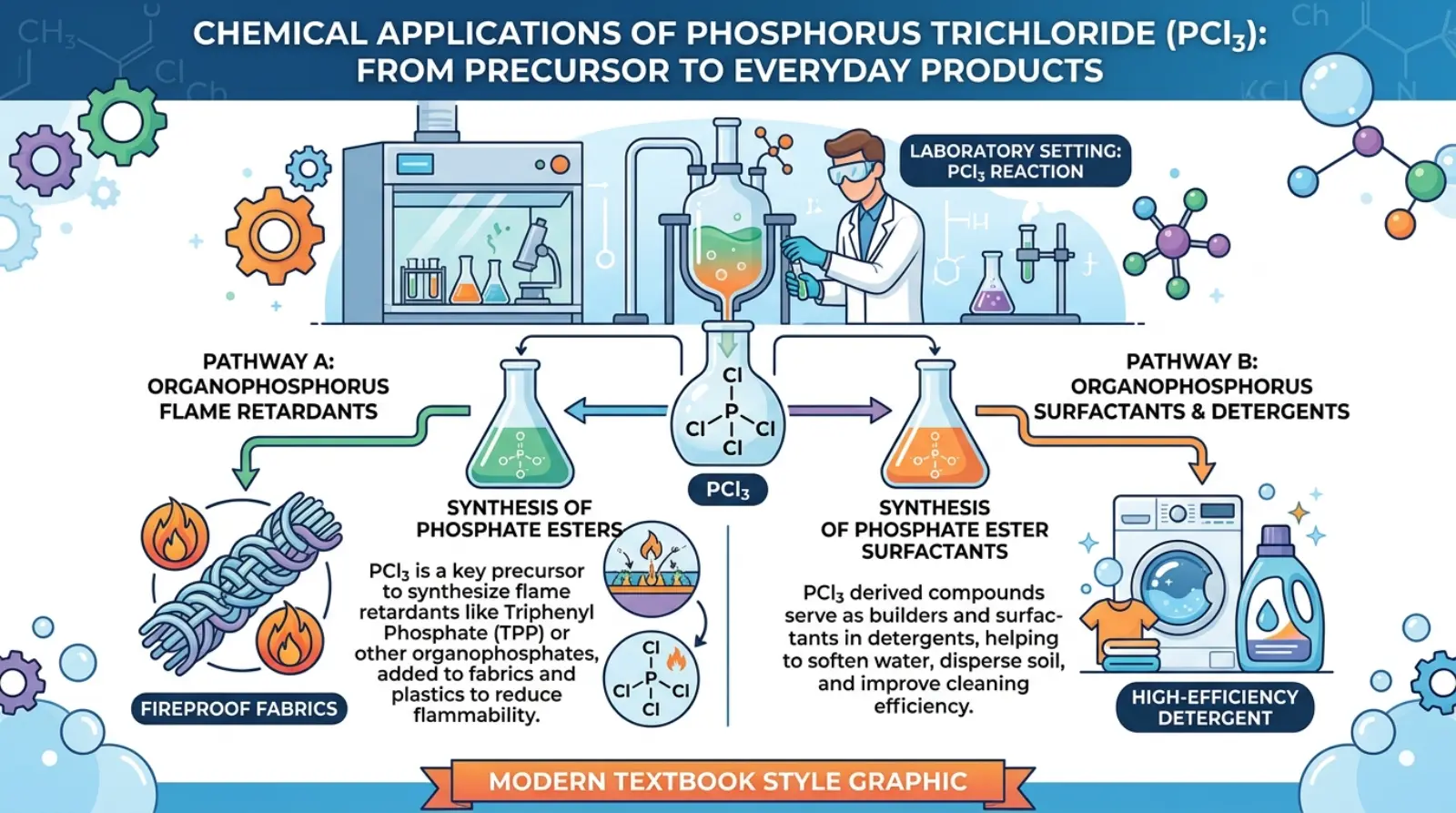
PCl3 is mainly discussed in chemistry, laboratory, industrial, and academic contexts rather than everyday conversation.
School
“Is PCl3 polar or nonpolar?”
“Draw the Lewis structure of PCl3.”
Homework
“Explain why PCl3 has a dipole moment.”
Classroom Conversation
“PCl3 is polar because its molecular geometry is trigonal pyramidal.”
Online Chemistry Content
A student might search:
“Why is PCl3 polar?”
“Does PCl3 have a dipole moment?”
“PCl3 Lewis structure and polarity”
Academic Writing
“PCl3 exhibits molecular polarity because of its asymmetric electron distribution.”
PCl3 in Different Chemistry Contexts
Electronegativity
Chlorine has a higher electronegativity than phosphorus. This makes the P–Cl bonds polar.
VSEPR Theory
VSEPR theory explains the shape by considering electron-pair repulsion around phosphorus.
Lewis Structure
The Lewis structure shows three P–Cl bonds and one lone pair on phosphorus.
Molecular Geometry
The molecular geometry is trigonal pyramidal.
Dipole Moment
Because the bond dipoles do not cancel, PCl3 has a nonzero molecular dipole moment.
Covalent Bonding
The P–Cl bonds are covalent bonds with unequal sharing of electrons.
PCl3 Polar or Nonpolar Comparison Table
| Feature | PCl3 |
|---|---|
| Chemical name | Phosphorus trichloride |
| Formula | PCl3 |
| Central atom | Phosphorus |
| P–Cl bonds | Polar covalent |
| Lone pairs on P | 1 |
| Molecular geometry | Trigonal pyramidal |
| Electron geometry | Tetrahedral |
| Overall polarity | Polar |
| Dipole moment | Nonzero |
| Main reason | Polar bonds do not cancel |
The most important row is overall polarity: polar.
PCl3 in Professional and Academic Life
PCl3 is commonly discussed in chemistry education, chemical research, and industrial chemistry.
Students may encounter it in questions about:
- Molecular polarity
- Lewis structures
- VSEPR theory
- Electronegativity
- Dipole moments
- Covalent bonding
- Molecular geometry
When writing a professional or academic explanation, avoid saying only “PCl3 is polar.”
A stronger answer explains why:
“PCl3 is polar because its three P–Cl bonds are polar and its trigonal pyramidal geometry prevents complete cancellation of the bond dipoles.”
That gives both the answer and the chemical reasoning.
PCl3 for Students and Beginners
Many beginners struggle because they learn polarity as a simple electronegativity problem.
But molecular polarity usually requires two steps:
Step 1: Check whether the bonds are polar.
Step 2: Check the molecular shape.
For PCl3:
P–Cl bonds → polar
Molecular shape → trigonal pyramidal
Dipoles → do not cancel
Final answer → polar
This four-step method works well for many molecular polarity questions.
Signs That a Molecule May Be Polar
When deciding whether a molecule is polar, look for these clues:
- Polar bonds are present.
- The central atom has lone pairs.
- The molecule has an uneven shape.
- Bond dipoles do not cancel.
- The molecule has an overall dipole moment.
PCl3 has several of these characteristics.
That is why it is a useful example for learning molecular polarity.
Simple Trick to Remember PCl3 Polar or Nonpolar
Use this shortcut:
PCl3 = Pyramidal = Polar
Think of PCl3 as a small pyramid.
Because the molecule is not flat and perfectly symmetrical, the pulls from the chlorine atoms do not cancel.
Think of it this way:
Imagine three people pulling an object in different directions.
If their positions are perfectly balanced, the forces can cancel.
But if one arrangement is uneven, some force remains.
PCl3 has an uneven three-dimensional arrangement because of its lone pair.
Uneven shape → dipoles remain → polar molecule.
Expert Tips for Solving Polarity Questions
Use this simple checklist:
- Draw the Lewis structure.
- Count lone pairs on the central atom.
- Find the molecular geometry.
- Check whether the bonds are polar.
- Ask whether the bond dipoles cancel.
- If they do not cancel, the molecule is polar.
For PCl3:
Lewis structure → one lone pair on P
Shape → trigonal pyramidal
P–Cl bonds → polar
Dipoles → do not cancel
Answer → PCl3 is polar.
Related Searches People Also Ask
Is PCl3 polar or nonpolar?
PCl3 is polar because it has polar P–Cl bonds and a trigonal pyramidal shape.
Why is PCl3 polar?
Its bond dipoles do not cancel because of its trigonal pyramidal molecular geometry.
What is the shape of PCl3?
PCl3 has a trigonal pyramidal molecular shape.
Does PCl3 have a lone pair?
Yes. Phosphorus has one lone pair in PCl3.
Are PCl3 bonds polar?
Yes. The P–Cl bonds are polar because chlorine attracts electrons more strongly than phosphorus.
What is the Lewis structure of PCl3?
It has three P–Cl single bonds and one lone pair on phosphorus.
What is the bond angle of PCl3?
The P–Cl bond angle is approximately 100°.
Is PCl3 ionic or covalent?
PCl3 is a covalent molecular compound.
Does PCl3 have a dipole moment?
Yes. Its asymmetric shape gives it a nonzero molecular dipole moment.
Is PCl3 trigonal planar?
No. PCl3 is trigonal pyramidal.
Final Verdict
PCl3 is polar.
The easiest way to remember it is:
Polar P–Cl bonds + trigonal pyramidal shape = polar PCl3.
The lone pair on phosphorus is especially important because it prevents the molecule from having a symmetrical trigonal planar shape.
Conclusion
So, is PCl3 polar or nonpolar?
The answer is simple: PCl3 is polar.
Its three P–Cl bonds are polar because chlorine attracts the shared electrons more strongly than phosphorus. More importantly, phosphorus has one lone pair, giving the molecule a trigonal pyramidal shape.
Because the bond dipoles do not completely cancel, PCl3 has an overall dipole.
If you are solving a chemistry exam question, remember this quick trick:
PCl3 → pyramidal → polar.
Once you learn to check both bond polarity and molecular shape, questions about polar and nonpolar molecules become much easier.

Camila Green is an English language writer who specializes in confusing word comparisons and spelling explanations. She creates simple, beginner-friendly guides on topics like “niece or neice” and other common English mistakes. Her writing focuses on clarity, real-life examples, and easy learning. At VerrsaPick, she helps readers improve their English with practical and engaging content.