Have you ever typed “inquire” in an email and then wondered if “enquire” was actually the correct spelling? You are not alone. These two words look almost identical, sound nearly the same, and have the same basic meaning.
The confusion becomes even stronger when you read English from different countries. You may see inquire in an American business email but enquire on a British website. So, is one wrong? Not at all.
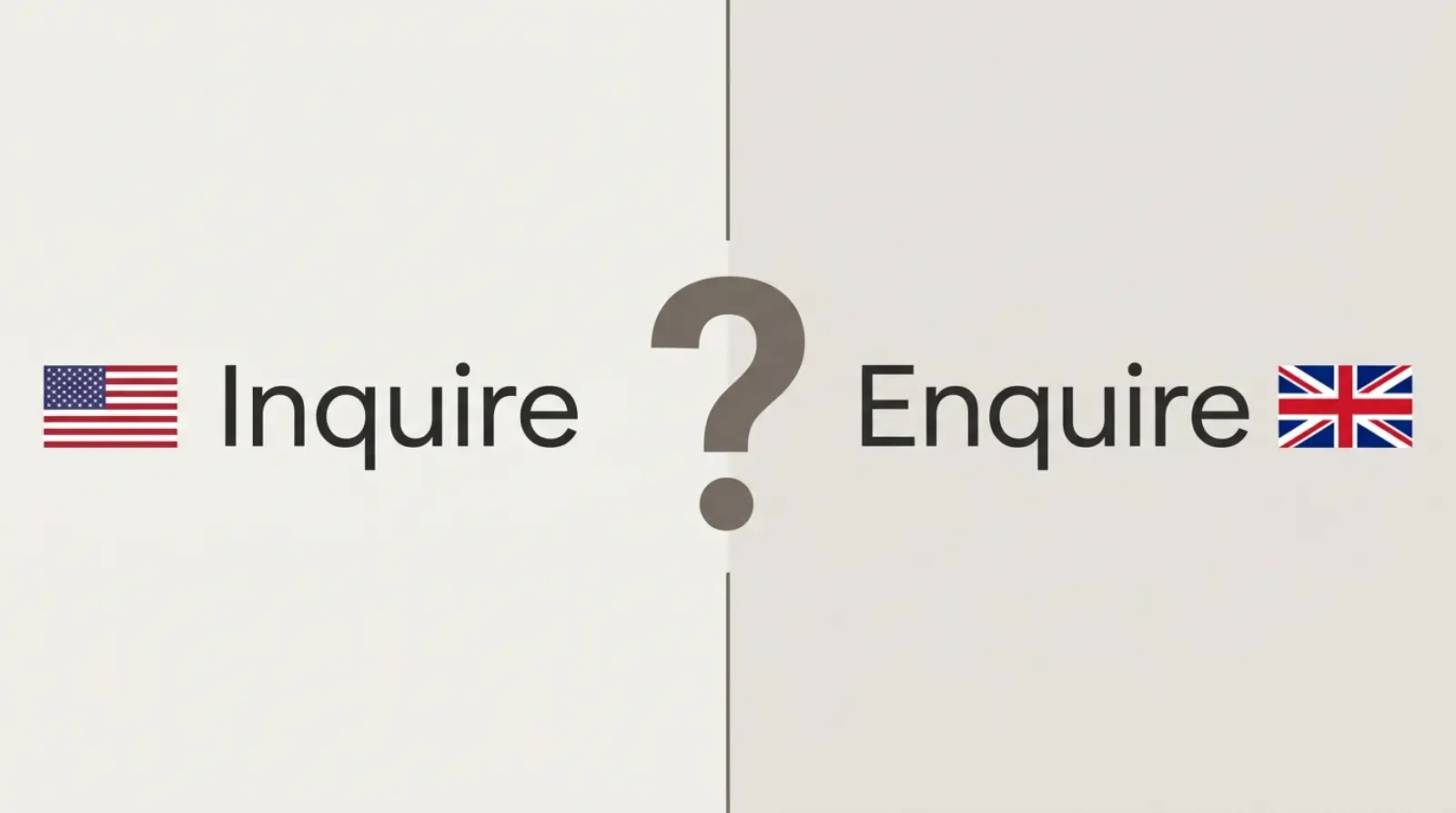
Both inquire and enquire are correct English words. The main difference is regional usage and style. In American English, inquire is the normal spelling. In British English, enquire is common, although inquire is also used. Cambridge lists enquire as the British form of inquire and defines both as asking for information.
You may encounter these words at school, in the workplace, in business emails, customer service messages, online forms, social media, and everyday conversations.
People usually search for:
- inquire or enquire meaning
- inquire or enquire correct spelling
- inquire vs enquire
- how to pronounce inquire
- how to pronounce enquire
- inquire or enquire in British English
- inquire or enquire in American English
- examples of inquire and enquire
- grammar difference between inquire and enquire
The good news is that you do not need to memorize two completely different words. They have the same basic meaning. You mainly need to remember which spelling fits the variety of English you are using.
In this guide, you’ll learn the meaning, pronunciation, examples, usage, grammar rules, common mistakes, expert tips, and simple explanations in easy English.
Inquire or Enquire – Quick Answer
👉 Inquire = to ask for information; the usual spelling in American English.
👉 Enquire = to ask for information; a common spelling in British English.
Both are correct.
Examples:
- I called to inquire about the price.
- I called to enquire about the price.
- She wants to inquire about the course.
- She wants to enquire about the course.
- We emailed the company to inquire about delivery.
Simple Rule:
👉 US English → inquire
👉 British English → enquire is common
Cambridge recognizes enquire as a UK form and inquire as the standard form used in American English.
Memory trick:
Think “US = in-quire” and “UK = en-quire.” This is only a memory aid, not a strict rule, because British English can also use inquire.
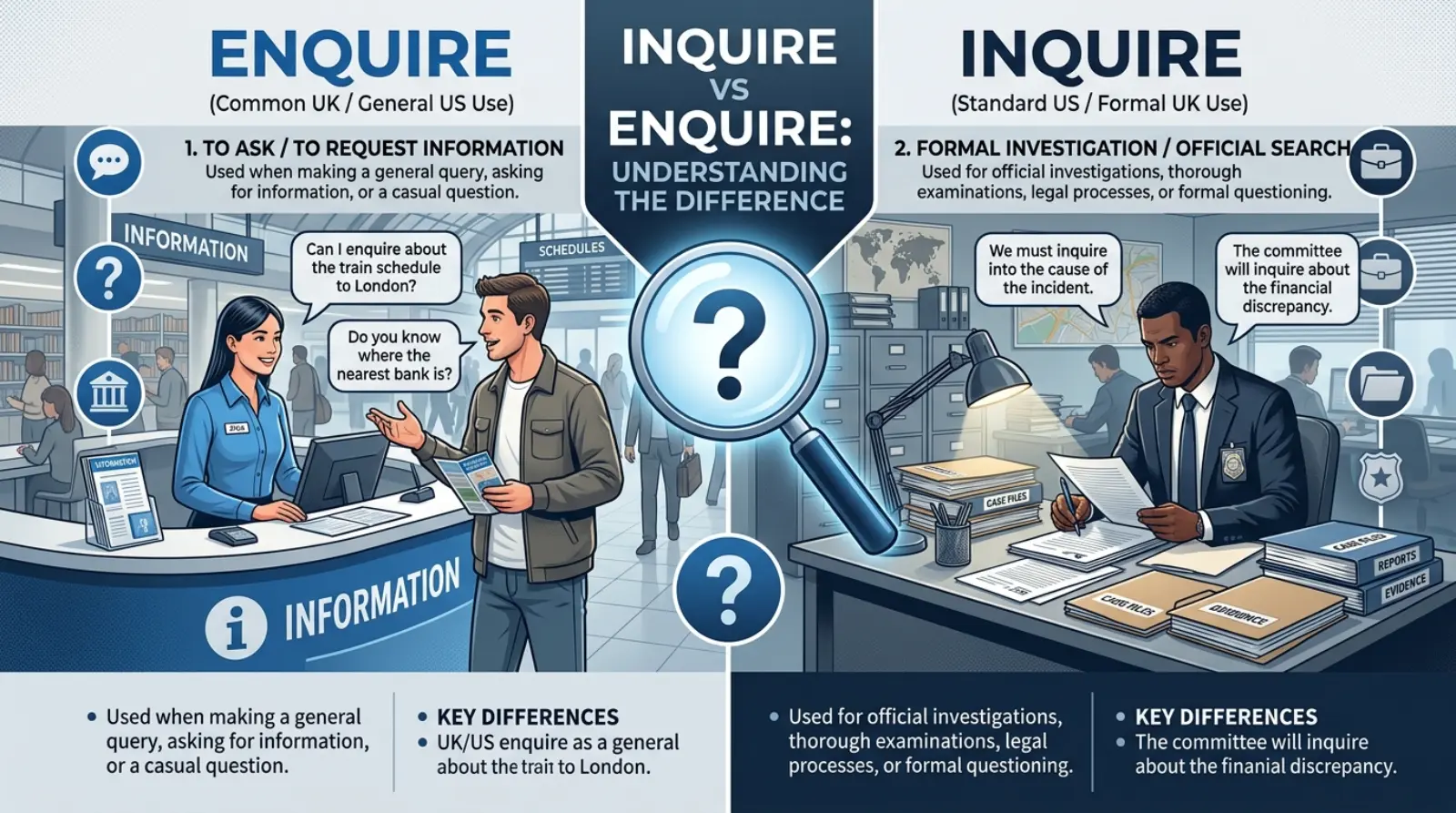
What Does Inquire or Enquire Mean?
Inquire and enquire mean to ask for information.
For example:
I am writing to inquire about your services.
This means:
I am writing to ask for information about your services.
Both words are verbs. They are often followed by about, whether, what, when, why, or how.
Synonyms
Common synonyms include:
- ask
- question
- request information
- seek information
- consult
- investigate
Opposites
There is no perfect direct opposite, but words such as answer, inform, or tell can express the opposite action depending on the sentence.
Related Terms
You may also see:
- inquiry
- enquiry
- inquirer
- enquirer
- inquiring
- enquiring
- inquire about
- enquire about
- inquire into
- enquire into
Inquiry and enquiry follow a similar regional spelling pattern.
The Origin of Inquire or Enquire
Both spellings have a long history in English and are related to older French and Latin forms connected with asking or seeking information.
Over time, English developed different spelling traditions. The forms inquire and enquire survived side by side.
Today, the biggest difference is regional rather than meaning-based.
American English generally favors inquire, while British English commonly uses enquire. Cambridge lists both forms and gives the same basic meaning: asking for information.
How to Pronounce Inquire or Enquire
Both words are pronounced almost the same.
Inquire: in-KWIRE
Enquire: en-KWIRE
A simple phonetic guide is:
inquire → /ɪnˈkwaɪər/
enquire → /ɪnˈkwaɪə(r)/ in British English
Cambridge gives the US pronunciation of inquire as /ɪnˈkwaɪr/ and the UK pronunciation as /ɪnˈkwaɪə(r)/.
Common Pronunciation Mistake
Do not pronounce the middle part like “keer.”
The key sound is “kwire.”
Think:
in + kwire = inquire
en + kwire = enquire
British English vs American English Usage
| Feature | British English | American English | Notes |
|---|---|---|---|
| Common spelling | enquire | inquire | Both are understood |
| Meaning | Ask for information | Ask for information | Same basic meaning |
| Pronunciation | Similar | Similar | Regional sound may vary |
| Formal writing | enquire/inquire | inquire | Inquire is especially common |
| Business writing | enquire is common | inquire is common | Both are professional |
| Academic writing | Both possible | inquire is usual | Follow local style |
| Related noun | enquiry/inquiry | inquiry | Regional preference |
British English does not completely reject inquire. Cambridge specifically notes inquire as a form used in the UK, while enquire is marked UK.
Which One Should You Use?
Use the spelling that matches your audience.
- Writing for Americans: choose inquire.
- Writing for a British audience: enquire is a natural choice.
- Writing for international business: inquire is widely understood.
- Academic writing: follow your institution’s preferred English style.
- Emails: either can be correct depending on your regional style.
- Social media: both are understandable.
- Professional documents: consistency matters more than switching between forms.
For example, if your company uses British English, you might write:
Please enquire about available appointments.
For American English:
Please inquire about available appointments.
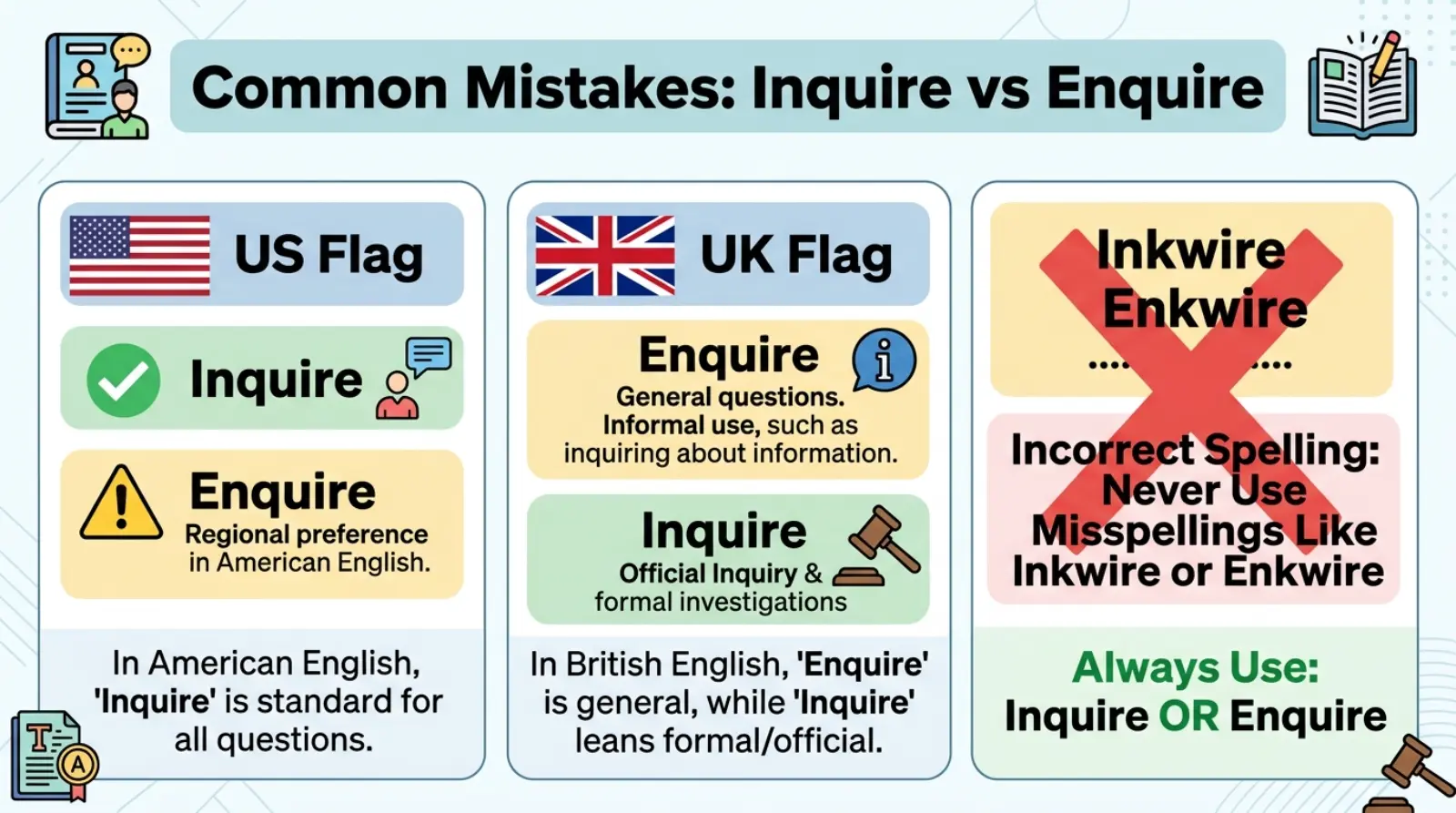
Common Mistakes With Inquire or Enquire
Mistake 1: Thinking Enquire Is Incorrect
❌ Enquire is wrong.
✔ Enquire is a correct English word.
It is especially common in British English.
Mistake 2: Thinking Inquire Is Only American
❌ British speakers never use inquire.
✔ Inquire is also used in British English.
The two forms overlap, although regional preferences differ.
Mistake 3: Mixing Styles Without a Reason
❌ Please enquire about the price and then inquire about delivery.
✔ Please enquire about the price and delivery.
Using both spellings in one document can look inconsistent.
Mistake 4: Confusing Inquire With Investigate
Inquire usually means ask for information, but inquire into can mean investigate something.
✔ The manager inquired about the delay.
✔ The committee inquired into the complaint.
Mistake 5: Using “Inquire” When “Ask” Sounds Better
“Inquire” is correct, but sometimes ask sounds more natural.
I asked my teacher about the homework.
This is usually more conversational than:
I inquired with my teacher about the homework.
Inquire or Enquire in Everyday Examples
Work
I would like to inquire about the open position.
School
I emailed the college to enquire about admission requirements.
Business
The customer called to inquire about the refund policy.
I am writing to enquire about the available packages.
Text Message
Can you inquire about the tickets for me?
Social Media
I messaged the page to inquire about the price.
Daily Conversation
I called to ask about the appointment.
Online Content
Visit our contact page to inquire about our services.
Inquire or Enquire in Different Contexts
Education
Students often use these words when asking about courses, admissions, exams, scholarships, or deadlines.
I am enquiring about the scholarship deadline.
Business
Businesses use inquire/enquire in customer service, sales, and professional communication.
Please inquire about bulk pricing.
Workplace
The word can make a request sound more formal than simply saying ask.
She inquired about the meeting schedule.
Writing and Communication
The choice depends mainly on your English variety and the audience. The important thing is to remain consistent.
Inquire or Enquire – Usage and Search Trends
People often search this phrase because spelling differences between American and British English create genuine confusion.
Searches commonly include:
- inquire or enquire which is correct
- inquire vs enquire UK
- inquire vs enquire US
- is enquire a word
- is inquire correct in British English
- enquire meaning in English
- inquire meaning and examples
- how to spell inquire
- how to spell enquire
- inquire pronunciation
- enquire pronunciation
The strongest pattern is regional: American English tends to favor “inquire,” while British English commonly uses “enquire.” The words are also relevant to business searches because people frequently use them when asking about prices, services, applications, bookings, and availability. Cambridge’s Business English Dictionary includes both regional usage patterns.
This makes the topic especially useful for English learners in countries such as the US, UK, India, Pakistan, Canada, and Australia, where people may encounter different English conventions online.
Inquire or Enquire Comparison Table
| Feature | Inquire | Enquire |
|---|---|---|
| Correct spelling? | Yes | Yes |
| Basic meaning | Ask for information | Ask for information |
| Verb? | Yes | Yes |
| Common in US English? | Yes | Less common |
| Common in UK English? | Yes | Yes |
| Professional use | Yes | Yes |
| Academic use | Yes | Yes |
| Social media use | Yes | Yes |
| Pronunciation | in-KWIRE | en-KWIRE |
| Main difference | Regional preference | Regional preference |
Inquire or Enquire in Professional Life
Choosing the right regional spelling can make your writing look polished and consistent.
In American business writing:
Please inquire about our current pricing.
In British business writing:
Please enquire about our current pricing.
Both sentences are clear and professional.
The bigger lesson is consistency. If your company follows British English, use British spelling throughout your document. If it follows American English, use American spelling.
Inquire or Enquire for Students and Beginners
Beginners often think one spelling must be wrong because the difference looks unusual.
The easiest way to understand it is:
Same meaning + different regional preference.
You do not need to learn a completely different definition.
Remember:
Inquire → common US spelling
Enquire → common UK spelling
Also remember that British English can use inquire, so do not mark it as automatically wrong.
Signs and Common Uses of Inquire or Enquire
You will commonly see these words when someone wants information about:
- prices
- products
- services
- courses
- jobs
- appointments
- tickets
- reservations
- delivery
- applications
- business opportunities
- customer support
- policies
- schedules
Common patterns include:
inquire/enquire about + noun
I inquired about the price.
She enquired whether the office was open.
The committee inquired into the complaint.
Simple Trick to Remember Inquire or Enquire
Think about the audience first.
American audience → INQUIRE
British audience → ENQUIRE
Then remember that both mean “ask for information.”
Think of it this way:
Imagine two people asking the same question.
The American writer says:
“I want to inquire about the course.”
The British writer says:
“I want to enquire about the course.”
The question is the same. Only the preferred spelling changes.
Expert Tips for Using Inquire or Enquire
- Know your audience. Use the spelling common in their variety of English.
- Stay consistent. Do not randomly switch between inquire and enquire.
- Use “ask” for casual writing when it sounds more natural.
- Use “inquire/enquire about” when requesting information formally.
- Remember “inquiry/enquiry” because the noun follows a similar regional pattern.
- Do not call “enquire” incorrect. It is a legitimate English spelling.
- Check your organization’s style guide for professional and academic documents.
Related Searches People Also Ask
Is inquire or enquire correct?
Both are correct. Inquire is especially common in American English, while enquire is common in British English.
Is enquire British or American?
Enquire is strongly associated with British English.
Is inquire American English?
Yes. Inquire is the usual American spelling.
Can British people use inquire?
Yes. British English also uses inquire.
Do inquire and enquire mean the same thing?
Yes, in their ordinary use, both mean to ask for information.
Are inquiry and enquiry also different?
Yes. The same regional spelling pattern generally applies: inquiry is common in American English, while enquiry is common in British English.
Is inquire formal?
It can sound more formal than the simple verb ask.
What is the pronunciation of inquire?
It is commonly pronounced in-KWIRE.
What is the pronunciation of enquire?
It is commonly pronounced en-KWIRE.
Which should I use in a US business email?
Use inquire.
Which should I use in British English?
Enquire is a natural choice, although inquire is also used.
Final Verdict
Inquire and enquire are both correct.
Inquire is the safer choice for American English.
Enquire is especially common in British English.
Both mean to ask for information.
The pronunciation is very similar.
Easy memory rule:
US → inquire. UK → enquire.
Just remember that British English can also use inquire, so enquire is not the “correct” version and inquire the “wrong” version—or vice versa.
Conclusion
The confusion around inquire or enquire is understandable because the two words have almost the same spelling, sound, and meaning.
The important difference is regional preference. Inquire is the normal choice in American English, while enquire is widely used in British English. Both can be used to mean “ask for information.”
If you are writing for a specific country, follow its spelling style. If you are writing for an international audience, inquire is widely recognized and works well.
Final memory trick: Ask yourself, “Am I writing US or UK English?” Then choose the spelling that matches your audience.

Camila Green is an English language writer who specializes in confusing word comparisons and spelling explanations. She creates simple, beginner-friendly guides on topics like “niece or neice” and other common English mistakes. Her writing focuses on clarity, real-life examples, and easy learning. At VerrsaPick, she helps readers improve their English with practical and engaging content.