Have you ever stopped while writing and wondered whether you should use her or hers? You’re not alone. This is one of the most common grammar questions for English learners because both words refer to a female person, yet they are used in different ways.
You may see her and hers in school assignments, workplace emails, books, social media posts, text messages, and everyday conversations. Since they look similar, many beginners accidentally use one in place of the other. A small mistake can make a sentence sound awkward or grammatically incorrect.
People usually search for:
- Her or hers meaning
- Difference between her and hers
- Her vs hers examples
- When to use her
- When to use hers
- Her definition
- Hers definition
- Grammar rules for her and hers
The good news is that the difference is easy to understand. Her is used before a noun or as an object pronoun, while hers is a possessive pronoun that replaces a noun. Once you learn this simple rule, you’ll know which word to use every time.
Whether you’re a student, English learner, teacher, writer, or professional, understanding the difference between her and hers will make your English clearer and more natural.
In this guide, you’ll learn the meaning, pronunciation, examples, usage, grammar rules, common mistakes, expert tips, and simple explanations in easy English.
Her or Hers – Quick Answer
Quick Answer
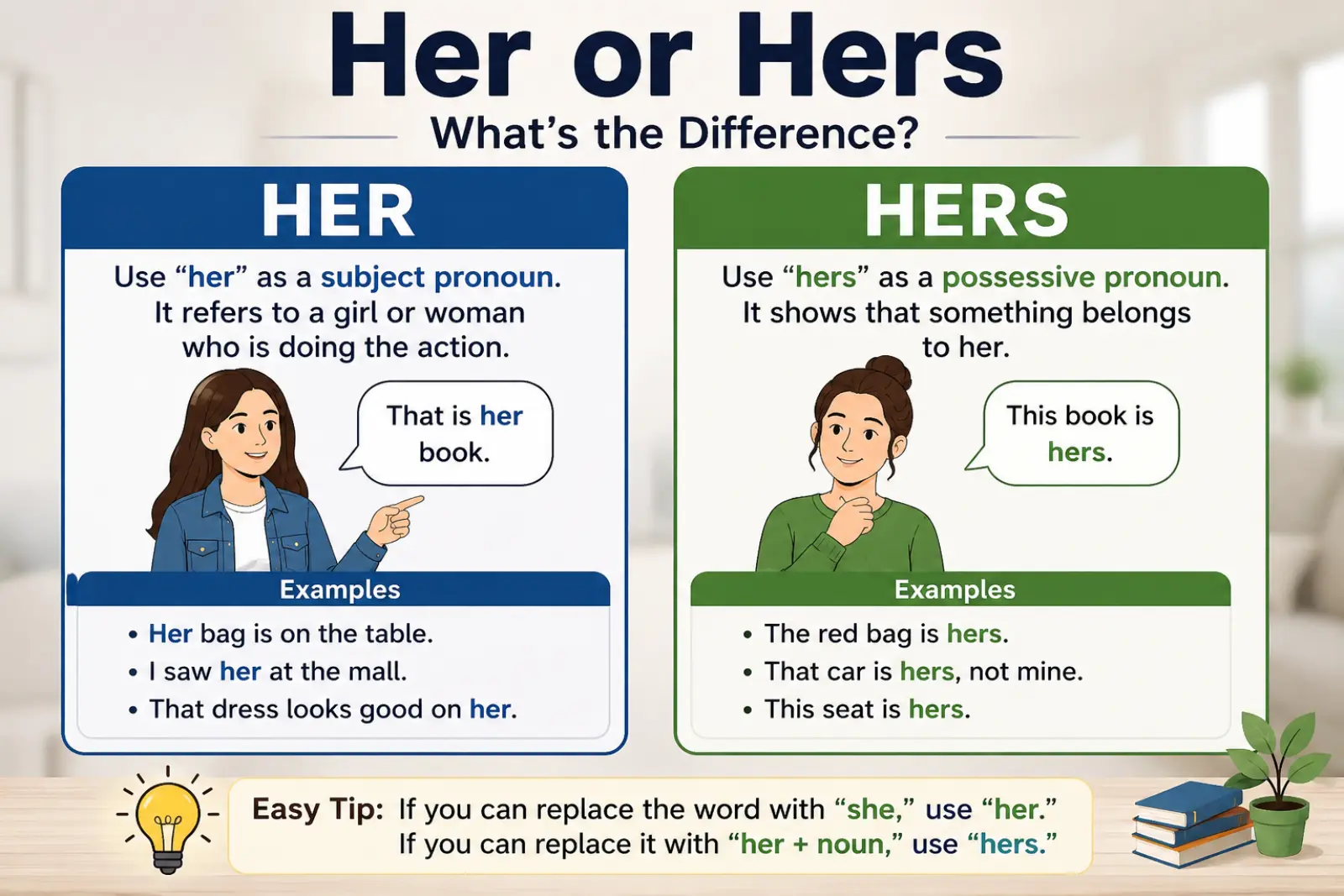
👉 Her = An object pronoun or possessive adjective used before a noun.
👉 Hers = A possessive pronoun that replaces a noun.
Both words are correct, but they are used in different grammar situations.
Examples
✅ I gave her the book.
✅ This is her backpack.
✅ The backpack is hers.
✅ That blue notebook is hers.
❌ This is hers backpack.
❌ I gave hers the book.
Simple Memory Trick
Think of it this way:
- Her + noun → her car, her phone, her idea
- Hers = stands alone → The car is hers.
If a noun comes after the word, use her.
If there is no noun after it, use hers.
What Does Her or Hers Mean?
What Does Her Mean?
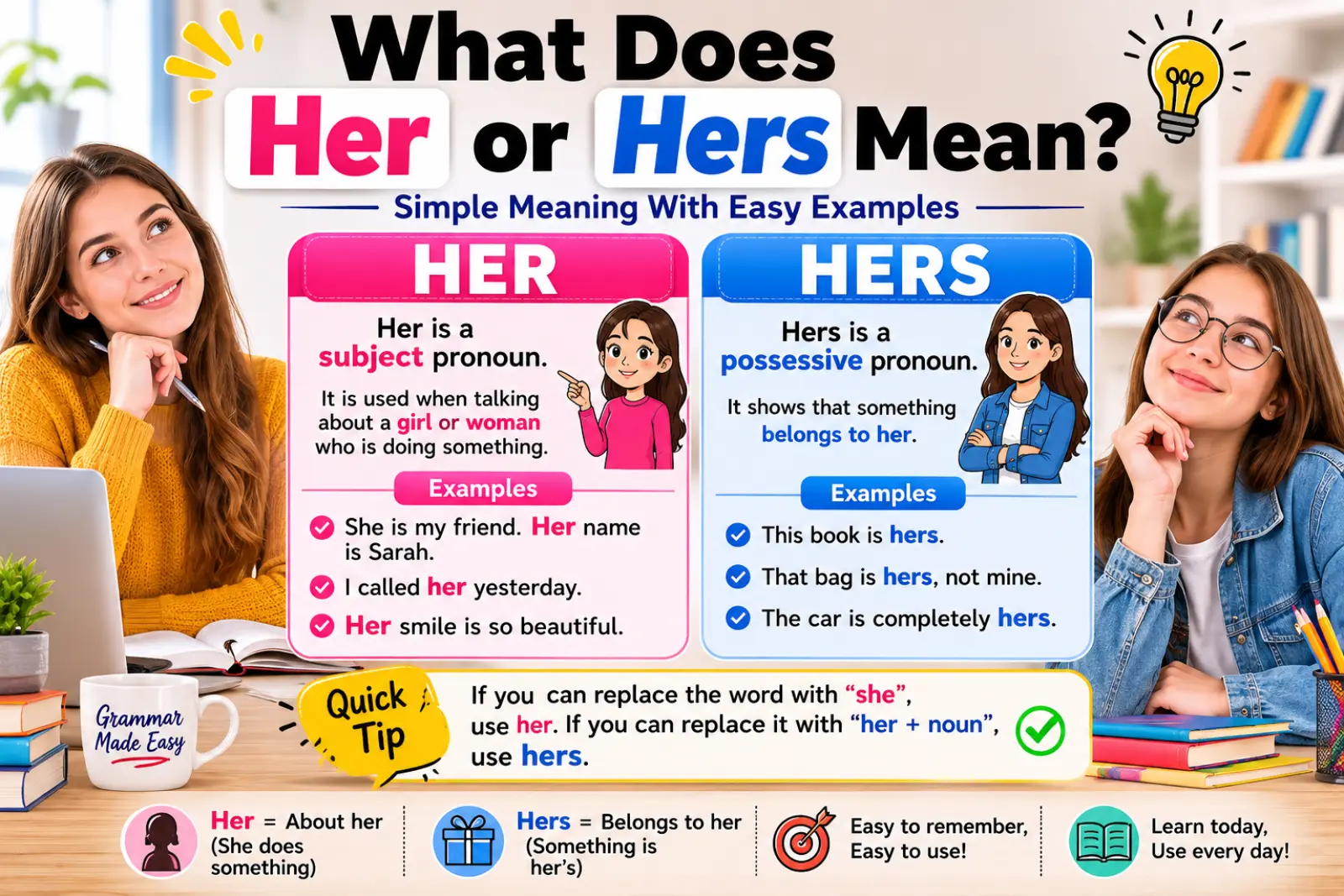
The word her has two main grammar jobs.
1. Her as an Object Pronoun
It refers to a female person receiving the action.
Examples:
2. Her as a Possessive Adjective
It shows that something belongs to a female person and always comes before a noun.
Examples:
- Her bag is on the table.
- Her teacher is very kind.
- I borrowed her notebook.
What Does Hers Mean?
Hers is a possessive pronoun.
It shows ownership but replaces the noun instead of appearing before it.
Examples:
- That phone is hers.
- The red jacket is hers.
- This seat is hers.
Notice that hers never comes before a noun.
Synonyms
Synonyms of Her
- That woman
- That girl
- The female person (depending on context)
Synonyms of Hers
- Belonging to her
- Her own
Opposites
Her
- Him
- His
- Them (context-dependent)
Hers
- His
- Theirs
- Ours
- Yours
- Mine
Related Terms
- She
- Herself
- Him
- His
- Their
- Theirs
- Mine
- Yours
- Ours
- Possessive pronouns
Common Variations
People often search for:
- Her vs hers
- Difference between her and hers
- Her meaning
- Hers meaning
- Her grammar
- Possessive pronouns
- Object pronouns
- Her examples
- Hers examples
- Her and hers worksheet
The Origin of Her or Hers
The words her and hers have been part of English for hundreds of years. They come from Old English pronouns that referred to female people and gradually developed into the forms we use today.
Origin of Her
The word her comes from Old English forms related to hire, which was used to show possession or refer to a female person. Over time, English grammar changed, and her became both an object pronoun and a possessive adjective.
Today, her is one of the most common words in spoken and written English.
Origin of Hers
The word hers developed later as a possessive pronoun. It allows speakers and writers to avoid repeating the same noun.
Instead of saying:
“That bag is her bag.”
English naturally says:
“That bag is hers.”
This makes sentences shorter, smoother, and easier to read.
How to Pronounce Her or Hers
Both words are easy to pronounce, but beginners sometimes confuse them.
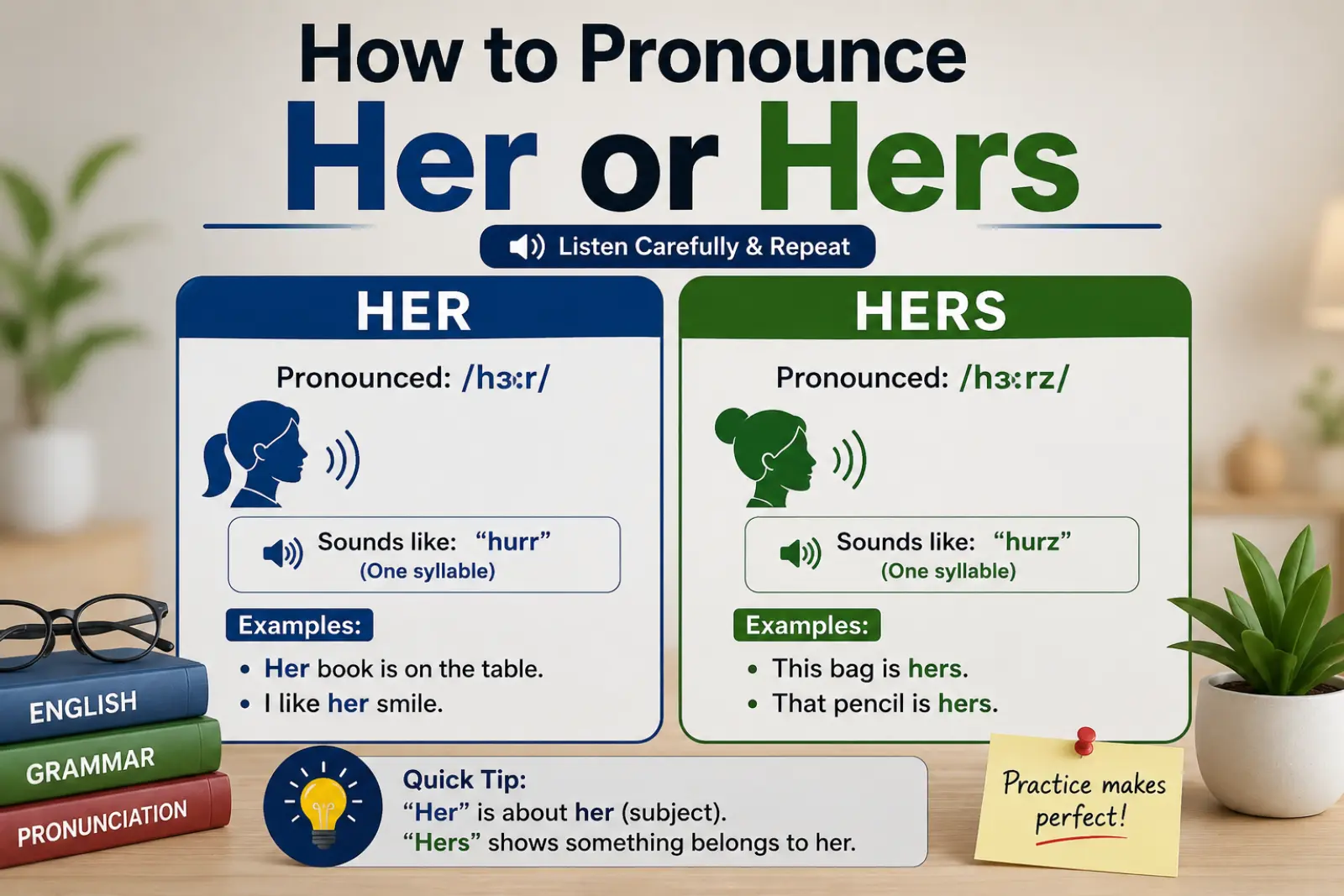
Her
Phonetic: hur
IPA: /hɜːr/ (British)
IPA: /hɝː/ (American)
Syllables
Her
(one syllable)
Hers
Phonetic: hurz
IPA: /hɜːrz/
Syllables
Hers
(one syllable)
Easy Speaking Trick
Say her first.
Now simply add an “z” sound to the end.
Her → Hers
Common Pronunciation Mistakes
❌ Saying her-es
❌ Dropping the final s sound
✔ Correct pronunciation:
Her
Hers
British English vs American English Usage
The grammar and spelling of her and hers are exactly the same in both British and American English.
| Feature | British English | American English | Notes |
|---|---|---|---|
| Spelling | Her / Hers | Her / Hers | Same spelling |
| Meaning | Same | Same | No difference |
| Pronunciation | Slight accent difference | Slight accent difference | Meaning unchanged |
| Grammar | Same | Same | Standard English |
| Everyday usage | Very common | Very common | Used worldwide |
Whether you’re writing in the United Kingdom, United States, Canada, Australia, India, Pakistan, or any other English-speaking country, the rules for her and hers remain the same.
Which One Should You Use?
Choose the word based on how it functions in the sentence.
Use Her When:
- ✅ Referring to a female as the object of a sentence
- ✅ Showing possession before a noun
- ✅ Writing emails
- ✅ School assignments
- ✅ Business communication
- ✅ Everyday conversations
Examples:
- I saw her yesterday.
- This is her notebook.
Use Hers When:
- ✅ Showing ownership without repeating the noun
- ✅ Writing naturally
- ✅ Avoiding repetition
- ✅ Academic writing
- ✅ Professional communication
Examples:
- The notebook is hers.
- That seat is hers.
Quick Usage Table
| Situation | Correct Word |
|---|---|
| I called ___ yesterday. | ✅ Her |
| This is ___ phone. | ✅ Her |
| The phone is ___. | ✅ Hers |
| That backpack belongs to her. | ✅ Hers |
| ___ teacher is friendly. | ✅ Her |
Coming in Part 2: Common mistakes, everyday examples, different contexts, Google Trends, comparison table, professional usage, student tips, memory tricks, expert advice, People Also Ask, FAQs, final verdict, conclusion, and SEO meta description.
part2
❌ Common Mistakes With Her or Hers
Many English learners know both words but are unsure when to use each one. Here are the most common mistakes and simple ways to avoid them.
Mistake 1: Using Hers Before a Noun
❌ This is hers book.
✅ This is her book.
Why it happens: Learners think hers works like his.
Tip: If a noun comes after the word, always use her
Mistake 2: Using Her Without a Noun
❌ That notebook is her.
✅ That notebook is hers.
Explanation: Hers replaces the noun, so you don’t need to repeat it.
Mistake 3: Adding an Apostrophe
❌ Her’s
✅ Hers
Explanation: Hers never has an apostrophe. Like his, its, and theirs, it is already possessive.
Mistake 4: Repeating the Noun
❌ The jacket is her jacket.
✅ The jacket is hers.
Tip: Use hers to avoid unnecessary repetition.
Mistake 5: Confusing Object Pronoun and Possessive Adjective
❌ I called hers yesterday.
✅ I called her yesterday.
Explanation: After a verb like called, helped, or met, use her.
Mistake 6: Mixing Up Her and She
❌ Her is my sister. (when used as the subject)
✅ She is my sister.
Explanation: She is a subject pronoun, while her is an object pronoun or possessive adjective.
🌍 Her or Hers in Everyday Examples
At Work
- I emailed her this morning.
- That desk is hers.
At School
- Her homework was excellent.
- The blue backpack is hers.
On Social Media
- Everyone liked her post.
- That Instagram account is hers.
Daily Life
- I borrowed her bicycle.
- The bicycle is hers.
In Emails
- Please send her the report.
- The final decision is hers.
In Text Messages
- Did you call her?
- The phone is hers.
In Online Content
- Her article became popular.
- The blog is hers.
In Conversations
- I met her yesterday.
- That beautiful house is hers.
🧠 Her or Hers in Different Contexts
Grammar Learning
Understanding her and hers is an important step in learning English pronouns.
Example:
- This is her pencil.
- The pencil is hers.
Education
Teachers often include her and hers in grammar lessons, worksheets, and quizzes.
Workplace Communication
Using the correct pronoun makes emails and reports clearer.
Example:
“Please return her documents.”
“The presentation is hers.”
Professional Writing
Business reports and formal writing use her and hers correctly to improve clarity and avoid repetition.
Everyday Communication
People use these words naturally in conversations with family, friends, classmates, and coworkers.
Social Media
You’ll often read sentences like:
- I love her videos.
- That profile is hers.
Academic Writing
Students use her and hers in essays, research papers, and reading exercises.
📈 Her or Hers – Google Trends & Usage Data
Many people search for her or hers because they are learning English grammar or preparing for exams.
Popular searches include:
- Difference between her and hers
- Her vs hers
- Her meaning
- Hers meaning
- Her grammar
- Possessive pronouns
- Object pronouns
- Her examples
- Hers examples
- Her and hers worksheet
Searches are especially common in:
- United States
- United Kingdom
- Canada
- Australia
- India
- Pakistan
Voice-search questions include:
- “When do I use her?”
- “What is the difference between her and hers?”
- “Can hers come before a noun?”
- “Is her a possessive pronoun?”
📊 Comparison Table: Her vs Hers
| Feature | Her | Hers |
|---|---|---|
| Part of speech | Object pronoun / Possessive adjective | Possessive pronoun |
| Meaning | Refers to a female person or shows possession before a noun | Shows ownership without a noun |
| Used before a noun | ✅ Yes | ❌ No |
| Stands alone | Sometimes | ✅ Yes |
| Formal writing | Yes | Yes |
| Academic writing | Yes | Yes |
| Everyday English | Very common | Very common |
| Common mistake | Used instead of she | Used before nouns |
💼 Her or Hers in Professional Life
Using the correct pronoun makes your writing more professional and easier to understand.
Examples:
- Please send her the updated report.
- The final presentation is hers.
- We appreciated her contribution.
- The office next door is hers.
Correct grammar builds confidence in business emails, presentations, reports, and workplace communication.
🎓 Her or Hers for Students or Beginners
Many learners struggle because both words refer to the same person.
Easy Learning Tips
- If a noun follows, use her.
- If no noun follows, use hers.
- Read English books to see both words in context.
- Practice writing your own example sentences.
- Use grammar-checking tools while learning.
With regular practice, choosing the correct word becomes natural.
🔍 Common Uses Related to Her and Hers
Her
- Before a noun
- Object of a verb
- School writing
- Business emails
- Everyday conversations
- Books and articles
Hers
- Showing ownership
- Replacing a noun
- Avoiding repetition
- Formal writing
- Social media
- Daily conversations
🧩 Simple Trick to Remember Her or Hers
Easy Memory Rule
Her = Her + Noun
Hers = Belongs to Her
Think of It This Way
Imagine your friend owns a laptop.
If you’re describing it, say:
“This is her laptop.”
If everyone already knows you’re talking about the laptop, simply say:
“The laptop is hers.”
One comes before the noun.
The other replaces the noun.
🏆 Expert Tips
Here are a few grammar tips that many learners miss:
- Never write her’s with an apostrophe.
- Remember that hers works like his, mine, ours, and theirs.
- If you’re unsure, look at the next word. If it’s a noun, choose her.
- Read your sentence aloud to see if it sounds natural.
- Practice with short sentences before writing longer paragraphs.
🌐 Related Searches People Also Ask
Here are common questions people search online:
- What is the difference between her and hers?
Her comes before a noun or acts as an object pronoun, while hers is a possessive pronoun. - Can hers come before a noun?
No. Use her before a noun. - Is her a possessive pronoun?
No. It is a possessive adjective and an object pronoun. - Is hers a possessive pronoun?
Yes. - Why is her’s incorrect?
Because hers never takes an apostrophe. - Can I say this book is her?
No. Say, “This book is hers.” - What comes after her?
Usually a noun when it’s a possessive adjective. - Is her used as an object?
Yes. Example: I helped her. - What are similar possessive pronouns?
Mine, yours, his, ours, theirs. - How can I remember the difference?
Remember: Her + noun, Hers = stands alone.
❓ Frequently Asked Questions
Is her and hers the same?
No. They have different grammar functions.
Can hers come before a noun?
No. Always use her before a noun.
Is her’s correct?
No. The correct spelling is hers.
What type of word is her?
It is an object pronoun and a possessive adjective.
What type of word is hers?
It is a possessive pronoun.
Can I say “The bag is her”?
No. Say, “The bag is hers.”
Is her used in formal writing?
Yes. It is correct in all types of English.
Is hers used worldwide?
Yes. It is standard English in British, American, Canadian, Australian, Indian, and Pakistani English.
🏁 Final Verdict
The difference is easy to remember:
- ✅ Her comes before a noun or works as an object pronoun.
- ✅ Hers stands alone to show ownership.
Using the correct word makes your writing more natural and grammatically correct.
✅ Conclusion
Although her and hers refer to the same female person, they are used differently in English grammar. Her is used before a noun or as the object of a sentence, while hers replaces a noun to show ownership. Learning this simple rule will help you avoid common grammar mistakes in school, work, and everyday conversations.
A final memory trick is: If a noun follows, use her. If no noun follows, use hers. Once you remember this rule, you’ll choose the correct word with confidence every time.

Camila Green is an English language writer who specializes in confusing word comparisons and spelling explanations. She creates simple, beginner-friendly guides on topics like “niece or neice” and other common English mistakes. Her writing focuses on clarity, real-life examples, and easy learning. At VerrsaPick, she helps readers improve their English with practical and engaging content.