Have you ever typed crain when you meant crane? This is a common spelling mistake, especially because both words sound almost the same. Many English learners, students, and even native speakers search online to find out which spelling is correct.
The confusion often appears while writing school assignments, business emails, text messages, construction reports, social media posts, or searching online. Since crane is used in different ways—such as a construction machine, a bird, or even a verb—it is important to know the correct spelling.
People usually search for:
- Crain or crane
- Is crain a word?
- Crane meaning
- Crane pronunciation
- Crane examples
- Crane definition
- Correct spelling of crane
In this guide, you’ll learn the meaning, pronunciation, examples, usage, grammar rules, common mistakes, expert tips, and simple explanations in easy English.
Crain or Crane – Quick Answer
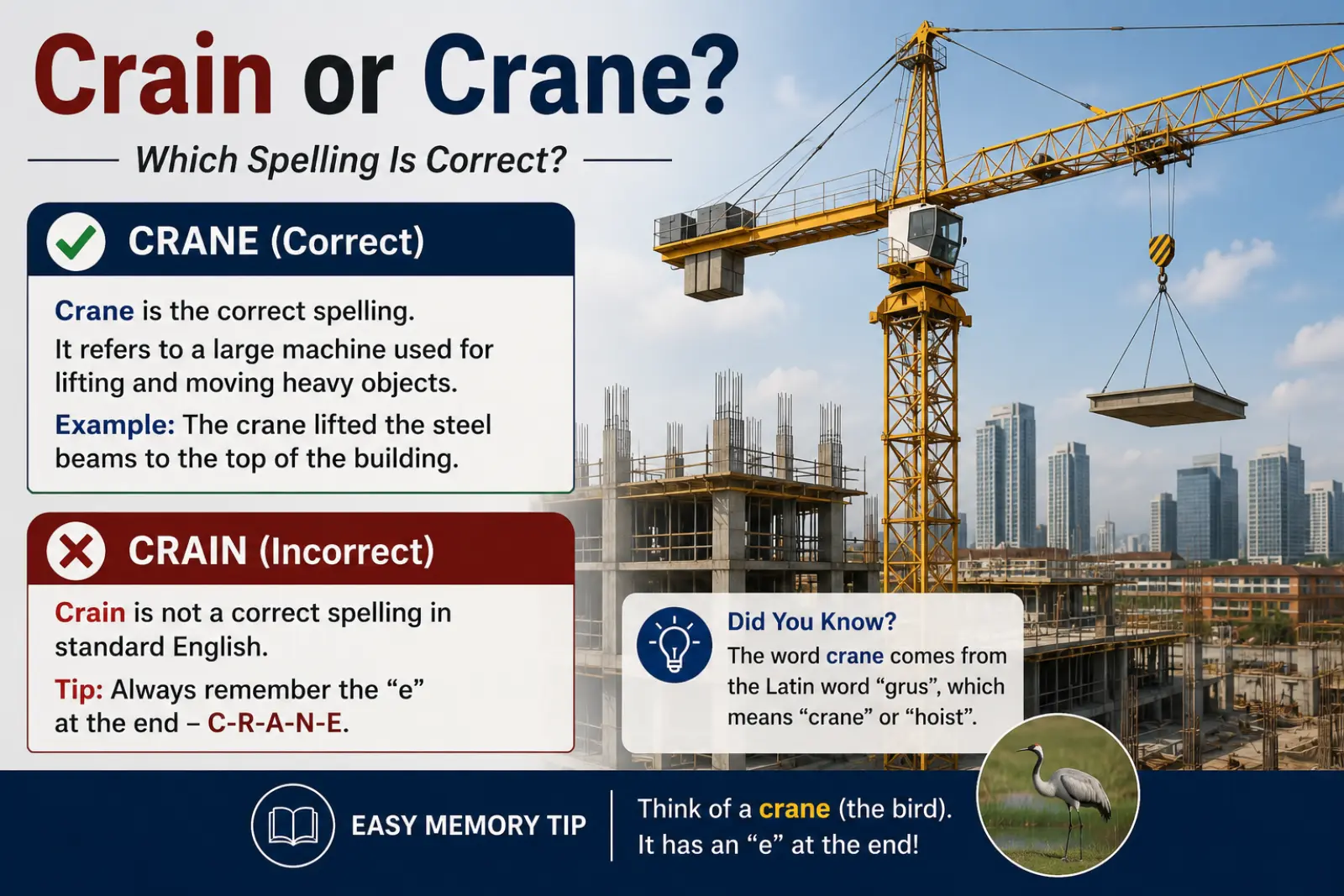
👉 Crane = ✅ Correct spelling. It refers to a tall lifting machine, a long-legged bird, or the act of stretching your neck.
👉 Crain = ❌ Usually an incorrect spelling of crane. It can appear as a surname, but it is not the standard English word.
Examples
- ✅ The crane lifted the heavy steel beams.
- ✅ We saw a beautiful crane near the lake.
- ✅ She craned her neck to see the stage.
- ❌ The crain lifted the building materials.
Simple Rule
👉 If you mean the bird or the machine, always write crane.
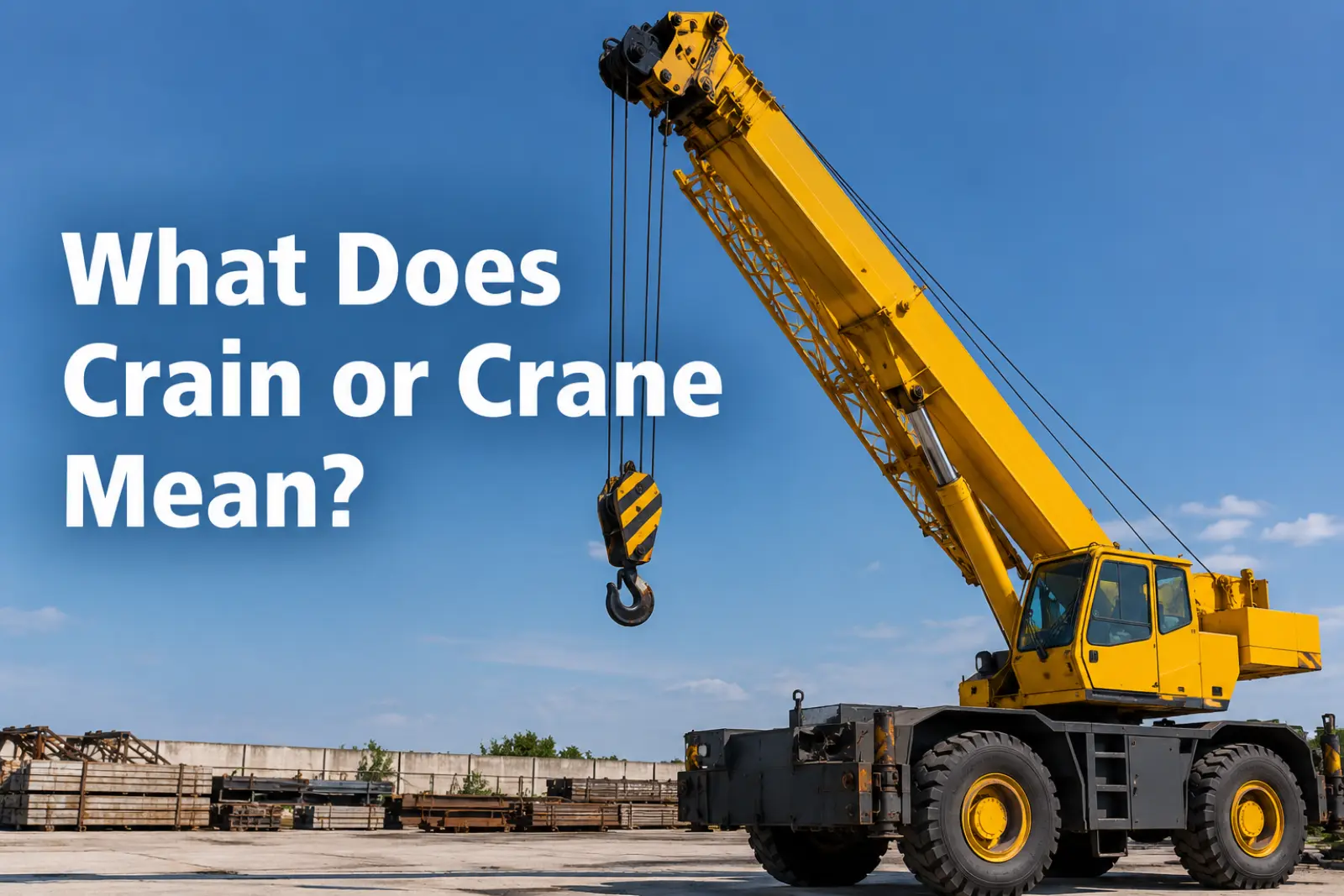
What Does Crain or Crane Mean?
Crane is a noun and sometimes a verb.
As a noun, it can mean:
- A large machine used for lifting heavy objects.
- A tall bird with long legs and a long neck.
As a verb, to crane means stretching your neck to see something better.
Synonyms
- Hoist (machine)
- Lift
- Heron (similar bird)
- Stretch (verb)
Opposites
- Lower
- Drop
- Bend down
Related Terms
- Construction
- Machinery
- Tower crane
- Mobile crane
- Bird
- Neck
Common Variations
- Crane
- Cranes
- Craning
- Craned
The Origin of Crain or Crane
The word crane comes from Old English cran, referring to the long-necked bird. Later, builders gave the same name to lifting machines because their long arms looked like the bird’s neck.
The spelling crain is generally a spelling mistake when people mean crane. However, Crain is also a family name in some English-speaking countries.
How to Pronounce Crane
Pronunciation:
Crane
Phonetic: KRAYN
It rhymes with:
- Train
- Brain
- Plane
- Chain
Easy Speaking Tip
Say the word train, but replace tr with cr.
British English vs American English Usage
There is no spelling difference between British and American English.
| Feature | British English | American English | Notes |
|---|---|---|---|
| Correct spelling | Crane | Crane | Same worldwide |
| Incorrect spelling | Crain | Crain | Usually incorrect |
| Pronunciation | Similar | Similar | Minor accent differences |
Which One Should You Use?
Always use crane when talking about:
- Construction equipment
- Birds
- Stretching your neck
Quick Usage Table
| Situation | Correct Word |
|---|---|
| Construction | Crane |
| Wildlife | Crane |
| School writing | Crane |
| Business reports | Crane |
| Social media | Crane |
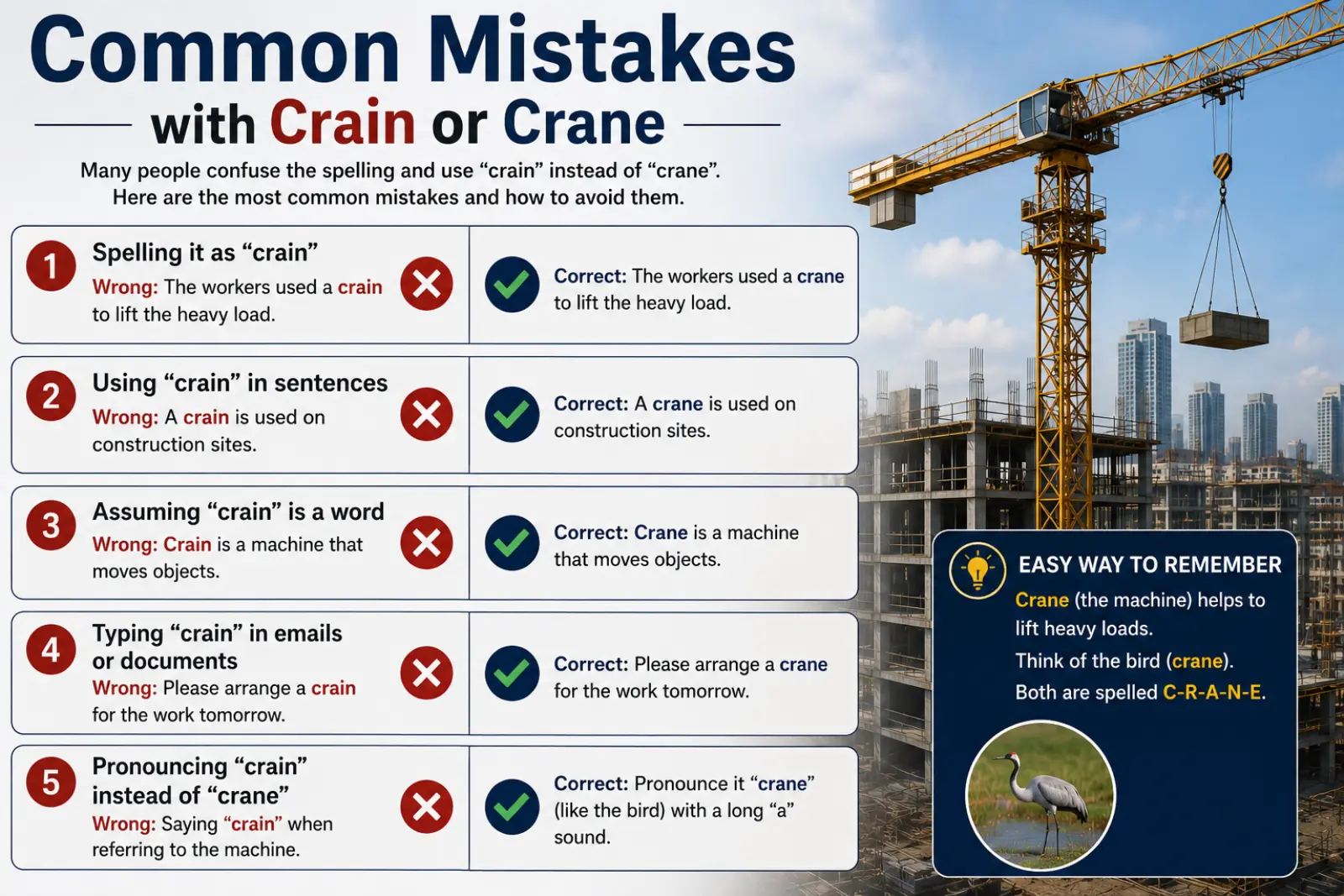
Common Mistakes with Crain or Crane
Mistake 1
❌ The crain lifted the truck.
✅ The crane lifted the truck.
Tip: Machines use crane, not crain.
Mistake 2
❌ We saw a white crain.
✅ We saw a white crane.
Mistake 3
❌ He used a construction crain.
✅ He used a construction crane.
Mistake 4
❌ She crained her neck.
✅ She craned her neck.
Mistake 5
❌ Crain is the correct spelling.
✅ Crane is the standard English spelling.
Crane in Everyday Examples
Work
The crane lifted heavy concrete blocks.
School
Students learned about the red-crowned crane.
Social Media
The sunset photo included a flying crane.
Daily Life
I craned my neck to see the fireworks.
Emails
The company rented a tower crane for the project.
Text Messages
Look at that huge crane near the bridge!
Online Content
The article explained how cranes work.
Conversations
A crane can lift hundreds of tons.
Crane in Different Contexts
Construction
Cranes move heavy materials safely on building sites.
Wildlife
Cranes are elegant birds found in many countries.
Engineering
Engineers use cranes to build bridges and skyscrapers.
Photography
Wildlife photographers often capture cranes during migration.
Communication
The verb crane describes stretching your neck to get a better view.
Crane – Google Trends & Usage Data
Many people search crain or crane because they hear the words but are unsure about the spelling.
Popular searches include:
- Crane meaning
- Is crain a word?
- Crane bird
- Construction crane
- Crane pronunciation
The keyword is commonly searched in the United States, United Kingdom, Canada, Australia, India, and Pakistan, especially by English learners and construction professionals.
Comparison Table
| Feature | Crane | Crain |
|---|---|---|
| Correct spelling | ✅ Yes | ❌ Usually No |
| Dictionary word | ✅ Yes | Mainly a surname |
| Construction term | ✅ Yes | ❌ No |
| Bird name | ✅ Yes | ❌ No |
| Professional writing | ✅ Yes | ❌ No |
| Everyday English | Very common | Rare |
Crane in Professional Life
The word crane is important in many industries:
- Construction
- Engineering
- Manufacturing
- Shipping
- Logistics
- Wildlife conservation
Using the correct spelling helps reports, emails, and technical documents appear accurate and professional.
Crane for Students or Beginners
Many beginners type crain because it sounds like train or brain.
Easy Learning Tips
- Remember the spelling crane ends with -ane.
- Think of plane and crane—both end with -ane.
- Practice using the word in short sentences.
Common Uses of Crane
People commonly use crane for:
- Construction machines
- Birds
- Heavy lifting
- Building projects
- Shipping ports
- Wildlife studies
- Stretching the neck
Simple Trick to Remember Crane
Memory Rule
Crane ends with “ane,” just like plane.
Think of it this way:
A crane can lift a plane. Both words end with -ane.
This simple trick makes the correct spelling easy to remember.
Expert Tips
- Read construction articles to become familiar with the word.
- Use spell-check before submitting documents.
- Learn word families like crane, craned, cranes, craning.
- Remember that Crain is mainly a surname, not the common English word.
Related Searches People Also Ask
- Is crain a real word?
- What is a crane in construction?
- What is a crane bird?
- How do you pronounce crane?
- Why do people spell crane as crain?
- Is crane a noun or a verb?
- What does craned mean?
- What types of cranes are used in construction?
- Is crane used in British and American English?
- How can I remember the spelling of crane?
FAQs
Is crane the correct spelling?
Yes. Crane is the correct spelling.
Is crain a real English word?
Not as the common noun. It is mainly used as a surname.
Is crane a bird?
Yes. A crane is a large, long-legged bird.
Is crane a machine?
Yes. A crane is also a heavy lifting machine.
How do you pronounce crane?
It is pronounced KRAYN.
Is crane used in British and American English?
Yes. The spelling is the same in both.
Why do people write crain?
Because it sounds similar to crane.
How can I remember the spelling?
Remember: A crane can lift a plane—both end with “-ane.”
Final Verdict
The correct spelling is crane.
Crain is usually a spelling mistake unless it refers to someone’s last name.
Easy Memory Rule:
Crane ends with “-ane,” just like plane.
Conclusion
The confusion between crain and crane is easy to understand because both words sound alike. However, in modern English, crane is the correct spelling for the bird, the construction machine, and the verb meaning to stretch your neck.
Whenever you’re writing for school, work, or online, use crane with confidence. It will make your writing clear, accurate, and professional.
Final memory trick: Think of a crane lifting a plane—both words end with “-ane.”

Camila Green is an English language writer who specializes in confusing word comparisons and spelling explanations. She creates simple, beginner-friendly guides on topics like “niece or neice” and other common English mistakes. Her writing focuses on clarity, real-life examples, and easy learning. At VerrsaPick, she helps readers improve their English with practical and engaging content.