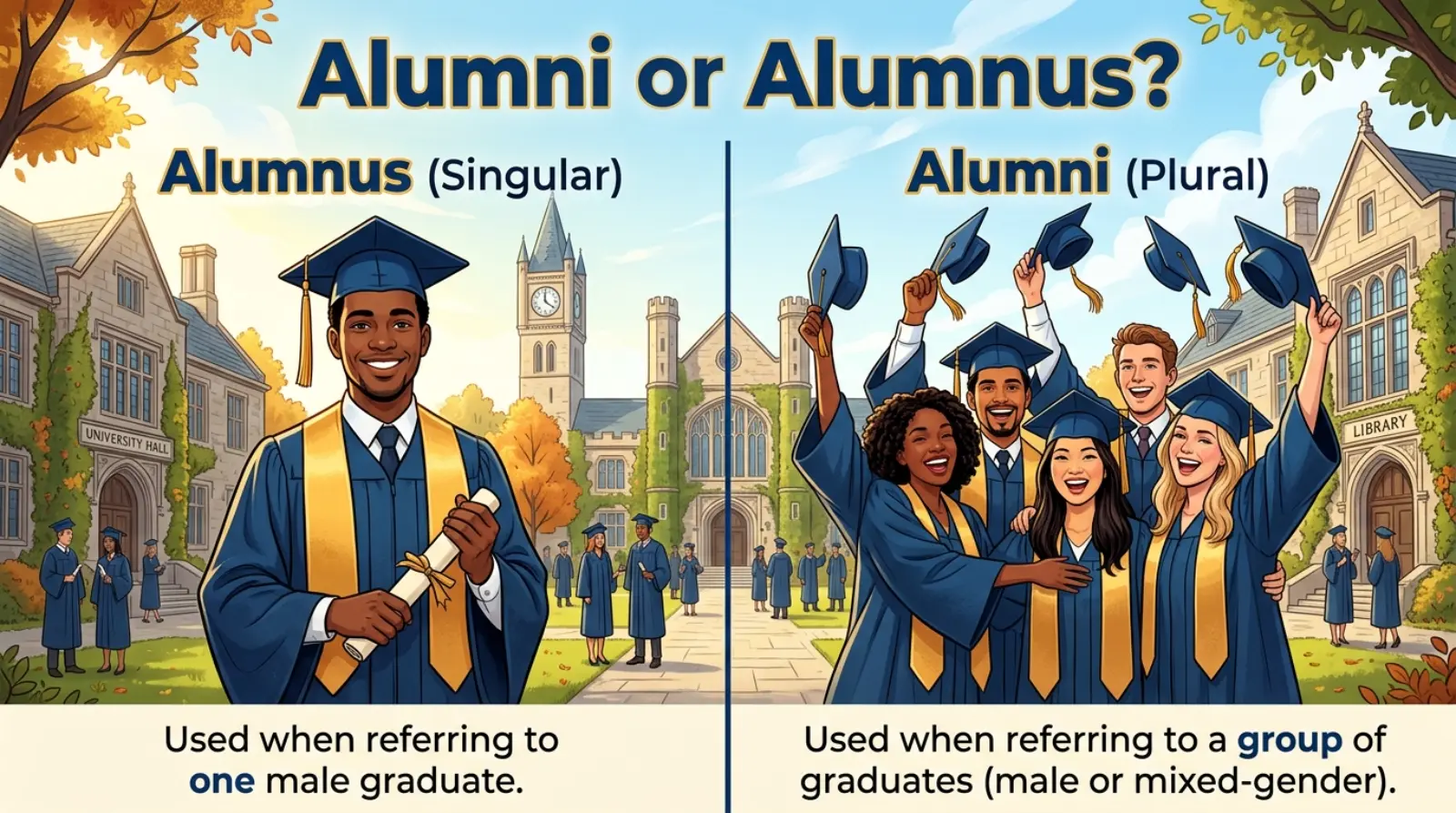
Have you ever written about a former student and wondered whether alumni or alumnus is the right word? You are not alone. These two words look almost identical, but their grammar is different.
You may see alumnus and alumni on school websites, university pages, graduation announcements, LinkedIn profiles, resumes, and professional emails. The confusion usually comes from Latin grammar because English kept both the singular and plural forms.
The good news is that the rule is simple once you know what each word means.
Alumnus means one male graduate or former student. Alumni is the plural form traditionally used for two or more male graduates or for a group of graduates of mixed gender. In modern English, however, alumni is also commonly used as a gender-neutral plural noun.
People usually search for:
- alumni or alumnus meaning
- alumni vs alumnus
- alumnus singular or plural
- alumni singular or plural
- how to use alumnus in a sentence
- how to use alumni in a sentence
- alumnus pronunciation
- alumni pronunciation
- difference between alumni and alumnus
- correct grammar for former students
These words matter because using the wrong form can make academic, workplace, or professional writing sound less polished.
In this guide, you’ll learn the meaning, pronunciation, examples, usage, grammar rules, common mistakes, expert tips, and simple explanations in easy English.
Alumni or Alumnus – Quick Answer
👉 Alumnus = one male former student or graduate
👉 Alumni = two or more former students or graduates
Traditionally, alumnus is singular and masculine, while alumni is plural.
However, modern English often uses alumni as a general, gender-neutral term for graduates or former students.
Examples
- John is an alumnus of Harvard University.
- Maria is an alumna of the university.
- John and David are alumni of the same school.
- The university invited its alumni to the reunion.
- Many successful alumni attended the event.
Simple Rule
Alumnus = one male
Alumna = one female
Alumni = more than one
Alumnae = more than one female
A simple memory trick is: “Alumnus” sounds like one person, while “alumni” ends in “i,” which traditionally marks the plural.
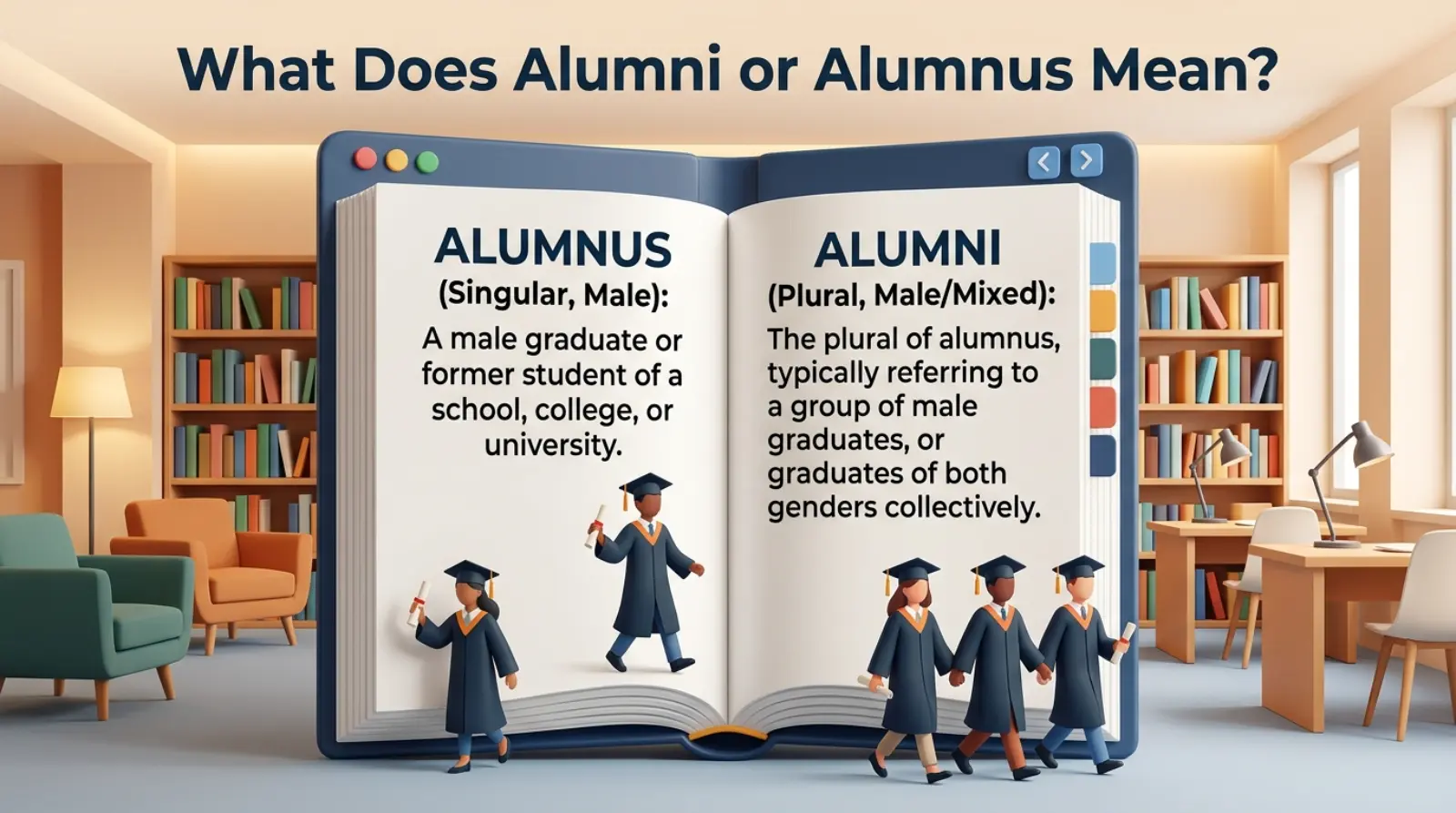
What Does Alumni or Alumnus Mean?
Both words describe someone who previously attended an educational institution.
This can include someone who:
- graduated from a school
- attended a college
- studied at a university
- completed a degree
- was formerly a student
What Does Alumnus Mean?
Alumnus is a singular noun traditionally used for one male graduate or former student.
For example:
James is an alumnus of Stanford University.
Here, alumnus refers to one man.
What Does Alumni Mean?
Alumni is traditionally the plural of alumnus.
For example:
The university welcomed hundreds of alumni.
Here, alumni refers to many former students.
Today, many schools and organizations use alumni as a broad, gender-neutral term.
Related Terms
| Word | Traditional meaning |
|---|---|
| Alumnus | One male former student |
| Alumna | One female former student |
| Alumni | Multiple former students |
| Alumnae | Multiple female former students |
Synonyms
Depending on context, related words include:
- graduate
- former student
- ex-student
- former graduate
- school graduate
- university graduate
These words are not always exact replacements. For example, someone can be a former student without graduating.
The Origin of Alumni and Alumnus
The words alumnus and alumni come from Latin.
The Latin word alumnus was connected with the idea of someone who was nourished or raised. Over time, it became associated with a pupil, foster child, or student.
English later adopted the word to describe former students and graduates.
Because the words came from Latin, their forms follow traditional Latin patterns:
- alumnus → singular masculine
- alumna → singular feminine
- alumni → plural masculine or mixed group
- alumnae → plural feminine
Modern English does not always follow old Latin gender rules strictly. That is why alumni is now widely used for groups of graduates regardless of gender.
How to Pronounce Alumni or Alumnus
Pronunciation can also cause confusion.
Alumnus
Alumnus → uh-LUM-nus
It has three syllables:
uh + LUM + nus
Example:
He is an alumnus of the college.
Alumni
Alumni → uh-LUM-nye
It has three syllables:
uh + LUM + nye
Example:
The alumni returned for the annual reunion.
Common Pronunciation Mistake
Do not pronounce alumni exactly like alumnus.
The ending changes:
- alumnus → “nus”
- alumni → commonly “nye”
British English vs American English Usage
There is no major spelling difference between British and American English for alumnus and alumni.
The main difference is often how formal or traditional the usage feels.
| Feature | British English | American English | Notes |
|---|---|---|---|
| Alumnus | Used | Used | Singular male |
| Alumna | Used | Used | Singular female |
| Alumni | Used | Used | Plural or general group |
| Alumnae | Used | Used | Plural female |
| Alum | Used | Used | Informal and gender-neutral |
| Pronunciation | Similar | Similar | Regional accents vary |
The word alum is especially useful in modern English because it avoids gender distinctions.
For example:
She is an alum of the university.
This sounds natural in many modern contexts.
Which One Should You Use?
Choose the word based on the number and context.
Use “alumnus” when:
- You mean one male former student.
- You are following traditional grammar.
- You are writing formally.
- You are describing one male graduate.
Example:
He is an alumnus of Yale.
Use “alumni” when:
- You mean several former students.
- You are discussing graduates as a group.
- You are writing for a university audience.
- You want a common general term for former students.
Example:
The alumni are attending the reunion.
Use “alum” when:
- You want informal, modern English.
- Gender is not important.
- You are writing conversationally.
Example:
She is an alum of the university.
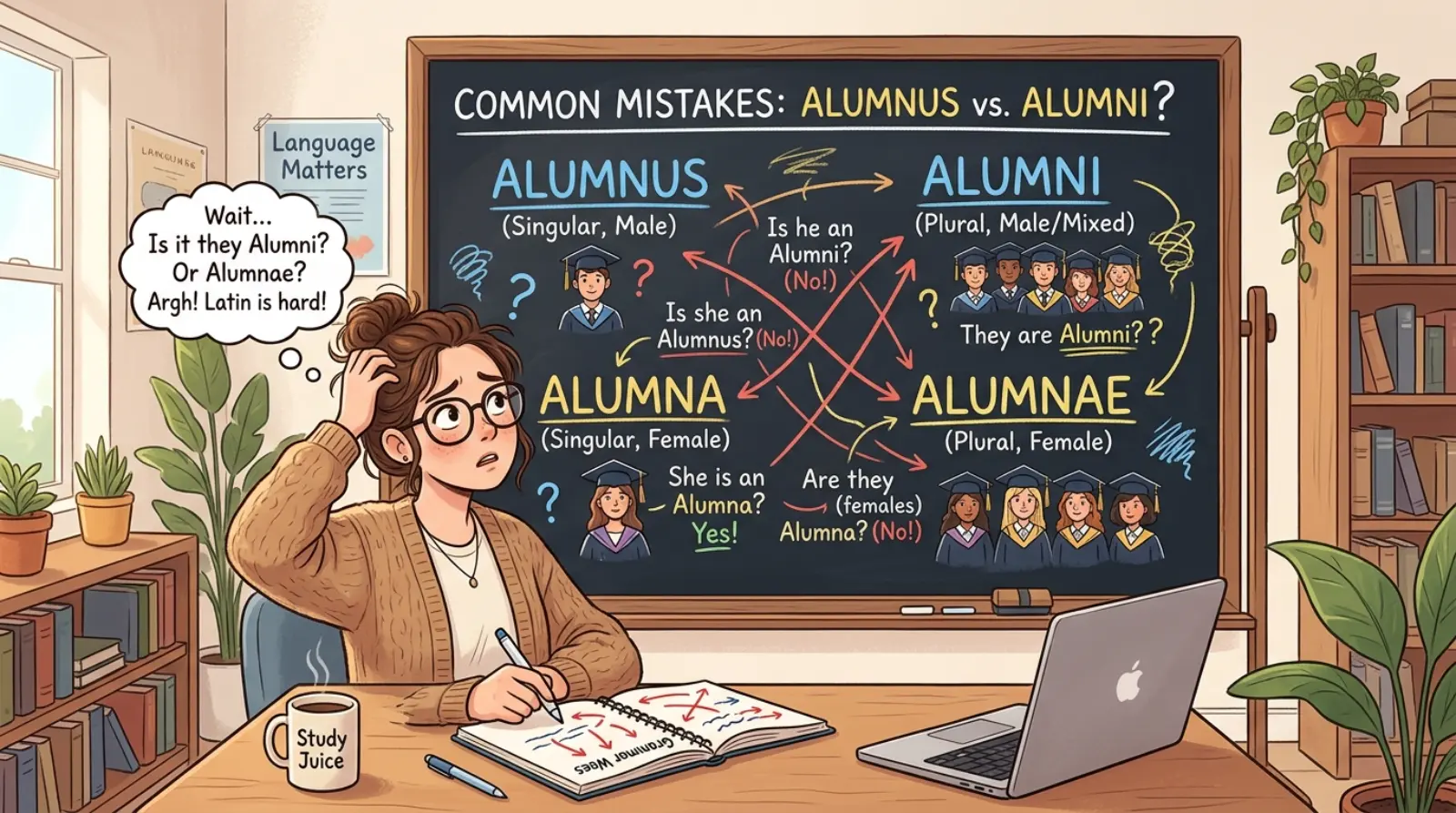
Common Mistakes With Alumni or Alumnus
Mistake 1: Using “alumni” for one male
❌ He is an alumni of the college.
✔ He is an alumnus of the college.
Why?
Traditionally, alumni is plural.
Correction tip:
If you are talking about one male, use alumnus.
Mistake 2: Treating “alumnus” as plural
❌ The alumnus attended the reunion.
This is incorrect if you mean several people.
✔ The alumni attended the reunion.
Why?
Alumnus refers to one person.
Memory tip:
One = alumnus. More than one = alumni.
Mistake 3: Calling one woman an “alumnus”
❌ Sarah is an alumnus of the university.
✔ Sarah is an alumna of the university.
Why?
In traditional Latin-based grammar, alumna is the feminine singular form.
In modern informal English, alum is also common.
Mistake 4: Assuming “alumni” always means men
❌ “The alumni means only male graduates.”
✔ “Alumni can traditionally refer to a group of men or a mixed group, and modern English often uses it broadly for graduates.”
Why?
Usage has become more flexible over time.
Mistake 5: Using “alumni” as a singular noun
❌ She is an alumni of the school.
✔ She is an alumna of the school.
Or, in modern informal English:
✔ She is an alum of the school.
Mistake 6: Confusing alumni with graduates
Someone can be a former student without necessarily being a graduate.
Graduate usually means someone who completed a course or degree.
Alumnus/alumna can refer more broadly to a former student or graduate, depending on the institution’s usage.
Alumni or Alumnus in Everyday Examples
At Work
Our new manager is an alumnus of the University of Chicago.
At School
The school invited its alumni to speak to current students.
In an Email
We are pleased to invite all alumni to our annual event.
On Social Media
Proud to be an alum of this amazing university!
In a Conversation
Are you an alumnus of this college?
Online Content
Several notable alumni have started successful companies.
In a Text Message
I just found out that she’s an alum of my university.
Alumni or Alumnus in Different Contexts
Education
Schools and universities frequently use alumni when referring to their former students.
For example:
The university’s alumni network connects graduates around the world.
This is one of the most common uses.
Professional Networking
Alumni networks can help former students connect with employers, mentors, and other graduates.
For example:
I contacted an alumnus from my university for career advice.
Business
Companies may mention an executive’s educational background.
The CEO is an alumnus of MIT.
This use can add context to a professional biography.
Social Media
People often use alum because it sounds shorter and more casual.
Proud alum! 🎓
Academic Writing
Formal writing may use the traditional forms when gender and number are known.
For example:
The alumnus contributed to the university’s research program.
Alumni – Google Trends and Search Behavior
People search for alumni or alumnus because the two words are easy to confuse.
Searches often come from students, graduates, writers, and people checking professional or academic documents.
Common long-tail searches include:
- alumni or alumnus difference
- is alumnus singular or plural
- is alumni singular or plural
- alumnus meaning
- alumni meaning
- alumnus pronunciation
- how to use alumni in a sentence
- how to use alumnus in a sentence
- alumni vs alum
- alumnus vs alumna
These searches can appear across the US, UK, India, Pakistan, Canada, and Australia.
The exact popularity of each search can change over time. More importantly, the confusion is caused by the Latin-based forms and the growing use of gender-neutral language.
Comparison Table: Alumni or Alumnus
| Feature | Alumnus | Alumni |
|---|---|---|
| Number | Singular | Plural |
| Traditional gender | Male | Male or mixed group |
| Meaning | One former student | Multiple former students |
| Grammar role | Noun | Noun |
| Formal usage | Yes | Yes |
| Academic usage | Yes | Yes |
| Workplace usage | Yes | Yes |
| Social media | Less common | Very common |
| Example | He is an alumnus. | They are alumni. |
| Modern alternative | Alum | Alum |
Alumni or Alumnus in Professional Life
These words often appear in resumes, biographies, university profiles, press releases, and professional networking.
Correct word choice can make your writing clearer.
For example:
Michael is an alumnus of Columbia University.
This clearly describes one person.
For a group:
The university’s alumni include leaders in technology, medicine, and business.
On professional platforms, alum is also increasingly common because it is simple and gender-neutral.
Alumni or Alumnus for Students and Beginners
Beginners often struggle because these words look almost the same.
The easiest approach is to focus on one versus many.
Think:
One male → alumnus
Many → alumni
If gender is important:
One female → alumna
Many females → alumnae
If you do not want to worry about traditional gender forms:
Use alum for one person in informal modern English.
Common Uses and Patterns
You will often see these phrases:
- alumni association
- alumni network
- alumni event
- alumni reunion
- alumni directory
- alumni newsletter
- notable alumni
- alumni community
- alumni members
- former alumni
One important writing point: “former alumni” is usually unnecessary because alumni already refers to former students.
Instead of:
former alumni of the university
write:
alumni of the university
Simple Trick to Remember Alumni or Alumnus
Remember this simple pattern:
Alumnus = one
Alumni = many
Alumna = one woman
Alumnae = multiple women
Think of it this way:
Imagine a graduation photo.
One male graduate standing alone?
👉 Alumnus
A group of graduates?
👉 Alumni
One woman?
👉 Alumna
A group of women?
👉 Alumnae
For casual modern English, alum works as a simple gender-neutral option.
Expert Tips
Here are a few easy ways to avoid mistakes:
- Check the number first. Is it one person or several?
- Remember the “-us” ending. Alumnus is traditionally singular.
- Remember “-i.” Alumni is traditionally plural.
- Use alum when you want a short, gender-neutral informal term.
- Follow the institution’s preferred wording when writing for a school or university.
- Do not assume alumni only means men. Modern usage is broader.
- Read the sentence aloud. This can help you notice awkward grammar.
- Check the subject and verb. “The alumnus is” is singular; “the alumni are” is plural.
Related Searches People Also Ask
Is alumnus singular or plural?
Alumnus is singular. It traditionally means one male former student.
Is alumni singular or plural?
Alumni is traditionally plural. It refers to multiple former students.
What is the female version of alumnus?
The traditional feminine singular form is alumna.
What is the plural of alumna?
The traditional plural is alumnae.
Can alumni refer to women?
Yes. Modern English commonly uses alumni as a broad term for a group of graduates, regardless of gender.
Is alum gender-neutral?
Yes. Alum is a common informal, gender-neutral term for a former student or graduate.
Can I say “I am an alumni”?
Usually, no, if you mean one person. Traditional grammar would use alumnus, alumna, or the informal alum.
What does alumni association mean?
An alumni association is an organization that connects former students of a school, college, or university.
Is “alumni” a formal word?
Yes. Alumni is widely used in formal academic and professional writing.
How do you pronounce alumnus?
It is commonly pronounced uh-LUM-nus.
How do you pronounce alumni?
It is commonly pronounced uh-LUM-nye.
Final Verdict: Alumni or Alumnus?
The difference is simple:
Alumnus = one male former student
Alumna = one female former student
Alumni = multiple former students
Alumnae = multiple female former students
Alum = informal, gender-neutral option
If you are talking about one male graduate, choose alumnus. If you are talking about a group, alumni is usually correct.
Conclusion
The words alumni or alumnus can look confusing at first, but the basic rule is easy.
Alumnus traditionally means one male former student, while alumni traditionally means more than one former student. Modern English often uses alumni broadly for groups of graduates, including women.
When you need a simple gender-neutral term for one person, alum is a useful modern choice.
The easiest memory trick is:
“Alumnus = one. Alumni = many.”
Once you remember that, choosing between these words becomes much easier in school, workplace, academic, and everyday writing.
Meta Description:
Alumni or alumnus? Learn the simple difference, meaning, pronunciation, grammar, and examples so you can use each word correctly.

Camila Green is an English language writer who specializes in confusing word comparisons and spelling explanations. She creates simple, beginner-friendly guides on topics like “niece or neice” and other common English mistakes. Her writing focuses on clarity, real-life examples, and easy learning. At VerrsaPick, she helps readers improve their English with practical and engaging content.