
Imagine you are writing an essay, email, or article and type “a historic event”. Then you stop and wonder: should it actually be “an historic event”? This small grammar choice can be surprisingly confusing, even for people who have used English for years.
The confusion comes from pronunciation. English speakers use a before a consonant sound and an before a vowel sound. But historic begins with the letter h, and the way that h is pronounced can vary by speaker, region, and style.
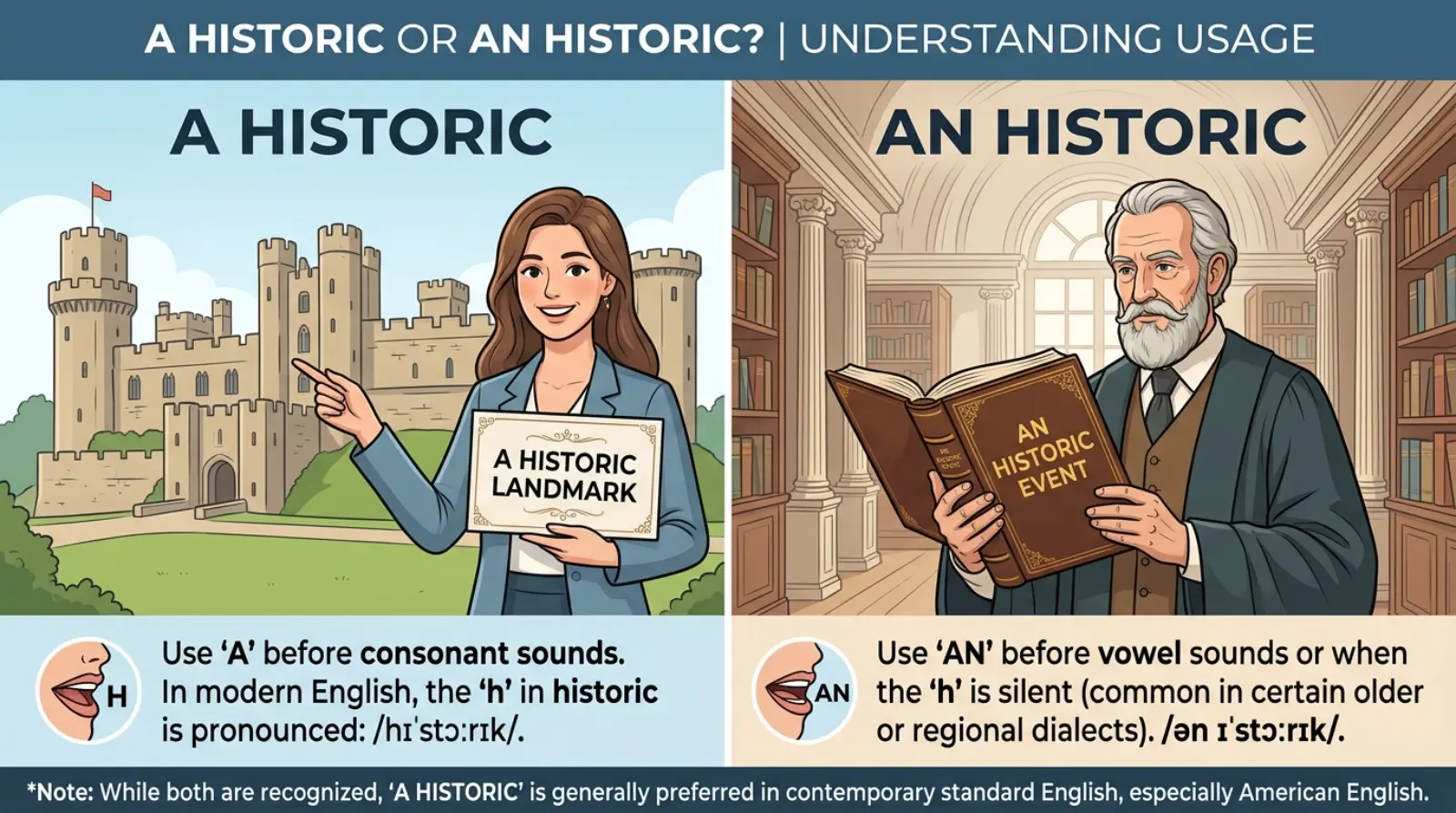
So, is it a historic or an historic? In modern standard English, a historic is the usual choice because the h in historic is normally pronounced: hih-STOR-ik. However, an historic is also found, especially in some varieties of British English and in formal or older writing where the initial h may be weak or silent.
People usually search for: the a historic or an historic meaning, correct grammar, pronunciation, examples, usage, definition, and grammar difference. You may also ask, “Is it a historic event or an historic event?” or “Which sounds more natural in American English?”
You can see this phrase in school essays, workplace writing, newspapers, books, social media, business communication, and everyday conversations. Choosing the right article can make your sentence sound natural and clear.
In this guide, you’ll learn the meaning, pronunciation, examples, usage, grammar rules, common mistakes, expert tips, and simple explanations in easy English.
A Historic or An Historic – Quick Answer
👉 A historic = the usual modern form when the h is pronounced.
👉 An historic = an accepted variant used by some speakers, especially in British English and formal or traditional writing.
Examples
- It was a historic moment. ✅
- The team achieved a historic victory. ✅
- It was an historic moment. ✅ Variant
- She witnessed a historic event. ✅
- They made a historic decision. ✅
Simple Rule
👉 Use a before a consonant sound.
👉 Use an before a vowel sound.
Because most speakers pronounce the h in historic, a historic is the natural choice for them.
What Does A Historic or An Historic Mean?
The phrases a historic and an historic have the same basic meaning. The difference is mainly about grammar, pronunciation, and English style.
Historic means something important or significant in history.
For example:
It was a historic day for the country.
This means the day was important enough to be remembered in history.
The article changes because of pronunciation, not because historic has a different meaning.
Synonyms
Depending on the sentence, words similar to historic include:
- Important
- Significant
- Memorable
- Notable
- Landmark
- Famous
Opposites
Depending on context, possible opposites include:
- Ordinary
- Unimportant
- Common
- Forgettable
- Insignificant
Related Terms
You may also see:
- Historic event
- Historic moment
- Historic achievement
- Historic decision
- Historic victory
- Historic occasion
- Historic agreement
- Historic change
Common Variations
The main question is:
a historic or an historic
But similar article questions occur with words beginning with h, such as:
- a hotel
- an hour
- a historical event / an historical event
- a hospital
- an honest person
The key is the sound, not simply the first letter.
The Origin of A Historic and An Historic
The word historic comes from history, which ultimately traces back through French and Latin to Greek roots connected with inquiry and knowledge.
The article choice developed from the way English speakers pronounced words beginning with h.
When an initial h was pronounced strongly, speakers naturally used a:
a historic event
When the h was weak or dropped in certain varieties of English, an could be used:
an historic event
Older British writing often used an before words beginning with an unstressed or weak h. Modern pronunciation has changed for many speakers, so a historic is now very common.
How to Pronounce A Historic or An Historic
Historic is commonly pronounced:
👉 hih-STOR-ik
The first sound is an audible h.
A historic
Say:
👉 uh his-TOR-ik
Because historic begins with the consonant sound h, a fits naturally.
An historic
Say:
👉 un his-TOR-ik
Some speakers use this form because of traditional pronunciation patterns or a weaker initial h.
Common Pronunciation Mistake
Do not choose an simply because historic begins with a vowel-like sound in your mind.
The important question is:
Can you hear the h sound?
If you clearly pronounce the h, a historic is the natural modern choice.
British English vs American English Usage
The difference is mainly one of style and pronunciation, not meaning.
| Feature | British English | American English | Notes |
|---|---|---|---|
| A historic | Common | Very common | Natural when h is pronounced |
| An historic | Used by some speakers | Less common | Often sounds formal or traditional |
| Meaning | Same | Same | No meaning change |
| Grammar rule | Based on sound | Based on sound | Article depends on pronunciation |
| Formal writing | Both can appear | A historic is usual | Style may vary |
In American English, a historic event is generally the normal choice.
In British English, an historic event can still be found, particularly in formal or traditional styles. However, a historic is also widely used.
Which One Should You Use?
For most modern writing, a historic is the safest and most natural choice.
- Academic writing: a historic event
- Workplace writing: a historic decision
- Business communication: a historic agreement
- News writing: a historic victory
- Everyday speech: a historic moment
- Social media: a historic day
Use an historic when it matches the pronunciation and style of the English variety you are following.
Mini Usage Table
| Sentence | Recommended? |
|---|---|
| It was a historic event. | ✅ |
| It was an historic event. | ✅ Variant |
| She made a historic discovery. | ✅ |
| He described it as an historic moment. | ✅ Variant |
Common Mistakes With A Historic or An Historic
Mistake 1: Choosing An Only Because of the Letter H
❌ It was an historic event because “historic” starts with h.
✔ It was a historic event.
Explanation: Articles depend on sound, not simply spelling.
Tip: Listen for the pronounced h.
Mistake 2: Thinking An Historic Is Always Wrong
❌ “An historic” can never be correct.
✔ An historic is an established variant used by some English speakers.
Explanation: English usage varies by region and style.
Tip: Do not treat every variation as a spelling error.
Mistake 3: Using A Before Every H Word
❌ an hour
❌ a honest person
✔ an hour
✔ an honest person
Explanation: Hour and honest begin with a vowel sound because the h is silent.
Mistake 4: Ignoring Pronunciation
❌ Choosing an without considering how you speak the word.
✔ Choose the article based on the sound you actually use.
Tip: Say the phrase aloud before deciding.
Mistake 5: Mixing Styles in Formal Writing
❌ Using an historic in one paragraph and a historic in another without a reason.
✔ Choose one style and use it consistently.
Explanation: Consistency makes formal writing smoother.
A Historic or An Historic in Everyday Examples
Work
Today marks a historic change for our company.
School
The students studied a historic event in class.
Social Media
What a historic moment!
Daily Life
Seeing that building was a historic experience for me.
Emails
Today was a historic day for our organization.
Text Messages
That was a historic win!
Online Content
The article explains a historic agreement between the two countries.
Conversations
“Was that a historic moment?”
“Yes, it certainly was.”
A Historic or An Historic in Different Contexts
Academic Writing
In essays and research writing, a historic is common:
The agreement represented a historic change in international relations.
Business
Companies may use the phrase when describing major milestones:
We reached a historic milestone this year.
News and Journalism
News writing often uses:
The country celebrated a historic victory.
Social Media
Social media tends to favor short and emotional phrases:
A historic day! 🇬🇧
Grammar Learning
For English learners, the most useful lesson is that a/an depends on sound.
Compare:
- a historic → h sound
- an hour → no h sound
- a hotel → h sound
- an honest person → no h sound
A Historic or An Historic – Usage Data and Search Behavior
People search for a historic or an historic because English articles can be confusing when spelling and pronunciation do not seem to match.
Common long-tail questions include:
- Is it a historic or an historic?
- Should I say a historic event?
- Is an historic grammatically correct?
- Why do people say an historic?
- Is a historic correct in British English?
- Is an historic American English?
- A historic moment or an historic moment?
The question appears among English learners in the US, UK, India, Pakistan, Canada, and Australia, where different accents and writing traditions can influence usage.
The important point is that a historic and an historic are not two different meanings. They reflect different pronunciation and style choices.
Comparison Table: A Historic vs An Historic
| Feature | A historic | An historic |
|---|---|---|
| Meaning | Important in history | Important in history |
| Grammar | Article + adjective | Article + adjective |
| Pronunciation basis | Pronounced h | Weak/silent h for some speakers |
| Modern usage | Very common | Less common in many varieties |
| American English | Common | Less common |
| British English | Common | Also used |
| Academic writing | Suitable | Suitable depending on style |
| Professional writing | Suitable | Suitable depending on style |
| Everyday speech | Very natural | Can sound formal/traditional |
| Beginner choice | Recommended | Learn as a variant |
A Historic or An Historic in Professional Life
Professional writing often needs to sound clear and natural.
For most modern business communication, a historic works well:
This is a historic opportunity for our company.
We reached a historic milestone.
The partnership marks a historic step forward.
If your organization follows a particular British editorial style, an historic may also appear. The important thing is to follow the style consistently.
A Historic or An Historic for Students and Beginners
Students often learn the simple rule:
a + consonant sound
an + vowel sound
Then they see an historic and become confused.
The solution is to remember that English grammar follows pronunciation.
Compare:
a historic event → h is pronounced
an hour → h is silent
a hotel → h is pronounced
an honest person → h is silent
This makes the rule much easier to understand.
Signs, Characteristics, and Common Uses
You will commonly see a historic or an historic before nouns such as:
- Event
- Moment
- Day
- Achievement
- Victory
- Decision
- Agreement
- Milestone
- Change
- Occasion
- Discovery
- Opportunity
The phrase usually describes something considered important, memorable, or significant in history.
Simple Trick to Remember A Historic or An Historic
Here is the easiest rule:
👉 Hear the H = use A
👉 Silent H = use AN
So:
a historic → pronounced h → A
an hour → silent h → AN
a hotel → pronounced h → A
an honest person → silent h → AN
Think of It This Way:
Don’t look at the first letter.
Listen to the first sound.
That one trick solves most a or an questions.
Expert Tips
- Say the phrase aloud. Your pronunciation can reveal the correct article.
- Remember that a/an is based on sound.
- Use a historic if you clearly pronounce the h and want the most common modern form.
- Know that an historic exists as a traditional or regional variant.
- Keep your style consistent in formal writing.
- Do not apply the same article to every word beginning with h.
- Compare historic with hour and honest to reinforce the rule.
Related Searches People Also Ask
Is it a historic event or an historic event?
Both occur, but a historic event is the usual modern form when the h is pronounced.
Why do people say an historic?
Some speakers use it because of traditional pronunciation and British English usage patterns.
Is an historic grammatically correct?
Yes, it can be grammatically acceptable depending on pronunciation and style.
Is a historic correct in American English?
Yes. A historic is the normal modern choice for most American speakers.
Is an historic British English?
It is found in British English, especially in formal or traditional usage, although a historic is also common.
Does a historic and an historic have different meanings?
No. They describe the same kind of important or significant event.
Why is it a historic instead of an historic?
Because the initial h is normally pronounced as a consonant sound.
Is historic a vowel or consonant sound?
When pronounced with a clear h, historic begins with a consonant sound.
Can I use an historic in an essay?
Yes, if it matches the style and pronunciation you are using. A historic is also fully suitable.
How can I remember a historic?
Remember: hear the H → use A.
FAQs
Is “a historic” correct?
Yes. A historic is standard and very common when the h in historic is pronounced.
Is “an historic” wrong?
Not necessarily. An historic is an established variant, especially in some British and traditional styles.
Which is more common, a historic or an historic?
A historic is generally the more common modern form, especially when the h is clearly pronounced.
Is a historic event grammatically correct?
Yes. A historic event is completely correct.
Is an historic event grammatically correct?
Yes, it can be correct depending on pronunciation and style.
Do a historic and an historic mean the same thing?
Yes. Both mean an important or significant event connected with history.
Why do we use “a” before historic?
Because historic normally begins with a pronounced h, which is a consonant sound.
Why do we say “an hour” but “a historic”?
Because the h in hour is silent, while the h in historic is normally pronounced.
Should students use a historic or an historic?
For most learners, a historic is the easiest modern form to use when the h is pronounced.
Can I use a historic in professional writing?
Yes. It is natural and appropriate for professional and business writing.
Final Verdict
A historic is the usual modern choice when you pronounce the h in historic.
An historic is also an established variant, particularly in some British English and traditional styles.
👉 Pronounced H = A historic
👉 Weak or silent H = An historic
Conclusion
The question a historic or an historic looks difficult at first, but the answer becomes simple when you focus on sound instead of spelling.
For most modern English speakers, a historic is the natural choice because the h in historic is pronounced. An historic is also used by some speakers and can appear in British or traditional formal writing.
So, when you are writing an essay, email, article, or social media post, a historic event, a historic moment, and a historic achievement are all perfectly natural.
Final memory trick: Don’t count letters—listen to sounds. Hear the H? Use A.

Camila Green is an English language writer who specializes in confusing word comparisons and spelling explanations. She creates simple, beginner-friendly guides on topics like “niece or neice” and other common English mistakes. Her writing focuses on clarity, real-life examples, and easy learning. At VerrsaPick, she helps readers improve their English with practical and engaging content.