Have you ever written a sentence like “I don’t want tea or coffee” and wondered whether nor would be better? You are not alone. Nor vs or is a common grammar question because both words connect ideas, but they do not work in exactly the same way.
You may see or and nor in school assignments, workplace emails, books, articles, conversations, and online writing. The confusion becomes stronger when a sentence already contains neither or another negative word.
People usually search for:
- nor vs or meaning
- nor vs or grammar difference
- when to use nor
- when to use or
- nor and or examples
- is nor the same as or?
- how to use neither nor
- how to use either or
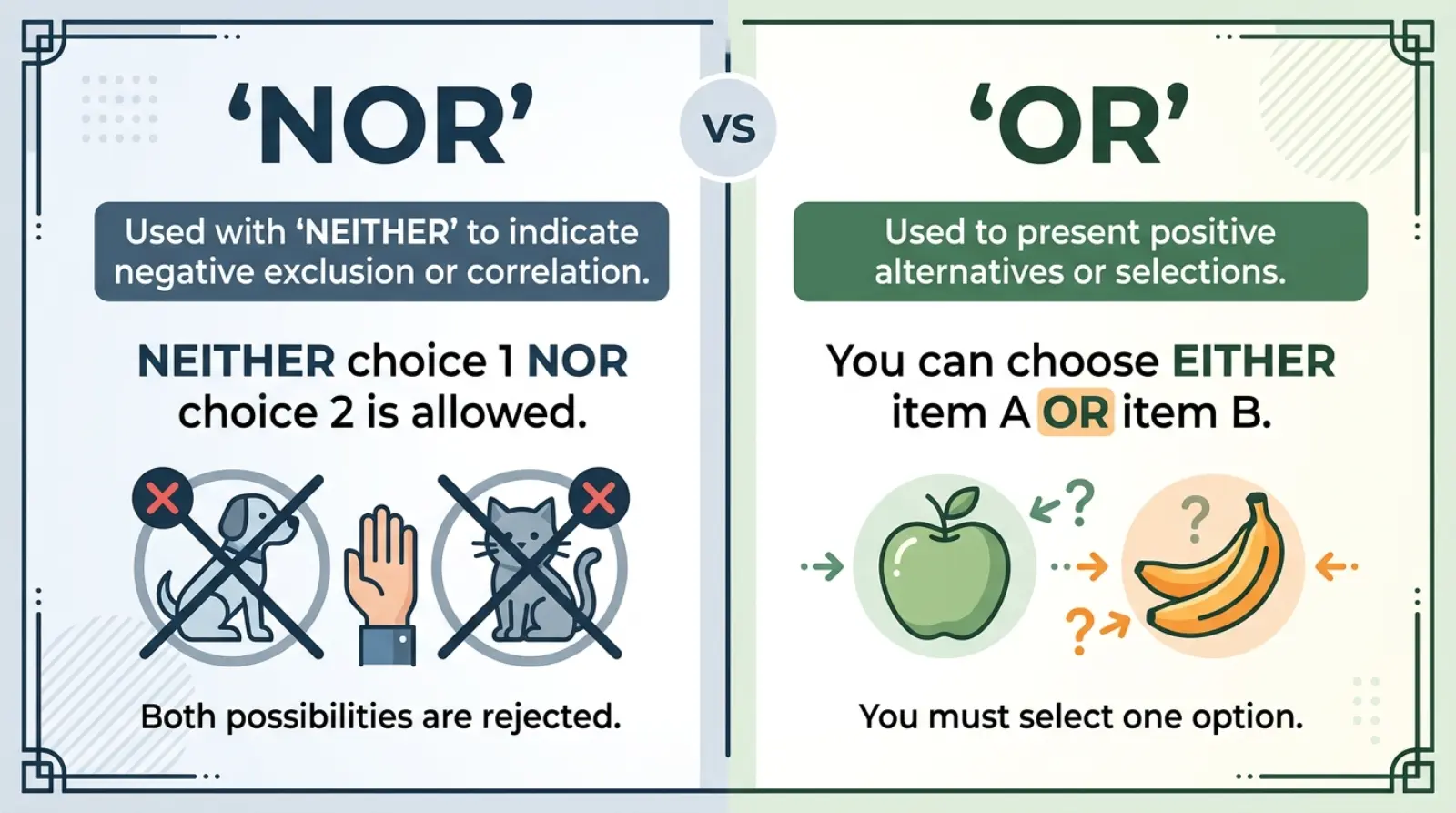
The good news is that the basic rule is simple. Or usually presents alternatives, while nor connects negative alternatives.
In this guide, you’ll learn the meaning, pronunciation, examples, usage, grammar rules, common mistakes, expert tips, and simple explanations in easy English.
Nor vs Or – Quick Answer
👉 Or = presents a choice or alternative.
👉 Nor = connects negative alternatives, often after “neither.”
Examples
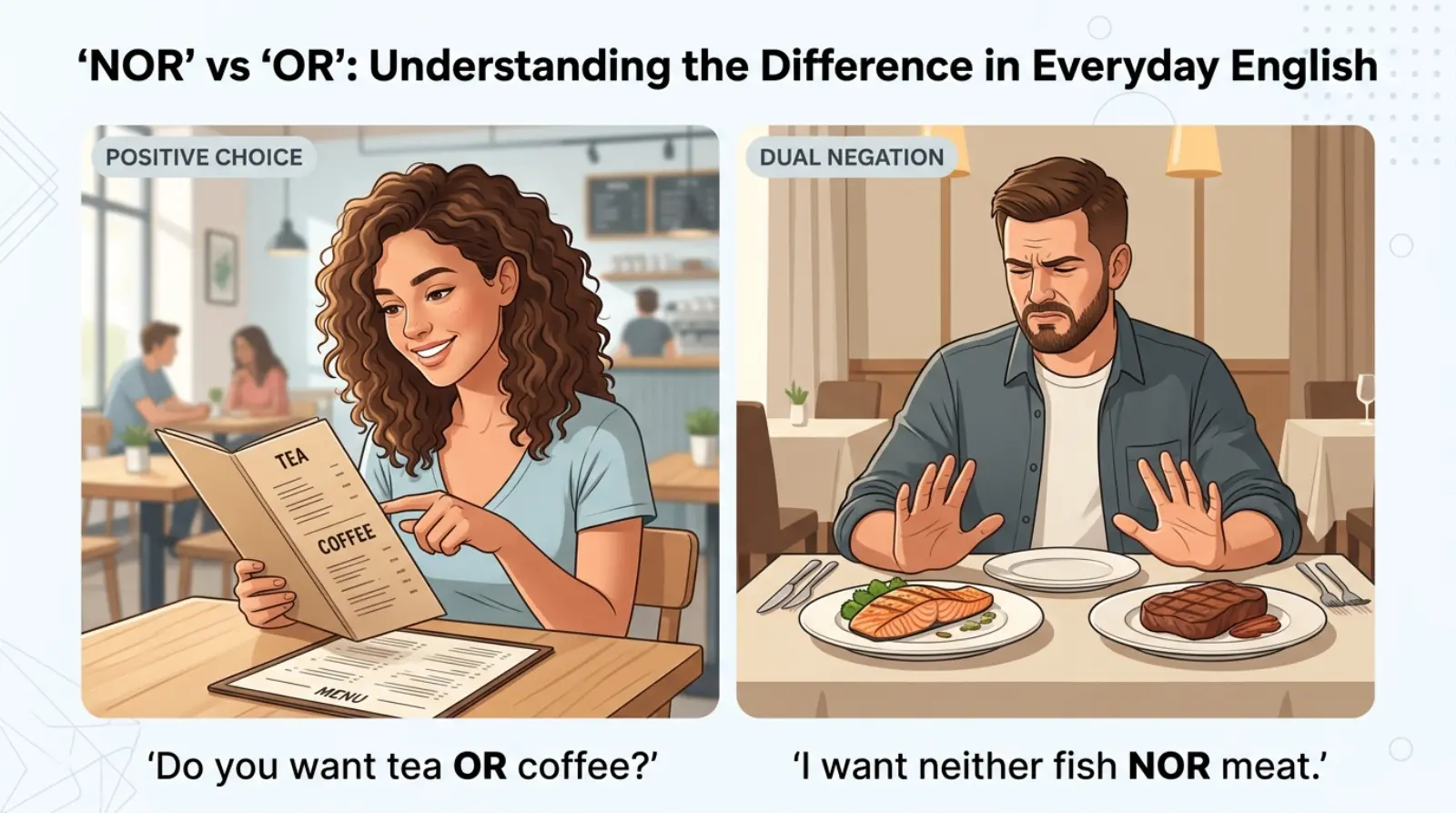
- Would you like tea or coffee? ✅
- I don’t want tea or coffee. ✅
- I want neither tea nor coffee. ✅
- Neither Ali nor Sara was there. ✅
Simple Rule
Think of it this way:
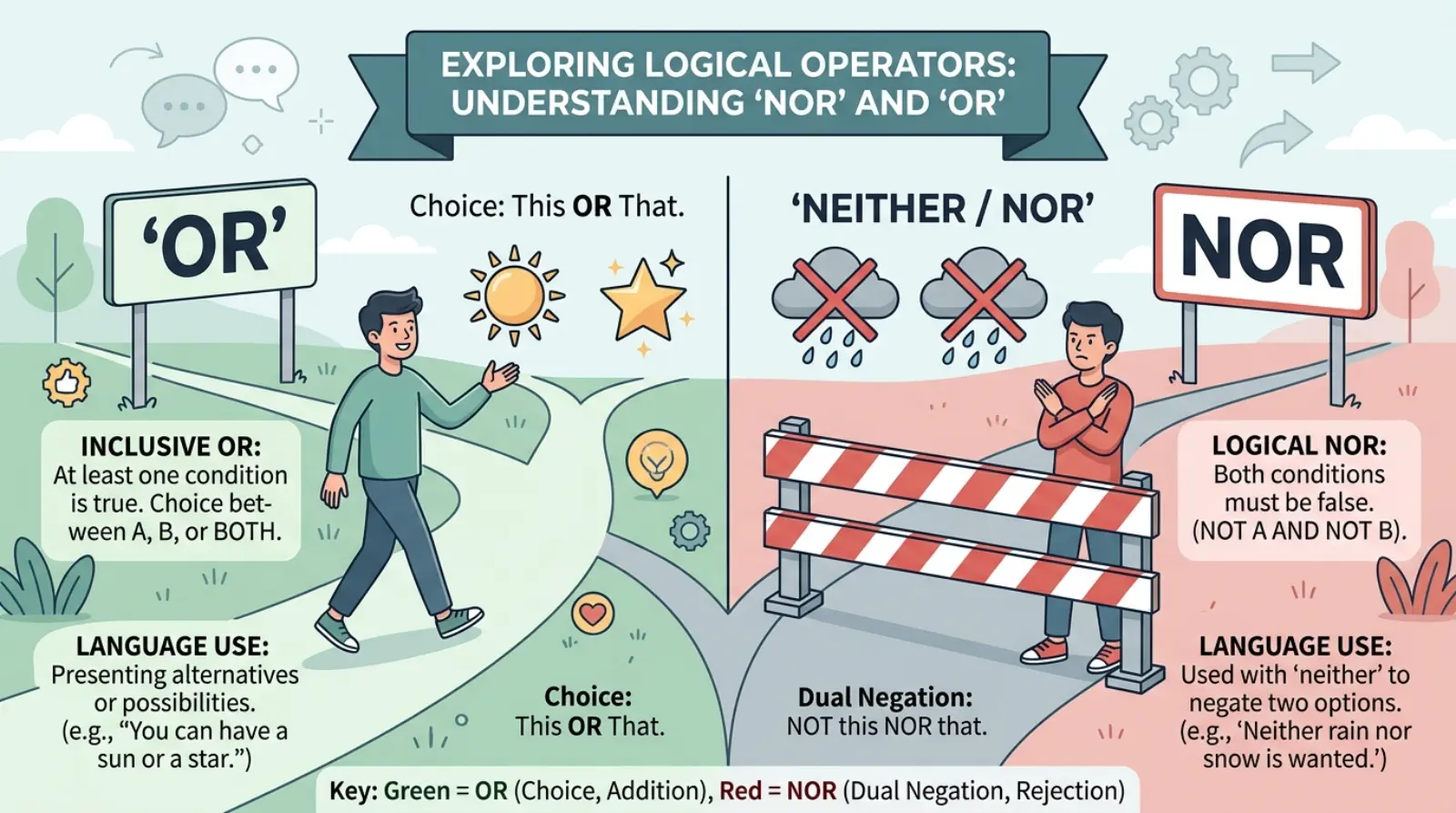
Or = this choice or that choice.
Nor = not this and not that.
A useful memory trick is:
Neither goes with nor. Either goes with or.
What Does Nor vs Or Mean?
Or is a coordinating conjunction used to show alternatives, choices, or possibilities.
For example:
You can call me or send me a message.
The sentence gives two possible choices.
Nor is also a conjunction, but it normally introduces another negative alternative.
For example:
She likes neither coffee nor tea.
This means she does not like coffee and does not like tea.
Related Terms
- either…or → two possible choices
- neither…nor → two negative choices
- both…and → two included ideas
- not…but → contrast between ideas
The Origin of Nor and Or
Both words have very old roots in English.
Or comes from Old English and has long been used to express alternatives.
Nor developed from older forms connected with negative alternatives. Its meaning became closely linked with expressions such as neither…nor.
Today, both words remain common in formal and everyday English, although nor can sound more formal in some sentences.
How to Pronounce Nor vs Or
The pronunciation is easy.
- or → /ɔːr/ or /ər/
- nor → /nɔːr/ or /nər/
In normal conversation, or may sound weaker and shorter.
For example:
Do you want tea or coffee?
The word or may sound almost like “er.”
Nor usually keeps its n sound:
Neither tea nor coffee.
A common mistake is dropping the n from nor when speaking.
British English vs American English Usage
There is no major grammar difference between British and American English for nor and or.
| Feature | British English | American English | Notes |
|---|---|---|---|
| Or | Common | Common | Shows alternatives |
| Nor | Common | Common | Often used with negative structures |
| Either…or | Common | Common | Gives alternatives |
| Neither…nor | Common | Common | Gives negative alternatives |
| Formal writing | Common | Common | Nor can sound formal |
The main rules are the same worldwide.
Which One Should You Use?
Use or when you are giving choices or alternatives.
- Do you want tea or juice?
- We can meet Monday or Tuesday.
- You can email me or call me.
Use nor when connecting negative alternatives.
- Neither option is cheap nor convenient.
- She likes neither cats nor dogs.
- He could neither read nor write.
For professional and academic writing, use the structure that clearly matches your meaning.
Common Mistakes With Nor vs Or
Mistake 1: Using nor for a normal choice
❌ Do you want tea nor coffee?
✔ Do you want tea or coffee?
Why? The question presents a normal choice, so or is correct.
Mistake 2: Forgetting neither
❌ I like neither tea or coffee.
✔ I like neither tea nor coffee.
Tip: Remember the pair neither…nor.
Mistake 3: Mixing either and nor
❌ You can either stay nor leave.
✔ You can either stay or leave.
Tip: Either pairs with or.
Mistake 4: Thinking nor simply means “or”
Nor is not always a direct replacement for or.
❌ Would you like pizza nor pasta?
✔ Would you like pizza or pasta?
Why? The sentence asks for a choice, not a negative combination.
Mistake 5: Using neither…or
❌ Neither John or Mike came.
✔ Neither John nor Mike came.
This is one of the most common learner mistakes.
Nor vs Or in Everyday Examples
Work
You can work from home or come into the office.
Neither the manager nor the assistant was available.
School
You can submit the assignment online or in person.
She studied neither French nor Spanish.
Social Media
Follow me on Instagram or TikTok.
I use neither platform regularly.
Emails
Please reply by email or phone.
Neither option is available at the moment.
Text Messages
Do you want pizza or burgers?
I want neither!
Daily Conversations
Should we walk or take the bus?
I want neither tea nor coffee.
Nor vs Or in Different Contexts
Education
Students commonly use or when describing choices:
Choose biology or chemistry.
They use nor in negative structures:
He studied neither biology nor chemistry.
Business
Or is useful when presenting options:
You can pay online or at the store.
Nor can connect negative business conditions:
Neither the buyer nor the seller agreed.
Professional Writing
Both words can appear in formal writing, but clarity matters more than sounding formal.
The report contains neither errors nor missing information.
Grammar Learning
The easiest pairs to remember are:
- either → or
- neither → nor
Nor vs Or: Comparison Table
| Feature | Or | Nor |
|---|---|---|
| Main meaning | Alternative or choice | Negative alternative |
| Common pair | Either…or | Neither…nor |
| Shows choice | Yes | Usually no |
| Shows negative meaning | Sometimes with context | Yes |
| Formal writing | Yes | Yes |
| Everyday speech | Very common | Less common |
| Example | Tea or coffee? | Neither tea nor coffee |
Nor vs Or in Professional Life
Choosing the right conjunction can make workplace writing clearer.
Compare:
Please choose Monday or Tuesday.
This gives two choices.
Now compare:
Neither Monday nor Tuesday works for me.
This rejects both choices.
That small difference can change the meaning of an email, report, proposal, or business message.
Nor vs Or for Students and Beginners
Beginners often struggle because both words connect ideas.
The easiest way to learn them is to memorize the two common pairs:
Either → Or
Either John or Mark will help.
Neither → Nor
Neither John nor Mark will help.
Then ask yourself one question:
Am I giving a choice, or am I rejecting both choices?
If you are giving a choice, use or.
If you are connecting negative alternatives, use nor.
Simple Trick to Remember Nor vs Or
Think of nor as having an N for negative.
👉 N = Negative → Nor
For example:
Neither rain nor snow stopped us.
Both things are being rejected or excluded.
Think of it this way:
Or opens a door between choices.
Coffee or tea?
Nor closes both doors.
Neither coffee nor tea.
That simple image can help you remember the difference.
Expert Tips for Using Nor vs Or
- Memorize the pairs: either/or and neither/nor.
- Look for a negative idea: nor often follows a negative structure.
- Do not use nor for ordinary choices.
- Read the sentence aloud: the meaning often becomes clearer.
- Check parallel structure: keep the words or phrases after the conjunction grammatically balanced.
For example:
She likes neither reading nor writing.
Both parts use the same form.
Related Searches People Also Ask
Is nor the same as or?
No. Or normally presents alternatives, while nor connects negative alternatives.
Can I use or after neither?
Usually no. The standard pair is neither…nor.
Can I use nor without neither?
Yes. Nor can appear after another negative statement.
He doesn’t like coffee, nor does he like tea.
What is the difference between either or and neither nor?
Either…or presents alternatives. Neither…nor says that both alternatives are not true or wanted.
Is nor formal English?
Nor is standard English and is especially common in formal or carefully structured writing.
Which is correct: neither or or neither nor?
The standard structure is neither…nor.
Is “or” positive and “nor” negative?
That is a useful beginner shortcut, although real grammar can be more complex.
Can nor be used in everyday English?
Yes. However, speakers may use simpler negative constructions in casual conversation.
FAQs About Nor vs Or
What is the main difference between nor and or?
Or gives alternatives. Nor connects negative alternatives.
Which is correct: either nor or either or?
The correct pair is either…or.
Which is correct: neither or or neither nor?
The standard form is neither…nor.
Can “nor” start a sentence?
Yes.
He didn’t call. Nor did he send a message.
Is “nor” always negative?
Nor normally carries a negative meaning or connects to a negative idea.
What is an easy way to remember nor?
Remember N = negative = nor.
Is “Do you want tea nor coffee?” correct?
No. Use:
Do you want tea or coffee?
Is “neither John nor Sarah” correct?
Yes.
Neither John nor Sarah attended the meeting.
Final Verdict
Or and nor are both conjunctions, but they have different jobs.
👉 Or = choice or alternative
👉 Nor = negative alternative
The easiest rule is:
Either → or
Neither → nor
When you remember these two pairs, most nor vs or questions become much easier.
Conclusion
The difference between nor vs or may look small, but choosing the right word makes your English clearer.
Use or when you are offering choices:
Would you like tea or coffee?
Use nor when connecting negative alternatives:
I want neither tea nor coffee.
If you ever feel stuck, look for the meaning first. Are you offering a choice, or are you saying that neither option applies?
Final memory trick: Or gives options; nor connects negative options.

Camila Green is an English language writer who specializes in confusing word comparisons and spelling explanations. She creates simple, beginner-friendly guides on topics like “niece or neice” and other common English mistakes. Her writing focuses on clarity, real-life examples, and easy learning. At VerrsaPick, she helps readers improve their English with practical and engaging content.