Imagine you are reading an English sentence and suddenly see the word fare. You may know words like fair, fee, or price, but fare can still feel confusing.
So, what does fare artinya mean?
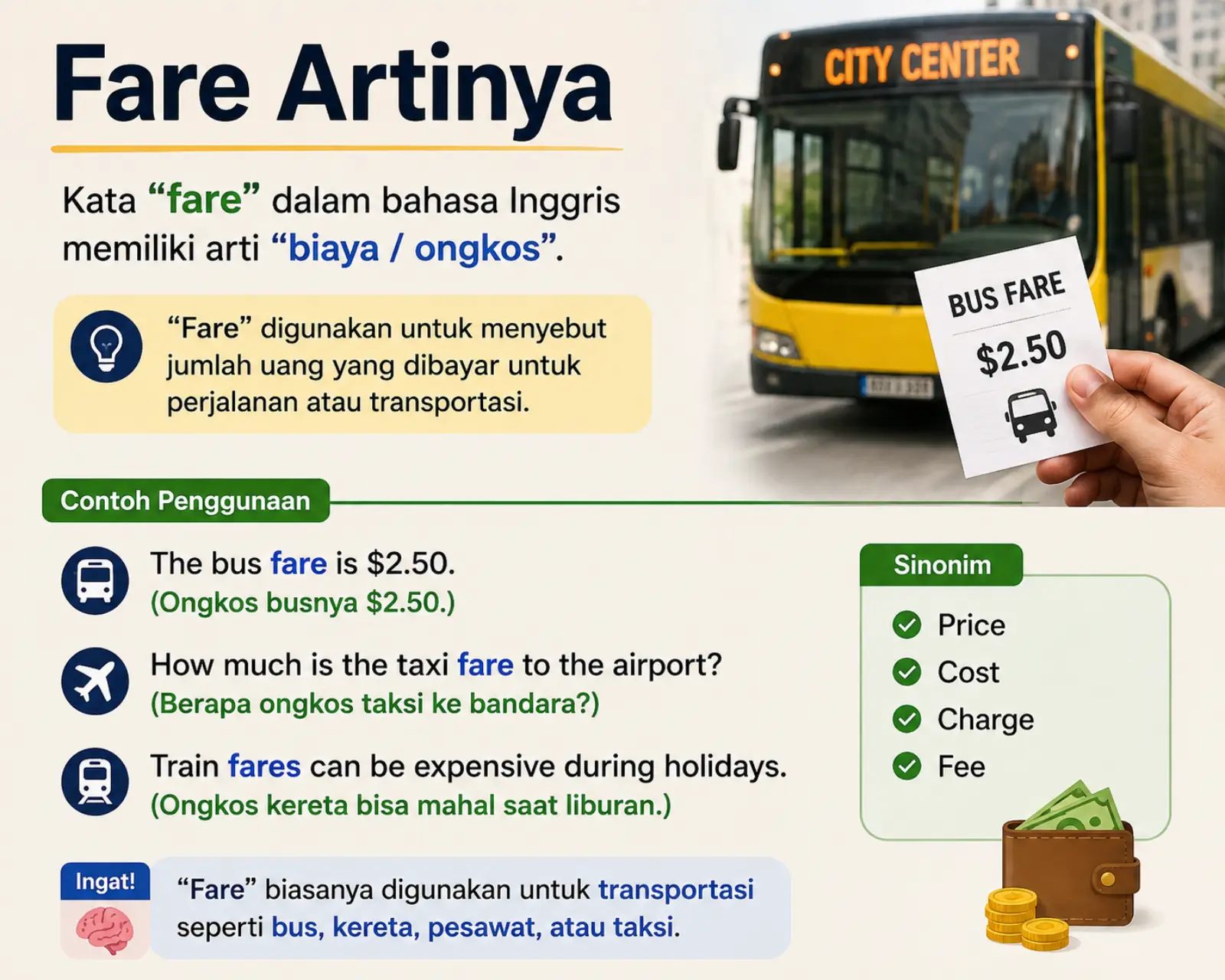
In Indonesian, fare artinya can mean tarif, ongkos, biaya perjalanan, atau makanan, depending on the sentence. Most often, fare refers to the money you pay for a bus, train, taxi, airplane, or other transportation. It can also be a verb meaning to do, perform, or progress, as in How did you fare?
People usually search for the meaning, pronunciation, examples, usage, definition, grammar difference, and correct context of fare. The word is common in travel, transportation, business, school English, conversations, websites, and everyday writing.
It can also be confused with fair, because both words sound the same in many English accents. However, their meanings are completely different.
For example, a taxi passenger may ask, “How much is the fare?” Here, fare means the amount of money charged for the trip. In another sentence, “How did you fare in the interview?” means “How did you do in the interview?”
Understanding these small differences can make English much easier.
In this guide, you’ll learn the meaning, pronunciation, examples, usage, grammar rules, common mistakes, expert tips, and simple explanations in easy English.
Fare Artinya – Quick Answer
tarif, ongkos, atau biaya yang dibayar untuk perjalanan.
perform, do, or progress when used as a verb.
Fare can also mean food, especially in expressions such as traditional fare.
Simple examples
- The bus fare is $2.
- How much is the train fare?
- We paid the taxi fare online.
- How did you fare in your exam?
- The restaurant serves traditional Italian fare.
Simple Rule
transport cost when talking about buses, trains, taxis, or flights.
do or perform when it is used as a verb.
food when it describes a type or style of food.
Memory trick: Think of fare as something connected to a trip, performance, or food.

What Does Fare Mean?
The word fare has several meanings in English.
1. Fare as a transportation cost
This is the most common meaning.
A fare is the amount of money you pay to use public transportation or another transport service.
Examples:
- The bus fare is affordable.
- What is the taxi fare?
- The train fare increased this year.
- We paid the airline fare before the trip.
In Indonesian, this meaning can be translated as tarif, ongkos, or biaya perjalanan.
2. Fare as a verb
As a verb, fare means to do, perform, or progress in a particular situation.
For example:
How did you fare in the interview?
This means:
How did you do in the interview?
Another common phrase is:
I hope you fare well.
It means:
I hope you do well.
3. Fare as food
Fare can also mean a particular type or style of food.
For example:
- The restaurant offers traditional Mexican fare.
- Seafood is popular local fare.
- The hotel serves simple breakfast fare.
Here, fare means food or a type of food.
Synonyms
Depending on the context, synonyms include:
- fare: transportation cost
- fee: charge for a service
- price: amount something costs
- charge: amount requested for a service
- food: fare in a food context
- perform: fare as a verb
- do: fare as a verb
- progress: fare as a verb
Opposites
There is no single opposite for every meaning of fare.
For transportation, you could use ideas such as free travel or no charge.
For the verb fare, the opposite may be fail, perform poorly, or struggle, depending on the sentence.
The Origin of Fare
The word fare has a long history in English.
It comes from an old Germanic language family and is connected with the idea of traveling or going. It is related to older English words connected with journeys and movement.
This history helps explain why fare became connected with transportation.
Over time, the word developed several uses. It became associated with the cost paid for a journey, the way someone performs, and eventually food or provisions.
Today, fare is still common in travel English and formal writing.
How to Pronounce Fare
Fare is usually pronounced:
👉 fair
It has one syllable.
Fare → /fer/ in many American English pronunciation guides.
It sounds like the word fair.
Examples:
- bus fare → bus fair
- train fare → train fair
- airline fare → airline fair
This creates one of the biggest spelling problems for English learners.
Remember:
Fare and fair sound alike, but their meanings are different.
British English vs American English Usage
The word fare is used in both British and American English.
| Feature | British English | American English | Notes |
|---|---|---|---|
| Transportation fare | Common | Common | Same meaning |
| Bus fare | Common | Common | Same usage |
| Taxi fare | Common | Common | Same meaning |
| Airfare | Common | Common | Often written as one word |
| Fare as a verb | Common | Common | Means do or perform |
| Fare meaning food | Common | Common | More common in formal descriptions |
| Pronunciation | Similar | Similar | Sounds like fair |
There is no major spelling difference between British and American English for fare.
Which One Should You Use?
Use fare when you are talking about a transportation charge.
Use fare for:
- bus tickets
- train journeys
- taxi rides
- airline tickets
- subway travel
- public transportation
Examples:
- The train fare is expensive.
- What is the bus fare?
- I paid the taxi fare.
Use fare as a verb when talking about someone’s performance or progress.
- She fared well in the competition.
- He did not fare well at the interview.
Use fare for food in descriptions such as:
- local fare
- traditional fare
- Italian fare
- vegetarian fare
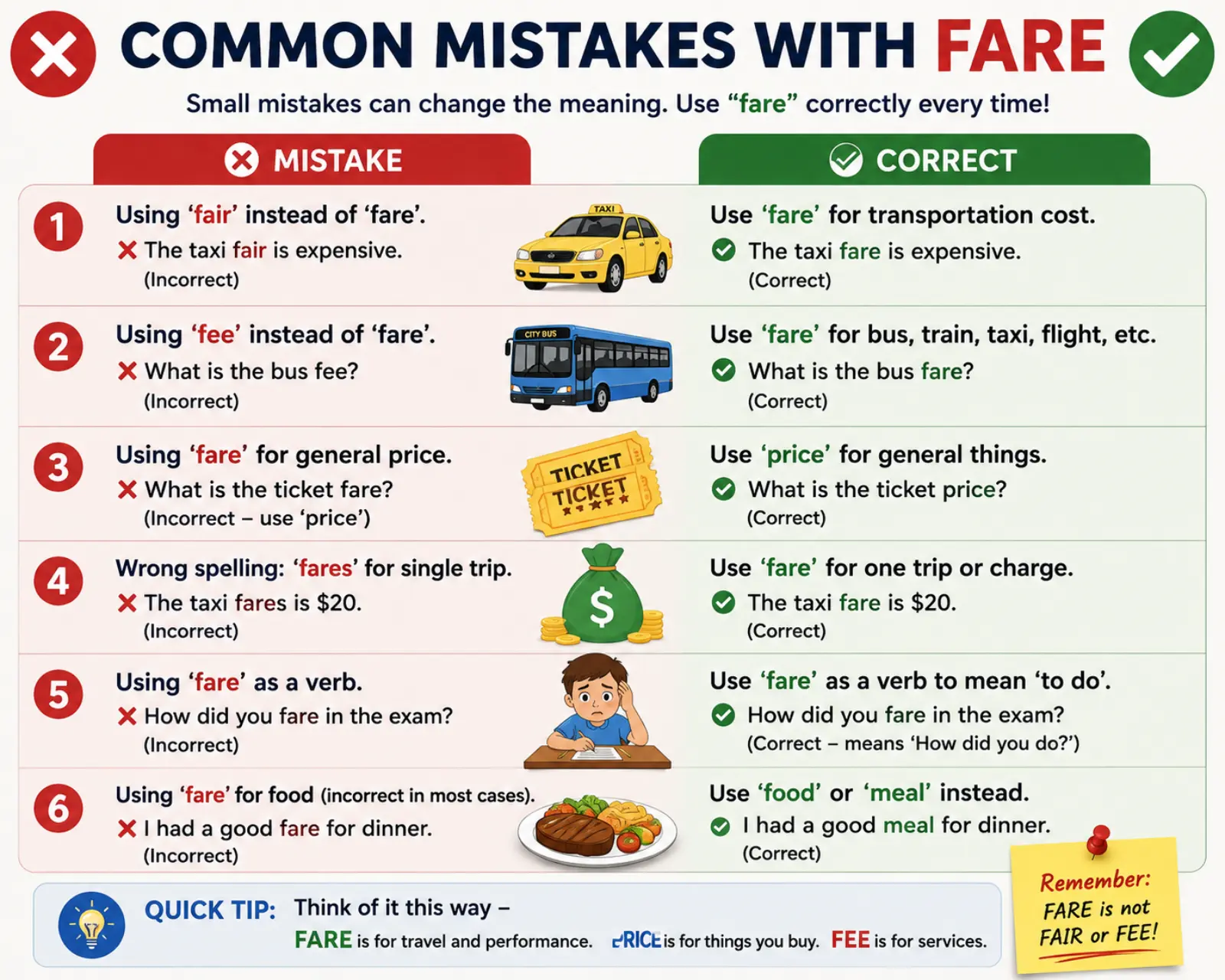
Common Mistakes With Fare
Mistake 1: Using fair for transportation
❌ The bus fair is expensive.
✔ The bus fare is expensive.
Why?
Fare means the transportation cost. Fair has different meanings, such as reasonable or just.
Tip: If you are paying for a ride, use fare.
Mistake 2: Thinking fare always means price
❌ The company fare for the service is $50.
✔ The company fee for the service is $50.
Why?
Fare is mainly used for transportation costs. A general service charge is usually called a fee.
Mistake 3: Confusing fare with fair
❌ The driver told me the taxi fair.
✔ The driver told me the taxi fare.
Tip: Think about travel. Travel cost = fare.
Mistake 4: Missing the verb meaning
Some learners think fare only means transportation cost.
But it can also be a verb.
✔ How did you fare in your test?
Here, fare means how you performed or did.
Mistake 5: Using fare incorrectly for food
Fare can describe food, but it is often used in phrases such as local fare or traditional fare.
✔ The restaurant serves traditional Thai fare.
This sounds more natural than using fare for every meal.
Fare in Everyday Examples
Work
- How did you fare during the job interview?
- The new employee fared well during training.
School
- How did you fare on the final exam?
- She fared better than expected.
Travel
- What is the bus fare?
- The train fare is cheaper than the taxi fare.
Daily Life
- I need enough money for the subway fare.
- The taxi fare was higher than expected.
Emails
- Please confirm the updated airfare.
- The fare includes one checked bag.
Text Messages
- Do you know the bus fare?
- The taxi fare was crazy!
Online Content
Travel websites often use terms such as:
- airfare
- train fare
- bus fare
- ticket fare
- fare calculator
- cheapest fare
Conversations
A: How much is the train fare?
B: It is about $5.
A: How did you fare in the competition?
B: I did pretty well.
Fare in Different Contexts
Education
In education, fare is usually used as a verb.
Example:
How did the students fare on the test?
It means:
How did the students perform?
Business
Business writing can use fare to describe performance.
The company fared well during the difficult year.
It can also appear in travel expenses:
The employee’s airfare was included in the travel budget.
Travel
Travel is the clearest context for fare.
Common expressions include:
- bus fare
- taxi fare
- train fare
- airfare
- subway fare
- minimum fare
- fare increase
Food
In food writing, fare means a style or type of food.
The café serves homemade American fare.
Communication
The expression fare well is another useful phrase.
I hope you fare well in your new job.
It means:
I hope you do well.
Fare – Google Trends and Usage
People search for fare artinya because they often meet the word while learning English, traveling, reading transportation information, or translating English sentences.
The Indonesian word artinya means meaning. Therefore, the search phrase fare artinya is a direct meaning-based query.
Common related searches include:
- fare artinya apa
- what does fare mean
- fare meaning in Indonesian
- fare meaning in English
- fare pronunciation
- fare vs fair
- bus fare meaning
- airfare meaning
- fare examples
- how to use fare in a sentence
Searchers from countries such as Indonesia, Pakistan, India, Malaysia, the US, the UK, Canada, and Australia may encounter the word in English lessons, travel websites, transportation apps, and online content.
The search intent is usually simple: the reader wants to understand the word quickly and use it correctly.
Comparison Table: Fare vs Fair
| Feature | Fare | Fair |
| Transportation cost | ✅ Yes | ❌ No |
| Means reasonable | ❌ No | ✅ Yes |
| Can be a verb | ✅ Yes | ❌ Usually no |
| Can describe food | ✅ Yes | ❌ No |
| Sounds like the other word | ✅ Yes | ✅ Yes |
| Example | bus fare | fair price |
| Indonesian meaning | tarif/ongkos | adil/wajar |
Easy difference
👉 Fare = transport cost
👉 Fair = reasonable, just, or an event
Example:
The taxi fare was expensive.
The price was fair.
Fare in Professional Life
Correct word choice matters in professional communication.
A travel company might write:
Our standard airfare includes one checked bag.
A manager might say:
The team fared well during the project.
Using fare correctly makes business writing clearer.
It is especially useful in:
- travel businesses
- airlines
- hotels
- transportation companies
- business reports
- customer service
- financial travel documents
- professional emails
For formal writing, always check the context before choosing fare, fee, price, or fair.
Fare for Students and Beginners
Beginners often struggle because fare and fair sound the same.
The easiest solution is to learn the word through short sentences instead of memorizing only the definition.
Try these:
The bus fare is $3.
How did you fare in the test?
The restaurant serves local fare.
Then remember the three main meanings:
Travel → performance → food
This simple pattern covers most common uses.
Common Uses of Fare
You will often see fare in these patterns:
- bus fare
- train fare
- taxi fare
- airfare
- fare price
- fare increase
- fare payment
- fare well
- fare better
- fare poorly
- local fare
- traditional fare
These phrases can help you recognize the meaning quickly.
Simple Trick to Remember Fare
Think of FARE as three ideas:
🚕 Travel → money for a ride
📈 Performance → how someone does
🍽️ Food → a type of food
Think of it this way:
If you get into a taxi, you pay a fare.
If someone asks how you did in an exam, they can ask:
How did you fare?
If a restaurant serves a certain style of food, it can be called its fare.
So, one word has three useful connections.
Expert Tips for Using Fare Correctly
- Look at the words around it.
If you see bus, train, taxi, or airline, fare probably means transportation cost. - Check the grammar.
If fare describes how someone performed, it is probably a verb. - Remember fare and fair are different.
They may sound alike, but they do not have the same meaning. - Learn common phrases.
Bus fare, airfare, and fare well are easier to remember as complete phrases. - Use examples while learning.
One real sentence can be easier to remember than a long dictionary definition.
Related Searches People Also Ask
What does fare mean in Indonesian?
Fare can mean tarif, ongkos, or biaya perjalanan. It can also mean melakukan dengan baik/buruk as a verb or makanan in certain contexts.
What is the difference between fare and fair?
Fare commonly means a transportation cost. Fair can mean reasonable, just, or an event.
What does bus fare mean?
Bus fare means the amount of money you pay to travel by bus.
What does airfare mean?
Airfare means the price charged for an airplane journey or flight ticket.
What does fare well mean?
Fare well means to do well or succeed in a situation.
Is fare a noun or verb?
Fare can be both a noun and a verb. As a noun, it can mean a transportation charge. As a verb, it can mean to perform or progress.
Is fare the same as price?
Not always. Fare is mainly used for transportation costs, while price has a much wider use.
Does fare mean food?
Yes. In expressions such as local fare or traditional fare, it can mean a particular type of food.
Why does fare sound like fair?
They are pronounced the same in many English accents. They are called homophones because they sound alike but have different meanings and spellings.
How can I remember fare?
Connect it with three ideas: travel, performance, and food.
FAQs About Fare Artinya
What is fare artinya in simple English?
Fare artinya is usually tarif, ongkos, or biaya perjalanan. The exact meaning depends on the sentence.
How do you pronounce fare?
Fare is pronounced like fair. It has one syllable.
Is fare used in American English?
Yes. Fare is common in American English, especially in transportation and travel.
Is fare used in British English?
Yes. British English also commonly uses fare for transportation costs and other meanings.
What is an example of fare in a sentence?
The train fare is $10.
Here, fare means the cost of the train journey.
What does fare mean as a verb?
As a verb, fare means to do, perform, or progress.
Example:
She fared well in the competition.
What is the difference between fare and fee?
A fare is commonly paid for transportation. A fee is a charge for a service, membership, or professional activity.
Can fare mean food?
Yes. Fare can describe a particular kind of food, especially in phrases like traditional fare.
Is fare a difficult English word?
Not really. It becomes easier once you remember its three common meanings: transport cost, performance, and food.
Final Verdict
Fare artinya usually means tarif, ongkos, or biaya perjalanan in Indonesian.
However, fare has two other important meanings:
- Fare = transportation cost
- Fare = perform or progress
- Fare = a type of food
The easiest memory rule is:
👉 Fare = travel money, how you do, or food.
Also remember that fare and fair sound alike but have different meanings.
Conclusion
Understanding fare artinya is easier once you stop thinking of fare as having only one meaning.
In travel English, fare usually means the amount you pay for a bus, train, taxi, airplane, or another journey. As a verb, it means to do or perform. In food-related writing, it can describe a particular type of food.
The biggest beginner mistake is confusing fare with fair. Remember that a fare is something you pay for a ride, while fair can describe something reasonable or just.
So, when you see fare, check the context first.
Easy final trick:
🚕 Ride → fare
📈 Performance → fare
🍽️ Food → fare
Once you connect these three ideas, the word becomes much easier to understand and use.

Camila Green is an English language writer who specializes in confusing word comparisons and spelling explanations. She creates simple, beginner-friendly guides on topics like “niece or neice” and other common English mistakes. Her writing focuses on clarity, real-life examples, and easy learning. At VerrsaPick, she helps readers improve their English with practical and engaging content.