If you’ve ever typed “recieve” and wondered if it was right, you’re not alone. “How do you spell receive?” is one of the most searched English spelling questions because the letters “ie” and “ei” often confuse learners.
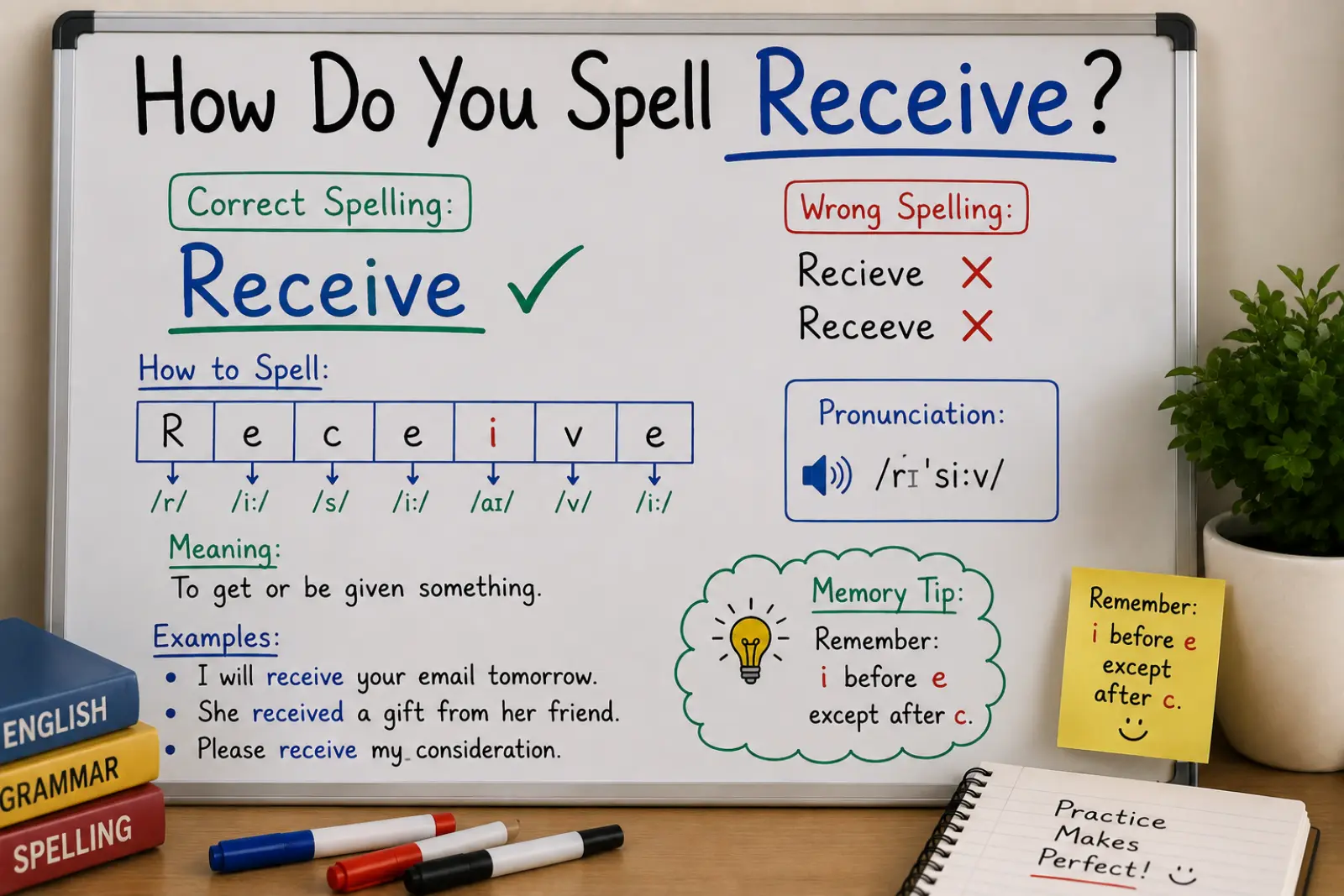
The correct spelling is:
✅ Receive
❌ Recieve
The word receive means to get, accept, or be given something.
Whether you’re writing a school assignment, a business email, a text message, or a social media post, spelling receive correctly helps you communicate clearly and professionally.
People usually search for:
- How do you spell receive?
- Is it receive or recieve?
- Receive meaning
- Receive pronunciation
- How to use receive in a sentence
- Why is receive spelled with “ei”?
In this guide, you’ll learn the correct spelling, pronunciation, grammar rules, examples, common mistakes, and an easy memory trick that will help you spell receive correctly every time.
How Do You Spell Receive? – Quick Answer
✅ Correct Spelling
Receive
❌ Incorrect Spelling
Recieve
Meaning
Receive means to get, accept, or take something that someone gives or sends.
Examples
- I received your email this morning.
- She received a birthday gift.
- We received the package yesterday.
- Did you receive my message?
- The student received an award.
Easy Memory Trick
Remember this famous spelling rule:
“I before E, except after C.”
Since the letter C comes before the vowels in receive, the correct spelling is EI, not IE.
What Does “Receive” Mean?
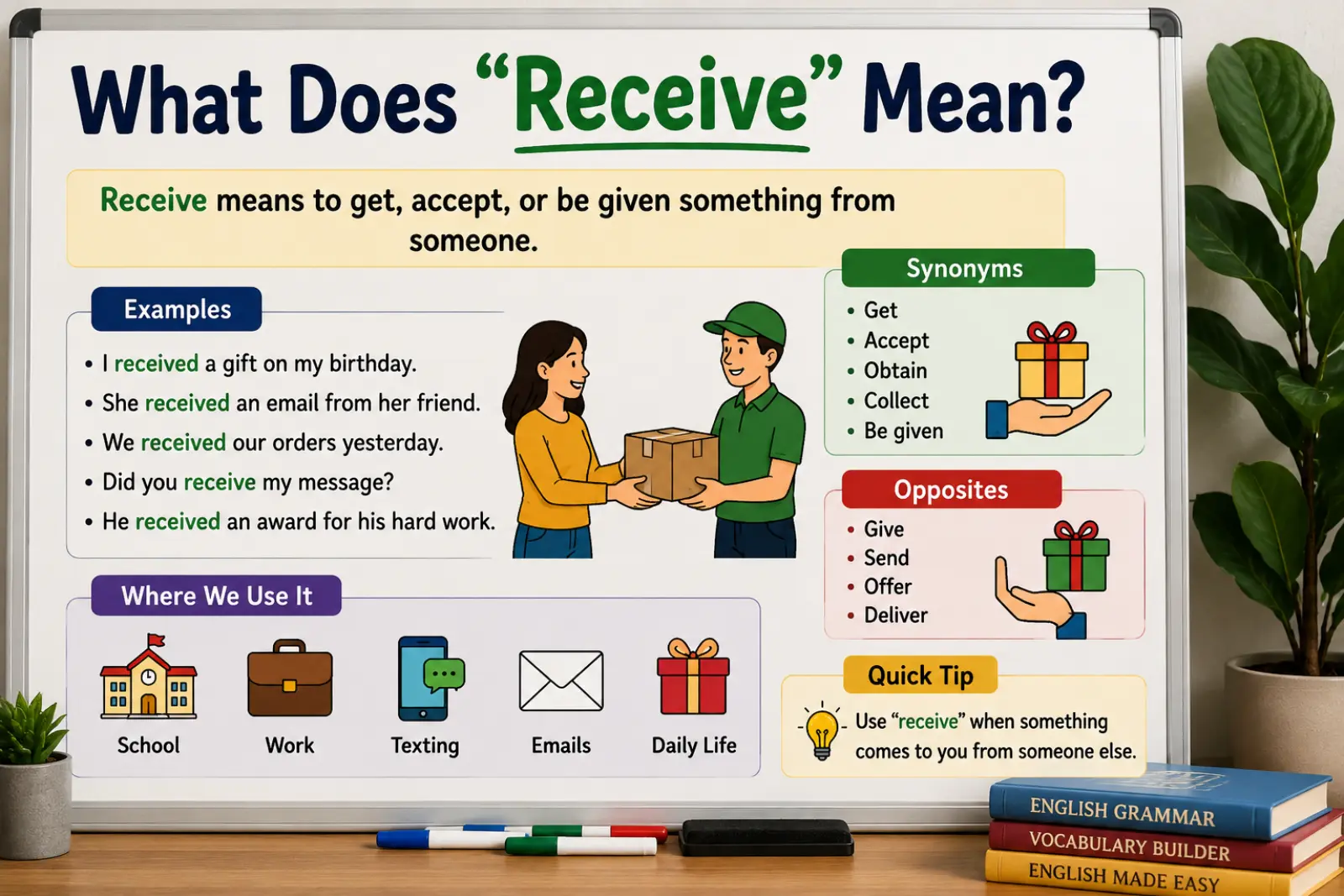
The verb receive means to get, accept, collect, or be given something.
You can receive:
- Emails
- Gifts
- Messages
- Payments
- Awards
- Phone calls
- Letters
- Information
Synonyms
- Get
- Accept
- Obtain
- Collect
- Gain
Opposites
- Give
- Send
- Donate
- Offer
Related Words
- Received
- Receiving
- Receiver
- Receipt
- Reception
How Do You Spell Receive in English?
The correct spelling is receive. This word is often misspelled as recieve, mainly because of the tricky order of the vowels. Receive means to get, accept, or be given something. For example, you might receive an email, a gift, a message, or a package. A simple way to remember the spelling is the rule “i before e, except after c”, which gives you receive. Learning this spelling can help you avoid one of the most common English spelling mistakes.
The Origin of Receive
The word receive comes from the Latin word recipere, meaning “to take back” or “to take in.” It later entered English through Old French.
Although English spelling has changed over time, receive has kept its traditional spelling, which is why many learners still confuse it today.
How to Pronounce Receive
Pronunciation
ri-SEEV
Phonetic
/rɪˈsiːv/
Easy Speaking Trick
Break it into two parts:
ri + seev
Stress the second syllable:
ri-SEEV
British English vs American English
The spelling of receive is exactly the same in both British and American English.
| Feature | British English | American English | Notes |
|---|---|---|---|
| Spelling | Receive | Receive | Same spelling |
| Meaning | Same | Same | No difference |
| Pronunciation | Very similar | Very similar | Slight accent only |
Which One Should You Use?
Always use receive in every type of writing.
Use “receive” in:
- ✅ School assignments
- ✅ Business emails
- ✅ Job applications
- ✅ Reports
- ✅ Social media
- ✅ Text messages
- ✅ Everyday conversations
| Situation | Correct Word |
|---|---|
| Academic writing | Receive |
| Professional writing | Receive |
| Daily conversation | Receive |
| Online communication | Receive |
Common Mistakes When Spelling Receive
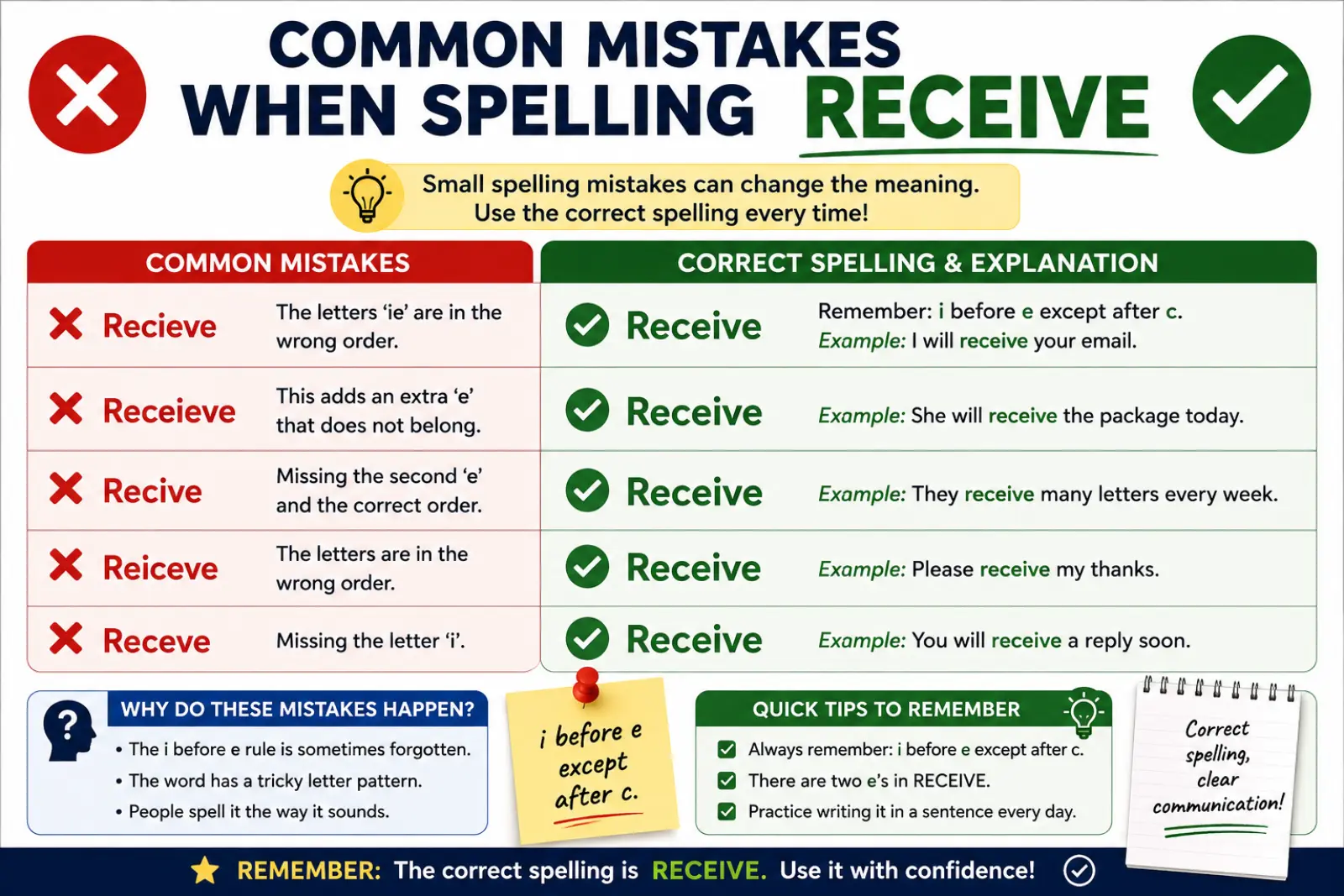
Mistake 1
❌ I recieve your message.
✅ I receive your message.
Why? The letters should be EI after C.
Mistake 2
❌ She recieved a gift.
✅ She received a gift.
Tip: The past tense is received, not recieved.
Mistake 3
❌ Did you recive the email?
✅ Did you receive the email?
Tip: Don’t forget the second e.
Mistake 4
❌ We have recived your payment.
✅ We have received your payment.
Tip: Proofread business emails carefully.
Mistake 5
❌ Please recieve this award.
✅ Please receive this award.
Remember: After C, write EI.
Everyday Examples of Receive
At School
“I received an A on my science test.”
At Work
“We received your application today.”
In Emails
“Thank you. I received your documents.”
Daily Life
“I received a package from my friend.”
Text Messages
“Did you receive my photo?”
Social Media
“I received so many birthday wishes today!”
Receive in Different Contexts
Education
Students receive grades, homework, certificates, and scholarships.
Business
Companies receive customer orders, invoices, and payments.
Technology
Phones receive notifications, emails, updates, and verification codes.
Communication
People receive messages, calls, invitations, and letters every day.
Why Do People Search “How Do You Spell Receive?”
Many English learners search this phrase because receive is one of the most commonly misspelled words in English.
Popular searches include:
- How do you spell receive correctly?
- Receive or recieve?
- Receive pronunciation
- Receive meaning
- How to remember receive
- Examples of receive
This keyword is especially popular among learners in the United States, United Kingdom, Canada, Australia, India, and Pakistan, where English is widely used in education and business.
Comparison Table
| Feature | Receive | Recieve |
|---|---|---|
| Correct spelling | ✅ Yes | ❌ No |
| Dictionary word | ✅ Yes | ❌ No |
| Professional writing | ✅ Yes | ❌ Never |
| School exams | ✅ Correct | ❌ Incorrect |
| Grammar | Correct verb | Misspelling |
How Do You Spell Receive in IELTS?
The correct spelling is receive, and it is important to use it correctly in the IELTS exam. Spelling mistakes can affect your writing quality and may lower your score for Lexical Resource and overall language accuracy. A common mistake is writing recieve, but this spelling is incorrect. You may use receive when discussing emails, education, payments, information, awards, or services. For example, “Students receive feedback from their teachers.” Remember that the correct order is r e c e i v e.
Receive in Professional Life
Correct spelling builds trust and professionalism.
Examples:
- “We have received your payment.”
- “Your application has been received.”
- “I received your report this morning.”
Spelling mistakes in emails or resumes can leave a poor impression, so always double-check words like receive.
Receive for Students and Beginners
Many beginners confuse ie and ei because English spelling isn’t always predictable.
Easy Tips
- Learn the rhyme “I before E, except after C.”
- Read English books regularly.
- Practice writing receive several times.
- Use spell check as a helper, not a replacement.
Simple Trick to Remember Receive
Memory Rule
After the letter C, use EI.
Think of it this way:
The letter C tells E to stand before I.
So write:
Receive = C + EI
Not:
Recieve = C + IE
Expert Spelling Tips
- Keep a list of commonly misspelled words.
- Read your writing aloud while proofreading.
- Practice difficult words using flashcards.
- Learn spelling patterns instead of memorizing individual words.
- Review words like receive, receipt, and deceive together.
Related Searches People Also Ask
Is “recieve” ever correct?
No. Recieve is always incorrect.
Why is receive spelled with “ei”?
Because it follows the spelling rule “I before E, except after C.”
How do you pronounce receive?
It is pronounced ri-SEEV.
What is the past tense of receive?
The past tense is received.
What does receive mean?
It means to get or accept something.
Is receive a verb?
Yes. It is a regular English verb.
Can I use receive in formal writing?
Yes. It is commonly used in academic and professional English.
How can I remember receive easily?
Remember: After C comes EI.
FAQs
How do you spell receive?
The correct spelling is receive.
Is recieve wrong?
Yes. It is a common spelling mistake.
What does receive mean?
It means to get or accept something.
How do you pronounce receive?
ri-SEEV.
Is receive used in business writing?
Yes. It is frequently used in emails, reports, and official documents.
What is the past tense of receive?
Received.
Why is receive difficult to spell?
Because many people confuse the letters IE and EI.
What is the easiest way to remember receive?
Use the rhyme: “I before E, except after C.”
Final Verdict
If you’re asking, “How do you spell receive?”, the answer is simple:
✅ Receive is the only correct spelling.
❌ Recieve is always incorrect.
The easiest way to remember it is:
After the letter C, write EI—not IE.
Conclusion
Knowing how to spell receive correctly is an important English skill. Although many people accidentally write recieve, the correct spelling is always receive. The word means to get or accept something, and it is used every day in school, work, emails, and conversations.
Whenever you’re unsure, remember the simple spelling rule:
“I before E, except after C.”
With a little practice and this easy memory trick, you’ll be able to spell receive correctly every time.

Camila Green is an English language writer who specializes in confusing word comparisons and spelling explanations. She creates simple, beginner-friendly guides on topics like “niece or neice” and other common English mistakes. Her writing focuses on clarity, real-life examples, and easy learning. At VerrsaPick, she helps readers improve their English with practical and engaging content.