Have you ever heard someone say “hisself” and wondered if it was correct? Maybe you saw it in a movie, heard it in a conversation, or noticed it on social media. Many English learners also ask if himself or hisself is the right word to use.
People usually search for himself or hisself meaning, correct spelling, pronunciation, examples, usage, and grammar difference because both words sound similar. This confusion often happens in school, daily conversations, online discussions, and even books that use regional dialects.
The good news is that the answer is simple. Standard English uses himself, while hisself is considered a nonstandard or dialect form. Knowing the difference helps you write clearly and speak with confidence in school, at work, and in professional communication.
In this guide, you’ll learn the meaning, pronunciation, examples, usage, grammar rules, common mistakes, expert tips, and simple explanations in easy English.
Himself or Hisself – Quick Answer
👉 Himself = The correct reflexive pronoun in Standard English.
👉 Hisself = A nonstandard regional or dialect form of himself. It is not accepted in formal writing.
Examples
- ✅ He taught himself to play the guitar.
- ✅ John blamed himself for the mistake.
- ❌ He taught hisself to drive. (Nonstandard)
- ❌ He looked at hisself in the mirror. (Standard English prefers himself.)
Simple Memory Trick
Think of “his + self = himself.” There is no standard English word called hisself.
What Does Himself or Hisself Mean?
Both words refer back to a male person already mentioned in the sentence.
Himself
- Correct English reflexive pronoun
- Used when the subject and object are the same person
- Accepted worldwide in formal and informal English
Hisself
- Regional or dialect pronunciation and spelling
- Common in some local speech
- Not recommended for school, exams, or professional writing
Synonyms
- Personally
- On his own
- By himself
Related Terms
- Yourself
- Herself
- Itself
- Themselves
The Origin of Himself or Hisself
Himself comes from Old English and has been the accepted standard form for centuries.
Hisself developed in some English dialects as spoken language changed over time. Writers sometimes use it in novels or dialogue to show a character’s accent or regional speech. However, grammar books still recognize himself as the correct standard form.
How to Pronounce Himself or Hisself
| Word | Pronunciation |
|---|---|
| Himself | him-SELF |
| Hisself | his-SELF |
Easy Tip
Stress the second part: SELF.
British English vs American English Usage
| Feature | British English | American English | Notes |
|---|---|---|---|
| Himself | ✅ Standard | ✅ Standard | Correct everywhere |
| Hisself | Rare dialect | Regional dialect | Not formal |
Which One Should You Use?
Always choose himself in:
- Academic writing
- School assignments
- Business emails
- Professional documents
- Newspapers
- Websites
Use hisself only when quoting someone’s speech or writing dialogue that reflects a specific dialect.
| Situation | Best Choice |
|---|---|
| School | Himself |
| Workplace | Himself |
| Social media | Himself |
| Formal writing | Himself |
| Fictional dialogue | Hisself (only if intentional) |
Common Mistakes with Himself or Hisself
Mistake 1
❌ He fixed hisself.
✔ He fixed himself.
Tip: Standard English always uses himself.
Mistake 2
❌ Tom blamed hisself.
✔ Tom blamed himself.
Mistake 3
❌ My brother hurt hisself.
✔ My brother hurt himself.
Mistake 4
❌ He introduced hisself.
✔ He introduced himself.
Mistake 5
❌ He prepared hisself.
✔ He prepared himself.
Everyday Examples
Work
“He completed the project himself.”
School
“The student taught himself French.”
Social Media
“He built this gaming PC himself.”
Daily Life
“He cooked dinner himself.”
“Our manager wrote the report himself.”
Conversation
“He said he would fix it himself.”
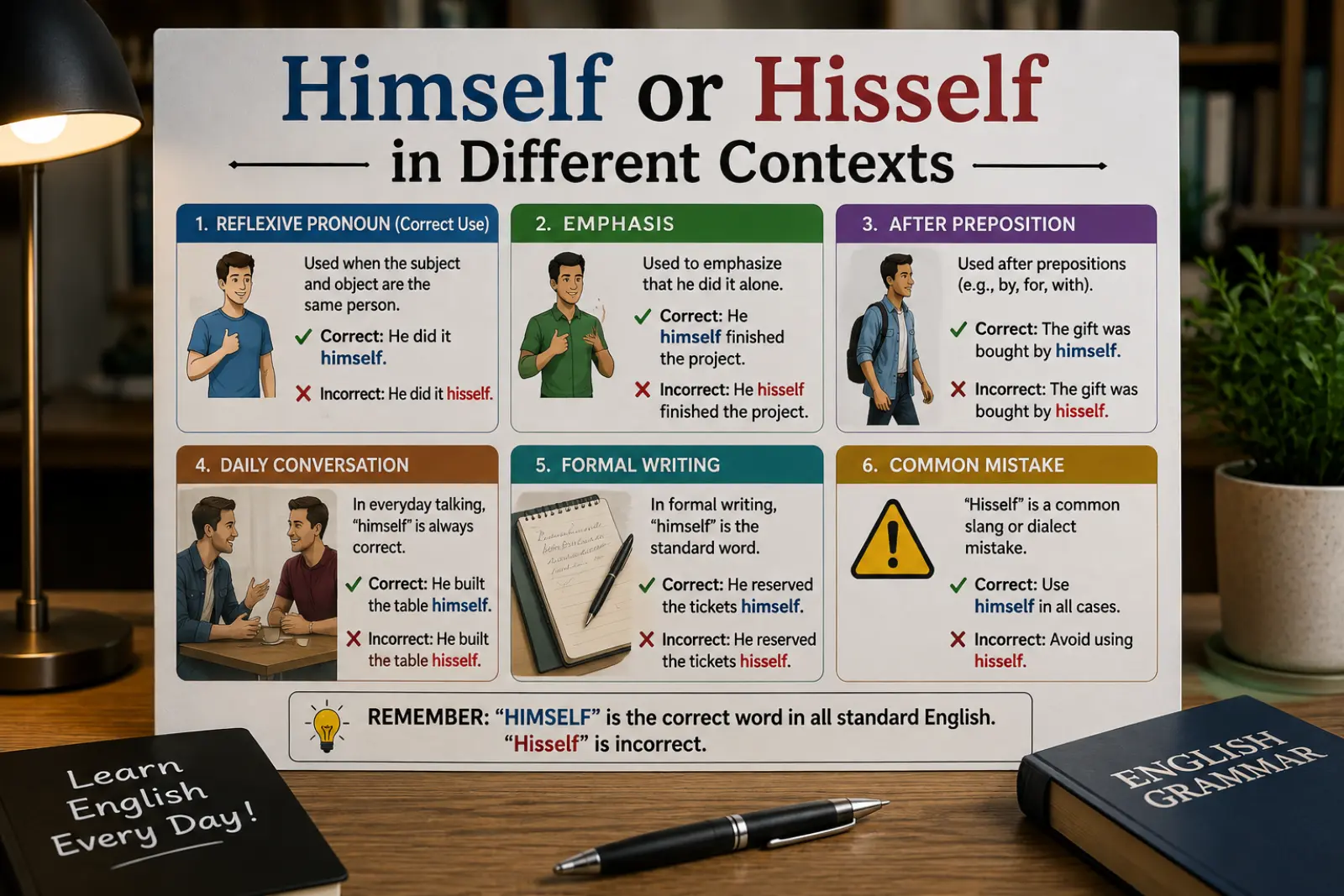
Himself or Hisself in Different Contexts
Grammar Learning
Himself is a reflexive pronoun used when the subject performs an action on the same person.
Literature
Authors may use hisself to show regional speech or a character’s background.
Communication
Using himself makes your writing clear and professional.
Google Trends and Usage
Searches for himself or hisself continue because learners want to know:
- Which spelling is correct
- Grammar rules
- Pronunciation
- Sentence examples
- Dialect differences
The topic is popular in the US, UK, Canada, Australia, India, and Pakistan, especially among English learners.
Comparison Table
| Feature | Himself | Hisself |
|---|---|---|
| Correct spelling | ✅ Yes | ❌ No (Standard English) |
| Meaning | Reflexive pronoun | Same meaning in dialect |
| Grammar | Correct | Nonstandard |
| Professional writing | Yes | No |
| School exams | Yes | No |
| Everyday speech | Yes | Regional only |
Himself or Hisself in Professional Life
Professional writing should always use himself.
Examples:
- “The CEO introduced himself.”
- “The employee completed the training himself.”
Using the standard form helps your writing appear polished and credible.
For Students and Beginners
Many learners choose hisself because it sounds natural in some conversations.
Remember:
- Himself = Correct English
- Hisself = Regional speech, not standard grammar
Simple Trick to Remember
Think of it this way:
His + Self = Himself
If you can say yourself, herself, and myself, then himself follows the same pattern.
Expert Tips
- Read quality books to reinforce correct grammar.
- Proofread essays for reflexive pronouns.
- Use grammar checkers before submitting school or work documents.
- If you’re writing dialogue, use hisself only when you intentionally want to show dialect.
Related Searches People Also Ask
- Is himself or hisself correct?
- Why do some people say hisself?
- Is hisself a real word?
- How do you use himself in a sentence?
- Is hisself acceptable in writing?
- What is a reflexive pronoun?
- Himself vs yourself grammar
- Why is himself the standard form?
- Can I use hisself in dialogue?
- How do English learners remember himself?
FAQs
Is himself correct?
Yes. Himself is the correct standard English word.
Is hisself a real word?
It exists in some dialects but is not accepted in standard English.
Can I use hisself in school?
No. Use himself instead.
Why do people say hisself?
It comes from regional speech patterns and local dialects.
Is hisself wrong?
It is considered nonstandard in formal English.
Is himself used in business writing?
Yes. It is the correct professional choice.
How do I remember the correct spelling?
Think: his + self = himself.
Can authors use hisself?
Yes, but mainly to show dialect or a character’s speech.
Final Verdict
The correct word is himself. It is accepted in schools, workplaces, exams, and professional writing. Hisself may appear in regional speech or fiction, but it should not replace himself in standard English.
Conclusion
Understanding the difference between himself or hisself is easy once you know the grammar rule. Himself is the standard and correct reflexive pronoun used in all formal situations. Hisself belongs mainly to regional dialects and informal dialogue.
A simple memory trick is: His + Self = Himself. If you remember that rule, you’ll choose the correct word every time.

Camila Green is an English language writer who specializes in confusing word comparisons and spelling explanations. She creates simple, beginner-friendly guides on topics like “niece or neice” and other common English mistakes. Her writing focuses on clarity, real-life examples, and easy learning. At VerrsaPick, she helps readers improve their English with practical and engaging content.