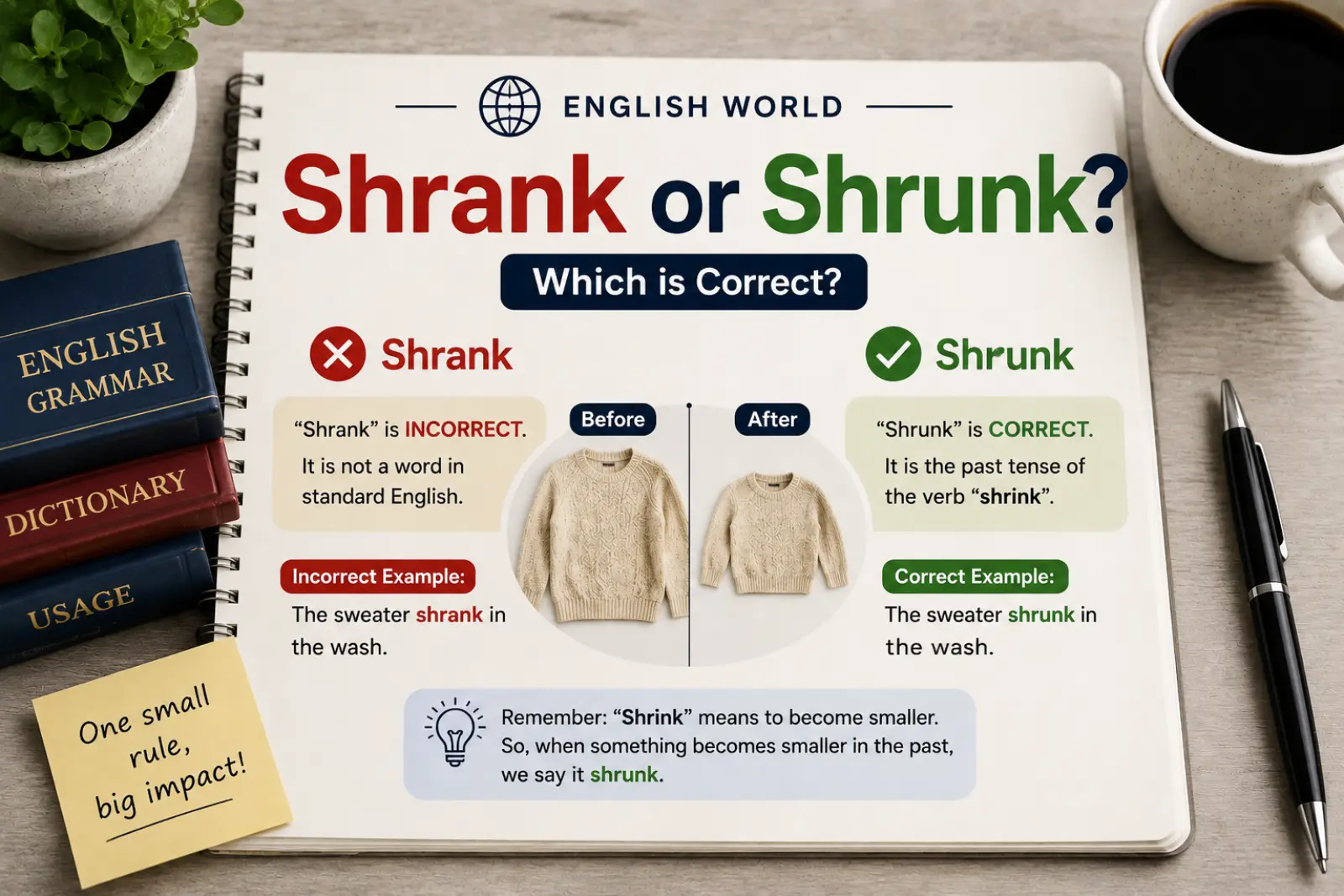
Have you ever wondered whether you should say “My sweater shrank” or “My sweater shrunk”? If so, you’re not alone. Many English learners—and even native speakers—get confused by these two words because both come from the verb shrink.
People usually search for shrank or shrunk because they want to know the correct grammar, pronunciation, meaning, examples, and when each word should be used. You’ll often hear these words in conversations about clothes, washing laundry, business, economics, health, and even storytelling.
The confusion happens because shrank and shrunk are both correct, but they are used differently in English grammar. One is usually the simple past tense, while the other is mainly the past participle. Knowing when to use each one will make your speaking and writing sound much more natural.
You’ll see these words in school assignments, workplace emails, news articles, books, social media posts, and everyday conversations. Whether you’re learning English, preparing for an exam, or simply trying to improve your grammar, understanding this difference is useful.
People usually search for:
- shrank or shrunk
- shrink past tense
- shrink past participle
- shrank meaning
- shrunk meaning
- pronunciation
- grammar difference
- examples
In this guide, you’ll learn the meaning, pronunciation, examples, usage, grammar rules, common mistakes, expert tips, and simple explanations in easy English
⭐ Shrank or Shrunk – Quick Answer
✅ Correct Answer
👉 Shrank = Simple past tense of shrink.
👉 Shrunk = Past participle of shrink (usually used with has, have, had, or be).
Both words are correct—they simply have different grammar jobs.
Examples
✅ My shirt shrank after I washed it.
✅ My sweater has shrunk.
✅ The company’s profits shrank last year.
✅ His jeans had shrunk in the dryer.
Simple Rule
- Yesterday → Shrank
- Has / Have / Had → Shrunk
Easy Memory Trick
Shrank = Past Action
Shrunk = Has/Have Done
📖 What Do Shrank and Shrunk Mean?
The verb shrink means to become smaller in size, amount, value, or importance.
Shrank
Shrank is the simple past tense.
It describes something that became smaller at a specific time in the past.
Example:
“My T-shirt shrank after one wash.”
Shrunk
Shrunk is the past participle.
It usually follows helping verbs such as:
- has
- have
- had
- was
- were
Example:
“My T-shirt has shrunk.”
Synonyms
- Became smaller
- Reduced
- Contracted
- Decreased
- Lessened
- Diminished
Opposites
- Grew
- Expanded
- Increased
- Enlarged
- Stretched
Related Terms
- Shrink
- Shrinking
- Reduction
- Contract
- Expand
- Decrease
- Minimize
🕰️ The Origin of Shrink
The word shrink comes from Old English scrincan, meaning to contract or become smaller.
Over time, English developed two common forms:
- Shrank (past tense)
- Shrunk (past participle)
Today, both are standard English and appear in books, newspapers, business reports, and everyday speech.
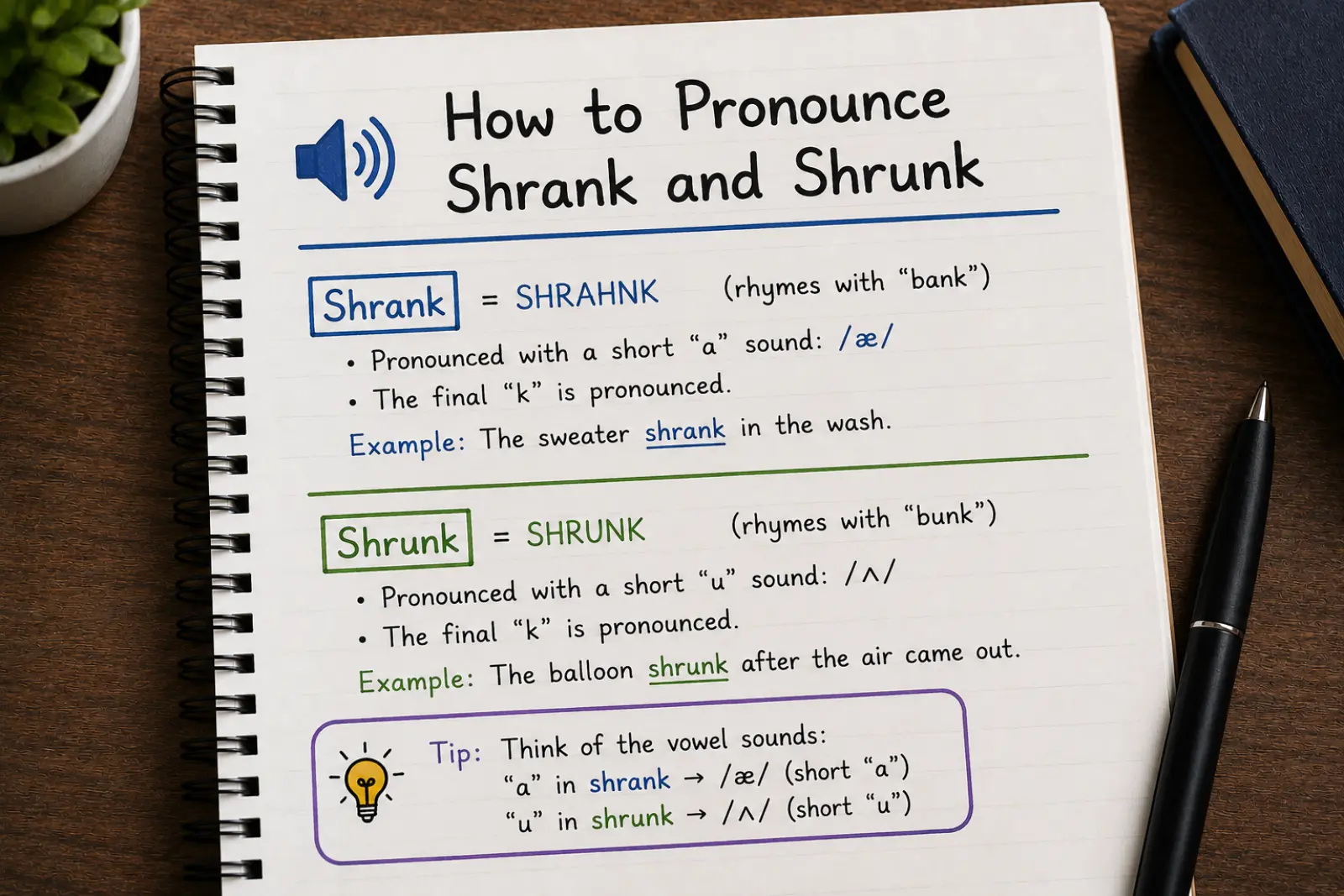
🔊 How to Pronounce Shrank and Shrunk
Shrank
Pronunciation:
SHRANK
Phonetic:
/ʃræŋk/
Shrunk
Pronunciation:
SHRUNK
Phonetic:
/ʃrʌŋk/
Common Mistakes
Some learners pronounce them the same.
Remember:
- Shrank rhymes with bank.
- Shrunk rhymes with trunk.
🇬🇧 British English vs American English Usage
| Feature | British English | American English | Notes |
|---|---|---|---|
| Shrank | Common | Common | Past tense |
| Shrunk | Common | Common | Past participle |
| Grammar | Same | Same | No difference |
Both British and American English follow the same grammar rules.
✅ Which One Should You Use?
Use Shrank when describing a completed action in the past.
Examples:
- The dress shrank.
- Sales shrank last month.
- My socks shrank.
Use Shrunk after helping verbs.
Examples:
- The dress has shrunk.
- Sales have shrunk.
- My socks had shrunk.
| Sentence Pattern | Correct Word |
|---|---|
| Yesterday… | Shrank |
| Last week… | Shrank |
| Has… | Shrunk |
| Have… | Shrunk |
| Had… | Shrunk |
❌ Common Mistakes with Shrank or Shrunk
Mistake 1
❌ My sweater has shrank.
✔ My sweater has shrunk.
Reason: After has, use the past participle.
Mistake 2
❌ My shirt shrunk yesterday.
✔ My shirt shrank yesterday.
Reason: Use the simple past with a finished time.
Mistake 3
❌ The economy has shrank.
✔ The economy has shrunk.
Mistake 4
❌ My jeans have shrank.
✔ My jeans have shrunk
Mistake 5
❌ Prices shrunk last month.
✔ Prices shrank last month.
🌍 Shrank and Shrunk in Everyday Examples
Laundry
My cotton shirt shrank in hot water.
School
The science experiment showed the balloon shrank in cold air.
Business
Company profits shrank during the recession.
Health
The tumor has shrunk after treatment.
Daily Life
My favorite sweater has shrunk.
Conversation
The ice cube shrank quickly in the sun.
News
The country’s economy shrank last quarter.
🧠 Shrank or Shrunk in Different Contexts
Grammar Learning
Remember:
- Shrink → Shrank → Shrunk
This is an irregular verb.
Business
Examples:
- Sales shrank.
- Profits have shrunk.
- The market shrank last year.
Clothing
Heat often causes clothes to shrink.
Example:
“My jacket shrank after drying.
Science
Scientists may describe materials that shrink when cooled or heated.
Health
Doctors may say:
“The swelling has shrunk.”
📈 Google Trends & Usage Data
The keyword shrank or shrunk is commonly searched because English learners often confuse the past tense with the past participle.
Search interest is especially strong in:
- United States
- United Kingdom
- India
- Pakistan
- Canada
- Australia
Popular searches include:
- Has shrank or has shrunk?
- Shrank vs shrunk
- Shrink grammar
- Shrunk meaning
- Shrank examples
- Past tense of shrink
📊 Comparison Table
| Feature | Shrank | Shrunk |
|---|---|---|
| Grammar | Past tense | Past participle |
| Correct | ✅ | ✅ |
| Used after has/have | ❌ | ✅ |
| Used with yesterday | ✅ | ❌ |
| Professional writing | Yes | Yes |
| Common mistake | Using after “has” | Using after “yesterday” |
💼 Shrank or Shrunk in Professional Life
Correct grammar is important in:
- Business reports
- Academic writing
- Financial news
- Scientific papers
- Workplace emails
Examples:
✅ Revenue shrank last year.
✅ Revenue has shrunk significantly.
These small grammar differences make professional writing clearer and more accurate.
🎓 Shrank or Shrunk for Students
Many students struggle because shrink is an irregular verb.
Instead of adding -ed, memorize all three forms:
- Shrink
- Shrank
- Shrunk
Practice writing complete sentences using each form.
🔍 Common Uses of Shrank and Shrunk
These words often appear when discussing:
- Clothes shrinking
- Business profits
- Population changes
- Ice melting
- Economic decline
- Health improvements
- Scientific experiments
- Household laundry
🧩 Simple Trick to Remember Shrank or Shrunk
Think of it this way:
Yesterday → Shrank
Has/Have/Had → Shrunk
Examples:
Yesterday my sweater shrank.
My sweater has shrunk.
This simple pattern works almost every time.
🏆 Expert Tips
A quick proofreading trick:
If your sentence contains:
- has
- have
- had
choose shrunk.
If your sentence talks about one finished event in the past, choose shrank.
This simple habit helps avoid one of the most common English grammar mistakes.
🌐 Related Searches People Also Ask
- Is it shrank or shrunk?
- What is the past tense of shrink?
- What is the past participle of shrink?
- Has shrank or has shrunk?
- Why is it shrunk after has?
- How do you pronounce shrank?
- Can I say my shirt shrunk yesterday?
- What does shrink mean?
- Is shrank correct English?
- Is shrunk an adjective?
❓ FAQs
Is shrank correct?
Yes. It is the simple past tense of shrink.
Is shrunk correct?
Yes. It is the past participle and is also sometimes used as an adjective.
Which is correct: has shrank or has shrunk?
Has shrunk is correct.
Which is correct: shrank yesterday or shrunk yesterday?
Shrank yesterday is correct.
What does shrink mean?
It means to become smaller in size, amount, or value.
Are shrank and shrunk interchangeable?
No. They have different grammar functions.
Is the grammar the same in British and American English?
Yes. Both use the same rules.
How can I remember the difference?
Remember:
Yesterday = Shrank
Has/Have/Had = Shrunk
🏁 Final Verdict
If you’re wondering shrank or shrunk, the answer is that both words are correct, but they are used differently.
- ✅ Shrank = Simple past tense.
- ✅ Shrunk = Past participle (usually after has, have, or had).
Using the right form makes your English sound natural and grammatically correct.
✅ Conclusion
The difference between shrank and shrunk is one of the most common grammar questions for English learners. Fortunately, the rule is simple once you understand how irregular verbs work. Use shrank for a completed action in the past and shrunk after helping verbs like has, have, or had.
Final Memory Trick:
Yesterday → Shrank
Has/Have/Had → Shrunk

Camila Green is an English language writer who specializes in confusing word comparisons and spelling explanations. She creates simple, beginner-friendly guides on topics like “niece or neice” and other common English mistakes. Her writing focuses on clarity, real-life examples, and easy learning. At VerrsaPick, she helps readers improve their English with practical and engaging content.