Have you ever typed “mold” and then wondered if it should be “mould” instead? You are not alone. This is one of those English spelling differences that can make even confident writers stop and check their sentence.
You may see mold in American websites, school materials, product descriptions, and online articles. At the same time, mould is common in British English and is also used in many other English-speaking regions.
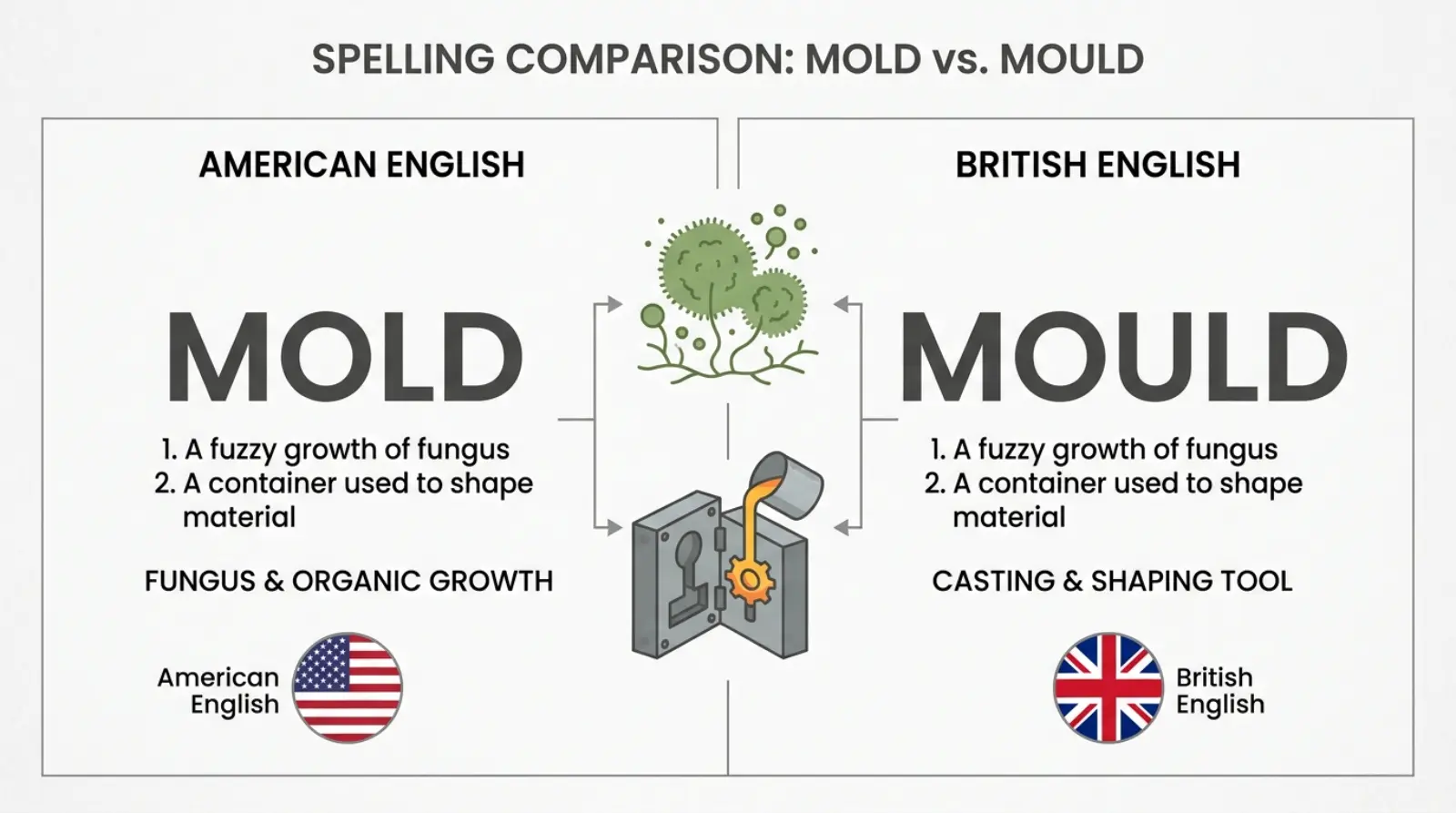
The good news is simple: both mold and mould are correct spellings. The main difference is the variety of English being used. Mold is the standard American spelling, while mould is the standard British spelling. The words have the same basic meanings and are pronounced the same way in normal speech.
This matters when you are writing for school, work, customers, or an international audience. Using one spelling consistently makes your writing look cleaner and more professional.
You might see these words when talking about damp walls, old food, fungi, baking, manufacturing, sculpture, or even someone’s character. For example, you could say, “There is mold on the bread” in American English or “There is mould on the bread” in British English.
People usually search for:
- mold or mould meaning
- mold or mould correct spelling
- mold or mould pronunciation
- mold or mould examples
- mold or mould usage
- mold or mould definition
- mold or mould grammar difference
In this guide, you’ll learn the meaning, pronunciation, examples, usage, grammar rules, common mistakes, expert tips, and simple explanations in easy English.
Mold or Mould – Quick Answer
👉 Mold = American English spelling
👉 Mould = British English spelling
Both words can describe a fungus that grows in damp places. They can also describe a container used to give something a particular shape, or the act of shaping something.
Examples
American English: There is mold on the cheese.
British English: There is mould on the cheese.
American English: Pour the chocolate into the mold.
British English: Pour the chocolate into the mould.
Simple Rule
👉 Mold = US English
👉 Mould = UK English
Memory trick: Think of the extra U in mould as part of the British spelling style, just like colour and favour.
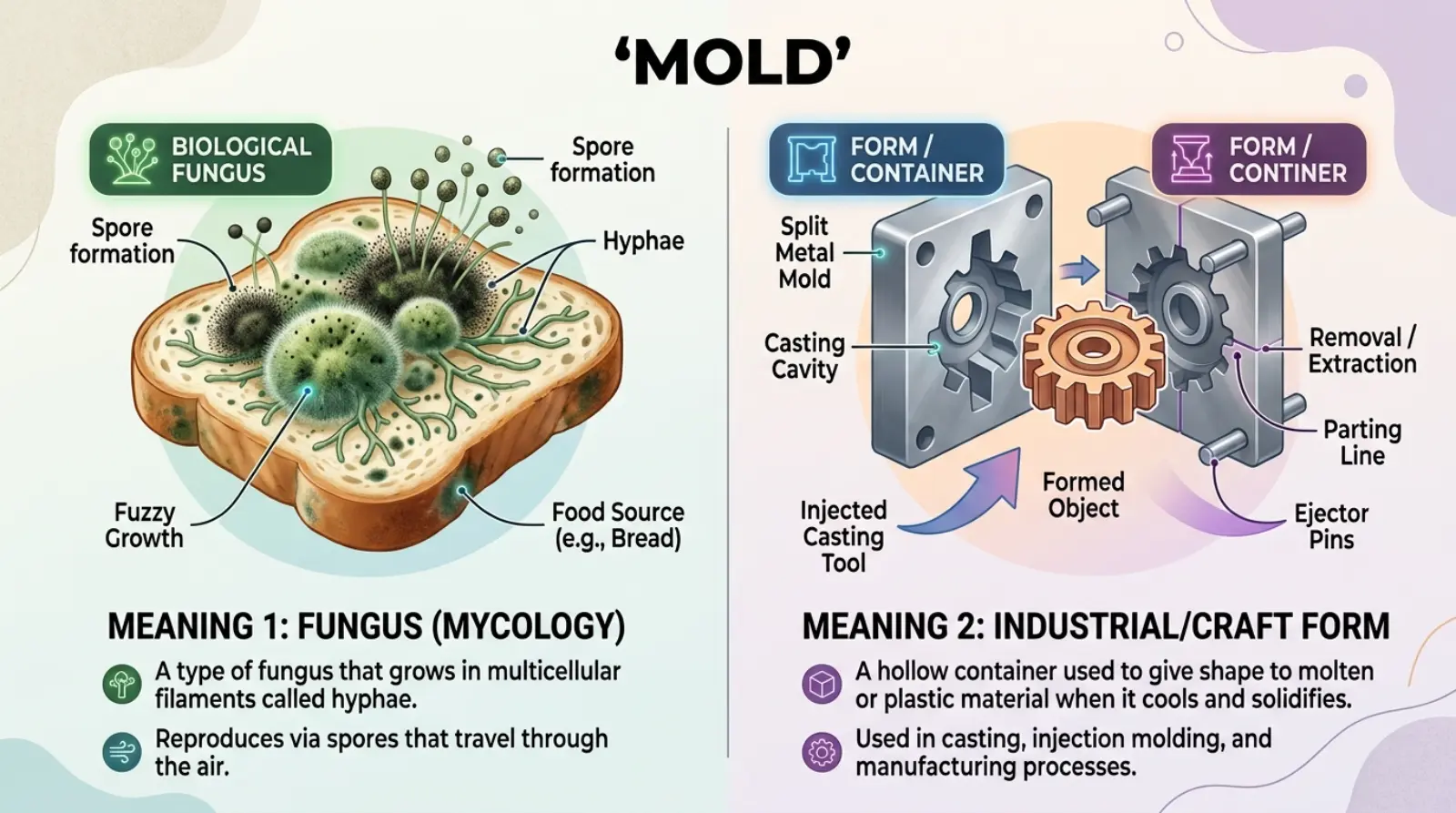
What Does Mold or Mould Mean?
Mold and mould have the same meaning. The spelling changes depending on the English variety.
The word has several important uses.
1. Fungus or Growth
Mold or mould can mean a soft or furry fungal growth that appears on food, walls, fabrics, or other damp materials.
Example:
“The bread has mold on it.”
2. A Shaping Container
A mold or mould can be a container or form used to give something a particular shape.
Example:
“Pour the liquid into the mold.”
3. To Shape Something
As a verb, mold/mould means to shape or form something.
Example:
“The artist molded the clay into a beautiful figure.”
It can also mean to influence someone’s development or character.
Synonyms
Depending on the meaning, related words include:
- fungus
- growth
- form
- shape
- container
- cast
- pattern
- structure
Related Terms
You may also see:
- mold growth
- mold spores
- mold removal
- moldy
- mouldy
- mold prevention
- mold remediation
- chocolate mold
- cake mould
- casting mold
The Origin of Mold or Mould
The history of mold/mould is more interesting than it first appears.
The word has several historical senses. The fungus-related meaning developed from Middle English forms connected with becoming moldy. The shaping meaning has a different historical development connected with words meaning a form or model.
The spelling eventually developed into two major English forms:
- mold in American English
- mould in British English
Both spellings have a long history, and the difference is mainly a spelling convention rather than a difference in meaning.
How to Pronounce Mold or Mould
Both mold and mould are normally pronounced the same way.
American English
Mold → /moʊld/
An easy pronunciation is:
mohld
British English
Mould → /məʊld/
It sounds very similar to the American pronunciation.
The important point is that the extra u in mould does not create an extra syllable.
So:
mold = mould
Same basic sound, different spelling. Cambridge lists /moʊld/ for the US form and /məʊld/ for the UK form.
British English vs American English Usage
| Feature | British English | American English | Notes |
|---|---|---|---|
| Spelling | mould | mold | Main difference |
| Meaning | Same | Same | No major meaning change |
| Fungus | mould | mold | Same word |
| Shaping form | mould | mold | Same word |
| Verb | mould | mold | Same function |
| Pronunciation | /məʊld/ | /moʊld/ | Very similar |
| Formal writing | Mould | Mold | Follow your chosen English style |
Dictionaries consistently identify mould as the British form and mold as the American form.
Which One Should You Use?
Use the spelling that matches your audience.
Use mold when:
- You are writing in American English.
- Your audience is mainly in the United States.
- Your school or workplace follows US English.
- You are using an American style guide.
Example:
“Black mold was found in the basement.”
Use mould when:
- You are writing in British English.
- Your audience is mainly in the UK.
- Your school follows British English.
- Your publication uses British spelling.
Example:
“Black mould was found in the basement.”
What About Canada and Australia?
English spelling can vary by country and by style guide. Canada may use both forms in different settings, while British-style spelling remains common in many contexts.
The safest approach is simple: check the spelling style used by your school, employer, publication, or website and stay consistent.
Common Mistakes With Mold or Mould
Mistake 1: Thinking one spelling is always wrong
❌ “Mould is an incorrect spelling.”
✔ Mould is correct in British English.
✔ Mold is correct in American English.
The mistake is treating a regional spelling difference as a spelling error.
Mistake 2: Mixing spelling styles
❌ “The colour of the mold was unusual.”
This mixes British colour with American mold.
✔ American: “The color of the mold was unusual.”
✔ British: “The colour of the mould was unusual.”
Mistake 3: Thinking they have different meanings
❌ “Mold means fungus, but mould means a shape.”
✔ Both mold and mould can have both meanings.
The spelling mainly reflects the English variety being used.
Mistake 4: Pronouncing the extra “u”
❌ Treating mould as if it has two syllables.
✔ Mould is normally one syllable and sounds like mold.
Mistake 5: Changing spelling randomly
❌ “We found mould in the kitchen, but the report calls it mold.”
✔ Pick one spelling style for the document and use it consistently.
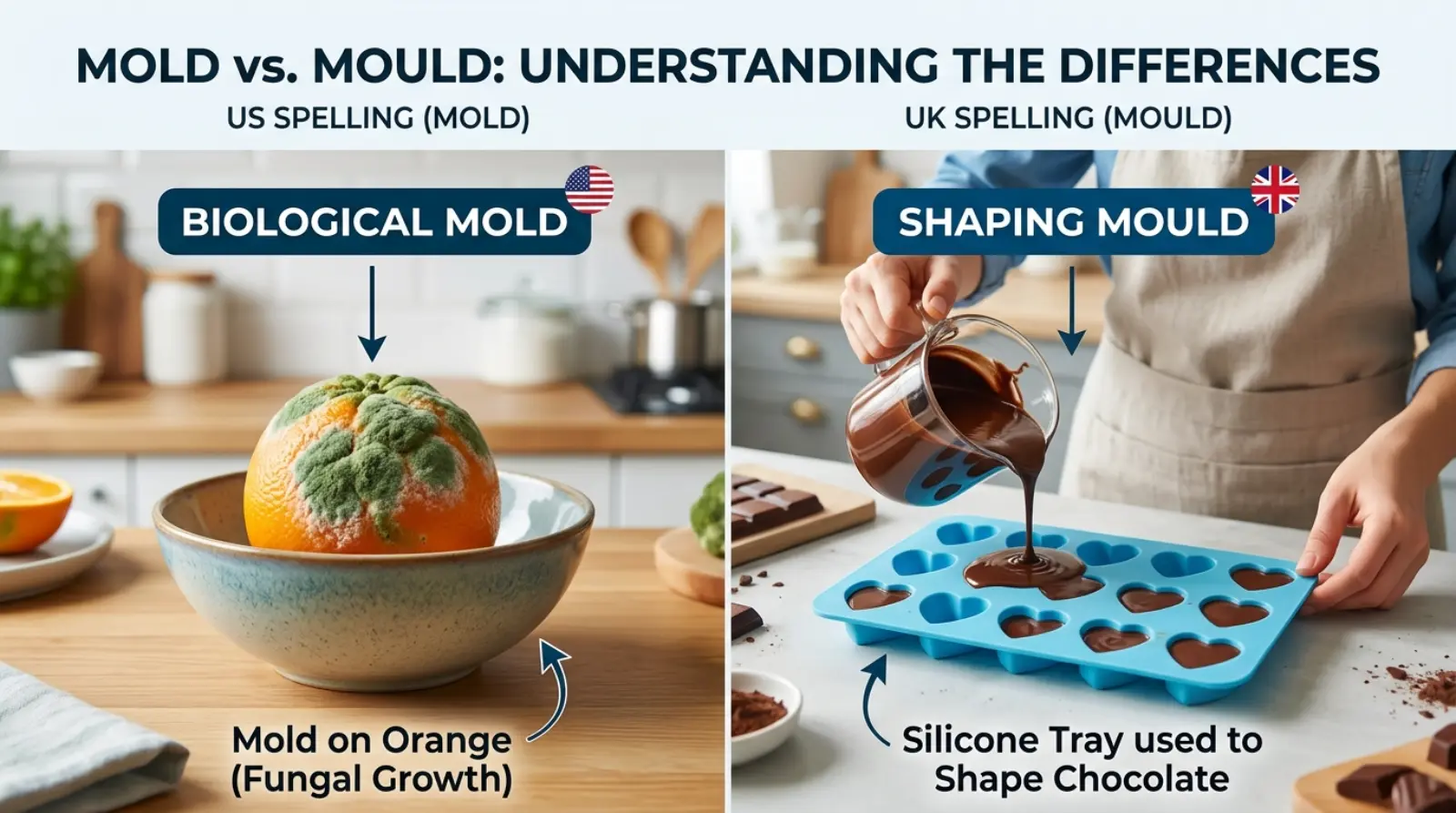
Mold or Mould in Everyday Examples
At Work
US: “The inspection found mold behind the wall.”
UK: “The inspection found mould behind the wall.”
At School
US: “The students used a plastic mold for the experiment.”
UK: “The students used a plastic mould for the experiment.”
On Social Media
Someone might post:
“There is mold growing on my bread!”
A British user may write:
“There is mould growing on my bread!”
In an Email
US: “Please arrange mold removal before the office reopens.”
UK: “Please arrange mould removal before the office reopens.”
In Daily Conversation
“I think there is mold in the bathroom.”
or
“I think there is mould in the bathroom.”
Both are natural.
Mold or Mould in Different Contexts
Education
Students often encounter this difference while learning American and British English.
A teacher may accept either spelling if it matches the required English variety.
Business
Businesses should follow a consistent style. A company targeting US customers will normally prefer mold, while a British company will normally use mould.
Manufacturing
Both forms can describe a tool or container used to shape materials such as plastic, metal, clay, or food.
Baking and Cooking
You may see:
- chocolate mold
- jelly mold
- cake mold
In British English, these are often written:
- chocolate mould
- jelly mould
- cake mould
Home and Buildings
The fungus meaning is common in discussions about damp rooms, bathrooms, basements, walls, food, and moisture.
Mold or Mould – Comparison Table
| Feature | Mold | Mould |
|---|---|---|
| Main variety | American English | British English |
| Correct spelling? | Yes | Yes |
| Meaning | Same | Same |
| Fungus | Yes | Yes |
| Shaping container | Yes | Yes |
| Verb | Yes | Yes |
| Pronunciation | /moʊld/ | /məʊld/ |
| Professional use | Common in US | Common in UK |
| Academic use | Follow US style | Follow UK style |
| Biggest mistake | Calling mould wrong | Calling mold wrong |
Mold or Mould in Professional Life
Spelling can affect how polished your writing looks.
Imagine a property inspection report written for a British company. Using mold throughout the document may look inconsistent if the company normally follows British English.
The same is true in the United States. A US report would normally use mold rather than mould.
For professional writing:
Choose one English style → use it consistently → proofread before publishing.
This small habit can make your writing look much more professional.
Mold or Mould for Students and Beginners
Beginners often struggle because English has many regional spelling differences.
You may learn:
- color → American
- colour → British
- favorite → American
- favourite → British
- mold → American
- mould → British
This makes the pattern easier to recognize.
Easy Beginner Shortcut
If your English class uses color, you will probably also see mold.
If your English class uses colour, you will probably see mould.
This is not an absolute rule for every word, but it is a useful memory clue.
Signs and Common Uses Related to Mold or Mould
You will commonly see the word in:
- home maintenance
- food safety
- construction
- property inspection
- baking
- manufacturing
- sculpture
- art
- gardening
- science
- biology
- environmental discussions
- health and building-related discussions
The word also appears in expressions such as “break the mold”, meaning to do something in a new or unusual way. Oxford lists this as an established idiom.
Simple Trick to Remember Mold or Mould
Think about the letter U.
👉 Mold = US
👉 Mould = UK
Another easy trick:
US → mold
UK → mould
Think of it this way:
If you are writing for an American reader, leave out the u.
If you are writing for a British reader, keep the u.
US: mold
UK: mould
The meaning does not change.
Expert Tips
- Know your audience. Decide whether you are writing American or British English.
- Stay consistent. Do not switch between mold and mould without a reason.
- Check related spellings. Words such as molded/moulded and molding/moulding can also vary by English variety.
- Do not confuse spelling with meaning. Mold and mould are not two completely different words in ordinary modern usage.
- Follow your style guide. Schools, publishers, businesses, and websites may have their own preferred English variety.
Related Searches People Also Ask
Is mold or mould correct?
Both are correct. Mold is standard American English, while mould is standard British English.
Is mould British or American?
Mould is mainly the British spelling. American English normally uses mold.
Is mold the American spelling?
Yes. Mold is the standard American spelling of mould.
Do mold and mould mean the same thing?
Yes. They can refer to fungal growth, a shaping container, or the act of shaping something.
How do you pronounce mould?
It is normally pronounced as one syllable, similar to mold.
Is “mold” a British spelling?
It can appear in British contexts, but mould is the usual British spelling.
Is “mould” wrong in American English?
It is generally understood, but mold is the standard American form.
Should I write mold or mould in an essay?
Use whichever spelling matches the English style required by your school, teacher, university, or publication.
What is the plural of mold?
In American English, the plural is usually molds. In British English, it is commonly moulds.
What is the British spelling of mold?
The British spelling is mould.
Mold or Mould – Google Trends and Usage
People search for mold or mould because English learners often notice the two spellings while reading websites from different countries.
Search behavior is especially likely when people encounter:
- mold/mould on walls
- mold/mould on food
- mold/mould meaning
- mold/mould spelling
- mold vs mould
- mold or mould in British English
- mold or mould in American English
- mold pronunciation
- mould pronunciation
The United States generally favors mold, while the UK favors mould. Learners in countries such as Pakistan, India, Canada, and Australia may encounter both forms because they consume content from both American and British sources.
For voice searches, common questions include “Is mold or mould correct?” and “What is the British spelling of mold?”
Final Verdict: Mold or Mould?
Both are correct.
👉 Mold = American English
👉 Mould = British English
They have the same main meanings and are normally pronounced very similarly.
The easiest rule is:
US → mold
UK → mould
If you are writing professionally, academically, or for a website, the most important thing is consistency. Choose the spelling that matches your target audience and use it throughout your writing.
Conclusion
The mold or mould question looks confusing at first, but the answer is actually simple.
Mold is the standard American spelling, while mould is the standard British spelling. Both can describe fungal growth, a shaping container, or the process of shaping something.
So, if you write “There is mold on the bread,” your spelling is correct in American English.
If you write “There is mould on the bread,” your spelling is correct in British English.
Final memory trick: US = mold, UK = mould. Once you remember that, this spelling difference becomes much easier.

Camila Green is an English language writer who specializes in confusing word comparisons and spelling explanations. She creates simple, beginner-friendly guides on topics like “niece or neice” and other common English mistakes. Her writing focuses on clarity, real-life examples, and easy learning. At VerrsaPick, she helps readers improve their English with practical and engaging content.