Have you ever wanted to describe someone who cries a lot, but stopped because you were unsure about the spelling? You may have typed cryer or crier into Google because both forms look possible.
The confusion makes sense. The verb is cry, so adding a person-ending can make cryer seem natural. However, the standard English noun is crier.
A crier is a person who cries. It can also describe someone who announces something loudly, especially in older or historical contexts. Cryer can appear in writing, but it is much less common and is generally not the preferred spelling for the person who cries.
You may come across this word in school, books, conversations, social media, online discussions, or descriptions of emotional people. Someone might say, I am a big crier, meaning they cry easily or often.
People usually search for cryer or crier because they want the correct spelling, definition, pronunciation, examples, grammar, and the difference between the two forms.
The good news is that the answer is simple: crier is the standard choice when you mean a person who cries.
In this guide, you’ll learn the meaning, pronunciation, examples, usage, grammar rules, common mistakes, expert tips, and simple explanations in easy English.
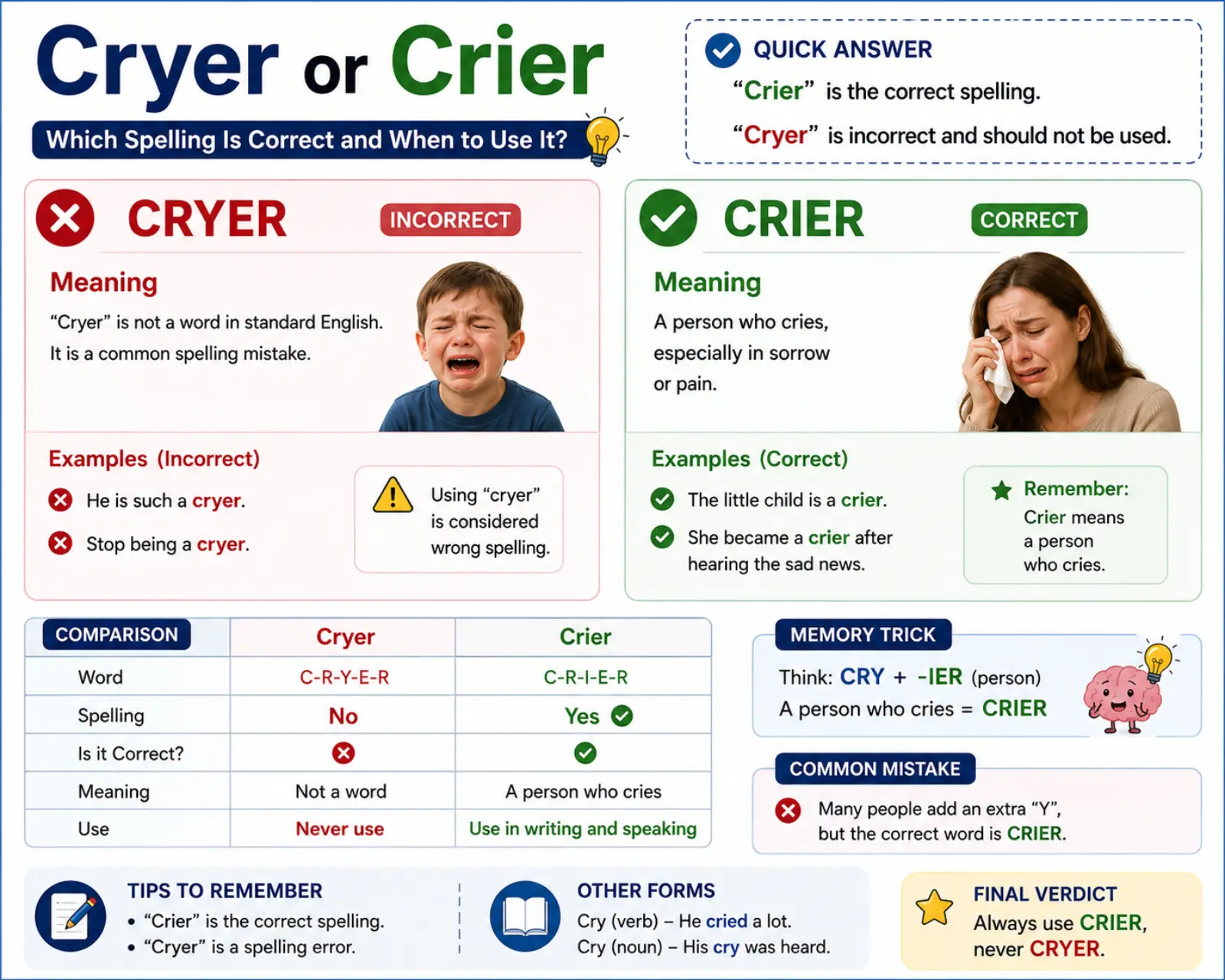
Cryer or Crier – Quick Answer
👉 Crier = the standard spelling
👉 Cryer = a less common variant
A crier is someone who cries.
Examples
- She is a frequent crier.
- The baby is a loud crier.
- I am not much of a crier.
- He became an emotional crier after the movie.
- She admits that she is a happy crier.
Simple Rule
👉 Cry → crier
The y changes to i before adding -er.
So:
cry + er → crier
This is the same spelling pattern seen in words such as:
- try → trier
- dry → drier
- fry → frier
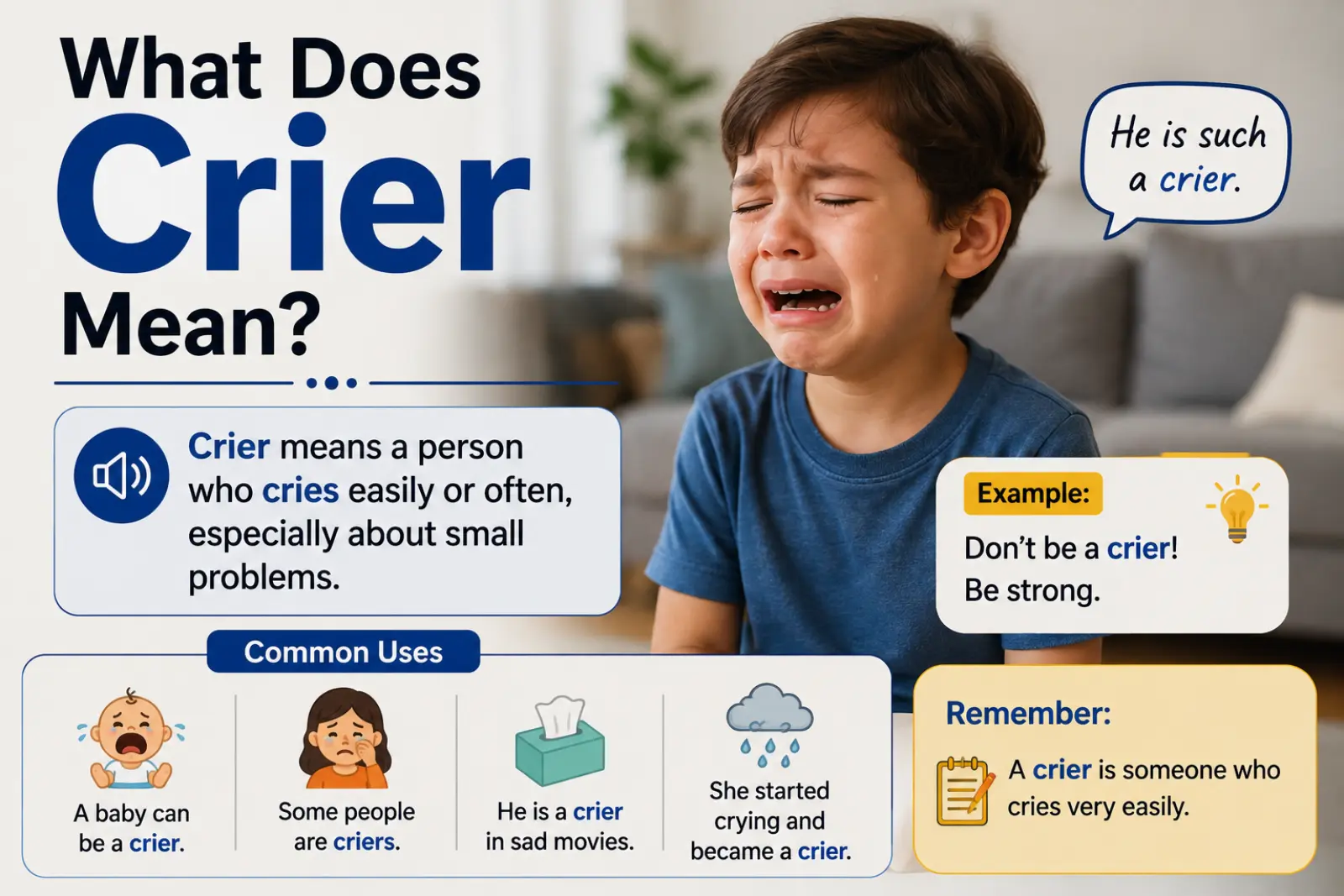
What Does Crier Mean?
A crier is a person who cries.
The word can describe someone who cries often, easily, or strongly.
For example:
My little brother is a loud crier.
This means the little brother cries loudly.
A crier can also have another meaning. Historically, a town crier was a person who publicly announced news or important information, often by calling out in a town.
Synonyms
Depending on the context, similar words include:
- weeper
- sobber
- mourner
- emotional person
These words are not always exact replacements, but they can describe someone who cries.
Opposites
Possible opposite ideas include:
- stoic
- unemotional person
- calm person
Related Terms
Common related words include:
- cry
- crying
- cried
- cries
- crier
- tearful
- tears
- weeping
- sobbing
The Origin of Cryer or Crier
The word crier comes from the verb cry combined with the suffix -er.
The suffix -er often creates a noun for a person who performs an action.
For example:
- teach → teacher
- work → worker
- sing → singer
- run → runner
- cry → crier
English spelling changes can happen when a word ending in y receives a suffix.
When cry becomes crier, the y changes to i.
This spelling pattern has existed in English for a long time and is still used in modern writing.
How to Pronounce Crier
Crier is usually pronounced:
👉 CRY-er
It has two syllables:
cry-er
The first part sounds like the word cry.
Examples:
- crier → CRY-er
- town crier → town CRY-er
A common mistake is trying to pronounce it as one syllable. Say the two parts clearly:
cry + er = crier
British English vs American English Usage
The standard spelling crier is understood in both British and American English.
| Feature | British English | American English |
|---|---|---|
| Standard spelling | crier | crier |
| Meaning | Person who cries | Person who cries |
| Pronunciation | Similar | Similar |
| Town crier | Common term | Common term |
| Formal writing | Crier | Crier |
There is no major British-American spelling difference for crier.
Which One Should You Use?
If you are writing about someone who cries, crier is the safest and most standard choice.
Use crier in:
- School assignments
- Articles
- Emails
- Professional writing
- Social media
- Personal messages
- Creative writing
- Everyday conversation
Quick examples
She is a crier.
My baby is a happy crier.
I have always been an emotional crier.
❌ She is a cryer.
For most modern English writing, choose crier.
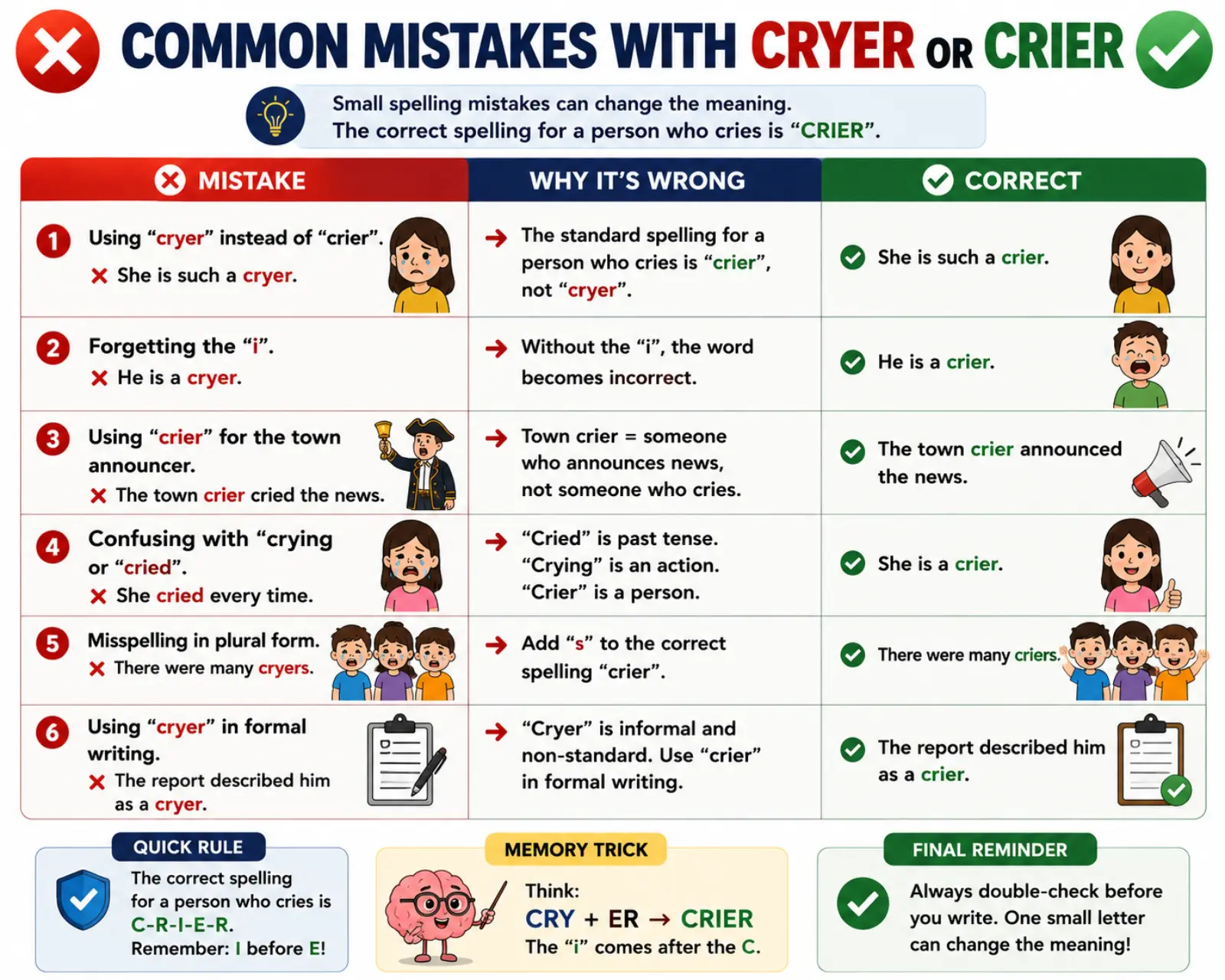
Common Mistakes With Cryer or Crier
Mistake 1: Using Cryer
❌ She is a big cryer.
✔ She is a big crier.
The standard spelling changes y to i before -er.
Mistake 2: Forgetting the I
❌ He is a loud cryer.
✔ He is a loud crier.
Remember that crier contains cri.
Mistake 3: Spelling It Crir
❌ The baby is a crir.
✔ The baby is a crier.
You still need the -er ending.
Mistake 4: Confusing Crier With Crying
Crier is a noun for a person.
Crying describes the action.
✔ She is a crier.
✔ She is crying.
Mistake 5: Confusing Crier With Cried
Cried is the past tense of cry.
✔ She cried yesterday.
Crier refers to a person.
✔ She is a crier.
Crier in Everyday Examples
Work
He is known as an emotional crier during farewell events.
School
The teacher comforted the young crier.
Social Media
I am definitely a happy crier.
Daily Life
My sister is a crier when she watches sad movies.
Text Messages
I am such a crier! That movie made me cry.
Online Content
The video turned me into a complete crier.
Conversations
Are you a crier when you watch emotional films?
Crier in Different Contexts
Emotional Conversations
People often use crier when talking casually about emotions.
I am a sensitive person and a total crier.
Here, the word is not necessarily negative. It can simply mean someone who expresses emotions through tears.
Movies and Entertainment
People often describe themselves as criers after watching emotional movies, shows, or videos.
That ending made me such a crier.
Parenting
Parents may describe babies or young children as criers.
The baby was a loud crier last night.
Historical Context
The phrase town crier has a special historical meaning. A town crier was a person who publicly announced news.
The town crier announced the king’s message.
This meaning is different from someone who cries emotionally.
Crier vs Cryer Comparison
| Feature | Crier | Cryer |
| Standard spelling | ✅ Yes | Less common |
| Person who cries | ✅ Yes | Sometimes seen |
| Common in modern English | ✅ Yes | No |
| Formal writing | ✅ Preferred | Usually avoid |
| Social media | ✅ Natural | Uncommon |
| Town crier | ✅ Correct | ❌ Not standard |
| Easy spelling | Cry + er → crier | Often treated as a spelling mistake |
The key difference
Crier is the standard English spelling for a person who cries.
Cryer may appear as a variant or in specific names, but it is not the normal spelling you should choose for general writing.
Crier in Professional Life
The word crier is not especially common in formal workplace writing because it can sound personal or informal.
However, it can appear in conversations, articles, interviews, and descriptions.
For example:
He described himself as an emotional crier.
In professional writing, you may sometimes choose a more neutral phrase such as:
She becomes emotional easily.
This sounds more formal.
Crier for Students and Beginners
The biggest spelling challenge is the change from y to i.
Remember this pattern:
- cry → crier
- try → trier
- dry → drier
When a word ends in consonant + y, the y often changes to i before a suffix.
So:
cry + er = crier
This is much easier to remember than simply memorizing the spelling.
Common Uses of Crier
You may see crier in these situations:
- Someone who cries easily
- Someone who cries often
- A person who becomes emotional
- A baby who cries loudly
- A person described humorously as emotional
- A historical town crier
- Books and creative writing
- Conversations about movies or feelings
The meaning depends on the sentence.
Simple Trick to Remember Crier
Think of it this way:
👉 Cry loses Y and gets I
Start with:
CRY
Add -ER.
Change Y → I:
CRIER
Visual memory
CRY → CRI + ER → CRIER
Do not let the original Y stay in the middle.
That gives you the easiest rule:
👉 Cry + er = crier
Expert Tips for Remembering Crier
- Say the word slowly: cry-er.
- Break it into two parts: cry + er.
- Remember Y changes to I.
- Compare it with trier: try → trier.
- Use it in a sentence: I am a happy crier.
- Proofread the middle: check for CRI, not CRY.
- Remember the historical phrase: town crier.
Related Searches People Also Ask
Is crier or cryer correct?
Crier is the standard spelling for a person who cries.
Is cryer a real word?
Cryer can be found as a variant, but crier is the usual standard spelling for general English.
Why is crier spelled with an i?
Because cry changes its final y to i before the -er suffix.
What does crier mean?
A crier is a person who cries. It can also refer to a town crier who announces news publicly.
How do you spell someone who cries a lot?
The usual spelling is crier.
Is crier a noun?
Yes. Crier is a noun because it names a person.
What is the plural of crier?
The plural is criers.
What is the difference between crying and crier?
Crying is the action. Crier is the person doing the action.
FAQs About Cryer or Crier
Is crier the correct spelling?
Yes. Crier is the standard spelling when referring to a person who cries.
Is cryer wrong?
Cryer is not the normal spelling used in standard modern English for this meaning. Crier is the safer choice.
How do you pronounce crier?
Crier is pronounced roughly CRY-er, with two syllables.
What does a crier mean?
A crier is someone who cries. The term can also describe a historical town crier.
What is the plural of crier?
The plural form is criers.
Is crier formal or informal?
It can be used in both contexts, but describing someone as a crier is often conversational.
What is a town crier?
A town crier was a person who publicly announced news and important messages.
Why do people spell crier as cryer?
The mistake happens because the original verb is cry, so people may simply add -er without changing the y.
What is an easy way to remember crier?
Remember:
CRY → CRI + ER → CRIER
Can I use crier on social media?
Yes. It is very natural in casual posts about emotional movies, songs, videos, or personal feelings.
Final Verdict
When choosing between cryer or crier, use:
👉 CRIER ✅
It is the standard spelling for a person who cries.
Cryer may appear as a less common variant, but it is not the best choice for normal English writing.
The easiest memory trick is:
CRY → CRIER
Change the Y to I before adding -ER.
Conclusion
The cryer or crier confusion is easy to solve once you understand the spelling pattern.
Crier is the standard word for someone who cries. It can describe a person who cries easily, often, or emotionally. It can also appear in the historical phrase town crier, where the meaning is someone who publicly announces news.
The main mistake is keeping the y from cry when adding -er.
Remember:
CRY → CRIER
Just change Y to I, and you have the correct spelling.

Camila Green is an English language writer who specializes in confusing word comparisons and spelling explanations. She creates simple, beginner-friendly guides on topics like “niece or neice” and other common English mistakes. Her writing focuses on clarity, real-life examples, and easy learning. At VerrsaPick, she helps readers improve their English with practical and engaging content.