
Have you ever stopped while writing and wondered whether to use dying or dieing? You’re not alone. This is one of the most common English spelling questions because the usual rule of changing “ie” to “y” before adding -ing has an important exception. Many students, writers, and English learners accidentally write dieing when they actually mean dying.
People usually search for dying or dieing meaning, correct spelling, pronunciation, grammar difference, examples, and usage because the two words look similar but are used in different situations. You’ll find this question in school assignments, workplace emails, novels, social media posts, blogs, and online searches.
The confusion happens because dying is the correct -ing form of the verb “die,” while dieing is a rare technical word used in manufacturing to describe the process of cutting or shaping material with a die machine. Most people will never need to use dieing in everyday writing.
Learning the difference will improve your grammar, help you avoid embarrassing spelling mistakes, and make your writing look more professional.
In this guide, you’ll learn the meaning, pronunciation, examples, usage, grammar rules, common mistakes, expert tips, and simple explanations in easy English.
Dying or Dieing – Quick Answer
👉 Dying = Correct spelling for the present participle of die.
👉 Dieing = A rare technical term related to dies (cutting or shaping tools in manufacturing).
Examples
- ✅ The flowers are dying because they need water.
- ✅ Many trees are dying during the drought.
- ✅ She felt the battery was dying.
- ✅ The factory is dieing metal sheets. (Technical industry use only.)
Simple Rule
If you mean “to stop living” or “coming to an end,” always use dying.
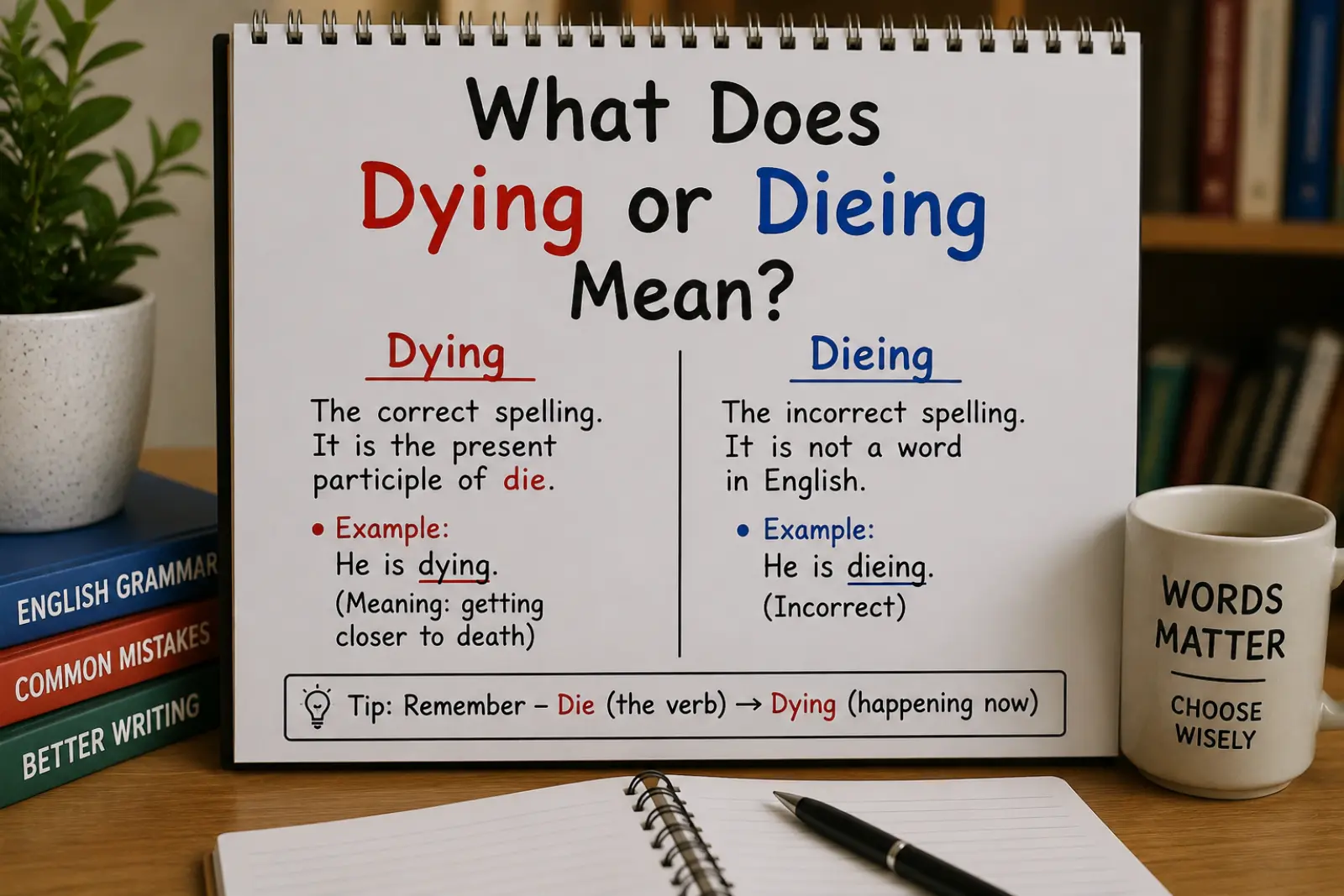
What Does Dying or Dieing Mean?
What Does “Dying” Mean?
Dying is the present participle and gerund of the verb die.
It means:
- No longer living
- Coming to an end
- Becoming weak or disappearing
Examples
- The plant is dying.
- My phone is dying.
- Old traditions are slowly dying.
Synonyms
- Fading
- Ending
- Perishing
- Declining
Opposites
- Living
- Growing
- Thriving
- Surviving
What Does “Dieing” Mean?
Dieing is a rare word used in engineering and manufacturing.
It refers to using a die, which is a special tool that cuts, stamps, or shapes materials.
Example
- The company specializes in dieing metal parts.
Outside technical industries, this spelling is usually considered a mistake.
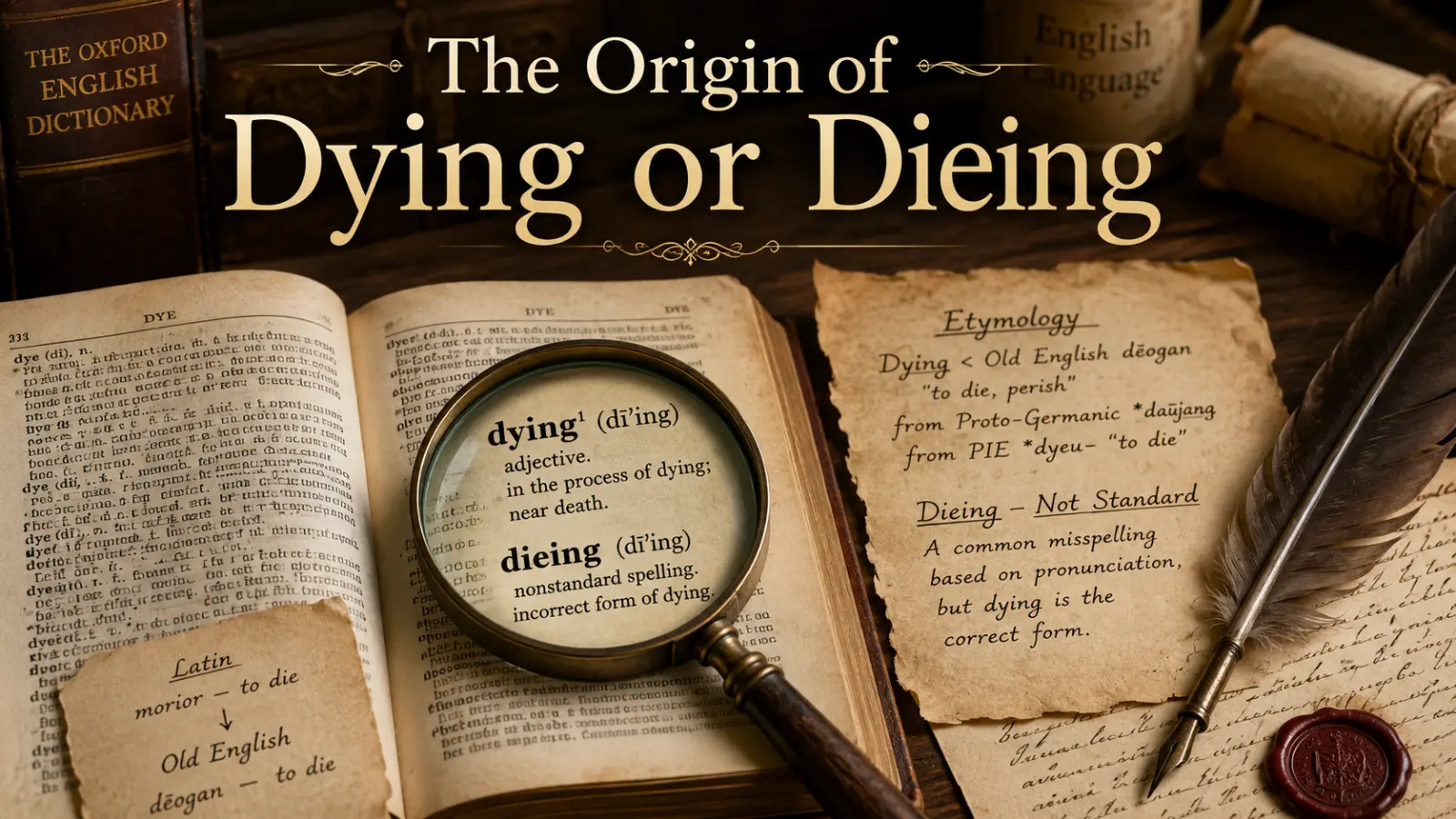
The Origin of Dying or Dieing
The verb die comes from Old Norse and has been part of English for hundreds of years.
Normally, verbs ending in -ie change to -ying when adding -ing.
Examples:
- Die → Dying
- Lie → Lying
- Tie → Tying
The spelling dieing developed later as a technical manufacturing term connected to the noun die (a cutting tool), not the verb die.
How to Pronounce Dying or Dieing
| Word | Pronunciation | Phonetic |
|---|---|---|
| Dying | DYE-ing | /ˈdaɪɪŋ/ |
| Dieing | DYE-ing | /ˈdaɪɪŋ/ |
Both words sound almost identical.
British English vs American English Usage
| Feature | British English | American English | Notes |
|---|---|---|---|
| Dying | ✅ Standard | ✅ Standard | Correct everywhere |
| Dieing | Rare | Rare | Mostly technical |
There is no spelling difference between British and American English for dying.
Which One Should You Use?
Choose dying in almost every situation.
Use dieing only if you are writing about industrial machines or manufacturing.
| Situation | Correct Word |
|---|---|
| A person stops living | Dying |
| A battery loses power | Dying |
| A flower wilts | Dying |
| Industrial cutting process | Dieing |
Common Mistakes with Dying or Dieing
Mistake 1
❌ My phone is dieing.
✅ My phone is dying.
Mistake 2
❌ The flowers are dieing.
✅ The flowers are dying.
Mistake 3
❌ He is dieing of laughter.
✅ He is dying of laughter.
Mistake 4
❌ English uses dieing as the normal spelling.
✅ English uses dying as the standard spelling.
Mistake 5
❌ Every sentence should use dieing.
✅ Only technical manufacturing uses dieing.
Dying or Dieing in Everyday Examples
School
- The science teacher explained why plants are dying.
Workplace
- My laptop battery is dying.
Social Media
- “My phone is dying. BRB!”
Daily Life
- The candle is dying.
- The project isn’t dying; it just needs more time.
Conversation
- The old tree is dying.
Dying or Dieing in Different Contexts
Grammar
Dying is the correct verb form taught in English grammar.
Literature
Authors often use dying in stories, poems, and novels.
Technology
People commonly say:
- My battery is dying.
- The Wi-Fi signal is dying.
Manufacturing
Only engineers and factory workers may use dieing when discussing cutting or shaping materials.
Google Trends & Usage Data
Searches for dying or dieing remain popular because learners want to know the correct spelling. Students, bloggers, and professionals in the US, UK, Canada, Australia, India, and Pakistan frequently search for:
- dying vs dieing
- is dieing a word
- correct spelling of dying
- dying meaning
- why is dying spelled with y
- dying examples
Comparison Table: Dying vs Dieing
| Feature | Dying | Dieing |
|---|---|---|
| Correct everyday spelling | ✅ Yes | ❌ No |
| Meaning | Present participle of die | Manufacturing process |
| Part of Speech | Verb | Technical noun/verb form |
| Academic writing | Very common | Rare |
| Business writing | Common | Rare |
| Everyday conversation | Very common | Almost never |
| Common mistake | Confused with dieing | Used instead of dying |
Dying or Dieing for Students
Many learners think adding -ing to die should create dieing.
But English changes die to dying before adding -ing.
Easy Trick
- Die → Dying
- Lie → Lying
- Tie → Tying
Remember these three words together.
Simple Trick to Remember Dying or Dieing
Think of it this way:
When “die” gets “-ing,” the “ie” changes to “y.”
Die → Dying
If you’re writing about life, death, batteries, plants, or emotions, dying is almost certainly the correct choice.
Expert Tips
- Remember the pattern: die → dying.
- Proofread words ending in -ing carefully.
- If the sentence is not about manufacturing tools, don’t use dieing.
- Reading books and articles will help you see the correct spelling naturally.
Related Searches People Also Ask
- Why is dying spelled with a y?
- Is dieing ever correct?
- How do you spell dying correctly?
- What is the difference between dying and dieing?
- Is dying a verb?
- Can a battery be dying?
- Why do people write dieing?
- Is dieing used in engineering?
- How do you pronounce dying?
- What are examples of dying in sentences?
FAQs
Is dying the correct spelling?
Yes. Dying is the correct spelling in normal English.
Is dieing a real word?
Yes, but it is a rare technical term used in manufacturing.
Why isn’t it spelled dieing?
Because English changes ie to y before adding -ing.
Which spelling should students use?
Almost always dying.
Is dying used in formal writing?
Yes. It is correct in both formal and informal English.
Can I say my phone is dying?
Yes. That is a common and correct expression.
Are dying and dieing pronounced the same?
Yes, they are pronounced almost the same.
Is dieing common?
No. Most people never use it outside technical industries.
Final Verdict
The correct spelling for everyday English is dying. It is the -ing form of the verb die. The word dieing exists, but it belongs mainly to manufacturing and engineering.
Easy memory rule:
Die + ing = Dying, not dieing.
Conclusion
Understanding the difference between dying and dieing is easier once you know the spelling rule. In everyday English, always choose dying when talking about people, animals, plants, batteries, emotions, or anything coming to an end. Save dieing for rare technical discussions about industrial cutting or shaping tools.
The easiest way to remember it is: die changes to dy before adding -ing. If you’re writing for school, work, or everyday communication, dying is almost always the correct choice.

Camila Green is an English language writer who specializes in confusing word comparisons and spelling explanations. She creates simple, beginner-friendly guides on topics like “niece or neice” and other common English mistakes. Her writing focuses on clarity, real-life examples, and easy learning. At VerrsaPick, she helps readers improve their English with practical and engaging content.