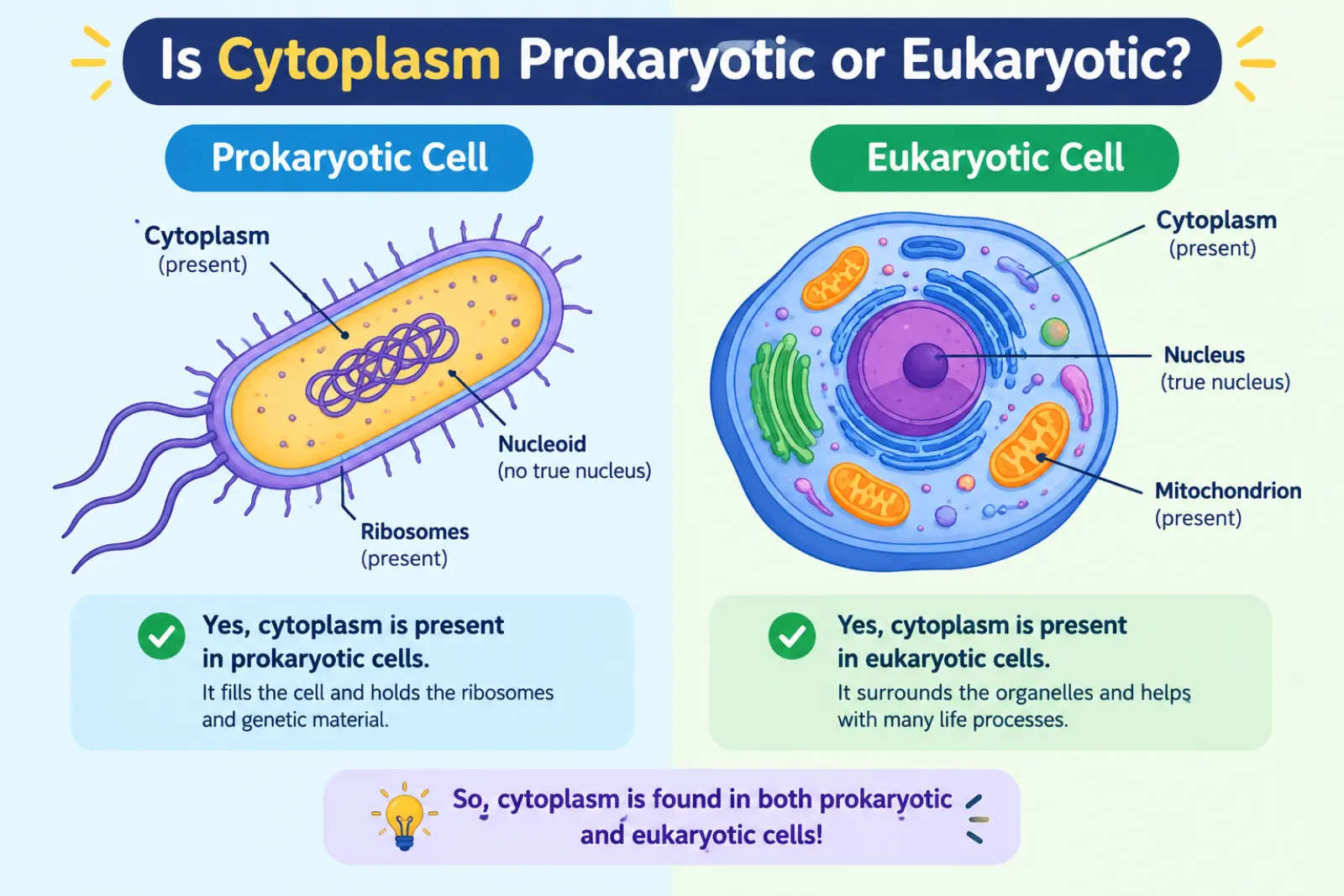
Have you ever looked at a cell diagram and wondered, is cytoplasm prokaryotic or eukaryotic? This is a common question for students because cytoplasm appears in both major types of cells.
The confusion usually happens because prokaryotic cells and eukaryotic cells are often taught as two completely different cell types. Students may then assume that every cell part must belong to only one group.
That is not true for cytoplasm.
Cytoplasm is found in both prokaryotic and eukaryotic cells. It is the material inside a cell where many important chemical reactions happen. However, the organization and contents of the cytoplasm can differ between the two cell types.
You may come across this question in biology classes, school exams, homework, textbooks, online quizzes, or science websites. It is also a common search for beginners trying to understand cell structure.
People usually search for:
- Is cytoplasm prokaryotic or eukaryotic?
- Do prokaryotic cells have cytoplasm?
- Do eukaryotic cells have cytoplasm?
- What is cytoplasm?
- What does cytoplasm contain?
- Is cytoplasm found in all cells?
- What is the difference between prokaryotic and eukaryotic cytoplasm?
Understanding this topic is important because cytoplasm is a basic part of cell biology. Once you understand it, topics such as the nucleus, ribosomes, organelles, and cell structure become much easier.
In this guide, you’ll learn the meaning, pronunciation, examples, usage, grammar rules, common mistakes, expert tips, and simple explanations in easy English.
Is Cytoplasm Prokaryotic or Eukaryotic? Quick Answer
Cytoplasm = found in both prokaryotic and eukaryotic cells.
Prokaryotic cells = have cytoplasm but do not have a membrane-bound nucleus.
Eukaryotic cells = have cytoplasm and usually contain a membrane-bound nucleus.
So, the best answer is:
Cytoplasm is neither only prokaryotic nor only eukaryotic. Both prokaryotic and eukaryotic cells have cytoplasm.
Simple Examples
- Bacteria have cytoplasm. ✅
- Archaea have cytoplasm. ✅
- Animal cells have cytoplasm. ✅
- Plant cells have cytoplasm. ✅
- Fungal cells have cytoplasm. ✅
Simple Rule
👉 If it is a cell, it has cytoplasm.
The major difference is not whether cytoplasm exists. The difference is what is organized inside the cell and whether the cell has membrane-bound organelles.
What Is Cytoplasm?
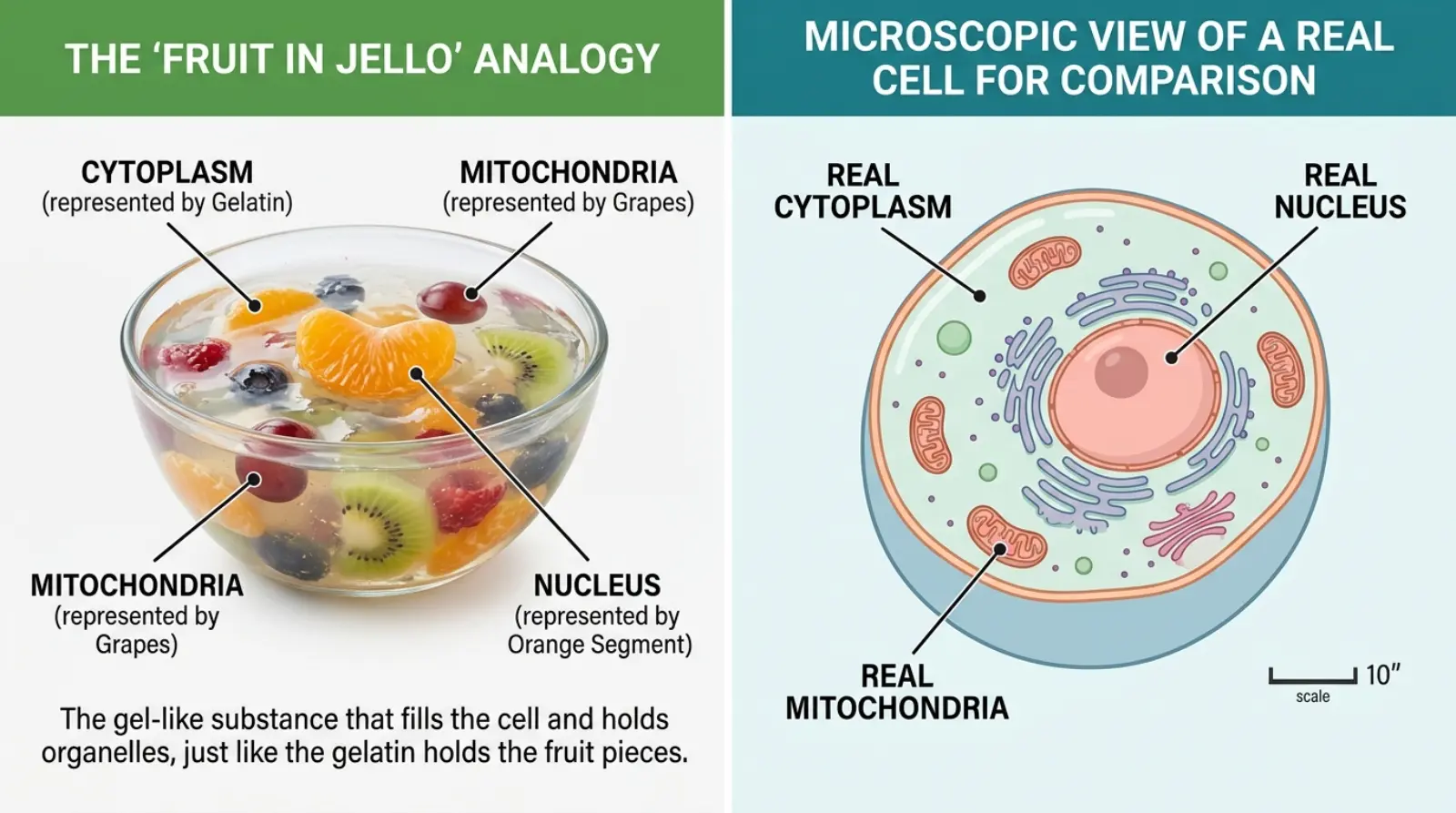
Cytoplasm is the material inside a cell, located between the cell membrane and, in eukaryotic cells, the nucleus.
It contains cytosol, along with various cell structures and materials. Many important chemical reactions and cellular processes take place in this area.
In a simple way, think of cytoplasm as the working environment inside a cell.
It helps support cellular activities such as metabolism, movement of materials, and many chemical reactions.
Cytoplasm in Prokaryotic Cells
Prokaryotic cells, such as bacteria, have cytoplasm.
They do not have a membrane-bound nucleus. Their DNA is located in a region called the nucleoid.
Their cytoplasm contains structures such as:
- Cytosol
- Ribosomes
- Enzymes
- Nutrients
- DNA in the nucleoid region
- Other cellular materials
Cytoplasm in Eukaryotic Cells
Eukaryotic cells also have cytoplasm.
Examples include animal, plant, fungal, and many protist cells.
Eukaryotic cells contain a membrane-bound nucleus and several membrane-bound organelles. Depending on the cell, the cytoplasm may contain structures such as:
- Mitochondria
- Endoplasmic reticulum
- Golgi apparatus
- Ribosomes
- Vesicles
- Cytosol
- Other organelles and cellular materials
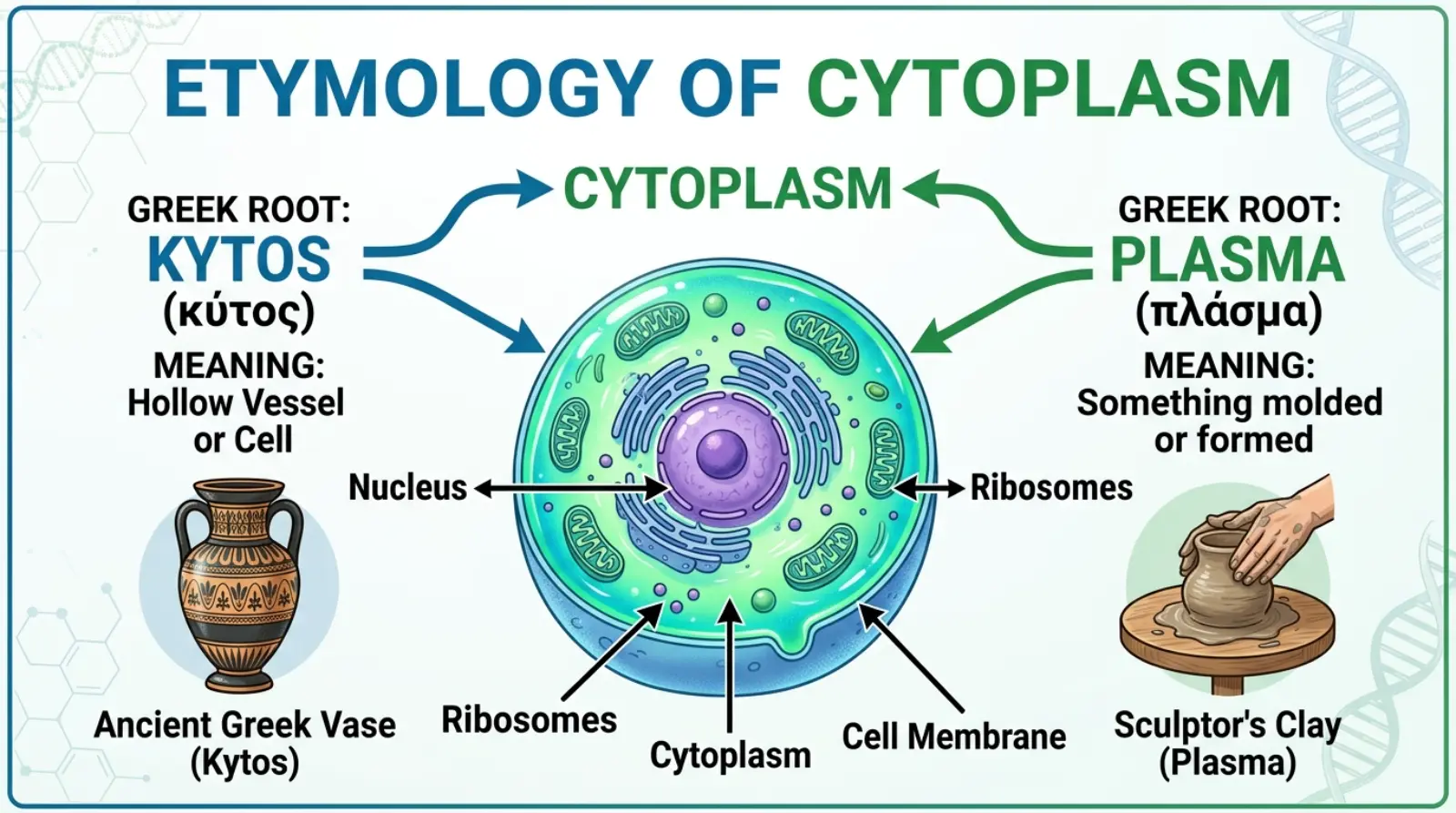
The Origin of the Word Cytoplasm
The word cytoplasm comes from scientific terms based on Greek roots.
“Cyto-” relates to cell, while “plasm” relates to something formed or molded.
The term became part of modern cell biology as scientists developed a better understanding of cell structure.
Today, cytoplasm is one of the basic terms used when studying cells.
How to Pronounce Cytoplasm
Cytoplasm → SY-toh-plaz-um
It has three main syllable parts:
cy-to-plasm
An easy way to say it is:
👉 SY-toh-plaz-um
A common mistake is placing too much emphasis on the final part. Practice saying the word slowly, then naturally:
SY → toh → plaz → um
British English vs American English Usage
There is no important spelling difference between British and American English for cytoplasm.
| Feature | British English | American English | Notes |
|---|---|---|---|
| Spelling | Cytoplasm | Cytoplasm | Same |
| Meaning | Same | Same | Refers to cell material |
| Pronunciation | Very similar | Very similar | Minor accent differences |
| Scientific use | Common | Common | Used in biology |
| Academic use | Common | Common | Used in textbooks and exams |
The scientific meaning stays the same worldwide.
Which One Should You Use?
If you are writing about cell biology, simply use cytoplasm.
It is appropriate for:
- School assignments
- Biology exams
- College work
- Scientific writing
- Laboratory reports
- Educational websites
- Textbooks
- Classroom discussions
For example:
Correct:
“The cytoplasm contains ribosomes and other cellular components.”
Also correct:
“Both prokaryotic and eukaryotic cells contain cytoplasm.”
The word does not change depending on the type of cell.
Common Mistakes About Cytoplasm
Mistake 1: Thinking cytoplasm belongs only to eukaryotic cells
❌ “Only eukaryotic cells have cytoplasm.”
✔ Both prokaryotic and eukaryotic cells have cytoplasm.
Tip: Remember that cytoplasm is a basic part of cells.
Mistake 2: Thinking bacteria have no cytoplasm
❌ “Bacteria do not have cytoplasm.”
✔ Bacterial cells contain cytoplasm.
Bacteria are prokaryotes, but they still have cytoplasm.
Mistake 3: Calling cytoplasm an organelle
❌ “The cytoplasm is an organelle.”
✔ Cytoplasm is the internal material and environment of the cell, not a membrane-bound organelle.
Mistake 4: Saying cytoplasm is the same as cytosol
❌ “Cytoplasm and cytosol are exactly the same.”
✔ Cytosol is the fluid portion of the cytoplasm.
The terms are related but are not always interchangeable.
Mistake 5: Thinking the cytoplasm contains only liquid
❌ “Cytoplasm is just water.”
✔ Cytoplasm contains cytosol plus cellular structures and dissolved substances.
Mistake 6: Thinking the nucleus is part of the cytoplasm
In eukaryotic cells, the nucleus is generally considered separate from the cytoplasm.
A simple model is:
Cell = nucleus + cytoplasm + cell membrane
Cytoplasm in Everyday Biology Examples
At School
“Your biology teacher may ask whether prokaryotic cells have cytoplasm.”
Answer: Yes.
In an Exam
Question: Is cytoplasm found in prokaryotic cells?
Answer: Yes. Prokaryotic cells contain cytoplasm.
In a Biology Assignment
“Both plant and animal cells contain cytoplasm.”
In Online Content
A biology website may describe cytoplasm as the material inside the cell where many cellular processes occur.
In a Conversation
Student: “Does a bacterium have cytoplasm?”
Teacher: “Yes. Bacteria are prokaryotes, and they have cytoplasm.”
Cytoplasm in Different Cell Biology Contexts
Prokaryotic Cells
Prokaryotes include bacteria and archaea.
They have:
- Cell membrane
- Cytoplasm
- Ribosomes
- Genetic material
- No membrane-bound nucleus
Eukaryotic Cells
Eukaryotes include animals, plants, fungi, and many protists.
They have:
- Cell membrane
- Cytoplasm
- Ribosomes
- A membrane-bound nucleus
- Various membrane-bound organelles
Plant Cells
Plant cells have cytoplasm around their organelles and nucleus. They also contain structures such as chloroplasts and a large central vacuole.
Animal Cells
Animal cells contain cytoplasm, a nucleus, mitochondria, ribosomes, and other cellular structures.
Is Cytoplasm Prokaryotic or Eukaryotic? Comparison Table
| Feature | Prokaryotic Cell | Eukaryotic Cell |
|---|---|---|
| Cytoplasm | Yes | Yes |
| Nucleus | No membrane-bound nucleus | Membrane-bound nucleus |
| DNA | In nucleoid region | Mainly inside nucleus |
| Ribosomes | Yes | Yes |
| Membrane-bound organelles | Generally absent | Present |
| Examples | Bacteria, archaea | Animals, plants, fungi |
| Cytoplasm function | Supports cellular reactions | Supports cellular reactions and contains organelles |
The key point is simple:
The presence of cytoplasm does not determine whether a cell is prokaryotic or eukaryotic.
The presence or absence of a membrane-bound nucleus is one of the major differences.
Cytoplasm in Professional and Scientific Life
Cytoplasm is important in many areas of biology and science.
Researchers study cytoplasm when examining:
- Cell metabolism
- Protein production
- Cellular transport
- Enzyme activity
- Cell signaling
- Disease processes
- Cell growth
- Biotechnology
In laboratory work, scientists may examine how substances move through the cytoplasm or how cellular structures interact.
Understanding cytoplasm is therefore useful beyond school biology.
Cytoplasm for Students and Beginners
Many students confuse cytoplasm with the nucleus because both are shown inside a cell diagram.
Use this simple approach:
Prokaryote: cytoplasm + DNA region, but no membrane-bound nucleus.
Eukaryote: cytoplasm + membrane-bound nucleus + other organelles.
When studying a diagram, first look for the nucleus.
If there is a clear membrane-bound nucleus, the cell is eukaryotic.
If there is no membrane-bound nucleus, it may be prokaryotic.
Common Uses and Characteristics of Cytoplasm
Remember these important facts:
- Cytoplasm is found in both major cell types.
- It is inside the cell membrane.
- It contains cytosol.
- It supports many chemical reactions.
- It contains or surrounds many cellular structures.
- Prokaryotic cells have cytoplasm.
- Eukaryotic cells have cytoplasm.
- Cytoplasm is not the same thing as the nucleus.
- Cytoplasm is not itself a membrane-bound organelle.
Google Searches and Long-Tail Questions
People often search “is cytoplasm prokaryotic or eukaryotic” because they want a quick answer for homework, revision, or an exam.
Related searches may include:
- Do prokaryotic cells have cytoplasm?
Yes. Prokaryotic cells contain cytoplasm. - Do eukaryotic cells have cytoplasm?
Yes. Eukaryotic cells also contain cytoplasm. - Is cytoplasm an organelle?
No. Cytoplasm is not a membrane-bound organelle. - What is cytoplasm made of?
It includes cytosol and various cellular components. - What is the function of cytoplasm?
It provides an environment where many cellular reactions and processes occur. - Do bacteria have cytoplasm?
Yes. Bacteria are prokaryotic cells with cytoplasm. - What is the difference between cytoplasm and cytosol?
Cytosol is the fluid part of cytoplasm. - Is cytoplasm found in plant cells?
Yes. Plant cells have cytoplasm. - Is cytoplasm found in animal cells?
Yes. Animal cells have cytoplasm. - What is the difference between prokaryotic and eukaryotic cells?
A major difference is that eukaryotes have a membrane-bound nucleus, while prokaryotes do not.
Expert Tips for Remembering Cytoplasm
Here are some easy biology study tips:
- Remember “cyto” = cell.
- Never assume cytoplasm belongs to only one cell type.
- Learn cytoplasm together with the cell membrane, nucleus, ribosomes, and organelles.
- When answering an exam question, clearly state that both prokaryotic and eukaryotic cells contain cytoplasm.
- Do not confuse cytoplasm with cytosol.
- Use cell diagrams to understand where cytoplasm is located.
Think of it this way:
Imagine a cell as a busy room.
The cytoplasm is like the working space inside the room.
In a prokaryotic cell, there is no separate membrane-bound office for the DNA.
In a eukaryotic cell, there is a special enclosed area called the nucleus.
Both rooms still have a working space.
That working space represents the basic idea of cytoplasm.
FAQs About Is Cytoplasm Prokaryotic or Eukaryotic
Is cytoplasm prokaryotic or eukaryotic?
Cytoplasm is found in both prokaryotic and eukaryotic cells. It is not exclusive to either group.
Do prokaryotes have cytoplasm?
Yes. Prokaryotic cells, including bacteria and archaea, have cytoplasm.
Do eukaryotes have cytoplasm?
Yes. Animal, plant, fungal, and many protist cells contain cytoplasm.
Is cytoplasm an organelle?
No. Cytoplasm is not a membrane-bound organelle. It is the internal material of the cell that supports many cellular processes.
What is cytoplasm made of?
Cytoplasm includes cytosol and various cellular structures and substances.
Is cytoplasm the same as cytosol?
No. Cytosol is the fluid portion of the cytoplasm. Cytoplasm is a broader term.
Does bacterial cytoplasm contain DNA?
Yes. Bacterial DNA is located in a region called the nucleoid, which is within the cell’s interior.
What is the main difference between prokaryotic and eukaryotic cells?
A major difference is that eukaryotic cells have a membrane-bound nucleus, while prokaryotic cells do not.
Is cytoplasm found in plant cells?
Yes. Plant cells contain cytoplasm along with their nucleus and other cellular structures.
Is cytoplasm found in animal cells?
Yes. Animal cells have cytoplasm that contains cytosol and various cellular components.
Final Verdict
Is cytoplasm prokaryotic or eukaryotic?
👉 Both.
Cytoplasm is found in prokaryotic and eukaryotic cells.
The important difference between these cell types is not the presence of cytoplasm. A major difference is the presence of a membrane-bound nucleus and other membrane-bound organelles in eukaryotic cells.
Easy Memory Rule
Prokaryote = cytoplasm + no membrane-bound nucleus.
Eukaryote = cytoplasm + membrane-bound nucleus.
Conclusion
The answer to “is cytoplasm prokaryotic or eukaryotic” is simple: cytoplasm is found in both types of cells.
Bacteria and archaea have cytoplasm even though they are prokaryotes. Plants, animals, fungi, and many other organisms also have cytoplasm because they are eukaryotes.
The easiest way to remember this is to focus on the nucleus.
Cytoplasm is common to both. The membrane-bound nucleus is a key feature that separates eukaryotic cells from prokaryotic cells.
Once you remember that rule, this common biology question becomes much easier.

Camila Green is an English language writer who specializes in confusing word comparisons and spelling explanations. She creates simple, beginner-friendly guides on topics like “niece or neice” and other common English mistakes. Her writing focuses on clarity, real-life examples, and easy learning. At VerrsaPick, she helps readers improve their English with practical and engaging content.