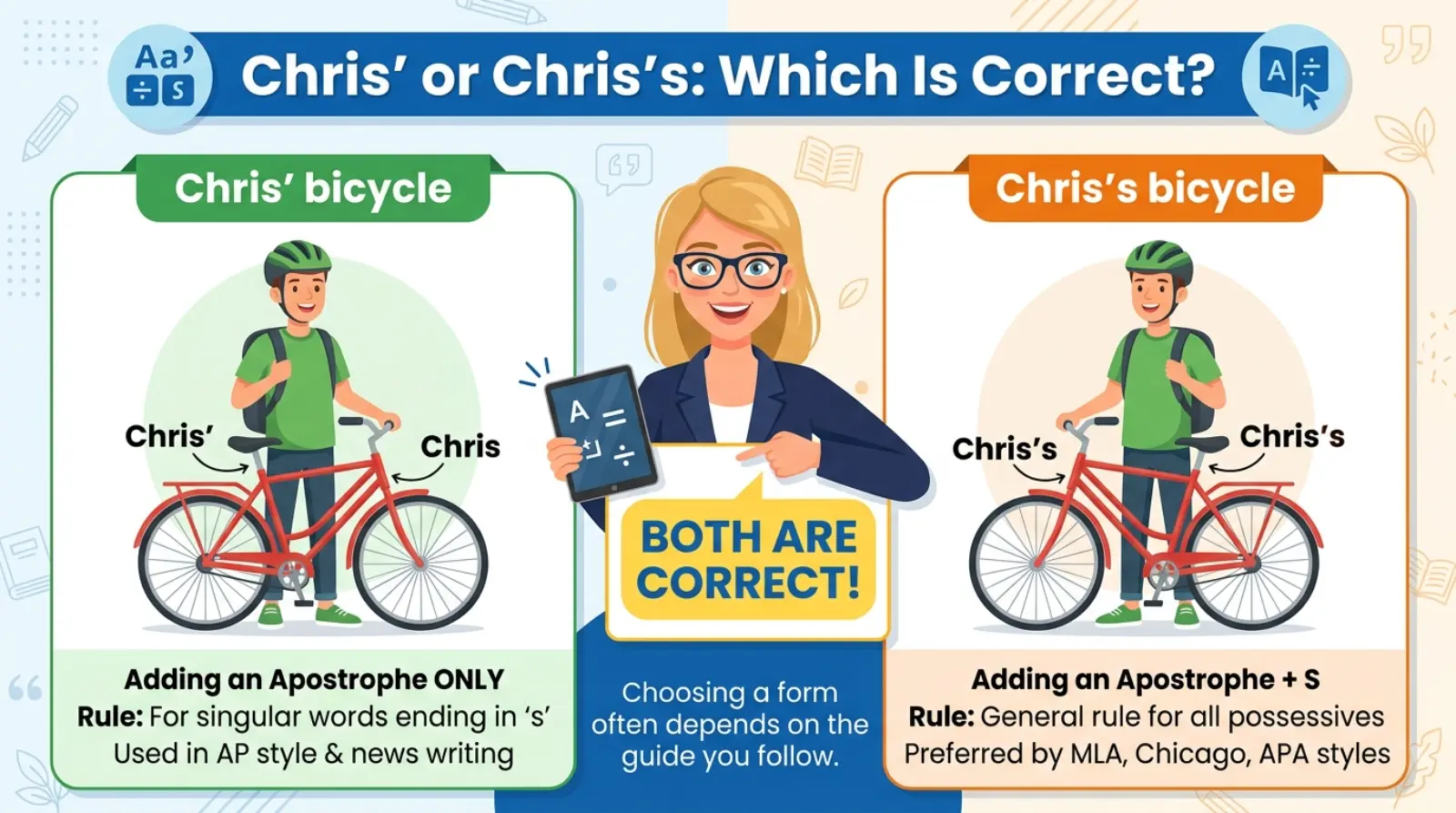
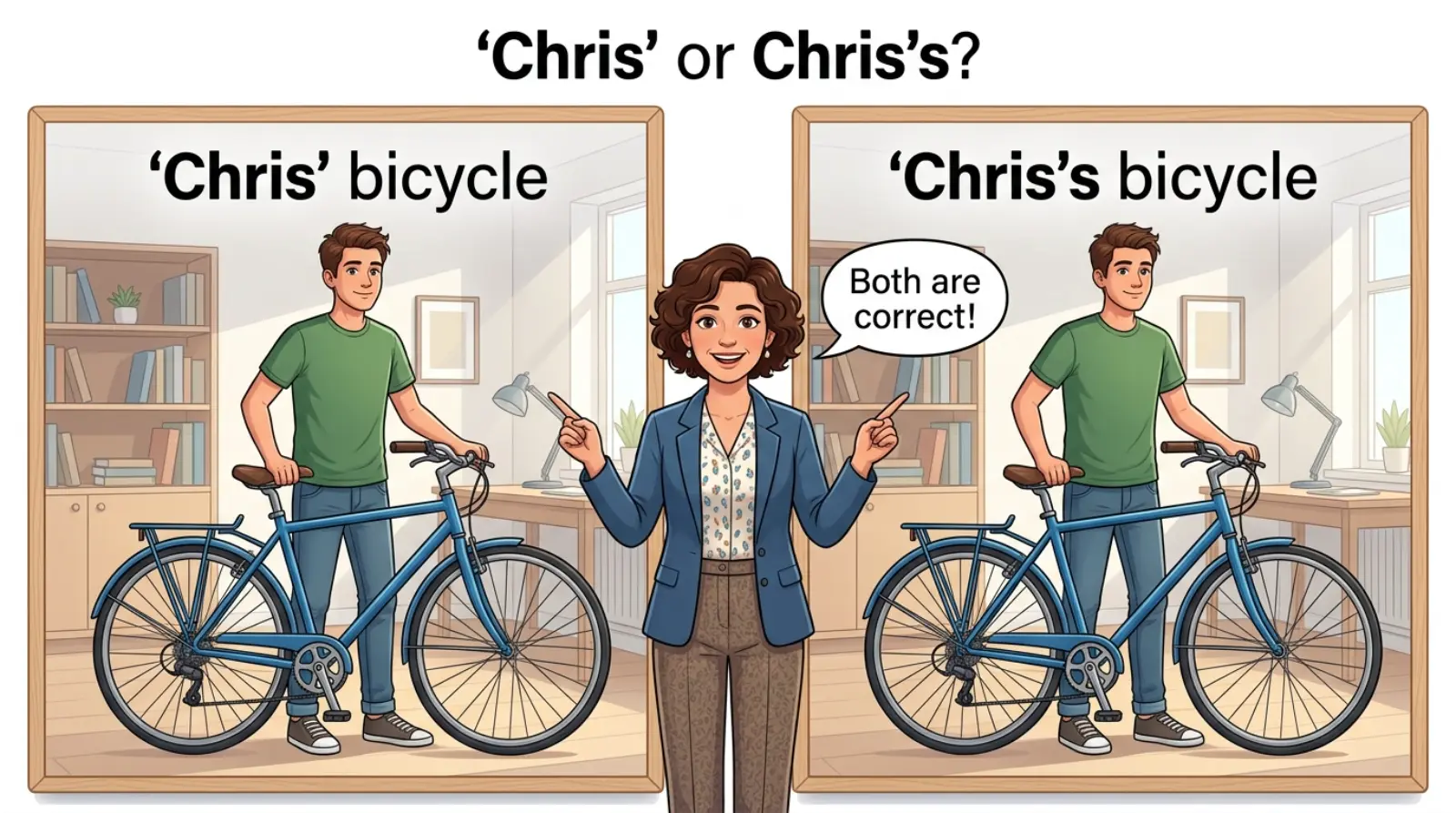
Have you ever written a sentence like “This is Chris’ car” and then wondered if it should actually be “Chris’s car”?
You are not alone. The choice between Chris’ or Chris’s confuses many English learners because both forms appear in books, websites, school assignments, and professional writing.
The reason is simple: Chris is a singular name that ends in s. English has more than one accepted style for forming the possessive of singular names ending in s.
In many modern style guides, Chris’s is preferred because it clearly shows the possessive form and is usually pronounced with an extra syllable. Other style guides allow or prefer Chris’, especially when following a particular editorial style.
So, is one always wrong? No. The answer depends partly on the style guide you are following.
People usually search for:
- Chris’ or Chris’s correct spelling
- Chris’ or Chris’s grammar
- Chris possessive form
- how to write Chris’s name
- Chris’ meaning
- Chris’s meaning
- Chris apostrophe rules
- singular possessive names ending in s
- Chris’s or Chris’ house
- which is correct, Chris’ or Chris’s
This guide makes the rule simple and gives you practical examples for school, work, emails, and everyday writing.
In this guide, you’ll learn the meaning, pronunciation, examples, usage, grammar rules, common mistakes, expert tips, and simple explanations in easy English.
Chris’ or Chris’s – Quick Answer
👉 Chris’s = widely preferred modern possessive form
👉 Chris’ = also accepted by some style guides
Both forms can indicate that something belongs to Chris.
Examples
- Chris’s car is outside.
- I borrowed Chris’s book.
- That is Chris’ car.
- We visited Chris’s office.
- Chris’ idea was very helpful.
The important point is that Chris’ is not simply an obvious spelling error. It is a possessive style choice used by some writers and style systems.
Simple Rule
If you do not have a specific style guide to follow, Chris’s is often the clearest choice.
If your school, company, publisher, or organization follows a particular style guide, use its rule consistently.
What Does Chris’ or Chris’s Mean?
Chris’s and Chris’ are possessive forms of the singular proper name Chris.
They tell readers that something belongs to, relates to, or is associated with Chris.
For example:
This is Chris’s phone.
The phone belongs to Chris.
Another example:
I read Chris’ article.
The article was written by or belongs to Chris.
Synonyms and Related Terms
The possessive can often be rewritten with of:
Chris’s car
can become:
the car of Chris
The second version is grammatically possible but usually sounds less natural.
Related Grammar Terms
This topic connects with:
- possessive nouns
- possessive proper nouns
- apostrophes
- singular nouns
- plural possessives
- names ending in s
- apostrophe rules
- possessive forms
The Origin of Chris’ and Chris’s
The difference comes from a broader English grammar question: How should we form the possessive of singular names ending in s?
English has developed different style conventions over time.
Some traditional and modern writing systems add ’s to singular names:
Chris → Chris’s
Other styles remove the extra s and use only an apostrophe:
Chris → Chris’
This is why you may see both forms in published writing.
The important thing is not to mix styles randomly. Follow the style required for your situation.
How to Pronounce Chris’ or Chris’s
The pronunciation can help you understand the difference.
Chris’s is commonly pronounced:
Chris-iz
It has an extra syllable compared with Chris.
For example:
Chris’s house
sounds roughly like:
Chris-iz house
With Chris’, many writers pronounce the possessive in the same way as Chris, especially in styles where the apostrophe-only form is used.
However, actual pronunciation can depend on the word that follows and the speaker.
Easy Speaking Tip
If you naturally pronounce an extra -iz sound, Chris’s makes that pronunciation visible in writing.
British English vs American English Usage
Both British and American English can use possessive forms for names ending in s, but individual style guides may make different recommendations.
| Feature | British English | American English | Notes |
|---|---|---|---|
| Chris’s | Common | Common | Widely accepted |
| Chris’ | Also used | Also used | Style-dependent |
| Possessive meaning | Same | Same | Both show possession |
| Apostrophe | Required | Required | The difference is whether s follows it |
| Best choice | Follow style guide | Follow style guide | Consistency matters |
There is no simple rule saying that Chris’s is British and Chris’ is American. Both forms can appear in both varieties.
Which One Should You Use: Chris’ or Chris’s?
If you are writing ordinary modern English and no special style guide is required, Chris’s is a safe and clear choice.
Use Chris’s when:
- Writing school assignments
- Writing general articles
- Sending emails
- Writing personal messages
- Creating everyday content
- You want the possessive form to be immediately clear
Examples:
Chris’s laptop is new.
I met Chris’s brother yesterday.
Use Chris’ when:
- A style guide specifically prefers it
- Your publication uses apostrophe-only possessives for certain names
- You need to follow an established editorial system
The most important rule is consistency.
Mini Usage Table
| Situation | Recommended approach |
|---|---|
| Casual writing | Chris’s is clear |
| School writing | Follow your teacher/style guide |
| Academic writing | Follow the required style |
| Business writing | Follow company style |
| Journalism | Follow publication style |
| Personal messages | Either may appear, but Chris’s is clear |
Common Mistakes With Chris’ or Chris’s
Mistake 1: Assuming Chris’ Is Always Wrong
❌ “Chris’ is never correct.”
✔ Chris’ is accepted by some style guides.
The mistake is treating one style preference as a universal grammar rule.
Mistake 2: Assuming Chris’s Is Wrong
❌ “You cannot add ’s after a name ending in s.”
✔ Chris’s is widely accepted and commonly preferred.
Many style systems form singular possessives this way.
Mistake 3: Forgetting the Apostrophe
❌ Chris car is outside.
✔ Chris’s car is outside.
The apostrophe shows the possessive relationship.
Mistake 4: Using Both Forms Together
❌ Chris’s’ car
✔ Chris’s car
Do not add two possessive endings.
Mistake 5: Confusing Plural and Possessive Forms
Chris is one person’s name.
If you are talking about several people named Chris, the plural can be Chrises.
A possessive plural would follow a different rule.
The apostrophe is not automatically added just because a word ends in s.
Mistake 6: Changing the Meaning
The apostrophe affects grammar, not the identity of the person.
Chris’s phone
means the phone belongs to Chris.
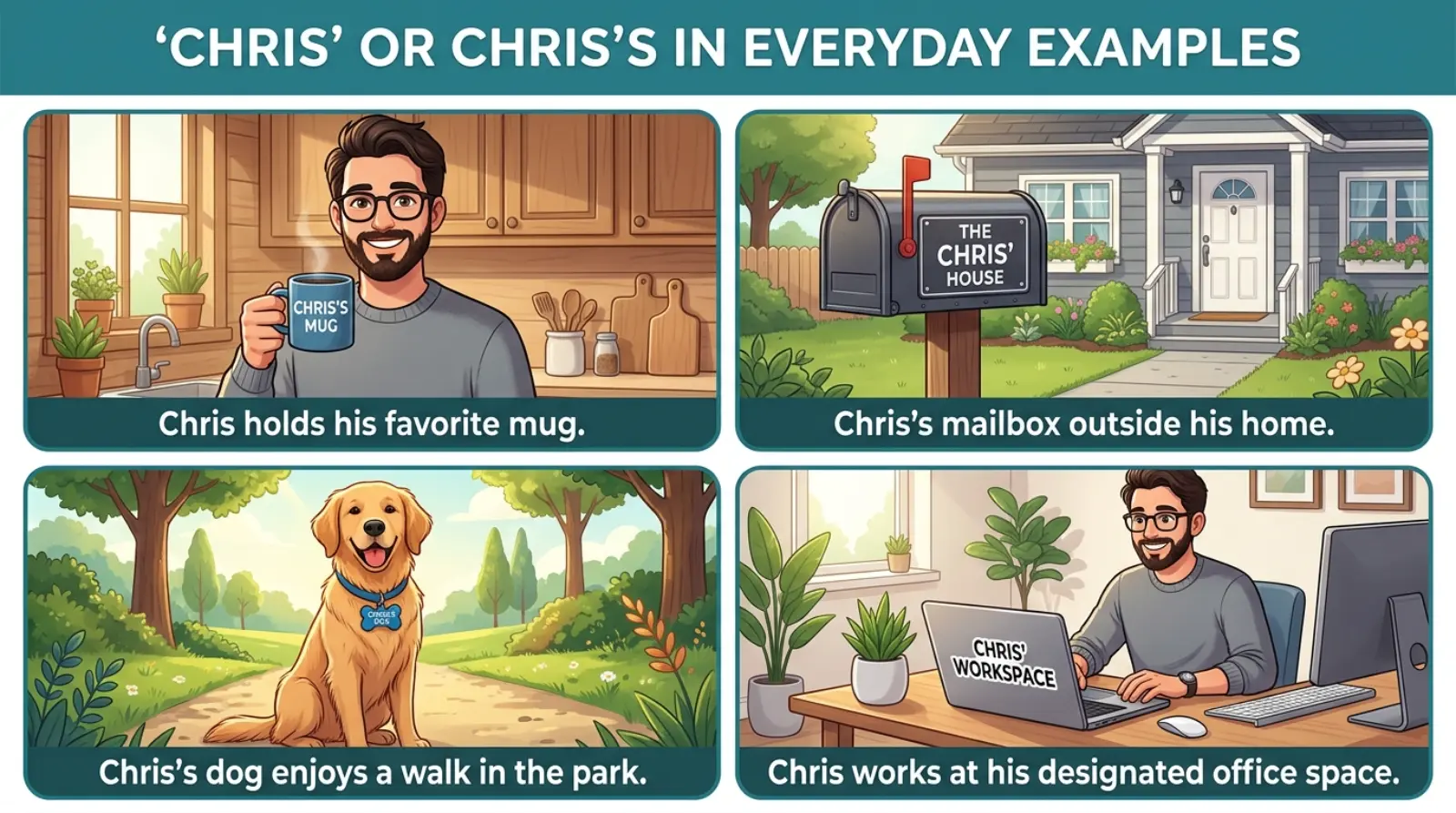
Chris’ or Chris’s in Everyday Examples
Work
I reviewed Chris’s report.
School
Chris’s presentation was excellent.
Social Media
Check out Chris’s new post.
Daily Life
I left my bag at Chris’s house.
I spoke with Chris’s manager.
Text Message
Is this Chris’s phone?
Online Content
Chris’s profile has been updated.
Conversation
That is Chris’s seat.
These examples all use Chris’s because it is a clear modern possessive form.
Chris’ or Chris’s in Different Contexts
Education
Students may encounter both forms in textbooks or writing guides.
If an assignment specifies a style guide, follow it rather than switching between forms.
Business
Professional writing benefits from consistency.
If your company normally writes Chris’s, keep that form throughout your document.
Academic Writing
Academic styles can have their own rules for possessives.
Always check the required style when writing formal papers.
Journalism
News organizations may have house styles that determine whether singular names ending in s take ’s or only ’.
Social Media
Informal posts are less strict, but correct possessive grammar still improves readability.
Chris’ or Chris’s – Google Searches and Usage
People often search this question because they see both forms online.
Searches may include:
- Is Chris’ correct?
- Is Chris’s grammatically correct?
- Chris’ or Chris’s house
- How do you make Chris possessive?
- Do you put an apostrophe after Chris?
- Is Chris’s the correct possessive?
- What is the possessive form of Chris?
- Chris’ vs Chris’s grammar
- Names ending in s possessive rule
- Singular possessive nouns ending in s
This confusion is common because different editorial styles can produce different answers.
For writers in the US, UK, Canada, Australia, India, Pakistan, and other English-speaking communities, the safest approach is to learn the basic grammar and then follow the style required by the audience.
Comparison Table: Chris’ vs Chris’s
| Feature | Chris’ | Chris’s |
|---|---|---|
| Possessive form | Yes | Yes |
| Shows Chris owns something | Yes | Yes |
| Apostrophe used | Yes | Yes |
| Extra “s” written | No | Yes |
| Widely accepted | Yes, style-dependent | Yes |
| Common in modern general writing | Yes | Often preferred |
| Formal writing | Style-dependent | Style-dependent |
| Main issue | Style choice | Style choice |
Chris’ or Chris’s in Professional Life
In professional writing, the biggest concern is usually consistency.
For example, if your company uses Chris’s, do not write Chris’ in one section and Chris’s in another without a reason.
Consider:
Please send Chris’s report to the manager.
This is clear and natural.
In a formal document, also check whether your organization follows a particular editorial guide.
Chris’ or Chris’s for Students and Beginners
This topic can feel harder than it really is.
Start with one basic idea:
Chris is one person.
When something belongs to Chris, you need a possessive form.
For example:
Chris’s book
means:
the book belonging to Chris.
If your teacher uses a style that allows Chris’, you may also see:
Chris’ book
The meaning is the same.
The key is to follow the required style.
Common Uses of Chris’ or Chris’s
You will usually see these forms before a noun:
- Chris’s car
- Chris’s house
- Chris’s phone
- Chris’s office
- Chris’s idea
- Chris’s brother
- Chris’s project
- Chris’s answer
- Chris’s team
- Chris’s computer
They can also appear in longer possessive phrases:
Chris’s new project was successful.
I liked Chris’s idea for the website.
Simple Trick to Remember Chris’ or Chris’s
Here is the easiest beginner rule:
Chris = one person.
For a clear general-purpose possessive form, add ’s:
Chris → Chris’s
Think of it this way:
Ask yourself:
“Does this belong to Chris?”
If the answer is yes, write a possessive form.
For example:
Does the laptop belong to Chris?
Yes.
It is Chris’s laptop.
If your required style uses apostrophe-only possessives for names ending in s, then Chris’ laptop may be correct in that style.
So the memory trick is:
First learn Chris’s as the clear standard form. Then check the style guide when needed.
Expert Tips for Using Chris’ or Chris’s
- Check the style guide.
Formal writing may require a specific convention. - Be consistent.
Do not randomly switch between Chris’ and Chris’s. - Remember that Chris is singular.
The question is about a singular possessive name. - Do not remove the apostrophe.
“Chris car” is not a possessive form. - Use pronunciation as a clue.
Chris’s often reflects an extra “-iz” sound. - Do not treat every name ending in s exactly the same without checking style.
Possessive rules can vary by editorial system. - For school or work, follow the requested style.
Consistency is more important than personal preference.
Related Searches People Also Ask
Is Chris’ grammatically correct?
Yes. Chris’ is accepted by some style guides as the possessive form of Chris.
Is Chris’s grammatically correct?
Yes. Chris’s is widely accepted and commonly preferred in modern general writing.
What is the possessive form of Chris?
Both Chris’s and Chris’ can be used, depending on the style guide.
Should I write Chris’s or Chris’?
If no style guide is specified, Chris’s is a clear and widely accepted choice. For formal work, follow the required style.
Is Chris’s pronounced differently?
Often, yes. Chris’s is commonly pronounced with an extra “-iz” sound.
Do you use an apostrophe after Chris?
Yes. A possessive form requires an apostrophe: Chris’s or Chris’.
Is Chris’ house correct?
Yes, it can be correct under styles that use an apostrophe alone for certain singular names ending in s.
Is Chris’s house correct?
Yes. Chris’s house is a standard possessive construction.
FAQs About Chris’ or Chris’s
Which is correct, Chris’ or Chris’s?
Both can be correct. Chris’s is widely accepted, while Chris’ is preferred by some style guides.
Is Chris’ a mistake?
No. It is not automatically a mistake. It can be a valid possessive form under certain style conventions.
Is Chris’s better than Chris’?
Not universally. Chris’s is often the clearer default, but the best choice depends on the style guide you are following.
What is the correct possessive form of Chris?
Common choices are Chris’s and Chris’. Check the style required for your writing.
Should I use Chris’s in school?
If your teacher or school provides no different rule, Chris’s is a clear choice. If a style guide is required, follow it.
Is Chris’s formal?
Yes. Chris’s can be used in formal, academic, and professional writing.
Why do some people write Chris’?
Some style guides form the possessive of singular names ending in s with only an apostrophe.
Can I use Chris’ and Chris’s in the same document?
You should not switch between them randomly. Pick the form required by your style guide and stay consistent.
Does Chris’ mean the same as Chris’s?
Yes. When used as possessives, both forms can mean that something belongs to or is associated with Chris.
Final Verdict
Chris’ and Chris’s can both be correct possessive forms.
The difference is mainly style, not meaning.
👉 Chris’s = widely accepted and a clear default
👉 Chris’ = accepted by some style guides
The easiest beginner choice is Chris’s, unless your school, employer, publisher, or style guide tells you to use Chris’.
Conclusion
The question “Chris’ or Chris’s?” does not have the same answer as a simple right-versus-wrong spelling mistake.
Both forms can be used to show possession, but different style guides make different choices.
If you are writing a normal email, assignment, article, or message and no special style is required, Chris’s is a clear and widely accepted option.
If you are following a specific editorial style, use the form that guide requires.
The easiest memory trick is simple: Chris is one person, and Chris’s is the clear possessive form to remember first.

Camila Green is an English language writer who specializes in confusing word comparisons and spelling explanations. She creates simple, beginner-friendly guides on topics like “niece or neice” and other common English mistakes. Her writing focuses on clarity, real-life examples, and easy learning. At VerrsaPick, she helps readers improve their English with practical and engaging content.