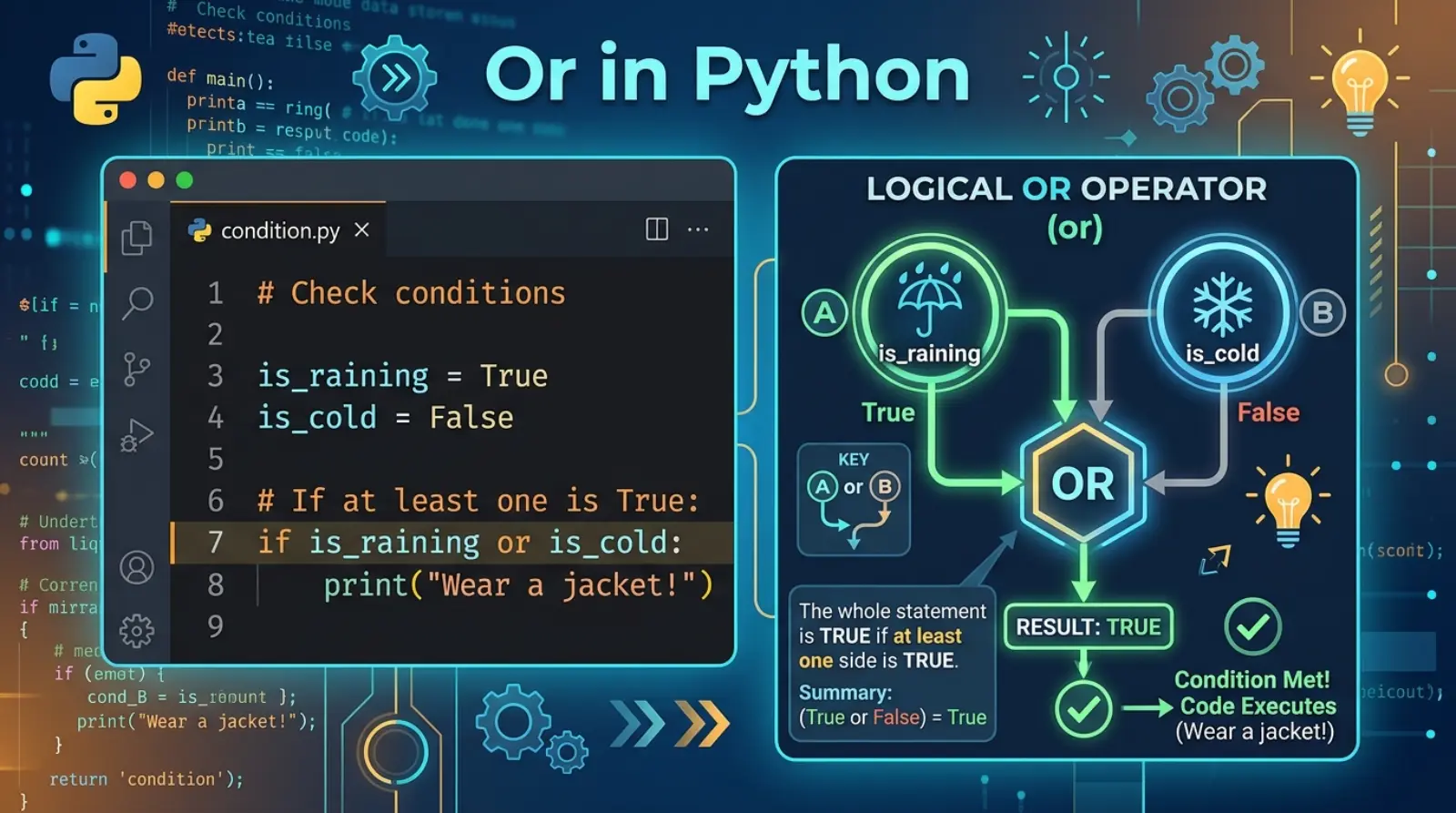
Have you ever written a Python if statement and wanted your program to do something when one condition or another condition is true?
For example, you may want to check whether a user entered "yes" or "y". You might also want to allow a person to log in with an email or a username.
This is where or in Python becomes useful.
The Python or operator is a Boolean operator used to combine conditions and values. It checks the first expression and only checks the second when necessary. Unlike some beginners expect, Python’s or does not always return True or False. It can return one of the actual operands.
According to the official Python documentation, x or y returns x when x is truthy. Otherwise, it evaluates and returns y. It is also a short-circuit operator.
People usually search for:
- or in Python meaning
- Python or operator
- how to use or in Python
- Python
orexamples - Python OR condition
orvsandin Python- Python logical operators
- why Python
orreturns a value
In this guide, you’ll learn the meaning, pronunciation, examples, usage, grammar rules, common mistakes, expert tips, and simple explanations in easy English.
Or in Python – Quick Answer
👉 or in Python = a logical operator that chooses between alternatives.
👉 x or y = return x if it is truthy; otherwise return y.
The simplest example is:
age = 20

if age < 18 or age > 65:
    print("Special category")
Here, the condition is true if either age < 18 or age > 65 is true.
Simple examples
x = True
y = False

print(x or y)
Output:
TrueAnother example:
username = ""

name = username or "Guest"
print(name)
Output:
GuestSimple Rule
Think of or as saying:
“Give me the first useful option. If the first one is not useful, try the second.”
Python’s or uses truth-value testing and short-circuit evaluation.
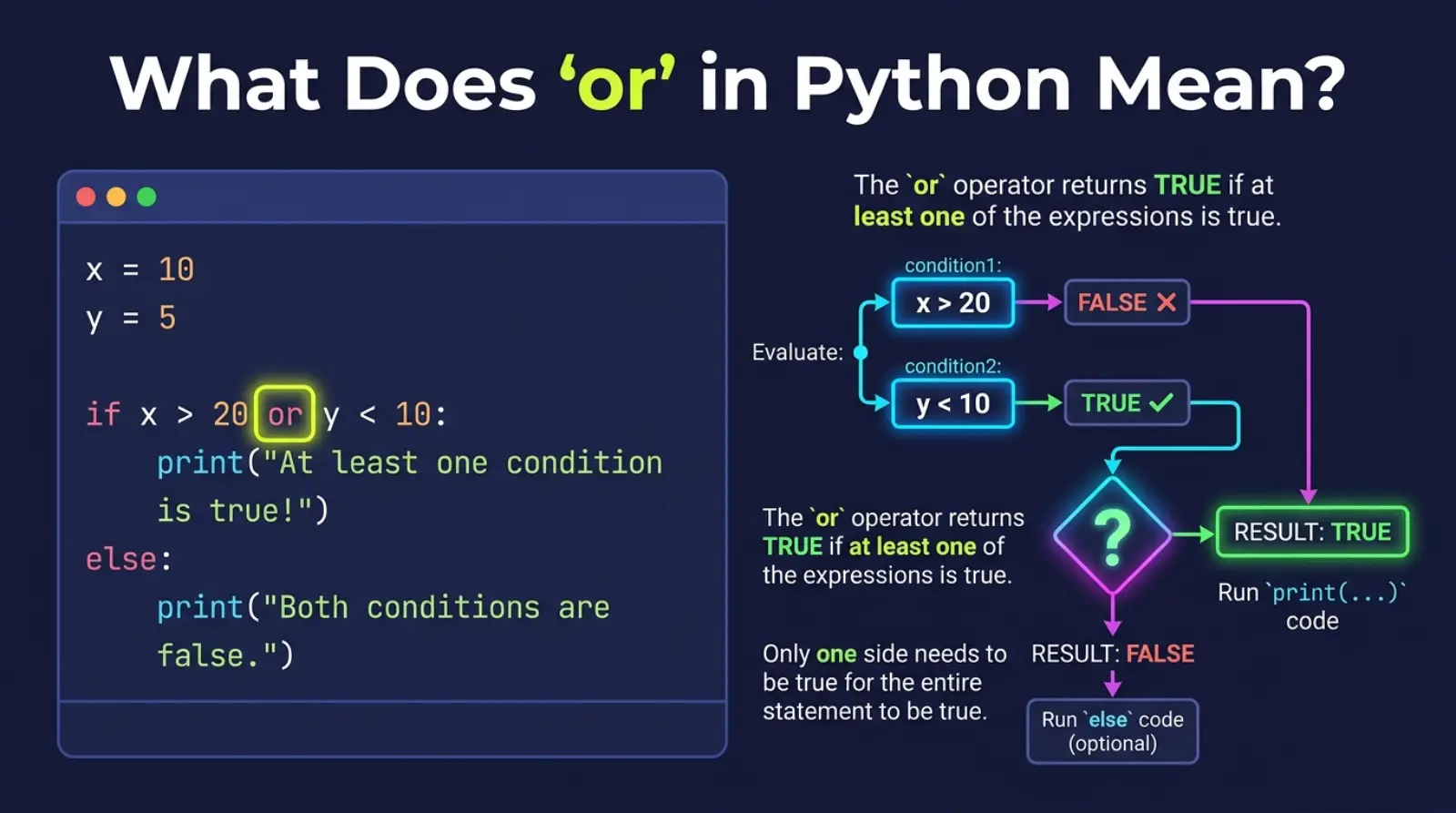
What Does Or in Python Mean?
In Python, or is a Boolean or logical operator.
It is commonly used when you want to test multiple possibilities.
For example:
temperature = 35

if temperature < 0 or temperature > 30:
    print("Temperature is outside the normal range.")
The condition is true because temperature > 30 is true.
The important thing to remember is that Python’s or is more flexible than a simple true/false operator.
For example:
result = 0 or 10
print(result)
Output:
10Why?
Because 0 is considered false, so Python moves to 10.
Synonyms
Depending on context, or can mean:
- either
- alternatively
- one of two choices
- otherwise
Related Terms
Important related Python concepts include:
andnot- Boolean values
- truthy values
- falsy values
- conditional statements
- short-circuit evaluation
- logical operators
- operator precedence
Common Variations
You will often see or inside:
if
while
return
It can also be used directly in expressions:
value = first_value or second_valueThe Origin of Or in Python
The word or is a standard English logical connector, but Python uses it as a reserved keyword with a specific programming meaning.
Python includes or, and, and not as Boolean operators. The language reference defines or as part of Python’s Boolean expression syntax.
Python’s current documentation describes Boolean operations and explains that or has lower priority than and.
How to Pronounce Or in Python
The word or is pronounced like the normal English word:
or → /ɔːr/ in many varieties of English.
You do not pronounce it differently just because it is Python code.
For example, when reading:
if age < 18 or age > 60:you can say:
“If age is less than 18 OR age is greater than 60.”
British English vs American English Usage
There is no meaningful British-versus-American difference in the Python or operator.
| Feature | British English | American English | Notes |
|---|---|---|---|
| Python keyword | or | or | Same |
| Meaning | Logical alternative | Logical alternative | Same |
| Spelling | or | or | Same |
| Code usage | Same | Same | Python syntax does not change |
| Pronunciation | Usually similar | Usually similar | Accent may vary |
Python syntax remains the same regardless of the programmer’s country.
Which One Should You Use?
If you need to express one condition OR another, use Python’s lowercase keyword:
orCorrect
if name == "Ali" or name == "Ahmed":
    print("Welcome")
Incorrect
if name == "Ali" OR name == "Ahmed":Python keywords are written in lowercase.
Use or for:
- multiple conditions
- alternative choices
- fallback values
- input validation
- conditional logic
- filtering decisions
Common Mistakes With Or in Python
Mistake 1: Using OR instead of or
❌ Incorrect:
if age > 18 OR age == 18:✔ Correct:
if age > 18 or age == 18:Python uses the lowercase keyword or.
Mistake 2: Forgetting to repeat the comparison
Beginners sometimes write:
if age == 18 or 21:This does not mean “age is 18 or 21.”
Use:
if age == 18 or age == 21:This is one of the most important beginner mistakes.
Mistake 3: Assuming or always returns True or False
Consider:
result = "Hello" or "World"The result is:
HelloPython returns an operand rather than converting everything to a Boolean result.
Mistake 4: Confusing or with |
These are different:
a or band:
a | bThe first is logical or. The second is the bitwise OR operator. Python’s operator module maps bitwise OR to operator.or_().
Mistake 5: Ignoring short-circuit behavior
Python does not necessarily evaluate both sides.
if first_condition or second_condition:
    print("True")
If first_condition is already truthy, Python does not need to evaluate the second expression.
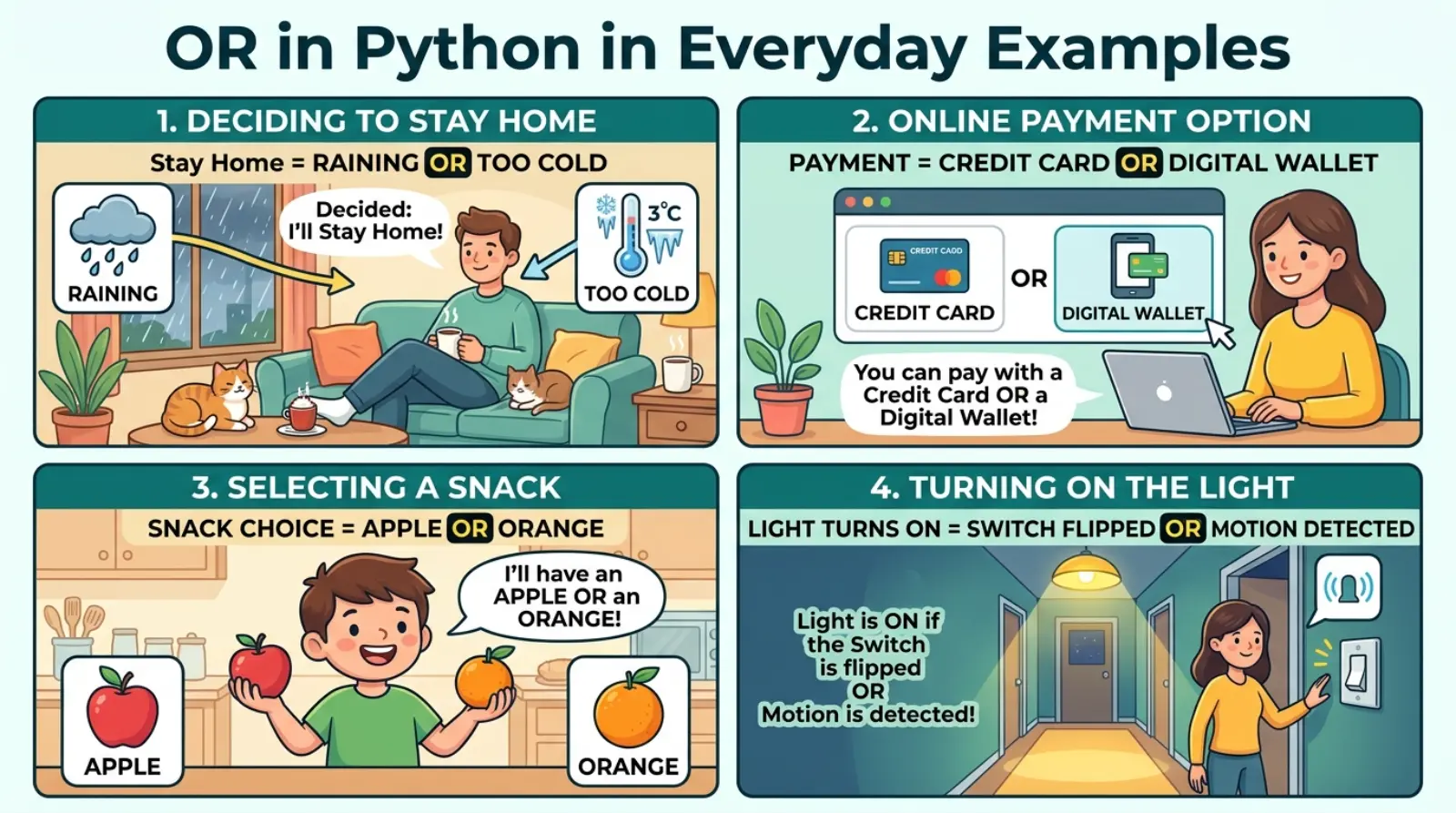
Or in Python in Everyday Examples
Work
if employee == "manager" or employee == "admin":
    allow_access()
School
if grade == "A" or grade == "B":
    print("Good result")
User Input
answer = input("Continue? ")

if answer == "yes" or answer == "y":
    print("Continuing...")
Fallback Value
name = user_name or "Guest"This is especially common when working with optional values.
Conversations and Text
A chatbot might use:
if message == "hello" or message == "hi":
    print("Hello!")
Or in Python in Different Contexts
Conditional Statements
The most common use is inside if:
if score < 40 or attendance < 75:
    print("Needs improvement")
While Loops
You can also use or in a while condition:
while password != "secret" or attempts < 3:
    print("Try again")
However, always check the logic carefully because or can make a condition remain true longer than expected.
Default Values
A popular Python pattern is:
city = user_city or "Unknown"If user_city is empty or otherwise falsy, Python uses "Unknown".
Multiple Choices
if choice == 1 or choice == 2 or choice == 3:
    print("Valid choice")
For many choices, membership testing can sometimes be cleaner:
if choice in (1, 2, 3):
    print("Valid choice")
Or in Python – Google Searches and Usage
People searching for or in Python are usually trying to understand one of three things: how the operator works, how it differs from and, or why it returns values instead of always producing True or False.
Common long-tail searches include:
- what does
ormean in Python - how does
orwork in Python - Python
oroperator examples - Python
orvsand - Python logical OR condition
- why does Python
orreturn a value - Python
orshort circuit oroperator in Pythonifstatement- Python
orvs|
These searches are common among beginners because the syntax looks simple, but its value-returning behavior can be surprising.
Comparison Table: Or in Python
| Feature | or | and |
|---|---|---|
| Basic meaning | Either option | Both conditions |
| Short-circuits | Yes | Yes |
| First operand used when | Truthy | Falsy |
| Common use | Alternatives | Combined requirements |
| Example | x or y | x and y |
| Returns operands | Yes | Yes |
Python documents or and and as short-circuit Boolean operations.
Or in Python in Professional Life
Developers use or in real applications for:
- input validation
- access rules
- configuration defaults
- form handling
- API data
- user preferences
- conditional workflows
- error handling
For example:
email = data.get("email") or "No email provided"This can provide a simple fallback when a value is missing or falsy.
However, professional Python code should prioritize readability. If a condition becomes complicated, parentheses or a clearer structure may make the logic easier to understand.
Or in Python for Students and Beginners
The easiest way to learn or is to start with plain English.
Imagine you tell a program:
“You can enter if you have a ticket OR a special pass.”
Python might express that as:
if has_ticket or has_special_pass:
    print("Entry allowed")
Only one of the two conditions needs to be true.
Remember:
OR = at least one acceptable option.
Common Uses and Patterns of Or in Python
You will frequently see these patterns:
Multiple conditions
if x > 10 or y > 10:
    print("At least one is large")
Fallback values
name = name or "Guest"Input choices
if command == "start" or command == "run":
    start_program()
Combining Boolean expressions
if logged_in and (is_admin or is_manager):
    print("Access granted")
Parentheses can make complicated Boolean logic much easier to understand.
Simple Trick to Remember Or in Python
Remember this:
or means “this choice OR that choice.”
Think of it this way:
You are choosing between two doors.
Door A OR Door BYou only need one acceptable door.
In Python:
if door_a or door_b:
    enter()
For conditions:
OR = one or more conditions can be true.
For values:
OR = use the first truthy value; otherwise use the next one.
Expert Tips for Using Or in Python
- Use lowercase
or. Python keywords are case-sensitive. - Repeat comparisons when necessary. Write
x == 1 or x == 2, notx == 1 or 2. - Remember short-circuit evaluation. The second expression may never run.
- Know the difference between
orand|. - Use parentheses when logic becomes complex.
- Remember that
orcan return an operand. - Test confusing expressions in a Python interpreter.
Python evaluates expressions from left to right, and operator precedence determines how combined expressions are grouped.
Related Searches People Also Ask
What does or mean in Python?
It is a logical operator used to provide alternatives or combine conditions.
How do you use or in Python?
Write it between expressions:
if x > 5 or y > 5:
    print("True")
What is the difference between or and and?
or needs an acceptable alternative, while and requires both sides to meet the condition.
Does Python or return Boolean values?
Not always. It returns one of its operands based on truth-value testing.
Is OR valid in Python?
No. Use lowercase or.
What is short-circuiting in Python?
It means Python may stop evaluating an expression when the result is already known.
What is or versus | in Python?
or is a logical Boolean operator. | is the bitwise OR operator.
Can or be used with strings?
Yes.
name = "" or "Guest"Can or be used in an if statement?
Yes. This is one of its most common uses.
What is the easiest way to remember Python or?
Think “either this or that.”
FAQs About Or in Python
Is or a keyword in Python?
Yes. or is a Python keyword used for Boolean operations.
What does x or y return?
It returns x if x is truthy. Otherwise, it evaluates and returns y.
Is Python or the same as OR in other programming languages?
The basic logical idea is similar, but exact behavior can differ between programming languages.
Why does False or True return True?
Because the first value is false, so Python evaluates the second value, which is true.
Why does "Hello" or "World" return "Hello"?
Because a non-empty string is truthy, so Python stops at the first operand.
Can I use more than two conditions with or?
Yes:
if a or b or c:
    print("At least one is true")
Is or case-sensitive?
Yes. Use lowercase or, not OR or Or.
Does or have lower precedence than and?
Yes. Python gives and higher priority than or. Parentheses can make your intended logic clearer.
Final Verdict
Or in Python is a logical operator used to express alternatives.
The basic pattern is:
x or yFor conditions, it means at least one option should be true.
For values, it returns the first truthy operand; if that operand is falsy, Python evaluates the next one.
Conclusion
Understanding or in Python is one of the first important steps in learning Boolean logic.
The main idea is simple: or gives your program another acceptable choice.
Use:
if condition1 or condition2:when either condition can make the result acceptable.
Just remember one important Python detail: or does not always return True or False. It can return an actual operand, and it uses short-circuit evaluation.
Easy memory trick:
👉 or = “this choice OR that choice.”
Once that idea becomes familiar, Python conditions, fallback values, input validation, and Boolean expressions become much easier to understand.

Camila Green is an English language writer who specializes in confusing word comparisons and spelling explanations. She creates simple, beginner-friendly guides on topics like “niece or neice” and other common English mistakes. Her writing focuses on clarity, real-life examples, and easy learning. At VerrsaPick, she helps readers improve their English with practical and engaging content.