Have you ever looked at XeF4 in a chemistry question and wondered, “Is XeF4 polar or nonpolar?” It can feel confusing because xenon and fluorine are very different atoms, and fluorine is highly electronegative.
If you only look at the Xe–F bonds, you might think XeF4 must be polar. However, molecular polarity depends on more than bond polarity. The shape and symmetry of the molecule are also extremely important.
XeF4 is commonly studied in chemistry classes when learning about Lewis structures, VSEPR theory, molecular geometry, bond polarity, lone pairs, and dipole moments. Understanding why XeF4 is nonpolar can also help you solve questions about other symmetrical molecules.
People usually search for:
- Is XeF4 polar or nonpolar?
- Why is XeF4 nonpolar?
- Is XeF4 a polar molecule?
- What is the shape of XeF4?
- What is the Lewis structure of XeF4?
- Does XeF4 have polar bonds?
- What is the molecular geometry of XeF4?
The good news is that the answer becomes simple once you understand its structure and symmetry.
In this guide, you’ll learn the meaning, pronunciation, examples, usage, grammar rules, common mistakes, expert tips, and simple explanations in easy English.
XeF4 Polar or Nonpolar – Quick Answer
👉 XeF4 = Nonpolar molecule
👉 Xe–F bonds = Polar covalent bonds
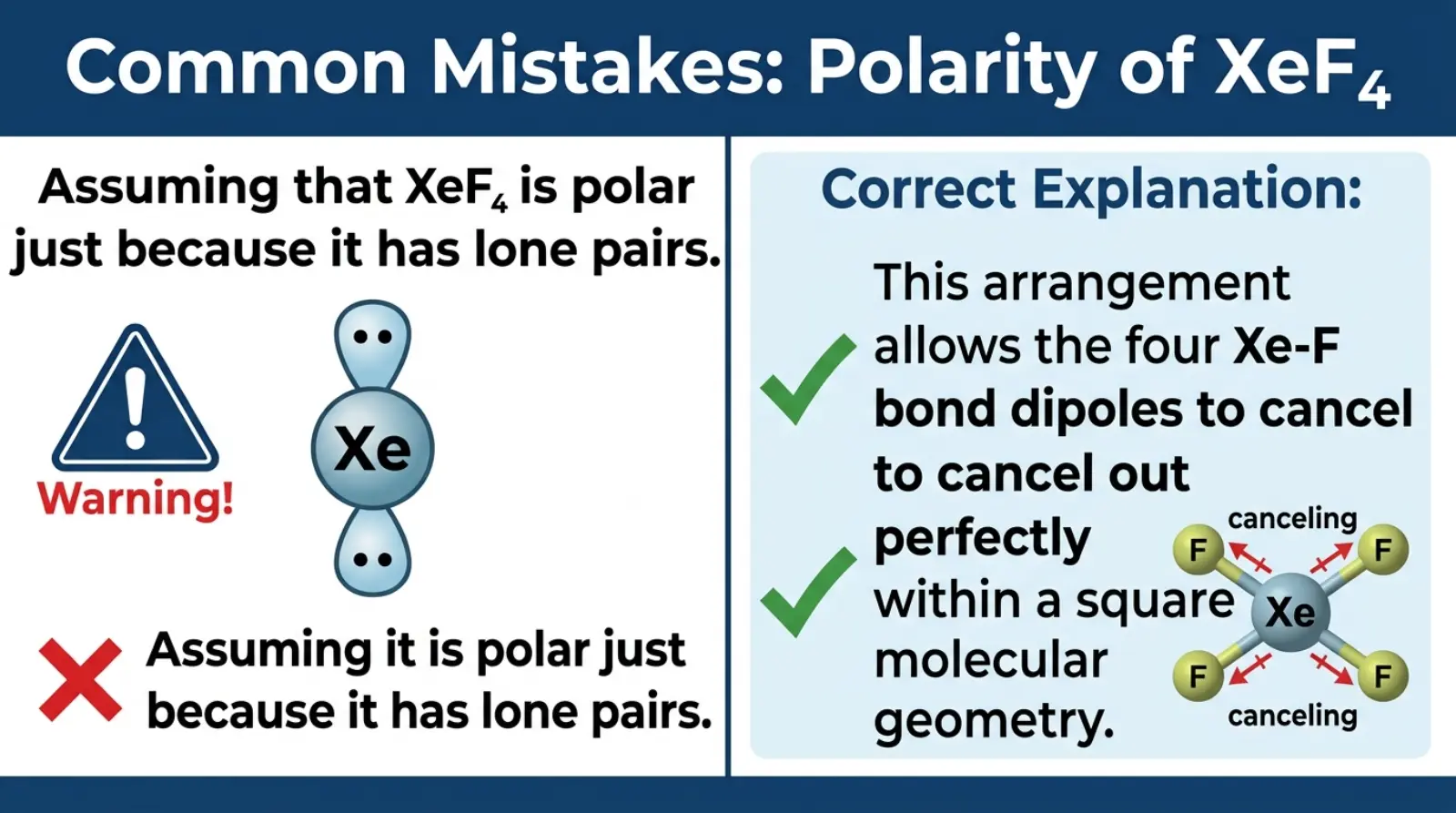
The important point is that XeF4 contains polar bonds, but the molecule itself is nonpolar.
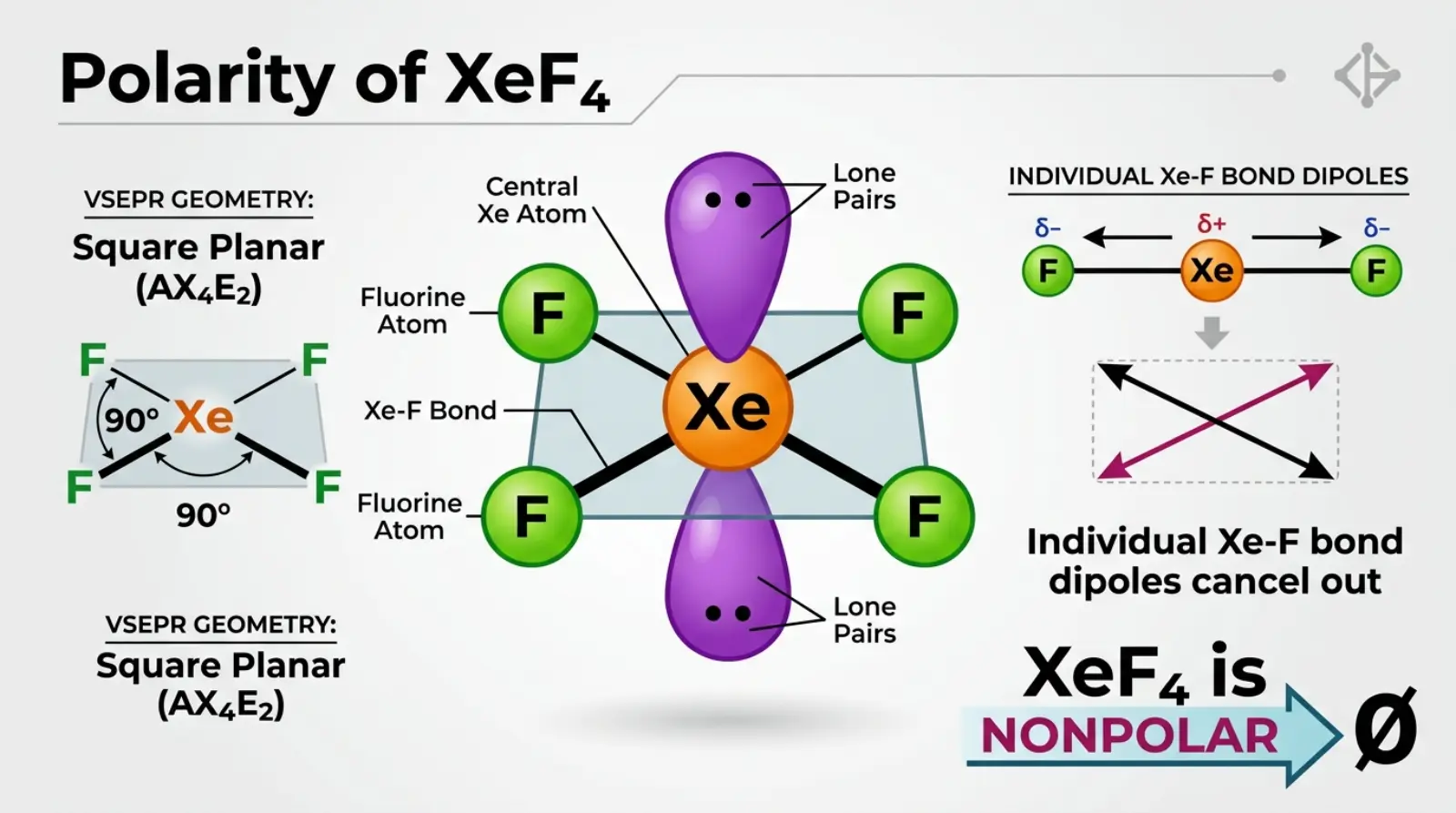
Why? XeF4 has a square planar shape. The four fluorine atoms are arranged symmetrically around the central xenon atom.
The bond dipoles point in opposite directions and cancel each other.
Simple examples
- XeF4 has four Xe–F bonds.
- Each Xe–F bond is polar.
- XeF4 has two lone pairs on xenon.
- The lone pairs occupy positions above and below the molecular plane.
- The four fluorine atoms form a square around xenon.
- The bond dipoles cancel out.
Simple Rule
👉 Polar bonds + symmetrical shape = molecule can be nonpolar.
Think of XeF4 as a balanced square. The pulls from the fluorine atoms cancel each other.
What Does XeF4 Mean?
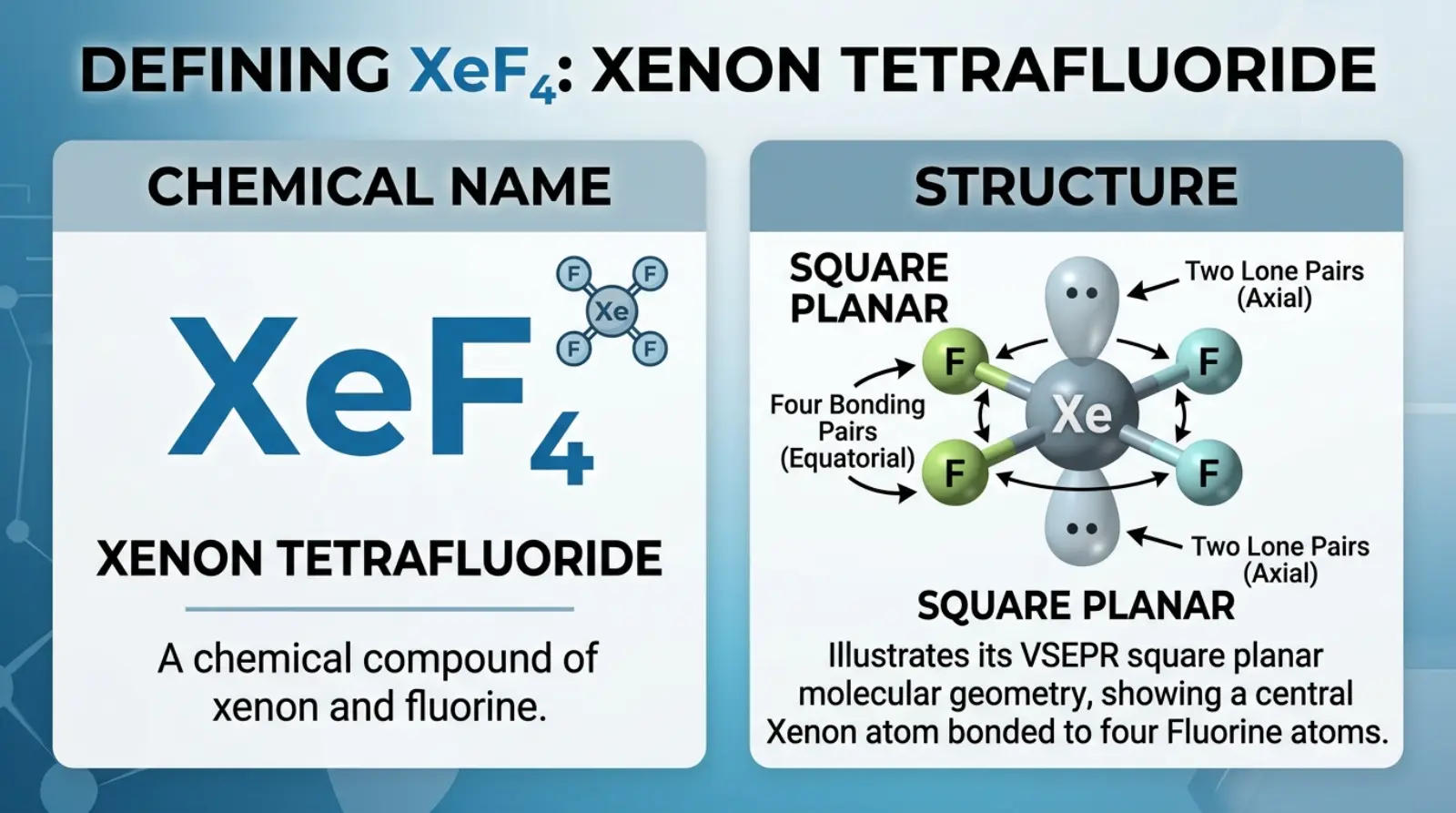
XeF4 is the chemical formula for xenon tetrafluoride.
It contains:
- 1 xenon (Xe) atom
- 4 fluorine (F) atoms
The name “tetrafluoride” tells us that four fluorine atoms are attached to xenon.
XeF4 is an important example of a molecule that demonstrates the difference between bond polarity and molecular polarity.
Is XeF4 made of polar bonds?
Yes.
Fluorine attracts bonding electrons more strongly than xenon. Therefore, each Xe–F bond has an unequal distribution of electrons.
So:
Xe–F bond → polar
But:
XeF4 molecule → nonpolar
Related Terms
Understanding these terms makes XeF4 easier:
- Electronegativity: An atom’s ability to attract bonding electrons.
- Dipole: A separation of positive and negative charge.
- Bond dipole: Polarity within a chemical bond.
- Molecular polarity: Overall charge distribution in a molecule.
- Lewis structure: A diagram showing bonds and valence electrons.
- VSEPR theory: A model used to predict molecular shape.
- Molecular geometry: The arrangement of atoms around the central atom.
The Lewis Structure of XeF4
To understand why XeF4 is nonpolar, start with its Lewis structure.
Xenon is the central atom because it can form bonds with fluorine. Four fluorine atoms surround xenon.
The basic structure contains four Xe–F single bonds.
Xenon also has two lone pairs.
A simplified representation is:
          F
          |
      F — Xe — F
          |
          F
This simple drawing does not fully show the three-dimensional arrangement. The actual molecular geometry is square planar.
Xenon has six electron regions around it:
- 4 bonding pairs
- 2 lone pairs
According to VSEPR theory, these six electron regions arrange themselves in an octahedral electron-domain geometry.
The two lone pairs occupy opposite positions.
That leaves the four fluorine atoms in one flat square plane.
Why Is XeF4 Nonpolar?
This is the most important part.
A molecule’s polarity depends on the vector sum of its bond dipoles.
Each Xe–F bond is polar because fluorine is more electronegative than xenon. The fluorine atoms pull electron density toward themselves.
However, XeF4 has a highly symmetrical structure.
The four Xe–F bonds point in four directions within the same plane:
- one toward the top
- one toward the bottom
- one toward the left
- one toward the right
The opposing bond dipoles cancel.
Therefore, the molecule has no overall dipole moment.
In simple words
Imagine four people pulling a box equally from four directions.
Everyone is pulling, but the box does not move in one direction.
XeF4 works in a similar way.
The polar Xe–F bonds pull electron density in different directions, but the symmetrical arrangement makes the overall effect cancel.
Therefore, XeF4 is nonpolar.
What Is the Shape of XeF4?
XeF4 has a square planar molecular geometry.
This means the four fluorine atoms and the central xenon atom lie in the same plane, forming a square-like arrangement.
Its electron-domain geometry is octahedral, but its molecular geometry is square planar because the two lone pairs are not counted when describing the arrangement of atoms.
Important distinction
| Property | XeF4 |
|---|---|
| Central atom | Xenon |
| Number of fluorine atoms | 4 |
| Lone pairs on Xe | 2 |
| Bond type | Polar covalent |
| Electron geometry | Octahedral |
| Molecular geometry | Square planar |
| Overall polarity | Nonpolar |
| Net dipole moment | Zero |
XeF4 Polar or Nonpolar: Bond vs Molecule
A common chemistry mistake is to assume that polar bonds always produce a polar molecule.
That is not true.
Consider XeF4:
Xe–F bonds are polar.
The molecule has a square planar shape.
The four bonds are arranged symmetrically.
Step 4: Opposing dipoles cancel.
Step 5: The net dipole moment is zero.
Final answer: XeF4 is nonpolar.
This same idea appears in molecules such as CO2, where polar bonds can also cancel because of molecular symmetry.
British English vs American English Usage
XeF4 is a chemical formula, so British and American English do not change the formula or its chemical meaning.
| Feature | British English | American English | Notes |
|---|---|---|---|
| Chemical formula | XeF4 | XeF4 | Same |
| Name | xenon tetrafluoride | xenon tetrafluoride | Same |
| Polar | polar | polar | Same |
| Nonpolar | non-polar/nonpolar | nonpolar | Both forms may appear |
| Molecular geometry | square planar | square planar | Same |
In modern chemistry writing, nonpolar is widely used as one word.
Which One Should You Use?
If your question is “Is XeF4 polar or nonpolar?”, the correct answer is:
👉 XeF4 is nonpolar.
For an academic chemistry answer, give the reason instead of writing only “nonpolar.”
A strong answer would be:
XeF4 is a nonpolar molecule because it has a symmetrical square planar structure. Although its Xe–F bonds are polar, the bond dipoles cancel, giving the molecule a net dipole moment of zero.
This explanation is useful for:
- Chemistry homework
- Exams
- Lab reports
- Class discussions
- Chemistry notes
- Online science questions
Common Mistakes With XeF4 Polar or Nonpolar
Mistake 1: Saying XeF4 is polar because fluorine is electronegative
❌ Incorrect: XeF4 is polar because fluorine attracts electrons strongly.
✔ Correct: XeF4 has polar Xe–F bonds, but the molecular dipoles cancel.
Tip: Always check the molecular shape.
Mistake 2: Calling XeF4’s bonds nonpolar
❌ Incorrect: The Xe–F bonds are nonpolar.
✔ Correct: The Xe–F bonds are polar covalent.
Tip: Bond polarity and molecular polarity are different concepts.
Mistake 3: Forgetting the lone pairs
❌ Incorrect: Xenon has only four electron groups.
✔ Correct: Xenon has four bonding pairs and two lone pairs.
Tip: Count both bonds and lone pairs when using VSEPR theory.
Mistake 4: Giving the wrong molecular geometry
❌ Incorrect: XeF4 is tetrahedral.
✔ Correct: XeF4 is square planar.
Tip: Two lone pairs change the arrangement of the bonded atoms.
Mistake 5: Thinking polar bonds always mean a polar molecule
❌ Incorrect: Every molecule containing polar bonds is polar.
✔ Correct: A molecule can have polar bonds but still be nonpolar if the dipoles cancel.
XeF4 in Different Chemistry Contexts
In Education
XeF4 is a useful example for learning:
- VSEPR theory
- Lewis structures
- Lone pairs
- Electronegativity
- Dipole moments
- Molecular geometry
- Molecular polarity
In Chemistry Exams
If asked whether XeF4 is polar or nonpolar, remember three things:
polar bonds + square planar shape + symmetry = nonpolar molecule
In Molecular Geometry
XeF4 demonstrates how lone pairs can affect molecular shape.
The electron geometry is octahedral, but the molecular geometry is square planar.
In Lewis Structure Questions
Students should count valence electrons carefully and identify the two lone pairs on xenon.
XeF4 – Google Trends and Common Search Intent
The search phrase “XeF4 polar or nonpolar” is mainly an educational question.
Students often search it before:
- chemistry exams
- homework assignments
- molecular geometry lessons
- VSEPR exercises
- polarity questions
Common long-tail searches include:
- Is XeF4 polar or nonpolar and why?
- Why is XeF4 nonpolar?
- Is XeF4 a polar molecule?
- Does XeF4 have polar bonds?
- What is the shape of XeF4?
- What is the molecular geometry of XeF4?
- What is the Lewis structure of XeF4?
- Does XeF4 have a dipole moment?
- Why does XeF4 have zero dipole moment?
- Is xenon tetrafluoride polar?
These questions are especially useful for students in chemistry courses because they combine several concepts into one problem.
XeF4 Polar or Nonpolar Comparison Table
| Feature | XeF4 |
|---|---|
| Chemical name | Xenon tetrafluoride |
| Central atom | Xe |
| Surrounding atoms | 4 F |
| Xe–F bonds | Polar |
| Lone pairs on Xe | 2 |
| Electron-domain geometry | Octahedral |
| Molecular geometry | Square planar |
| Symmetrical molecule | Yes |
| Dipoles cancel | Yes |
| Net dipole moment | Zero |
| Overall molecule | Nonpolar |
XeF4 for Students and Beginners
If you’re new to chemistry, do not try to memorize the answer alone.
Learn the reasoning.
Use this four-step method:
- Draw the Lewis structure.
- Count bonding pairs and lone pairs.
- Find the molecular geometry.
- Check whether the bond dipoles cancel.
For XeF4, the result is:
4 Xe–F bonds + 2 lone pairs → square planar → symmetrical → dipoles cancel → nonpolar.
This method can help you solve many other polarity questions.
Simple Trick to Remember XeF4 Polar or Nonpolar
Think of XeF4 as a perfectly balanced square.
There is a fluorine atom on each side of xenon.
The pulls are balanced from opposite directions.
Think of it this way:
Polar bonds are like four people pulling.
Molecular symmetry is like everyone pulling equally.
When the pulls balance, there is no overall direction of pull.
👉 XeF4 = nonpolar
The easiest memory sentence is:
“XeF4 is square and fair, so its dipoles cancel there.”
Expert Tips
When solving polarity questions, use these expert shortcuts:
- Do not decide polarity from electronegativity alone.
- First determine whether individual bonds are polar.
- Then find the three-dimensional molecular shape.
- Look for symmetry.
- Check whether the bond dipoles cancel.
- Remember that lone pairs can strongly affect molecular geometry.
- Distinguish electron geometry from molecular geometry.
- For XeF4, remember octahedral electron geometry but square planar molecular geometry.
The most important lesson is simple:
Bond polarity does not automatically equal molecular polarity.
Related Searches People Also Ask
Is XeF4 polar or nonpolar?
XeF4 is nonpolar because its square planar structure is symmetrical and its bond dipoles cancel.
Are the Xe–F bonds polar?
Yes. The Xe–F bonds are polar covalent bonds because fluorine attracts electrons more strongly than xenon.
Why is XeF4 nonpolar?
Its four polar Xe–F bonds are arranged symmetrically, so their dipoles cancel.
What is the shape of XeF4?
XeF4 has a square planar molecular geometry.
What is the electron geometry of XeF4?
The electron-domain geometry of XeF4 is octahedral.
How many lone pairs does XeF4 have?
The central xenon atom has two lone pairs.
Does XeF4 have a dipole moment?
The overall molecular dipole moment of XeF4 is zero because the bond dipoles cancel.
Is XeF4 symmetrical?
Yes. Its four fluorine atoms are arranged symmetrically around xenon in a square planar structure.
Is XeF4 an example of polar bonds but a nonpolar molecule?
Yes. XeF4 is a classic example of this important chemistry concept.
How can I remember that XeF4 is nonpolar?
Remember: square planar + symmetrical + dipoles cancel = nonpolar.
Final Verdict
XeF4 is nonpolar.
However, its Xe–F bonds are polar.
The reason the entire molecule is nonpolar is its square planar and highly symmetrical structure. The four bond dipoles point in opposite directions and cancel each other.
The easiest rule to remember:
👉 Polar bonds + symmetrical arrangement = nonpolar molecule when the dipoles cancel.
For XeF4:
Polar Xe–F bonds → square planar shape → dipoles cancel → XeF4 is nonpolar.
Conclusion
The answer to “XeF4 polar or nonpolar?” is clear: XeF4 is a nonpolar molecule.
The tricky part is understanding why. Fluorine is more electronegative than xenon, so each Xe–F bond is polar. But molecular polarity depends on the entire structure, not just individual bonds.
XeF4 contains four Xe–F bonds and two lone pairs on xenon. VSEPR theory gives it an octahedral electron geometry and a square planar molecular geometry. Because the molecule is symmetrical, its bond dipoles cancel.
So whenever you see XeF4 in a chemistry question, remember:
“Four fluorines make a balanced square, so the dipoles cancel.”
That simple idea is enough to remember that XeF4 is nonpolar.

Camila Green is an English language writer who specializes in confusing word comparisons and spelling explanations. She creates simple, beginner-friendly guides on topics like “niece or neice” and other common English mistakes. Her writing focuses on clarity, real-life examples, and easy learning. At VerrsaPick, she helps readers improve their English with practical and engaging content.