Have you ever downloaded a file and wondered, “Is GB or MB bigger?” You may see 500 MB, 1 GB, or 2 GB when checking your phone storage, downloading an app, buying an internet package, or looking at a computer file. If you are not familiar with storage units, these numbers can feel confusing.
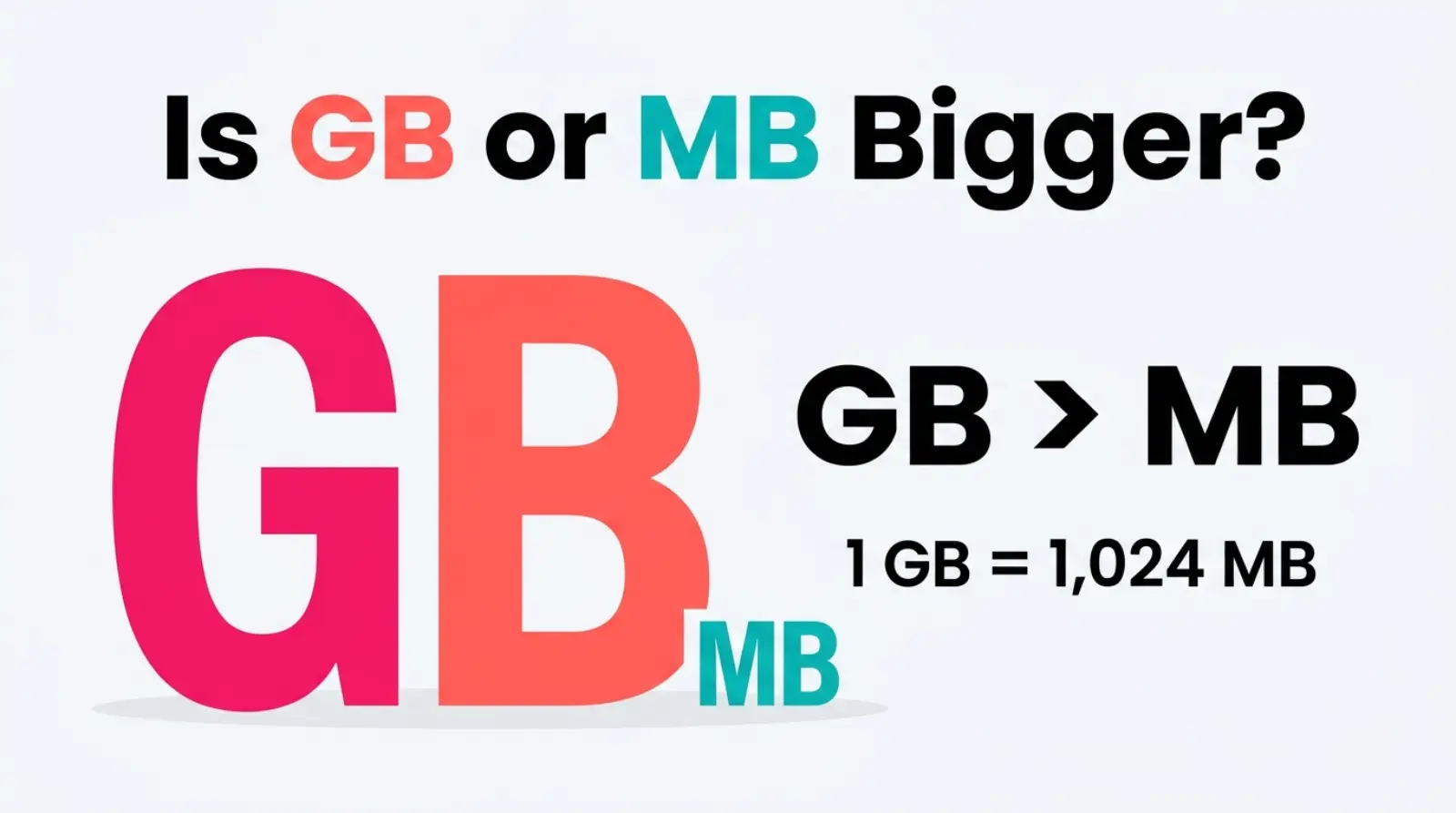
The good news is that the answer is simple: GB is bigger than MB.
A megabyte (MB) is smaller than a gigabyte (GB). In common computer storage measurements, 1 GB = 1,024 MB. Some companies and storage devices use decimal measurements, where 1 GB = 1,000 MB, but GB is still the larger unit.
This question often comes up in school, workplace technology, smartphones, computers, cloud storage, social media, gaming, and everyday internet use. You might also search for “is GB bigger than MB,” “GB vs MB,” “how many MB in 1 GB,” or “which is bigger GB or MB?”
People usually search for:
- Is GB or MB bigger?
- Is GB bigger than MB?
- How many MB are in 1 GB?
- What does GB mean?
- What does MB mean?
- GB vs MB—which one is larger?
- Is 500 MB bigger than 1 GB?
- Is 1 GB enough storage?
Understanding these units makes it easier to compare file sizes, internet downloads, phone storage, memory cards, apps, videos, and documents.
In this guide, you’ll learn the meaning, pronunciation, examples, usage, grammar rules, common mistakes, expert tips, and simple explanations in easy English.
Is GB or MB Bigger? – Quick Answer
👉 GB (gigabyte) = bigger
👉 MB (megabyte) = smaller
In the commonly used binary-style conversion:
1 GB = 1,024 MB
In decimal storage measurements:
1 GB = 1,000 MB
Simple Examples
- 1 GB is bigger than 1 MB.
- 5 GB is bigger than 500 MB.
- 1 GB = 1,024 MB in the common binary-based conversion.
- 2 GB = 2,048 MB using that conversion.
- 500 MB is less than 1 GB.
Easy Memory Trick
Think of the letters:
M → G
A megabyte comes before a gigabyte in the usual storage-size scale.
KB → MB → GB → TB
As you move to the right, the storage unit gets bigger.
What Does “GB or MB” Mean?
MB stands for megabyte.
GB stands for gigabyte.
Both are units used to measure digital information and storage. You can see them when checking:
- Phone storage
- Computer storage
- USB drives
- Memory cards
- Cloud storage
- App sizes
- Video files
- Photo collections
- Game downloads
- Documents
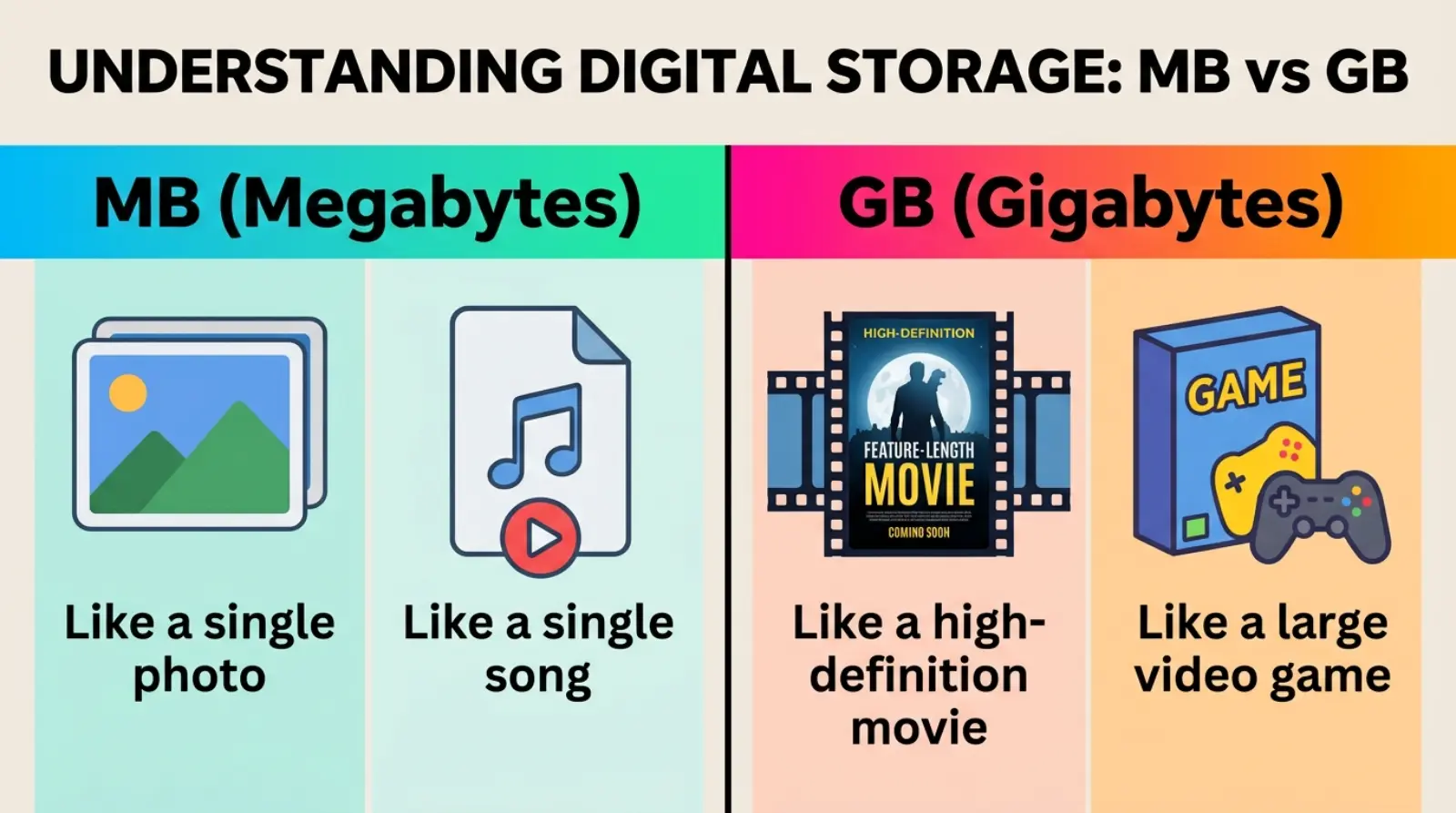
For example, if a photo is 5 MB and a video is 2 GB, the video is much larger.
MB Meaning
A megabyte is a relatively small digital storage unit. Documents, images, songs, and smaller files may be measured in MB.
GB Meaning
A gigabyte is a larger storage unit. Modern phones, computers, games, applications, and storage drives are often measured in GB.
Related Terms
The common storage-size order is:
Bit → Byte → KB → MB → GB → TB → PB
- KB = kilobyte
- MB = megabyte
- GB = gigabyte
- TB = terabyte
- PB = petabyte
The Origin of MB and GB
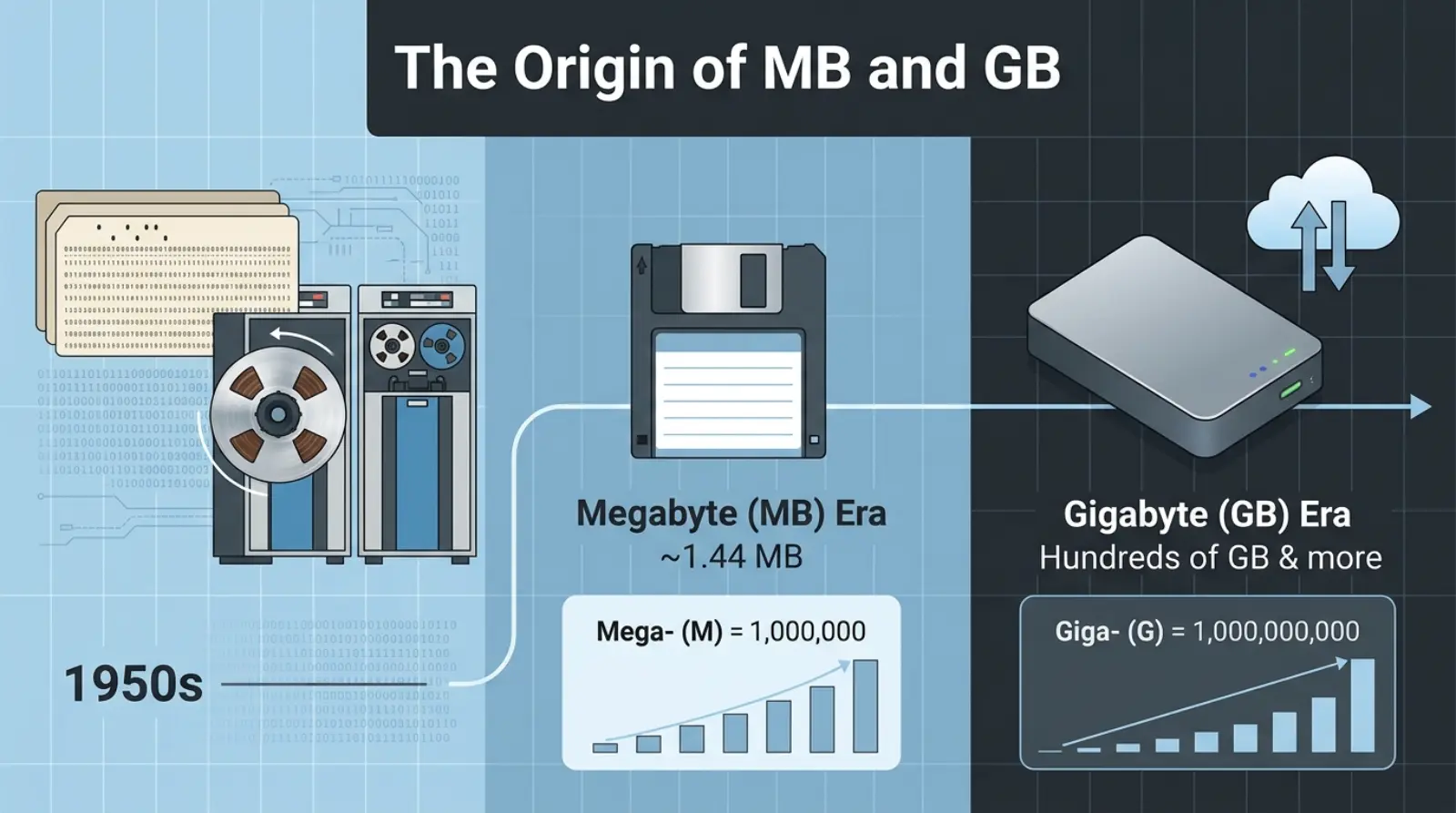
The terms come from the metric-style prefixes used with byte, a basic unit of digital information.
The prefix mega- represents a larger quantity, while giga- represents an even larger quantity.
That is why:
Megabyte < Gigabyte
Historically, computers often worked with powers of 2, which led to the familiar 1,024 MB = 1 GB calculation. However, storage manufacturers commonly use decimal units, where 1,000 MB = 1 GB.
This difference is why you may sometimes see slightly different numbers depending on the device, operating system, or storage company.
How to Pronounce GB and MB
These abbreviations are usually spoken by saying their letters.
GB: “gee-bee”
MB: “em-bee”
Full Forms
- GB = Gigabyte
- MB = Megabyte
Do not confuse MB with Mb.
That capital B matters.
- MB = megabytes
- Mb = megabits
Similarly:
- GB = gigabytes
- Gb = gigabits
Bytes and bits are different units.
British English vs American English Usage
There is no major British-versus-American difference in the meaning of MB and GB.
| Feature | British English | American English | Notes |
|---|---|---|---|
| MB | Megabyte | Megabyte | Same |
| GB | Gigabyte | Gigabyte | Same |
| Pronunciation | “em-bee,” “gee-bee” | “em-bee,” “gee-bee” | Essentially the same |
| Spelling | Megabyte/Gigabyte | Megabyte/Gigabyte | Same |
| Usage | Technology/storage | Technology/storage | Same |
The important difference is not British vs American English. It is the difference between decimal and binary measurements.
Which One Should You Use?
You do not normally choose between MB and GB. The size of the file or storage determines which unit is appropriate.
Use MB when:
- A file is relatively small.
- You are describing a photo.
- You are checking a small app or document.
- A download is under about 1 GB.
Example:
“This PDF is 25 MB.”
Use GB when:
- A file is large.
- You are describing phone storage.
- You are comparing computer storage.
- You are talking about large games or videos.
Example:
“My phone has 256 GB of storage.”
For professional and academic writing, write the full term when the audience may not understand the abbreviation.
Common Mistakes With “Is GB or MB Bigger?”
Mistake 1: Thinking the smaller number is always smaller
❌ 500 GB is smaller than 1,000 MB.
✔ 500 GB is much bigger than 1,000 MB.
The unit matters, not just the number.
Mistake 2: Thinking 1 MB = 1 GB
❌ 1 MB = 1 GB
✔ 1 GB is approximately 1,000 MB or 1,024 MB, depending on the measurement system.
Mistake 3: Ignoring the capital B
❌ “10 Mb means 10 megabytes.”
✔ 10 MB means 10 megabytes.
A lowercase b generally means bits, while an uppercase B means bytes.
Mistake 4: Comparing numbers without converting them
❌ “800 MB is bigger because 800 is greater than 2.”
✔ 2 GB is bigger than 800 MB.
Convert the units before comparing them.
Mistake 5: Confusing storage with internet speed
A file may be measured in MB, while internet speed may be advertised in Mbps.
These are not the same thing.
GB and MB in Everyday Examples
Work
A small Word document might be 2 MB, while a large project folder could be several GB.
School
A presentation may be 10 MB, while a collection of course videos could use several GB.
Social Media
Photos and videos can vary from a few MB to hundreds of MB or more.
Daily Life
A phone with 128 GB of storage can hold far more data than one with 32 GB.
Emails
An email attachment might be limited to a certain number of MB.
Text Messages
A normal text message uses very little data, while sending videos can use much more.
Online Content
Large videos, software downloads, and games are often measured in GB.
Conversations
Someone might say, “This game is 80 GB,” meaning the game requires a large amount of storage.
GB vs MB in Different Contexts
Education
Students often encounter MB and GB when downloading books, submitting assignments, or storing educational videos.
Technology
Computer and phone specifications commonly use GB for storage capacity.
Gaming
Modern games can require tens or even hundreds of GB of storage.
Business
Companies use GB and TB when discussing databases, backups, cloud storage, and digital files.
Cloud Storage
Cloud services often advertise storage plans in GB or TB.
Internet and Downloads
Download sizes may appear in MB or GB. A large game update might be several GB, while a small document may be only a few MB.
GB or MB: Detailed Comparison
| Feature | MB | GB |
|---|---|---|
| Full form | Megabyte | Gigabyte |
| Size | Smaller | Larger |
| Common conversion | 1,000 KB | 1,000 MB |
| Binary-style conversion | 1,024 KB | 1,024 MB |
| Used for | Smaller files | Larger files/storage |
| Example | 25 MB photo/file | 128 GB phone |
| Larger unit | ❌ | ✅ |
Bottom line: GB is bigger than MB.
GB and MB in Professional Life
Knowing the difference can prevent simple but costly technology mistakes.
Imagine an employee needs to upload a 2 GB video but thinks the file is only 2 MB. The misunderstanding could affect email attachments, cloud uploads, storage planning, or project deadlines.
Businesses regularly deal with:
- Database storage
- Cloud backups
- Large media files
- Software packages
- Website assets
- Video production
- Data transfers
- Server storage
When discussing technical information professionally, always check whether the measurement uses bytes or bits and whether the conversion is decimal or binary.
GB or MB for Students and Beginners
Many beginners struggle because the numbers can be misleading.
For example:
900 MB vs 2 GB
At first, 900 looks larger than 2. But 2 GB is larger, because GB is a much larger unit.
Beginner Shortcut
Remember this order:
KB → MB → GB → TB
Each step moves to a larger storage unit.
So:
GB > MB > KB
That one line answers most beginner questions.
Common Uses of MB and GB
You will commonly see MB and GB when:
- Downloading apps
- Installing games
- Buying phones
- Checking laptop storage
- Uploading videos
- Sending attachments
- Buying memory cards
- Checking USB drives
- Using cloud storage
- Downloading software
- Managing photos
- Checking file sizes
A simple pattern is:
Small file → usually MB
Large file/storage → usually GB
This is not an absolute rule, but it is a useful everyday guide.
Google Search Intent and Usage
People search “is GB or MB bigger” because digital storage terms are easy to mix up, especially when comparing a large number of MB with a small number of GB.
Common long-tail searches include:
- Is GB bigger than MB?
- Is MB smaller than GB?
- How many MB are in 1 GB?
- Which is bigger, 1 GB or 1,000 MB?
- Is 500 MB bigger than 1 GB?
- GB vs MB storage
- What is the difference between MB and GB?
- Is GB or MB better?
- How much storage is 1 GB?
- What does GB mean on a phone?
This type of search is common among students, smartphone users, computer users, gamers, and people comparing internet or storage plans in countries such as the US, UK, India, Pakistan, Canada, and Australia.
Voice searches are also natural:
“Is a gigabyte bigger than a megabyte?”
“How many megabytes are in a gigabyte?”
These questions have a simple direct answer, which makes them ideal for a featured-snippet-style explanation.
Expert Tips for Understanding Storage Units
Here are a few habits that make digital storage much easier to understand:
- Always check the unit.
Never compare 500 MB and 1 GB by looking only at the numbers. - Remember GB is larger than MB.
- Check B vs b.
MB and Mb are different. - Convert before comparing.
Turn both measurements into MB or both into GB. - Know the measurement system.
Decimal and binary calculations can differ. - Look at the context.
Storage capacity, file size, and internet speed may use different units.
Think of It This Way
Imagine money.
A megabyte is like a dollar, while a gigabyte is like a much larger bundle of dollars.
You would not compare “500 dollars” with “2 bundles” without knowing what each bundle contains.
The same idea applies to digital storage.
Unit first, number second.
Related Searches People Also Ask
Is GB bigger than MB?
Yes. A gigabyte is larger than a megabyte.
How many MB are in 1 GB?
Depending on the measurement system, 1 GB is 1,000 MB or commonly 1,024 MB in binary-style computing.
Is 500 MB bigger than 1 GB?
No. 1 GB is larger than 500 MB.
Is 1,000 MB equal to 1 GB?
Under the decimal system, yes. In binary-style usage, 1 GB is often treated as 1,024 MB.
Which is better, MB or GB?
Neither is “better.” They are measurement units. GB simply represents a larger amount of data.
Is MB used for file size?
Yes. Smaller files are often displayed in MB.
Is GB used for phone storage?
Yes. Phone storage is commonly listed in GB.
Is MB bigger than KB?
Yes. A megabyte is larger than a kilobyte.
Is TB bigger than GB?
Yes. A terabyte is larger than a gigabyte.
What comes after GB?
The next common unit is TB, or terabyte.
FAQs
Is GB or MB bigger?
GB is bigger. A gigabyte contains about 1,000 or 1,024 megabytes, depending on the measurement system.
What does MB stand for?
MB stands for megabyte, a unit used to measure digital information.
What does GB stand for?
GB stands for gigabyte, a larger unit of digital information and storage.
Is 1 GB equal to 1,024 MB?
In the common binary-style calculation, yes. However, decimal storage measurements use 1,000 MB per GB.
Is 2 GB bigger than 500 MB?
Yes. 2 GB is much bigger than 500 MB.
Which is bigger: 100 MB or 1 GB?
1 GB is bigger.
What is the easiest way to remember GB vs MB?
Remember:
KB → MB → GB → TB
Each step moves to a larger unit.
Are MB and Mbps the same?
No. MB means megabytes, while Mbps means megabits per second, commonly used for data-transfer speed.
Is GB used for storage?
Yes. Phone, computer, USB, memory-card, and cloud storage are commonly measured in GB or TB.
Why does my device show a different GB amount?
Manufacturers may use decimal measurements, while operating systems may calculate storage differently. Reserved system space can also affect the amount available to you.
Final Verdict
So, is GB or MB bigger?
👉 GB is bigger than MB.
The easiest rule to remember is:
KB < MB < GB < TB
And when comparing two values, always look at the unit before looking at the number.
Conclusion
The question “is GB or MB bigger” has a simple answer: GB is bigger.
A megabyte is a smaller digital storage unit, while a gigabyte represents a much larger amount of data. In everyday use, you will see MB for smaller files and GB for larger files, phone storage, games, videos, and other digital content.
Just remember:
MB = smaller
GB = bigger
And one final memory trick: “G” comes after “M” in the storage ladder, so GB is the bigger unit.

Camila Green is an English language writer who specializes in confusing word comparisons and spelling explanations. She creates simple, beginner-friendly guides on topics like “niece or neice” and other common English mistakes. Her writing focuses on clarity, real-life examples, and easy learning. At VerrsaPick, she helps readers improve their English with practical and engaging content.