Have you ever written a sentence like “I am walking towards the door” and then wondered whether it should be “I am walking toward the door”? If so, you are not alone. Towards or toward is a common English grammar question, especially for students, writers, and people learning the difference between British and American English.
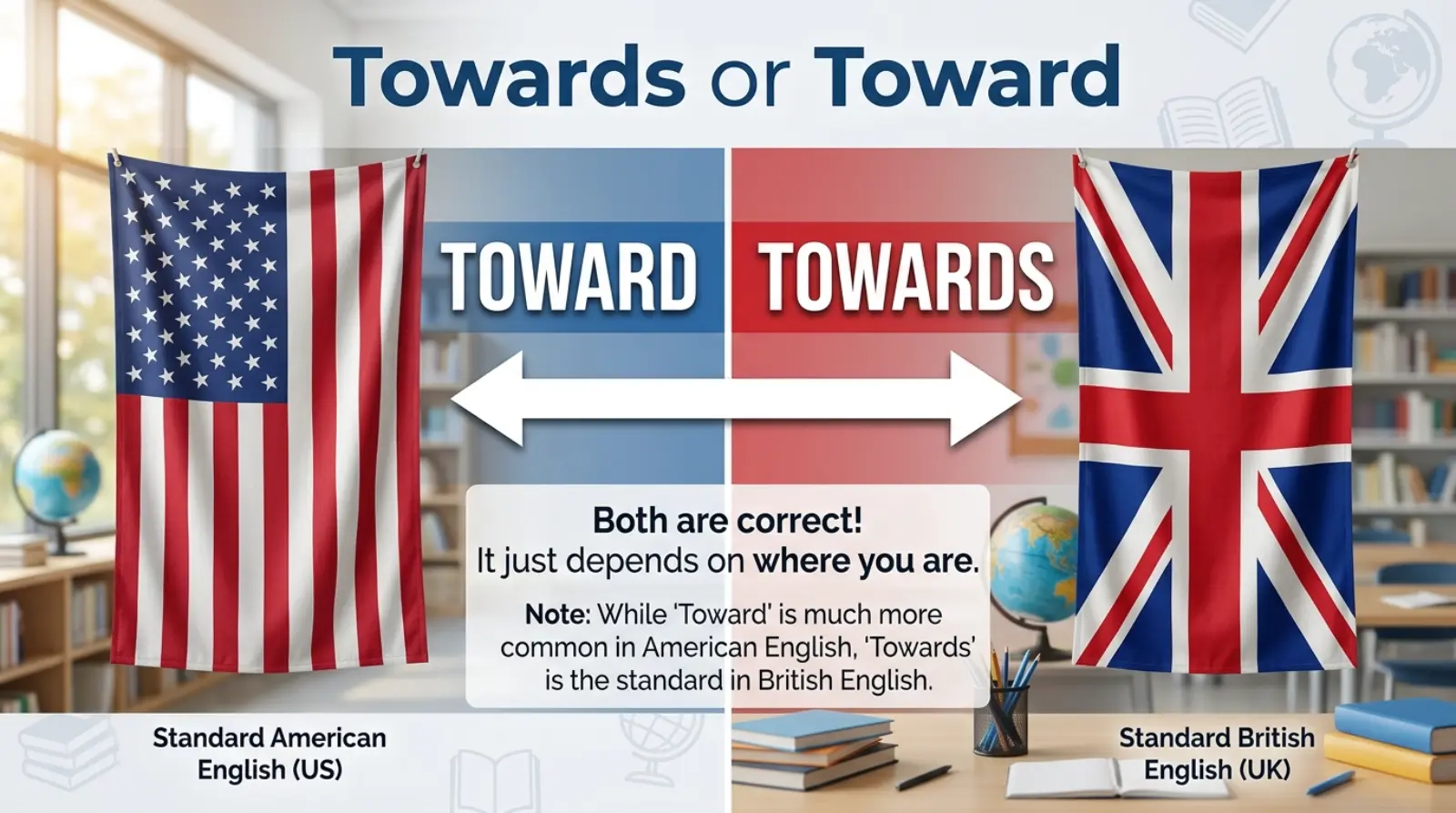
The good news is simple: both “toward” and “towards” are correct English words. They usually have the same meaning and can often be used in the same sentences. The main difference is regional preference. Toward is more common in American English, while towards is especially common in British English.
People usually search for: the towards or toward meaning, correct spelling, pronunciation, examples, usage, definition, and grammar difference. You may see these words in school assignments, workplace emails, books, news articles, social media posts, business writing, and daily conversations.
Understanding this small difference can make your writing feel much more natural. It is especially useful if you write for an international audience because different English-speaking countries may prefer different forms.
In this guide, you’ll learn the meaning, pronunciation, examples, usage, grammar rules, common mistakes, expert tips, and simple explanations in easy English.
Towards or Toward – Quick Answer
👉 Toward = in the direction of someone or something; closer to a goal or result.
👉 Towards = the same basic meaning as “toward.”
Both are grammatically correct. The choice usually depends on the variety of English you are using.
Examples
- She walked toward the door. ✅
- She walked towards the door. ✅
- We are working toward a solution. ✅
- We are working towards a solution. ✅
- He moved toward the center. ✅
- He moved towards the center. ✅
Simple Rule
👉 American English: “toward” is generally preferred.
👉 British English: “towards” is generally preferred.
Memory trick: Think toward = shorter American form, while towards = common British form.
What Does Towards or Toward Mean?
Toward and towards are prepositions that describe movement, direction, position, or progress.
For example:
The child ran toward the playground.
This means the child ran in the direction of the playground.
They can also describe progress toward something:
She is working toward her goal.
Here, “toward” does not describe physical movement. It means she is making progress in the direction of achieving her goal.
Synonyms
Depending on the sentence, related words include:
- in the direction of
- approaching
- nearer to
- in the direction
- progressing to
- heading toward
Opposites
Possible opposites include:
- away from
- backward
- farther from
- against, depending on context
Related Terms
You may also see:
- toward the end
- toward the future
- toward a goal
- toward home
- move toward
- work toward
- look toward
- walk toward
The Origin of Towards and Toward
The word toward has a long history in English. It developed from older English forms connected with the idea of being in the direction of something.
The ending -s in “towards” does not create a completely different meaning. Instead, “towards” developed as a variant form that became especially common in British English.
Over time, both forms became standard. Today, you can find toward and towards in respected English dictionaries and published writing.
The important point for modern learners is that neither form is simply a spelling mistake.
How to Pronounce Towards or Toward
Toward
Pronunciation is commonly close to:
tuh-WORD or tawrd, depending on accent.
Towards
Pronunciation is commonly close to:
tuh-WORDZ
The final s in “towards” usually has a z sound.
Easy Speaking Trick
Break them down:
- toward → tuh-WORD
- towards → tuh-WORDZ
Do not pronounce “towards” as though the final s were completely silent.
British English vs American English Usage
The biggest difference between toward and towards is regional preference rather than grammar.
| Feature | British English | American English | Notes |
|---|---|---|---|
| Preferred form | Towards | Toward | Both are correct |
| Meaning | Direction/progress | Direction/progress | Same basic meaning |
| Grammar | Preposition | Preposition | No major difference |
| Formal writing | Towards is common | Toward is common | Style preference |
| Everyday speech | Towards is common | Toward is common | Both understood |
| International English | Both | Both | Context matters |
For example:
British English:
We are moving towards a better solution.
American English:
We are moving toward a better solution.
Neither sentence is wrong.
Which One Should You Use?
Use the form that matches your audience and the style of English you are writing.
Use “toward” when:
- Writing primarily for an American audience
- Following American English style
- Writing academic or business content in US English
- Creating US-focused website content
Example:
The company is working toward its annual target.
Use “towards” when:
- Writing primarily for a British audience
- Following British English conventions
- Writing for readers in the UK
- Using a style guide that prefers “towards”
Example:
The company is working towards its annual target.
Important Tip
If you choose one form, be consistent throughout a document.
Common Mistakes With Towards or Toward
Mistake 1: Thinking “towards” is incorrect
❌ She walked towards the car.
✔ She walked towards the car.
Explanation: “Towards” is completely correct.
Tip: Do not remove the s simply because you learned American English.
Mistake 2: Thinking “toward” is incorrect
❌ He moved toward the door.
✔ He moved toward the door.
Explanation: “Toward” is also standard English.
Tip: Both forms are accepted.
Mistake 3: Mixing styles without reason
You might use “toward” in one section and “towards” in another.
✔ Choose the form that matches your intended English variety and use it consistently.
Mistake 4: Confusing “toward” with “to”
❌ She walked toward to the store.
✔ She walked toward the store.
Why? “Toward” already expresses direction, so you normally do not add another “to” after it.
Mistake 5: Assuming the meaning changes
❌ “Toward” means physical movement, while “towards” means emotional movement.
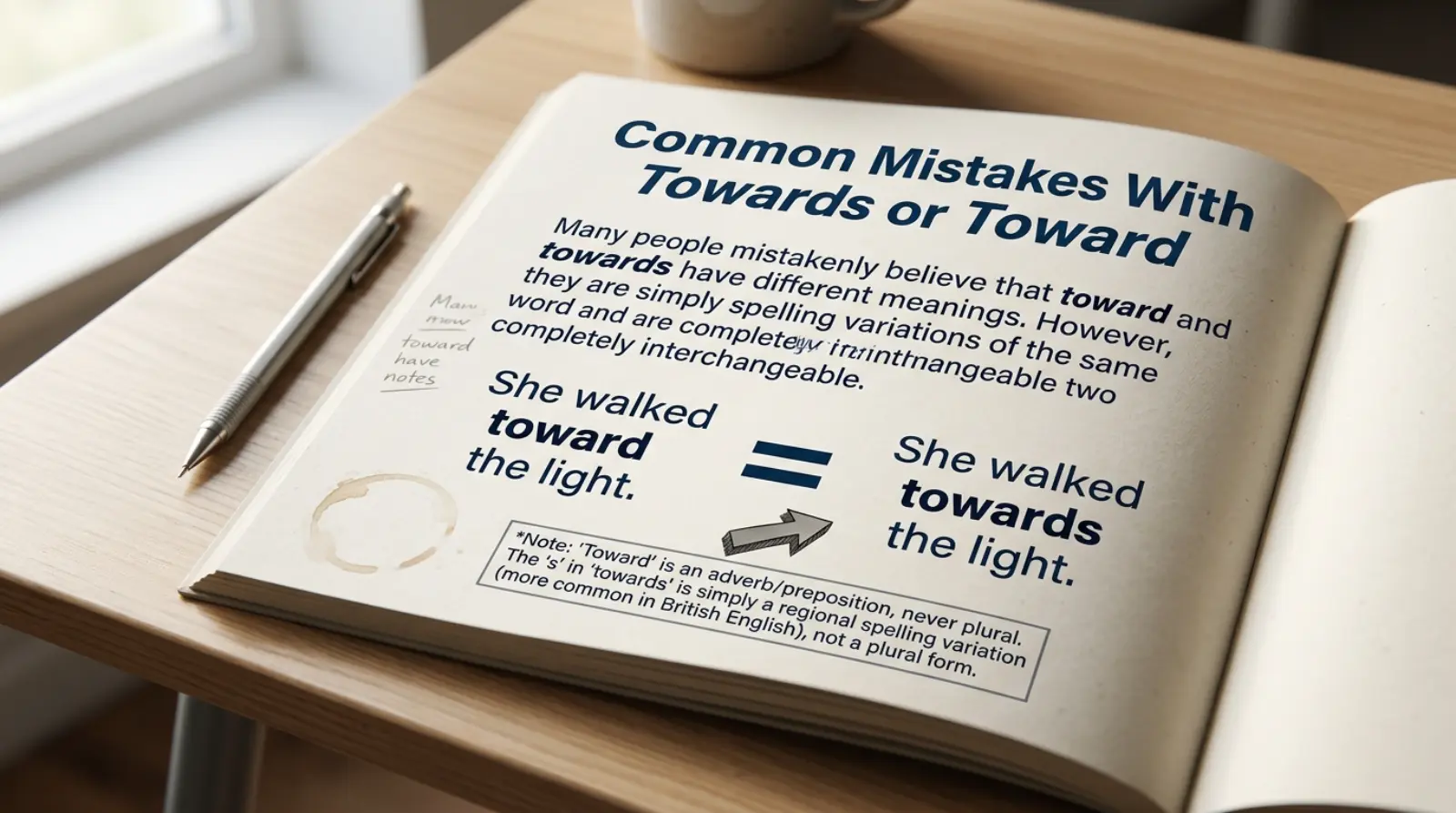
✔ They normally have the same meaning.
The difference is mainly regional and stylistic.
Towards or Toward in Everyday Examples
| Situation | Example |
|---|---|
| Work | We are working toward a solution. |
| School | The student walked towards the classroom. |
| We are moving toward the next stage. | |
| Texting | I’m heading towards home. |
| Social media | Looking toward a better future. |
| Daily life | He ran toward the bus. |
| Business | The company is moving towards expansion. |
| Conversation | She came toward me. |
All of these can be grammatically correct.
Towards or Toward in Different Contexts
In Education
Students often see both forms in books and assignments.
The research points toward a possible answer.
British-style writing might use:
The research points towards a possible answer.
In Business
Both forms work well in professional communication.
We are working toward our sales target.
or:
We are working towards our sales target.
In Professional Writing
The key is consistency. If your organization follows a specific style guide, follow that guide.
In Social Media
Social media users freely use both forms:
Moving towards better days. ❤️
Taking one step toward my dreams.
In Personal Communication
Both sound natural:
I’m walking toward you.
I’m walking towards you.
Towards or Toward – Comparison Table
| Feature | Toward | Towards |
|---|---|---|
| Correct? | Yes | Yes |
| Meaning | Direction/progress | Direction/progress |
| Word type | Preposition | Preposition |
| American English | More common | Less common |
| British English | Used | More common |
| Formal writing | Yes | Yes |
| Academic writing | Yes | Yes |
| Texting | Yes | Yes |
| Social media | Yes | Yes |
| Main difference | Regional preference | Regional preference |
Google Trends and Usage Data
Searches for towards or toward usually come from people who are unsure about regional English, grammar, or writing style. The question is especially common among students, ESL learners, bloggers, and professionals writing for international audiences.
Related searches often include:
- toward or towards which is correct
- is towards grammatically correct
- is toward correct English
- toward vs towards British English
- toward vs towards American English
- toward meaning and examples
- towards meaning in English
- how to use toward in a sentence
- how to use towards in a sentence
- toward pronunciation
- towards pronunciation
Search behavior can also vary across the US, UK, India, Pakistan, Canada, and Australia, because English usage differs by region.
Towards or Toward for Students and Beginners
This pair can be confusing because learners sometimes expect one word to be right and the other to be wrong.
The easiest lesson is:
They are both correct.
The difference is mostly about English variety and style.
Beginner shortcut
If you are writing American English, choose toward.
If you are writing British English, towards is often the natural choice.
Do not worry if you see the other form in a book or online. It does not automatically mean there is a grammar error.
Simple Trick to Remember Towards or Toward
Think of the final S as a style signal, not a meaning signal.
👉 Toward = common US preference
👉 Towards = common UK preference
Think of two roads leading to the same place. One road is labeled toward, and the other is labeled towards. The destination is the same.
Think of it this way:
toward + s = towards
The extra s does not normally change the meaning.
Expert Tips
- Know your audience. Use “toward” for American English and “towards” when British usage is preferred.
- Stay consistent. Avoid switching forms randomly in the same article.
- Do not mark “towards” as wrong. It is a standard English form.
- Do not mark “toward” as wrong either. It is widely used, especially in American English.
- Check your style guide. Academic and professional organizations may have their own preferences.
- Focus on the sentence meaning. Both words normally express direction or progress.
- Read naturally. Seeing both forms in quality English writing is normal.
Related Searches People Also Ask
Is toward or towards correct?
Both are correct. “Toward” is more common in American English, while “towards” is more common in British English.
Is towards grammatically correct?
Yes. “Towards” is a standard English preposition.
Is toward grammatically correct?
Yes. “Toward” is also standard English.
Which is more American, toward or towards?
“Toward” is generally more common in American English.
Which is more British, toward or towards?
“Towards” is generally more common in British English.
Does toward mean the same as towards?
Yes, in normal modern usage, they have essentially the same meaning.
Can I use toward in British English?
Yes. “Toward” is understood and used in British English, although “towards” is often preferred.
Can I use towards in American English?
Yes. Americans understand and use “towards,” although “toward” is generally more common.
Should I use toward in formal writing?
Yes, especially if you are following American English conventions.
Should I use towards in academic writing?
Yes. It is perfectly acceptable when it matches the English variety and style guide you are following.
FAQs
Is “toward” or “towards” correct?
Both are correct. The main difference is regional preference.
What is the difference between toward and towards?
There is usually no difference in meaning. “Toward” is more common in American English, while “towards” is often preferred in British English.
Which spelling should I use in American English?
Use toward as the usual choice.
Which spelling should I use in British English?
Use towards as the usual choice.
Can both words be used in the same sentence?
Yes, but normally you would choose one based on your intended style.
Is “towards” informal?
No. “Towards” can be used in formal, academic, and professional writing.
Is “toward” more formal?
Not necessarily. It is simply the preferred form in many American English contexts.
Does adding “s” change the meaning?
No. In normal usage, toward and towards mean essentially the same thing.
Is “toward to” correct?
Usually no.
❌ She walked toward to the door.
✔ She walked toward the door.
What does “toward” mean in “work toward a goal”?
It means making progress in the direction of achieving a goal.
Final Verdict
Toward and towards are both correct.
The easiest rule is:
👉 American English → toward
👉 British English → towards
The meaning does not normally change. Both words can describe movement, direction, or progress.
Conclusion
The towards or toward question looks complicated at first, but the answer is actually simple. You do not need to memorize two different definitions because both words usually mean the same thing.
If you write American English, toward is generally the better choice. If you write British English, towards is often more natural. Both can appear in professional, academic, casual, and everyday English.
The most important thing is not to think that one is “right” and the other is “wrong.” Instead, think about your audience and stay consistent.
Easy memory trick:
Toward = common US choice. Towards = common UK choice. Same basic direction, different style preference.

Camila Green is an English language writer who specializes in confusing word comparisons and spelling explanations. She creates simple, beginner-friendly guides on topics like “niece or neice” and other common English mistakes. Her writing focuses on clarity, real-life examples, and easy learning. At VerrsaPick, she helps readers improve their English with practical and engaging content.