Imagine writing about a computer, music, or a medical test and suddenly wondering: disc or disk? You may have seen both spellings and wondered if one is simply wrong.
The truth is more interesting. Both “disc” and “disk” are correct English words, but they are not always used in the same situations. The difference can depend on the type of object, the field you are writing about, and sometimes British or American English.
This confusion is common because the two words sound exactly the same. You might see disc when talking about music, anatomy, or sports. You may see disk when talking about computers, storage, or technology. However, there are exceptions.
People usually search for the disc or disk meaning, correct spelling, pronunciation, examples, usage, definition, and grammar difference because the two words look almost identical. Students may meet them in school. Office workers may see them in technical documents. You can also find both spellings in websites, software, medical information, and everyday conversations.
The good news is that learning the difference does not have to be difficult. You only need to understand the common patterns.
In this guide, you’ll learn the meaning, pronunciation, examples, usage, grammar rules, common mistakes, expert tips, and simple explanations in easy English.
Disc or Disk Quick Answer
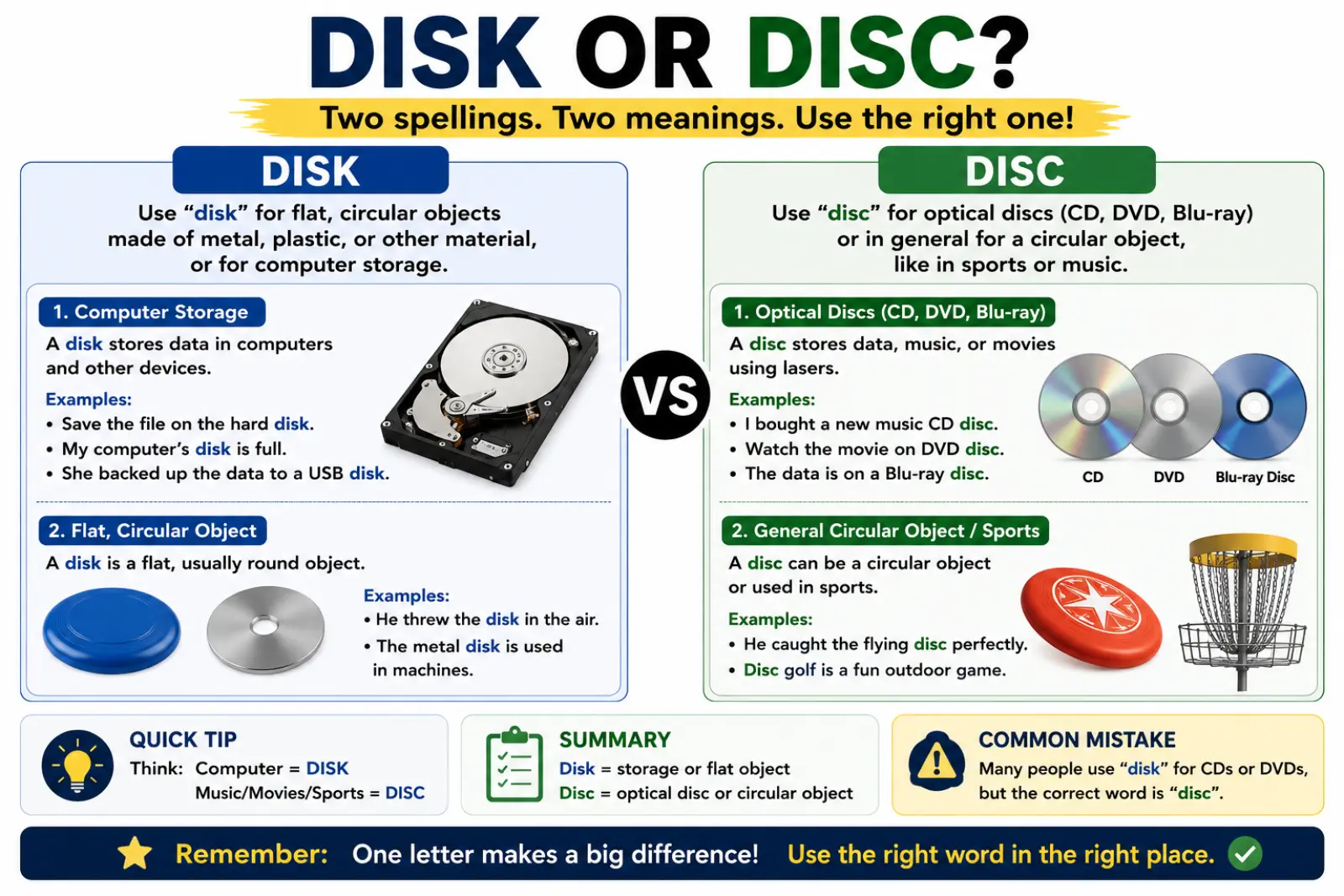
👉 Disc = a flat, round object; commonly used in British English and in areas such as music, anatomy, and sports.
👉 Disk = a flat, round object; especially common in American English and computer technology.
Both spellings are correct. The best choice depends on the context.
Examples
- I bought a new music disc. ✅
- The doctor examined the spinal disc. ✅
- The computer has a hard disk. ✅
- Save the files to the disk. ✅
- The athlete threw the disc. ✅
Simple Rule
👉 Think “disk” for computer storage. Think “disc” for many physical, medical, music, and British English uses.
This is a helpful shortcut, but it is not an absolute rule.
What Does Disc or Disk Mean?
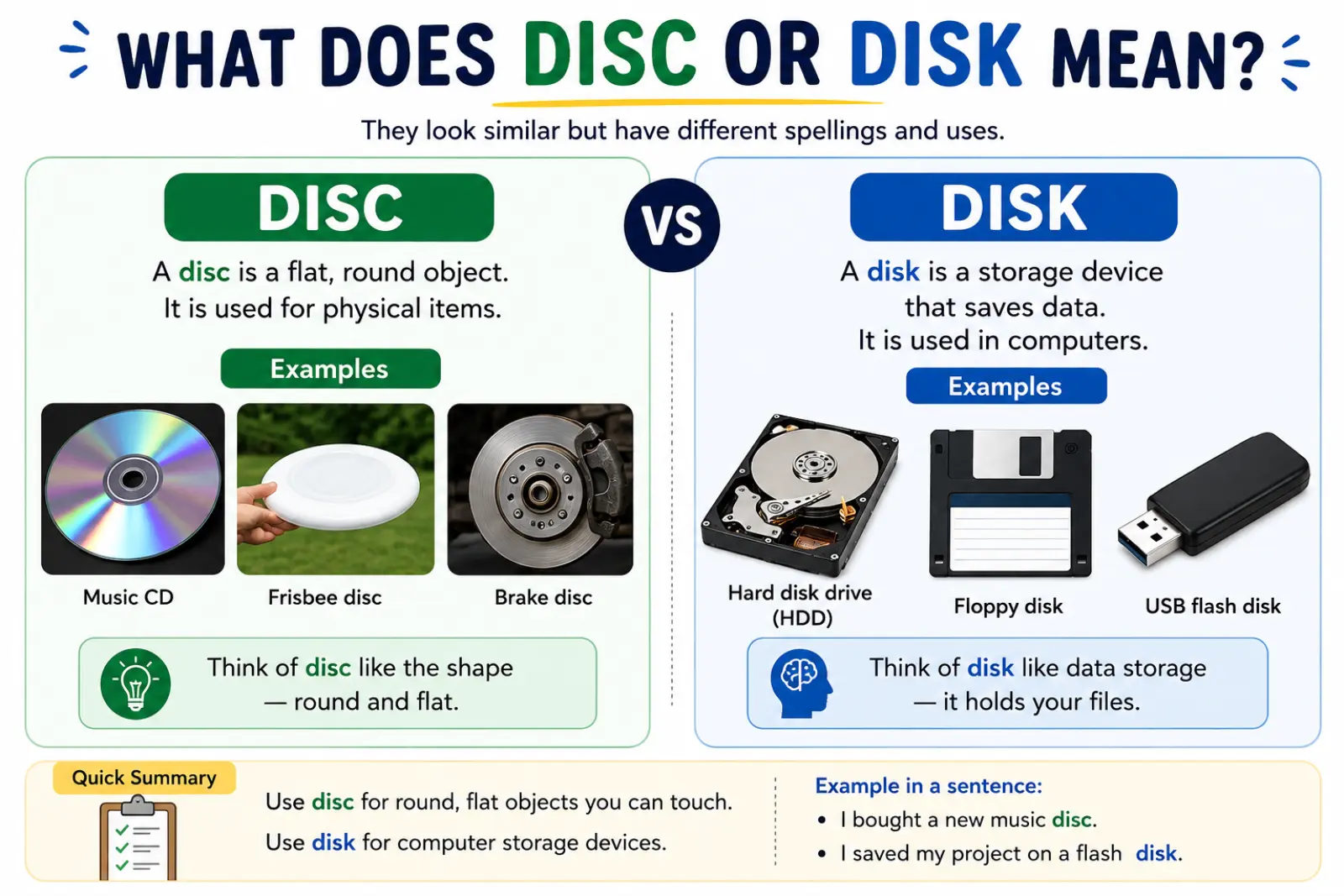
Disc and disk both describe something that is generally flat and round.
The main difference is usage, not basic meaning.
Disc is common in phrases such as:
- compact disc
- spinal disc
- slipped disc
- disc golf
- brake disc
Disk is especially common in computing:
- hard disk
- disk drive
- disk space
- disk storage
- floppy disk
The words are pronounced the same, so you cannot hear the spelling difference in conversation.
Synonyms
Depending on the context, related words include:
- circle
- plate
- platter
- round object
- storage medium
Opposites
There is no direct opposite of disc or disk. These words describe shapes or objects rather than an action or quality.
Related Terms
Common related terms include disc drive, disk drive, hard disk, compact disc, spinal disc, disc golf, disk space, disk storage, and optical disc.
The Origin of Disc or Disk
Both spellings have a long history.
Disc comes from the Latin word discus, meaning a round or circular object. The word entered English through French and became associated with flat, round objects.
Disk developed as a variant spelling of the same word. Over time, different areas of English developed different preferences.
Technology helped make disk especially common in American English. Terms such as hard disk and disk drive became standard in computing.
Meanwhile, disc remained common in British English and in several specialized terms, including compact disc and spinal disc.
So, neither spelling is simply a misspelling of the other.
How to Pronounce Disc or Disk
Both words are pronounced the same way:
Disc → disk
Phonetically, both are approximately /dɪsk/.
It is a single syllable.
Try saying:
disk
The spelling changes, but the pronunciation does not.
Common Pronunciation Mistake
Some beginners think disc should have a different sound because of the letter c. It does not.
👉 Disc = disk = /dɪsk/
The final sound is like the word risk, with a d at the beginning.
British English vs American English Usage
British and American English often show different preferences.
| Feature | British English | American English | Notes |
|---|---|---|---|
| General spelling | Disc is common | Disk is common in some contexts | Both exist |
| Computer storage | Disk is common | Disk is very common | “Hard disk” is standard |
| Music | Disc is common | Disc is common | “Compact disc” is widely used |
| Anatomy | Disc is common | Disc is common | “Spinal disc” is standard |
| Disc golf | Disc | Disc | Sport uses “disc” |
| Pronunciation | /dɪsk/ | /dɪsk/ | Same pronunciation |
The difference is not simply British = disc and American = disk. Both forms appear in both varieties of English.
Which One Should You Use?
Choose the spelling based on the phrase and subject.
Use disk when writing about:
- computer storage
- hard disks
- disk drives
- disk space
- digital storage
Use disc when writing about:
- compact discs
- spinal discs
- disc golf
- brake discs
- some physical or medical objects
Quick Usage Table
| Phrase | Common Form |
| Hard disk | Disk |
| Disk drive | Disk |
| Disk space | Disk |
| Compact disc | Disc |
| Spinal disc | Disc |
| Disc golf | Disc |
| Brake disc | Disc |
When you are unsure, check the standard spelling of the specific term rather than guessing.
Common Mistakes With Disc or Disk
Mistake 1: Treating One Spelling as Always Wrong
❌ “Disk is wrong because the correct spelling is disc.”
✔ Both disc and disk are correct.
The correct choice depends on context.
Tip: Learn common phrases instead of memorizing one universal rule.
Mistake 2: Writing “Hard Disc” in Computer Contexts
❌ “My computer has a hard disc.”
✔ “My computer has a hard disk.”
Why? Computer terminology commonly uses disk.
Mistake 3: Assuming the Words Have Different Pronunciations
❌ “Disc and disk sound different.”
✔ “Disc and disk are pronounced the same.”
Tip: Focus on the meaning and context, not the sound.
Mistake 4: Changing a Standard Technical Term
❌ “Please check the disk golf rules.”
✔ “Please check the disc golf rules.”
Why? The established name of the sport is disc golf.
Mistake 5: Thinking “Disc” Is Only British
❌ “Americans never use disc.”
✔ Americans also use disc in terms such as compact disc and spinal disc.
Mistake 6: Thinking “Disk” Is Always About Computers
❌ “Disk can only describe computer storage.”
✔ Disk can also be used for other round objects and in some technical contexts.
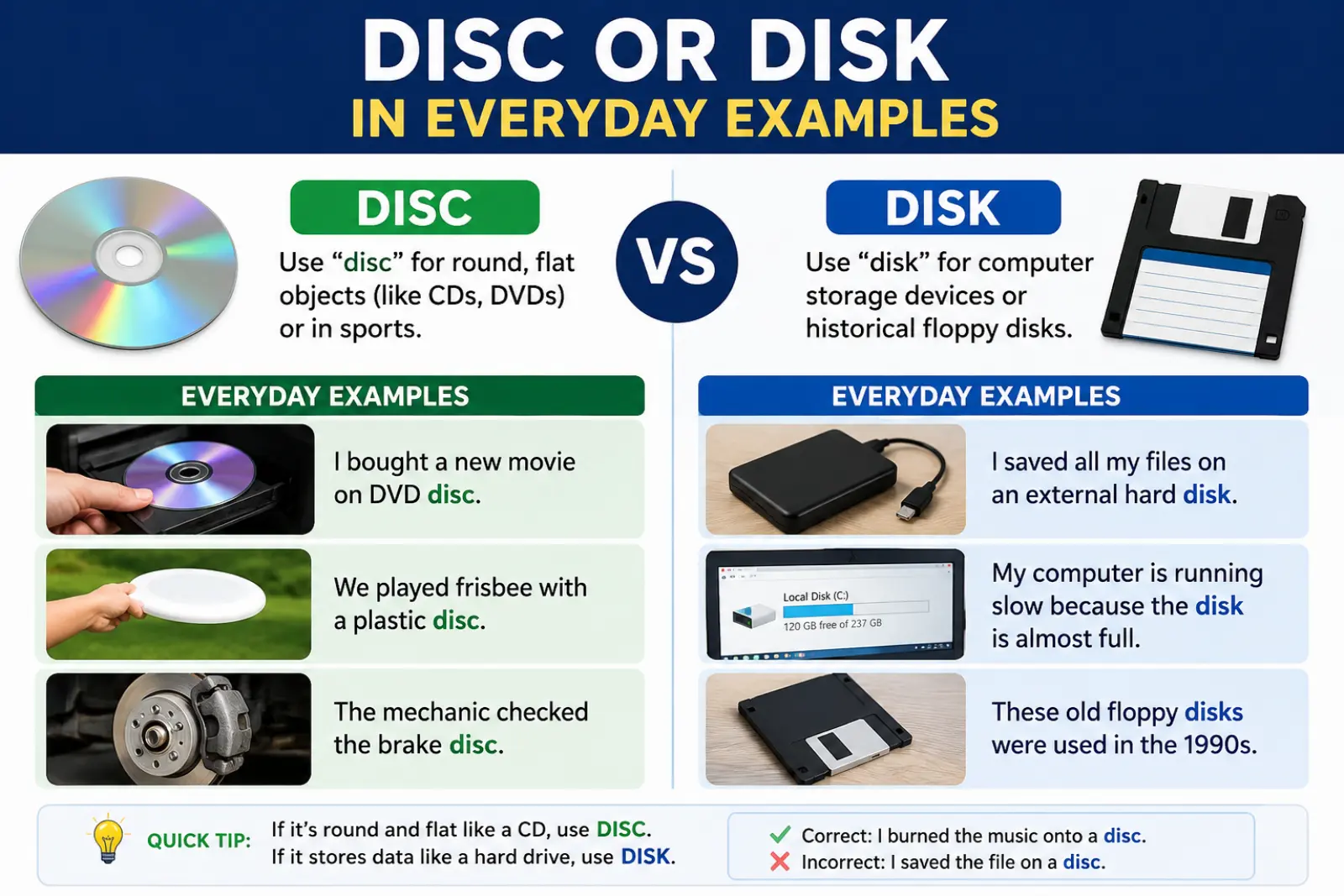
Disc or Disk in Everyday Examples
Work:
“Please check how much disk space is available.”
School:
“The teacher explained the shape of a disc.”
Daily life:
“I found an old compact disc in the closet.”
Email:
“The files are stored on the computer’s disk.”
Text message:
“Do you still have that old music disc?”
Online content:
“The article explains how a hard disk works.”
Medical context:
“The doctor said the spinal disc was damaged.”
Sports:
“She plays disc golf on weekends.”
Disc or Disk in Different Contexts
Technology
Disk is strongly associated with computers and digital storage.
Examples include hard disk, disk drive, disk space, disk image, and disk storage.
Music
Disc is common in terms connected with recorded music.
For example:
“The album was released on compact disc.”
Medicine
Disc is widely used in anatomy.
Examples include:
- spinal disc
- intervertebral disc
- slipped disc
Sports
Disc appears in sports terminology, especially disc golf.
The word describes the flying disc used in the game.
Workplace Writing
In professional writing, use the spelling that belongs to the established term.
For example:
“The server has limited disk space.”
Using the standard technical term makes your writing clearer.
Disc or Disk Google Trends and Usage
Searches for disc or disk are usually driven by spelling confusion and differences between technical and everyday language.
People may search questions such as:
- “Is it disc or disk?”
- “What is the difference between disc and disk?”
- “Is hard disk or hard disc correct?”
- “How do you spell disc?”
- “What does disc mean?”
- “What does disk mean?”
- “Is disk American English?”
- “Is disc British English?”
Search behavior can also vary by country. Users in the US, UK, Canada, Australia, India, and Pakistan may encounter both forms because English terminology spreads across education, technology, medicine, and online content.
A useful long-tail search strategy is to connect the spelling with a specific phrase, such as disc or disk in computer terminology or disc vs disk in British and American English.
Comparison Table: Disc or Disk
| Feature | Disc | Disk |
| Correct spelling | Yes | Yes |
| Basic meaning | Flat, round object | Flat, round object |
| Pronunciation | /dɪsk/ | /dɪsk/ |
| Computer storage | Less common | Very common |
| Music | Very common | Less common |
| Anatomy | Very common | Less common |
| Disc golf | Standard | Not standard |
| Professional use | Context dependent | Common in computing |
| British English | Common | Also used |
| American English | Common in some terms | Very common in computing |
Disc or Disk in Professional Life
Choosing the right established term matters in professional writing.
A technical report might say:
“The disk is nearly full.”
A medical report might say:
“The spinal disc shows signs of damage.”
A music description might say:
“The album is available on compact disc.”
The goal is not to choose disc or disk based on personal preference. Use the spelling that fits the professional field.
Disc or Disk for Students and Beginners
Beginners often struggle because the words have:
- the same pronunciation
- nearly the same spelling
- similar meanings
- different common uses
The easiest approach is to learn complete phrases.
Instead of memorizing disk = computer, learn:
👉 hard disk
👉 disk drive
👉 disk space
Instead of memorizing disc = physical object, learn:
👉 compact disc
👉 spinal disc
👉 disc golf
This makes the difference much easier to remember.
Common Uses of Disc or Disk
Here are the most useful patterns:
- Hard disk: computer storage device
- Disk drive: device used to read or manage storage
- Disk space: available computer storage
- Compact disc: optical storage medium
- Spinal disc: cushion between bones in the spine
- Disc golf: sport played with flying discs
- Brake disc: circular part of a vehicle braking system
These phrases are often more useful than trying to create one strict rule.
Simple Trick to Remember Disc or Disk
Think of it this way:
👉 Disk = computer
👉 Disc = many traditional, physical, medical, music, and sports terms
Picture a computer screen when you see disk.
Picture a round physical object when you see disc.
For example:
Hard disk → computer 💻
Compact disc → music 💿
Spinal disc → body 🦴
Disc golf → sport 🥏
This is not a perfect rule, but it is an excellent beginner shortcut.
Expert Tips for Using Disc or Disk Correctly
- Learn phrases, not isolated words.
“Hard disk” is easier to remember than a long spelling rule. - Check the field.
Computing often favors disk, while medicine often uses disc. - Do not rely on pronunciation.
Both words sound the same. - Watch for fixed terms.
Names such as disc golf and compact disc have established spellings. - Keep regional English in mind.
British and American English can have different preferences. - Use consistency in professional writing.
Once you choose the standard term, keep it consistent.
Related Searches People Also Ask
Is disc or disk correct?
Both are correct spellings. Context determines the better choice.
Is hard disk or hard disc correct?
Hard disk is the standard computer term.
Is compact disc or compact disk correct?
Compact disc is the established term.
Is spinal disc or spinal disk correct?
Spinal disc is the common standard form.
Are disc and disk pronounced the same?
Yes. Both are normally pronounced /dɪsk/.
Is disk American English?
Disk is especially common in American computer terminology.
Is disc British English?
Disc is common in British English, but it is also used in American English.
Why are disc and disk different?
They developed as spelling variants and became preferred in different contexts.
What is the difference between a disc and a disk?
The basic meaning is similar, but common usage differs by field and terminology.
Should I use disc or disk in computer writing?
Use disk for common computer terms such as hard disk and disk space.
FAQs About Disc or Disk
Is “disc” a correct spelling?
Yes. Disc is a correct English spelling and is common in many established terms.
Is “disk” a correct spelling?
Yes. Disk is also correct and is especially common in computing.
Which is correct, disc or disk?
Both are correct. The right choice depends on the context and standard phrase.
Is “disc” or “disk” used for computers?
Disk is usually preferred for computer storage, as in hard disk and disk drive.
Is “disc” or “disk” used in medicine?
Disc is commonly used for anatomical terms such as spinal disc.
Do disc and disk mean the same thing?
They have the same basic idea of a flat, round object, but their common uses differ.
Do disc and disk sound the same?
Yes. Both are normally pronounced /dɪsk/.
Which spelling should beginners learn?
Learn the common phrases. Start with hard disk, compact disc, spinal disc, and disc golf.
Is disc more common in British English?
Disc is widely used in British English, but disk is also used in technical terms, especially computing.
Can I use disc and disk interchangeably?
Not always. Some established terms strongly prefer one spelling, so replacing it can sound unusual or incorrect.
Final Verdict
Disc or disk? Both are correct.
👉 Use disk often for computer technology, such as hard disk and disk space.
👉 Use disc in established terms such as compact disc, spinal disc, disc golf, and brake disc.
The easiest memory trick is:
Computer → disk. Many physical, medical, music, and sports terms → disc.
Conclusion
The disc or disk question can seem confusing because both words have the same pronunciation and a closely related meaning. However, you do not need to worry about choosing between them every time you write.
The key is to learn the common expressions. Hard disk belongs to computer language, while compact disc, spinal disc, and disc golf use the spelling disc.
Regional English also matters, but context is usually the most helpful guide.
So, remember one simple idea: disk is strongly linked with computers, while disc appears in many established physical, medical, music, and sports terms.

Camila Green is an English language writer who specializes in confusing word comparisons and spelling explanations. She creates simple, beginner-friendly guides on topics like “niece or neice” and other common English mistakes. Her writing focuses on clarity, real-life examples, and easy learning. At VerrsaPick, she helps readers improve their English with practical and engaging content.