
Imagine you start a new job in the United States. Your employer asks you to complete tax paperwork, but you see terms like W2 or 1099. Suddenly, you wonder, “Am I an employee or an independent contractor?”
This is a common question for people starting a new job, freelance project, side hustle, or contract role. The difference between W2 or 1099 can affect how you pay taxes, receive benefits, handle work expenses, and manage your income.
People usually search for W2 or 1099 meaning, W2 vs 1099 taxes, W2 employee vs 1099 contractor, which is better, and how to choose between W2 or 1099.
The key point is simple. A W2 worker is generally an employee, while a 1099 worker is generally an independent contractor. The tax forms are different because the working relationship is different.
This guide explains the differences in simple English, with examples, a comparison table, common mistakes, tax basics, and practical tips.
W2 or 1099 – Quick Answer
👉 W2 = Employee
You generally work for an employer. The employer usually withholds certain taxes from your paycheck and may offer benefits.
👉 1099 = Independent Contractor
You generally work for yourself or your own business. You usually handle your own estimated taxes and receive payment reported on a 1099 form when applicable.
Simple Examples
- You work full time for a company and receive a regular paycheck → W2
- You freelance for several clients → 1099
- You work as an independent consultant → 1099
- You are hired as a regular employee by a business → W2
Simple Rule:
👉 W2 usually means you are an employee. 1099 usually means you are an independent contractor.
Memory Trick:
Think W2 = Work for an employer and 1099 = Work independently.
Important: The IRS classification depends on the actual working relationship, not simply what a company calls you or which form you receive.
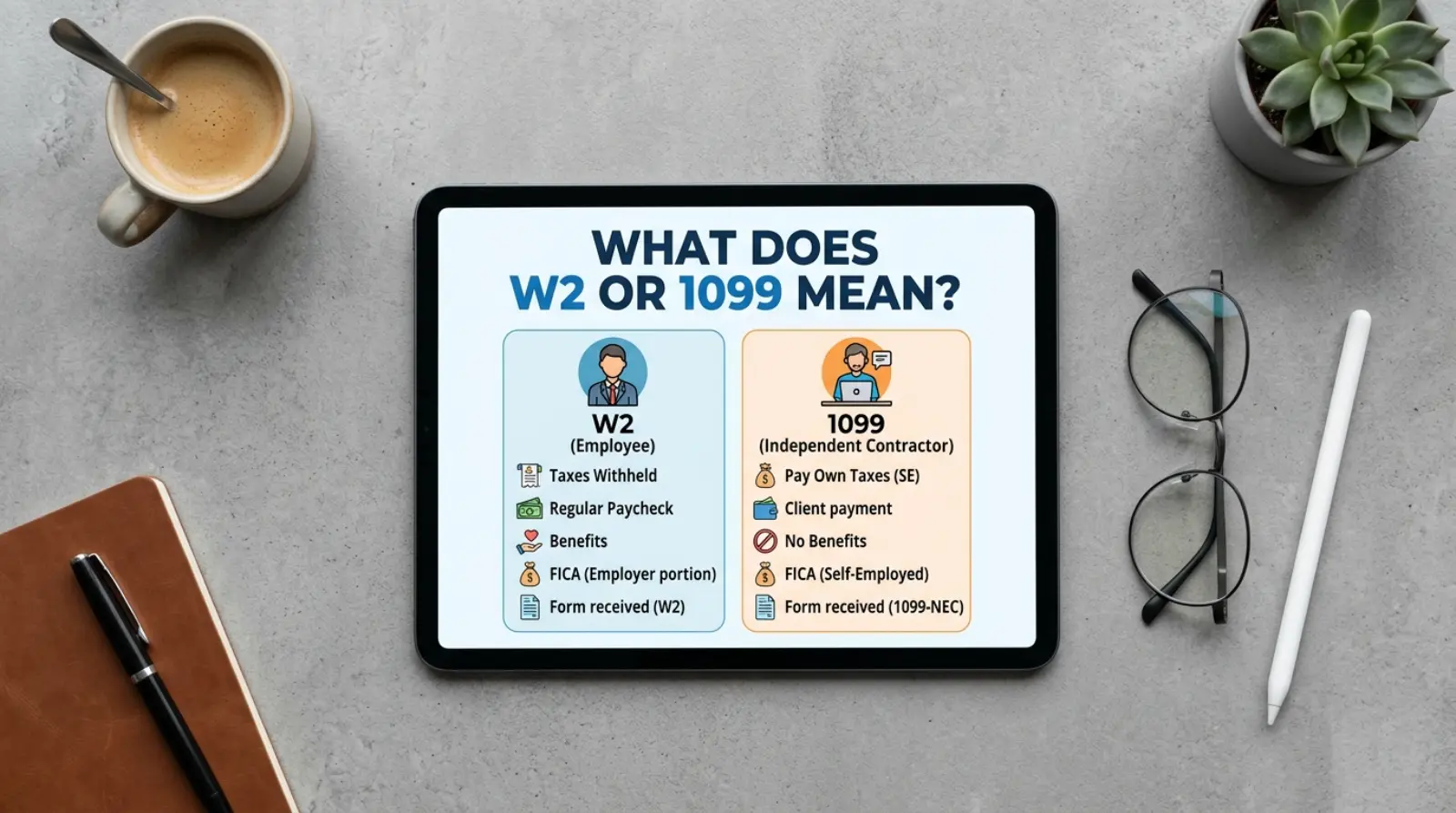
What Does W2 or 1099 Mean?
The terms W2 and 1099 refer to US tax forms used for different types of income reporting.
A W2 employee works as an employee for a company or organisation. The employer generally withholds federal income tax and payroll taxes from the employee’s wages.
A 1099 worker is usually an independent contractor. The worker operates more independently and may provide services to businesses or clients. The business generally does not withhold employment taxes from payments to the contractor.
Related Terms
- Employee
- Independent contractor
- Freelancer
- Self employed worker
- Payroll taxes
- Income tax
- Estimated tax payments
- Tax withholding
- Business expenses
- Employee benefits
Common Variations
You may hear:
- W2 employee
- W2 job
- W2 employment
- 1099 contractor
- 1099 worker
- 1099 freelancer
- Independent contractor
- Contract worker
These terms can describe similar ideas, but the exact tax treatment depends on the person’s situation.
W2 or 1099: The Main Difference
The biggest difference is the working relationship.
A W2 employee usually works under an employer’s direction. The employer often controls important parts of the job, such as work duties, schedule, and workplace rules.
An independent contractor usually has more control over how the work is completed. They may work with multiple clients and operate their own business.
| Feature | W2 Employee | 1099 Independent Contractor |
|---|---|---|
| Worker status | Employee | Independent contractor |
| Tax withholding | Usually handled through payroll | Usually handled by the worker |
| Pay | Regular wages or salary | Payments for services |
| Benefits | May receive employer benefits | Usually no employer benefits |
| Work control | Employer often has more control | Worker usually has more independence |
| Tax planning | Employer withholds taxes | Worker may need estimated payments |
| Business expenses | Usually limited employee deductions | May have eligible business expenses |
| Multiple clients | Less common | Common |
| Job protection | May have employee protections | Generally different protections |
| Business responsibility | Employer handles many business costs | Worker often handles more costs |
W2 or 1099: Which One Should You Choose?
There is no single answer for everyone.
A W2 job may be attractive if you want:
- A regular paycheck
- Employer tax withholding
- Potential health insurance
- Retirement plan access
- Paid time off
- A more structured work environment
A 1099 role may be attractive if you want:
- More independence
- Flexible work arrangements
- Multiple clients
- Control over your business
- Potentially more freedom in how you complete projects
However, a 1099 worker may need to manage taxes, insurance, retirement savings, and business costs independently.
Quick Example
W2:
A marketing employee works for one company, follows company policies, and receives a regular salary.
1099:
A freelance designer works with several clients and decides how to complete each project.
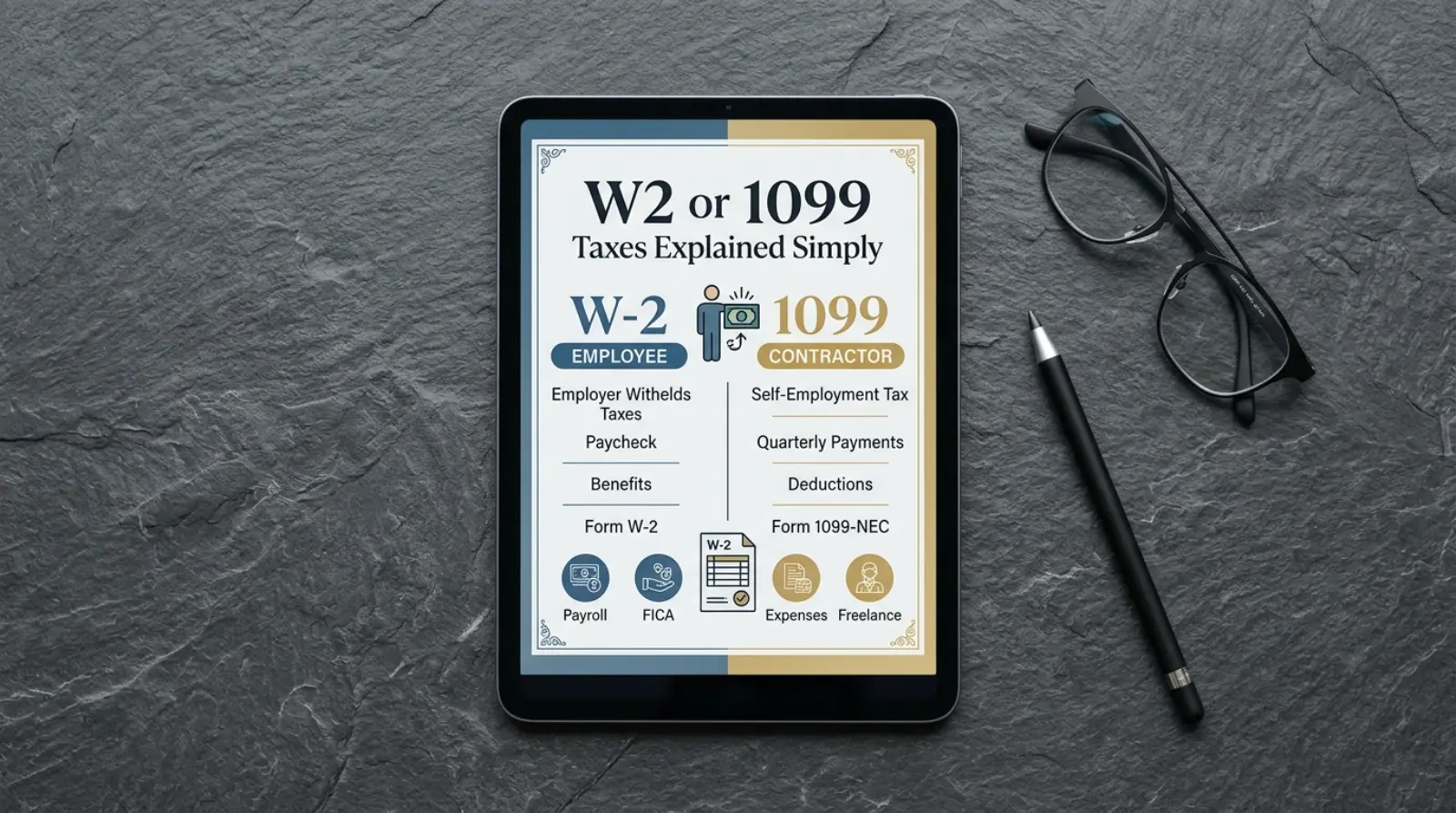
W2 or 1099 Taxes Explained Simply
Taxes are one of the biggest reasons people compare W2 or 1099.
For a W2 employee, taxes are generally withheld from each paycheck. The employee receives a W2 after the tax year showing wages and certain taxes withheld.
For an independent contractor, payments may be reported on a 1099 form when applicable. The contractor generally needs to track income and expenses and may need to make estimated tax payments.
A 1099 worker may also have self employment tax obligations.
The exact tax amount depends on many factors, including total income, deductions, filing status, and other income sources.
Important: A 1099 worker should not assume that every dollar received is available to spend. Setting money aside for taxes can help avoid a large surprise later.
Common Mistakes With W2 or 1099
Mistake 1: Thinking 1099 Means No Taxes
❌ “I received a 1099, so I don’t pay taxes.”
✔ A 1099 worker may still owe income and self employment taxes.
Tip: Keep records of income and possible business expenses.
Mistake 2: Thinking W2 Means No Tax Work
❌ “My employer withheld taxes, so I never need to file a tax return.”
✔ Most employees still need to file a tax return based on their situation.
Tip: Keep your W2 and other tax documents organised.
Mistake 3: Choosing 1099 Only Because the Pay Looks Higher
❌ “The contractor rate is higher, so it must be the better deal.”
✔ A contractor may have to handle taxes, insurance, retirement savings, and other costs.
Tip: Compare the complete package, not just the hourly rate.
Mistake 4: Assuming the Company Can Choose Any Classification
❌ “The company called me a contractor, so I am automatically a 1099 worker.”
✔ Worker classification depends on the actual facts and relationship.
Tip: Look at who controls the work and how the relationship operates.
Mistake 5: Forgetting About Benefits
❌ “A $40 hourly contractor rate is always better than a $30 hourly W2 rate.”
✔ The W2 job may include valuable benefits that change the overall comparison.
Tip: Compare pay, benefits, taxes, time off, and other costs.
W2 or 1099 in Everyday Examples
Workplace
W2:
“I joined the company as a full time W2 employee.”
1099:
“I work as a 1099 contractor for several businesses.”
Freelancing
A freelance writer may work with different clients and send invoices for completed projects. This can be common in independent contracting.
Small Business
A business may hire an independent contractor for a specific service, such as web design, consulting, or photography.
Conversation
“Is this position W2 or 1099?”
This question is common when someone is considering a new job or contract.
“Could you confirm if this position is classified as W2 employment or independent contractor work?”
W2 or 1099 in Different Contexts
Full Time Employment
W2 employment is common for regular company jobs. Employees may have set schedules, managers, payroll systems, and company benefits.
Freelancing
1099 work is common among freelancers. The worker may have several clients and manage their own business activities.
Consulting
Consultants often work independently and may provide specialised services to different organisations.
Gig Work
Some gig workers may receive tax forms related to independent contractor income. The exact reporting depends on the platform and the worker’s situation.
Remote Work
Remote work can be either W2 or 1099. Working from home does not automatically determine your worker classification.
W2 or 1099 in Professional Life
Before accepting a position, ask clear questions about the arrangement.
You can ask:
- Is this a W2 employee position?
- Is this an independent contractor role?
- Who handles tax withholding?
- Are benefits included?
- Is the pay hourly, salaried, or project based?
- Will I receive a W2 or applicable 1099 form?
- Are there expected work hours?
- Who controls how the work is performed?
These questions can help you understand the real value of an offer.
W2 or 1099 for Students and Beginners
Beginners often struggle because the pay rate can look very different.
For example, a contractor may be offered a higher hourly rate. That does not automatically mean they will take home more money.
A simple way to compare offers is to consider:
- Gross pay
- Tax responsibilities
- Health insurance
- Retirement benefits
- Paid time off
- Business expenses
- Job flexibility
- Job security
The best option depends on your personal needs and the actual job arrangement.
Simple Trick to Remember W2 or 1099
Think of two doors.
🚪 W2 Door: You join an employer’s team as an employee.
🚪 1099 Door: You operate more independently and provide services as a contractor.
Think of it this way:
W2: “I work as an employee for the company.”
1099: “I provide services independently to clients or businesses.”
This is only a memory trick. It is not a legal test for worker classification.
Expert Tips for Choosing W2 or 1099
Before accepting a job, calculate the total value.
Do not compare only:
W2 hourly pay vs 1099 hourly pay
Instead, compare:
Pay + benefits + taxes + expenses + flexibility + time off
Also, read the contract carefully.
If you are unsure about your classification or tax obligations, consider speaking with a qualified tax professional. Tax rules can change, and individual situations are different.
Related Searches People Also Ask
Is W2 better than 1099?
Not always. W2 work may offer more benefits and simpler tax withholding, while 1099 work may offer more independence.
Is 1099 better than W2?
Not automatically. It depends on your income, expenses, benefits, flexibility, and personal goals.
Do 1099 workers pay more taxes?
They may have additional self employment tax responsibilities, but the final tax result depends on the individual’s full financial situation.
Can you be W2 and 1099 at the same time?
Yes. A person can have a W2 job while earning 1099 income from separate freelance or contract work.
Is a freelancer W2 or 1099?
A freelancer is generally an independent contractor, but classification depends on the actual working relationship.
Is remote work W2 or 1099?
Remote work can be either. Working remotely does not by itself determine worker status.
Who pays taxes on 1099 income?
The independent contractor generally handles their own tax obligations on that income.
Does W2 mean full time?
No. W2 employees can work full time or part time.
FAQs About W2 or 1099
What is the easiest way to understand W2 or 1099?
Think of W2 as employee work and 1099 as independent contractor work.
Which is better for beginners?
W2 employment may be easier for beginners because payroll generally handles tax withholding. However, the right choice depends on the job.
Do W2 employees get benefits?
They may. Benefits depend on the employer and the specific position.
Do 1099 contractors get paid holidays?
Usually not as an employee benefit. Contractors generally negotiate their own rates and time off.
Can a 1099 worker have multiple clients?
Yes. Independent contractors often work with multiple clients.
Can a W2 employee work from home?
Yes. W2 employees can work remotely, in an office, or in a hybrid arrangement.
What is the biggest difference between W2 and 1099?
The biggest difference is the nature of the working relationship and who handles payroll taxes and employment responsibilities.
Should I save money for 1099 taxes?
It is generally wise for independent contractors to plan ahead for tax obligations rather than spending all their income.
Final Verdict
W2 or 1099? The simplest answer is:
👉 W2 = Employee
👉 1099 = Independent contractor
A W2 position may provide regular payroll and potential employee benefits. A 1099 role may provide greater independence but often comes with more responsibility for taxes and business costs.
Easy memory rule:
W2 = You work as an employee.
1099 = You work independently.
Conclusion
Understanding W2 or 1099 can make a big difference when you are comparing jobs, freelance work, and contract opportunities.
The biggest lesson is simple. A W2 employee usually works within an employer’s structure. A 1099 independent contractor usually has more control and handles more responsibilities independently.
Do not judge an offer by the pay rate alone. Look at taxes, benefits, expenses, flexibility, and the full working relationship.
Final memory trick:
W2 means employee. 1099 means independent contractor.

Camila Green is an English language writer who specializes in confusing word comparisons and spelling explanations. She creates simple, beginner-friendly guides on topics like “niece or neice” and other common English mistakes. Her writing focuses on clarity, real-life examples, and easy learning. At VerrsaPick, she helps readers improve their English with practical and engaging content.