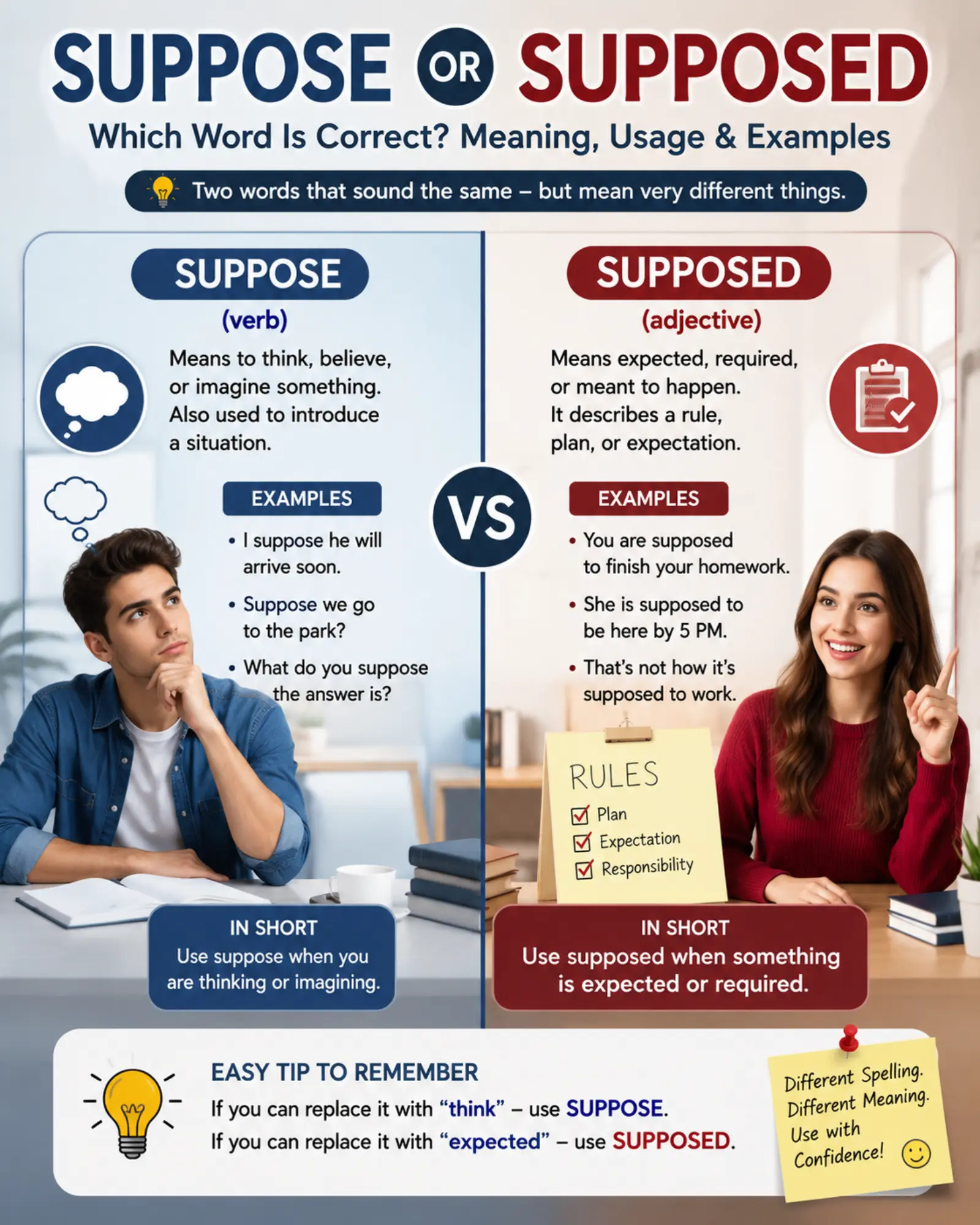
Have you ever written a sentence like “I am suppose to be here” and wondered if it should be suppose or supposed? You’re not alone. This is one of the most common grammar mistakes in English because the words sound similar in everyday speech.
People usually search for suppose or supposed meaning, correct grammar, pronunciation, examples, usage, definition, and difference between suppose and supposed. You’ll see these words in school assignments, business emails, social media posts, text messages, and everyday conversations.
The confusion often happens because native speakers sometimes pronounce supposed to quickly, making the -d sound hard to hear. However, suppose and supposed have different grammar roles and are not always interchangeable.
Learning the difference will help you write more accurately and speak more confidently.
In this guide, you’ll learn the meaning, pronunciation, examples, usage, grammar rules, common mistakes, expert tips, and simple explanations in easy English.
Suppose or Supposed – Quick Answer
👉 Suppose = A verb that means to assume, believe, or imagine.
👉 Supposed = The past tense and past participle of suppose. It is also commonly used in the phrase be supposed to, meaning “expected” or “required.”
Examples
- I suppose you’re right. ✅
- She is supposed to arrive at 6 p.m. ✅
- We suppose the meeting will be short. ✅
- They were supposed to finish yesterday. ✅
Easy Memory Trick
Suppose = Think
Supposed = Expected
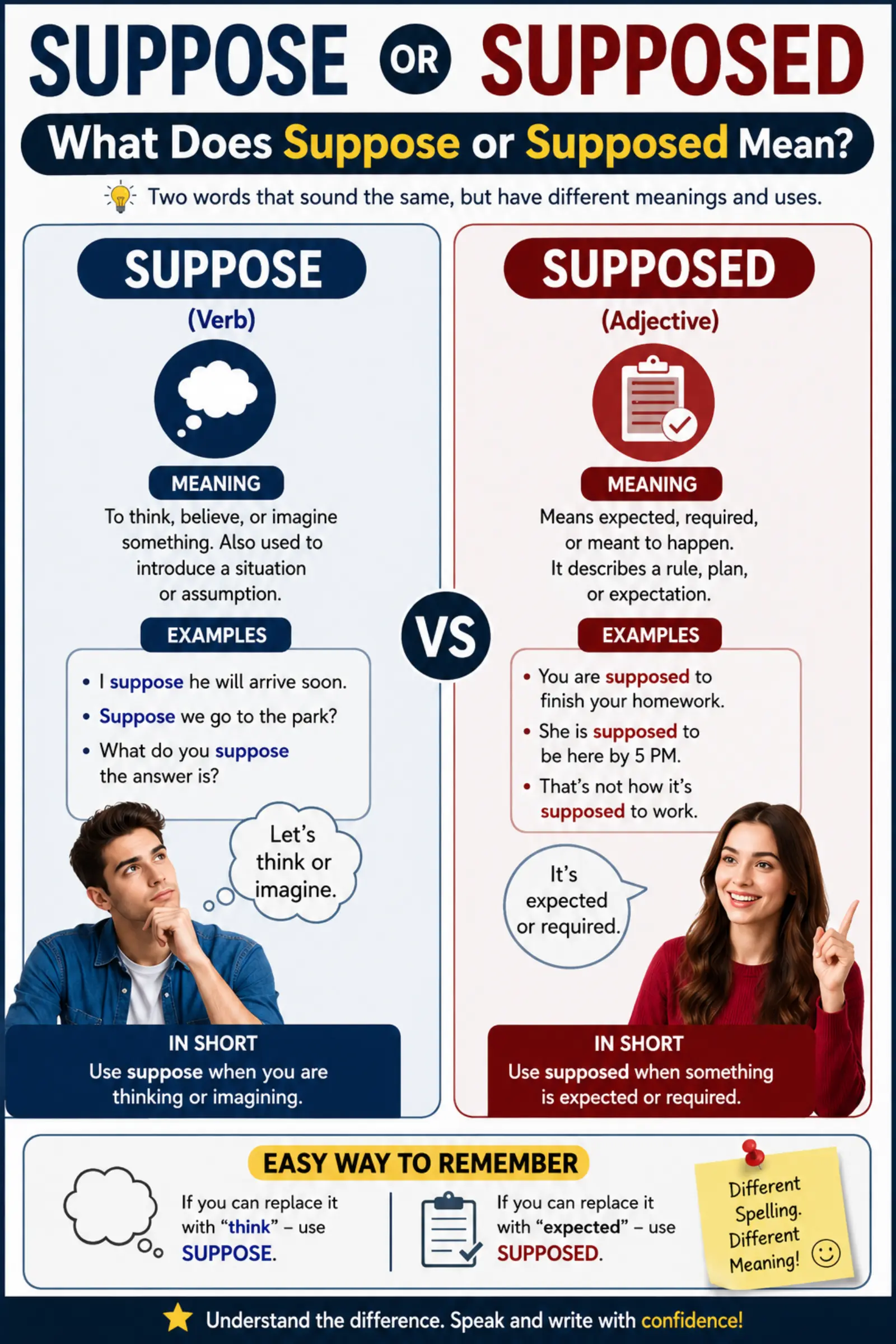
What Does Suppose or Supposed Mean?
Suppose
Suppose means to think, assume, or believe something may be true.
Examples:
- I suppose it will rain.
- Let’s suppose the answer is correct.
Supposed
Supposed often means something is expected, planned, or required.
Examples:
- You’re supposed to wear a seat belt.
- He was supposed to call me.
Synonyms
- Assume
- Believe
- Expect
- Imagine
- Think
Opposites
- Know
- Confirm
- Prove
- Verify
Related Terms
- Assume
- Expected
- Required
- Believed
- Thought
The Origin of Suppose or Supposed
The word suppose comes from the Latin word supponere, meaning “to place under” or “to assume.”
Over time, English speakers began using suppose to express ideas, assumptions, or expectations. The form supposed developed as its past tense and later became part of the common expression be supposed to.
How to Pronounce Suppose or Supposed
- Suppose → suh-POHZ
- Supposed → suh-POHZD
Pronunciation Tip
The -d at the end of supposed is often spoken very softly in fast conversations, which causes confusion.
British English vs American English Usage
| Feature | British English | American English | Notes |
|---|---|---|---|
| Suppose | ✅ Same | ✅ Same | No difference |
| Supposed | ✅ Same | ✅ Same | Same grammar rules |
Which One Should You Use?
Use suppose when talking about an idea or assumption.
Use supposed when something is expected or required.
| Situation | Correct Word |
|---|---|
| I ___ you’re right. | Suppose |
| She is ___ to help. | Supposed |
| We ___ they will win. | Suppose |
| He was ___ to call. | Supposed |
Common Mistakes
Mistake 1
❌ I am suppose to study.
✔ I am supposed to study.
Mistake 2
❌ She suppose to arrive today.
✔ She is supposed to arrive today.
Mistake 3
❌ I supposed you’re busy.
✔ I suppose you’re busy.
Mistake 4
❌ We are suppose to leave.
✔ We are supposed to leave.
Mistake 5
❌ Using suppose instead of supposed after am, is, are, was, or were.
✔ Use supposed after these helping verbs.
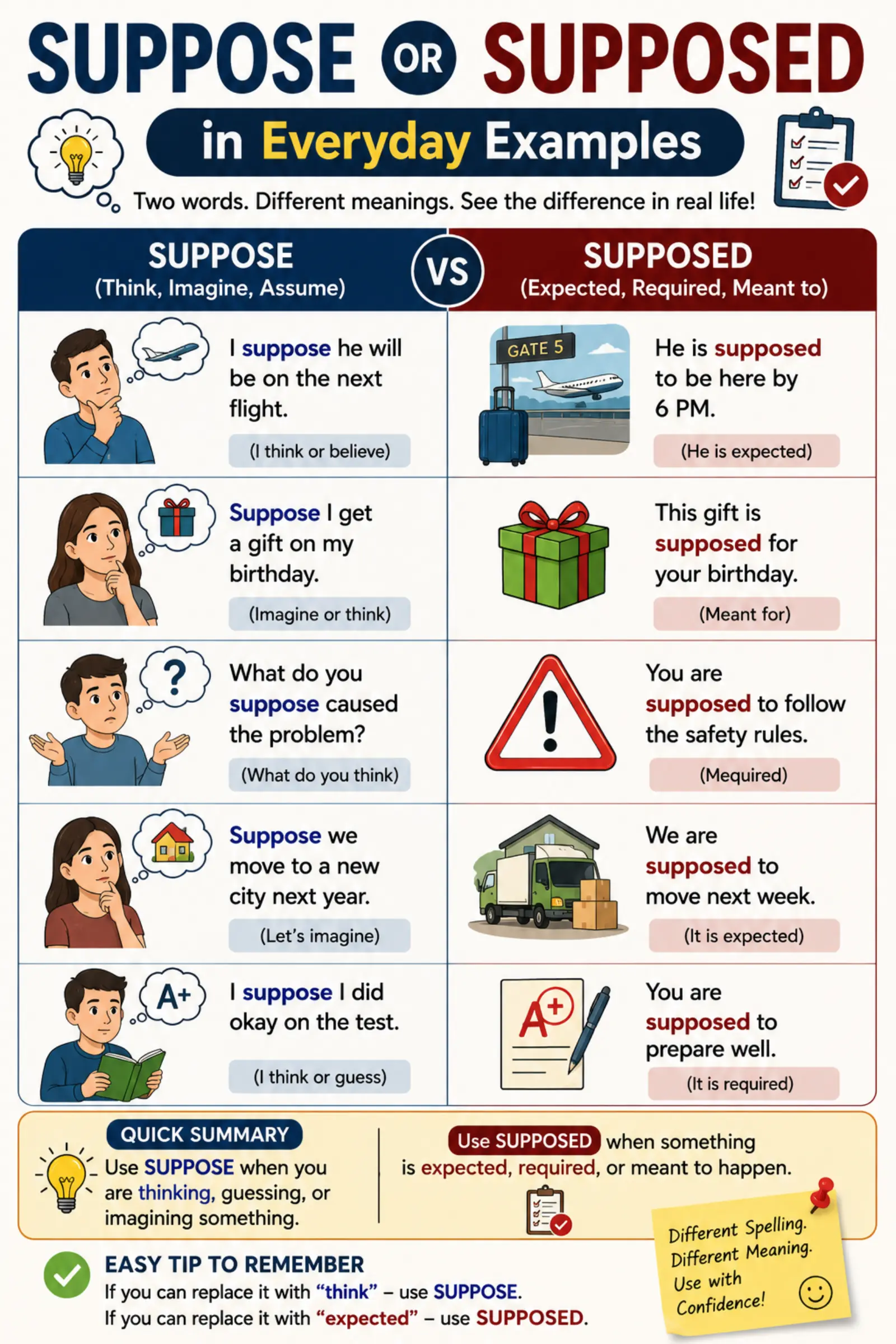
Suppose or Supposed in Everyday Examples
School
Students are supposed to submit homework on time.
Workplace
I suppose the meeting will end early.
Social Media
You’re supposed to tag your friends.
Daily Life
I suppose we can leave now.
You were supposed to receive my message yesterday.
Suppose or Supposed in Different Contexts
Grammar
Suppose is a verb.
Supposed is the past form and is often used as an adjective in expressions like be supposed to.
Conversation
Both words are common in everyday English.
Professional Writing
Correct grammar is important in reports, emails, and business communication.
Education
Students frequently confuse these words in writing tests.
Google Trends & Usage Data
Searches for suppose or supposed remain popular because learners often hear supposed without clearly hearing the final -d.
This topic is commonly searched in the United States, United Kingdom, Canada, Australia, India, and Pakistan.
Popular searches include:
- Suppose vs supposed
- Am I suppose or supposed?
- Supposed meaning
- Suppose meaning
- Supposed to grammar
Comparison Table
| Feature | Suppose | Supposed |
|---|---|---|
| Part of Speech | Verb | Past tense / Adjective |
| Meaning | Think or assume | Expected or required |
| Formal Writing | Yes | Yes |
| Everyday English | Very Common | Very Common |
| Common Mistake | Used instead of supposed | Missing the final -d |
Suppose or Supposed in Professional Life
Using the correct word makes your writing more professional.
Examples:
- Employees are supposed to follow company policies.
- I suppose the project will finish next week.
Suppose or Supposed for Students
Many students write “I am suppose to”, but this is incorrect.
Remember:
Be + supposed + to
Examples:
- I am supposed to study.
- She is supposed to call.
Common Uses
People use these words in:
- School writing
- Business emails
- Daily conversations
- News articles
- Text messages
- Social media
- Books
- Workplace communication
Simple Trick to Remember Suppose or Supposed
Think of it this way:
💭 Suppose = Think
📅 Supposed = Expected
If you see am, is, are, was, or were, you usually need supposed.
Expert Tips
- Read your sentence aloud.
- Look for helping verbs before choosing the word.
- Remember the phrase be supposed to.
- Practice with short example sentences every day.
Related Searches People Also Ask
- Is it suppose or supposed?
- What does supposed to mean?
- Why do people say suppose instead of supposed?
- Is I am suppose to correct?
- How do you pronounce supposed?
- Is suppose a verb?
- What is the past tense of suppose?
- Can supposed be an adjective?
- What are examples of supposed to?
- How do I remember the difference?
FAQs
Is it suppose or supposed?
If you mean “expected to,” the correct phrase is supposed to.
What does suppose mean?
It means to think, assume, or believe.
What does supposed mean?
It usually means expected, required, or planned.
Is “I am suppose to” correct?
No. The correct phrase is I am supposed to.
Are both words correct?
Yes, but they have different meanings and grammar uses.
Why do people confuse them?
The final -d in supposed is often hard to hear in fast speech.
Can suppose be used in formal writing?
Yes. It is a standard English verb.
How can I remember the difference?
Think: Suppose = Think and Supposed = Expected.
Final Verdict
Both suppose and supposed are correct English words, but they are used differently. Use suppose when talking about an assumption or opinion. Use supposed when something is expected or required.
Easy memory rule:
Suppose = Think
Supposed = Expected
Conclusion
Understanding the difference between suppose or supposed is one of the easiest ways to improve your English grammar. Although they sound similar, they serve different purposes in a sentence. Whenever you use the phrase be supposed to, remember to include the final -d. With a little practice, choosing the correct word will become natural.

Camila Green is an English language writer who specializes in confusing word comparisons and spelling explanations. She creates simple, beginner-friendly guides on topics like “niece or neice” and other common English mistakes. Her writing focuses on clarity, real-life examples, and easy learning. At VerrsaPick, she helps readers improve their English with practical and engaging content.