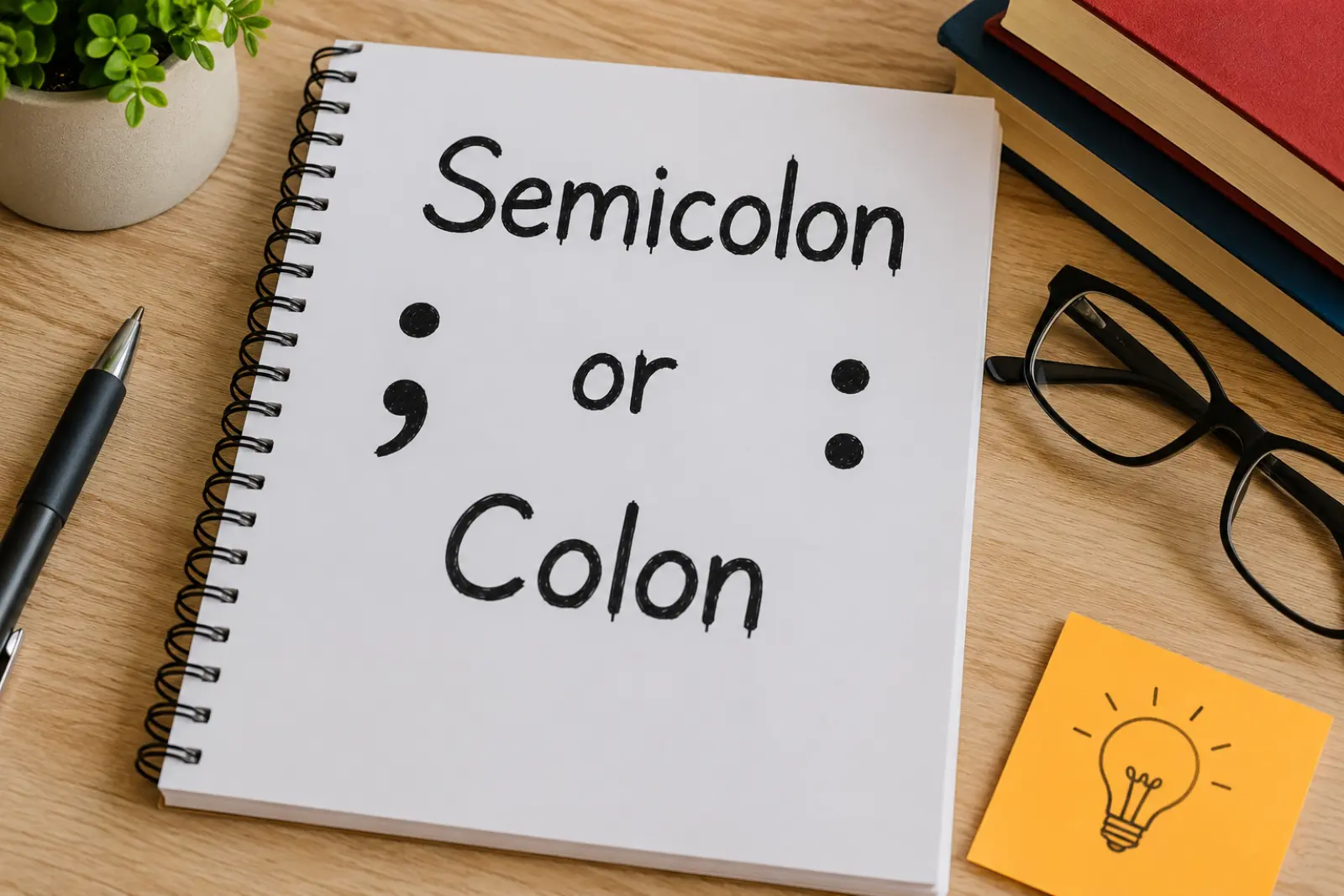
Have you ever paused while writing an email, school essay, or social media post and wondered whether you should use a semicolon or colon? You’re not alone. These two punctuation marks often confuse students, writers, and even professionals because they look similar but serve different purposes.
People usually search for semicolon or colon when they want to improve their grammar, write more clearly, or avoid common punctuation mistakes. Whether you’re preparing a school assignment, sending a business email, writing blog content, or simply trying to improve your English, understanding these punctuation marks can make your writing look more polished and professional.
Many beginners ask questions like: What’s the difference between a semicolon and a colon? When should I use each one? Can I replace one with the other? These are common concerns because both punctuation marks connect ideas, but they do so in different ways.
In this guide, you’ll learn the meaning, pronunciation, examples, usage, grammar rules, common mistakes, expert tips, and simple explanations in easy English.
⭐ Semicolon or Colon – Quick Answer
👉 Semicolon (;) = Connects two closely related complete sentences.
Example:
I studied all night; I passed the exam.
👉 Colon (:) = Introduces a list, explanation, quotation, or example.
Example:
Bring these items: a notebook, a pen, and a ruler.
Simple Rule
- Semicolon = Join related ideas
- Colon = Introduce something
Easy Memory Trick
Semicolon connects. Colon introduces.
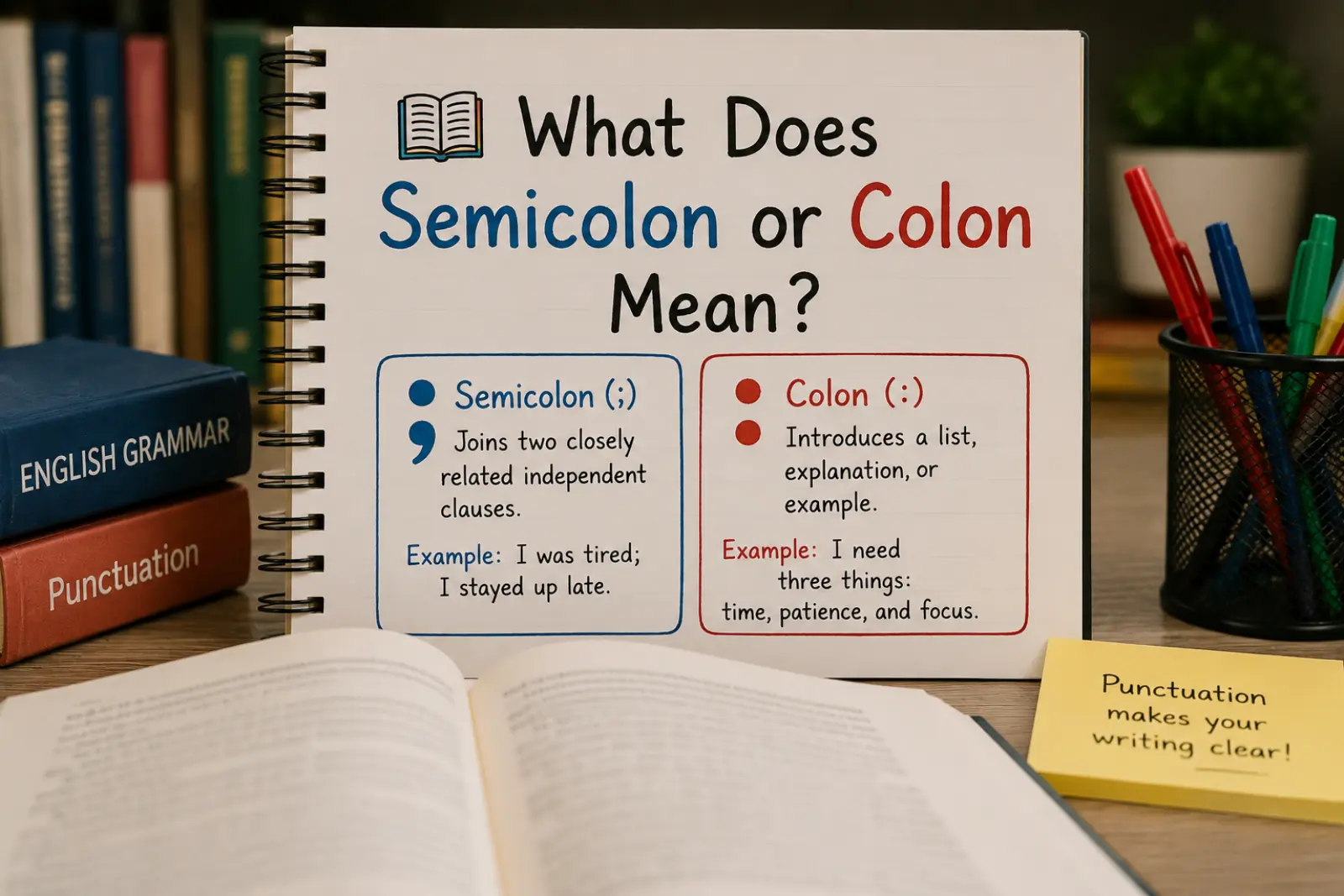
📖 What Does Semicolon or Colon Mean?
A semicolon (;) is a punctuation mark used to connect two independent clauses that are closely related without using a conjunction like and or but.
A colon (:) is used to introduce information that explains, expands, or lists something mentioned before it.
Related Terms
- Comma
- Period
- Dash
- Independent clause
- Punctuation marks
Common Variations
- Semicolon vs colon
- Colon or semicolon examples
- Semicolon and colon rules
- Difference between semicolon and colon
🕰️ The Origin of Semicolon and Colon
Both punctuation marks have been part of English writing for hundreds of years.
- The colon comes from Ancient Greek writing and was originally used to separate sections of text.
- The semicolon was introduced in the late 1400s by Italian printer Aldus Manutius to connect closely related ideas.
Today, both are standard punctuation marks used in books, business writing, journalism, and academic work.
🔊 How to Pronounce Semicolon and Colon
| Punctuation | Pronunciation | Phonetic |
|---|---|---|
| Semicolon | SEM-ee-koh-lun | /ˈsɛmɪˌkoʊlən/ |
| Colon | KOH-lun | /ˈkoʊlən/ |
Common Mistake
Many learners pronounce colon like “column.” They are different words with different meanings.
🇬🇧 British English vs American English Usage
The grammar rules are almost identical in both varieties of English.
| Feature | British English | American English | Notes |
|---|---|---|---|
| Semicolon Rules | Same | Same | No difference |
| Colon Rules | Same | Same | Widely accepted |
| Pronunciation | Slight accent difference | Slight accent difference | Meaning stays the same |
✅ Which One Should You Use?
| Situation | Use |
|---|---|
| Join two complete sentences | Semicolon |
| Introduce a list | Colon |
| Introduce an explanation | Colon |
| Separate complex list items | Semicolon |
| Formal writing | Both when appropriate |
Quick Examples
✔ She loves reading; her sister enjoys painting.
✔ I need three things: coffee, bread, and milk.
❌ Common Mistakes with Semicolon or Colon
Mistake 1
❌ I bought: apples and bananas.
✔ I bought three fruits: apples, bananas, and oranges.
Why? A colon should follow a complete sentence.
Mistake 2
❌ I was tired; because I worked late.
✔ I was tired because I worked late.
Why? A semicolon should not come before “because.”
Mistake 3
❌ She is honest: she always tells the truth.
✔ She is honest; she always tells the truth.
Why? Two complete ideas should usually be joined with a semicolon.
Mistake 4
❌ We packed clothes; shoes; snacks.
✔ We packed clothes, shoes, and snacks.
Why? Semicolons are unnecessary in a simple list.
Mistake 5
❌ My hobbies are reading; swimming; cooking.
✔ My hobbies are: reading, swimming, and cooking.
🌍 Everyday Examples
School
The teacher gave us one task: write a short story.
Workplace
The meeting ended early; everyone returned to work.
Please attach these documents: your resume, cover letter, and references.
Social Media
Today’s goal: stay positive.
Daily Conversation
I wanted to go outside; it started raining.
🧠 Semicolon or Colon in Different Contexts
Academic Writing
Essays often use semicolons to connect related arguments and colons to introduce evidence or lists.
Business Communication
Reports and presentations use colons before bullet lists and semicolons in complex sentences.
Content Writing
Bloggers use colons in headings and semicolons to improve sentence flow.
Professional Emails
Using the correct punctuation makes your writing look more polished and trustworthy.
📈 Google Trends & Usage
Searches for semicolon or colon remain popular because many students, English learners, bloggers, and professionals want to improve their writing.
Common searches include:
- Difference between semicolon and colon
- Semicolon examples
- Colon punctuation rules
- When to use a semicolon
- Colon vs semicolon in English grammar
These searches are common in the US, UK, India, Pakistan, Canada, and Australia, where English writing skills are important for education and work.
📊 Comparison Table
| Feature | Semicolon | Colon |
|---|---|---|
| Symbol | ; | : |
| Main Purpose | Connect ideas | Introduce information |
| Joins Sentences | Yes | No |
| Introduces Lists | No | Yes |
| Used Before Examples | No | Yes |
| Formal Writing | Yes | Yes |
| Beginner Difficulty | Medium | Easy |
💼 Semicolon or Colon in Professional Life
Correct punctuation improves:
- Business emails
- Reports
- Academic papers
- Website content
- Marketing materials
Professional writing becomes clearer and easier to understand when punctuation is used correctly.
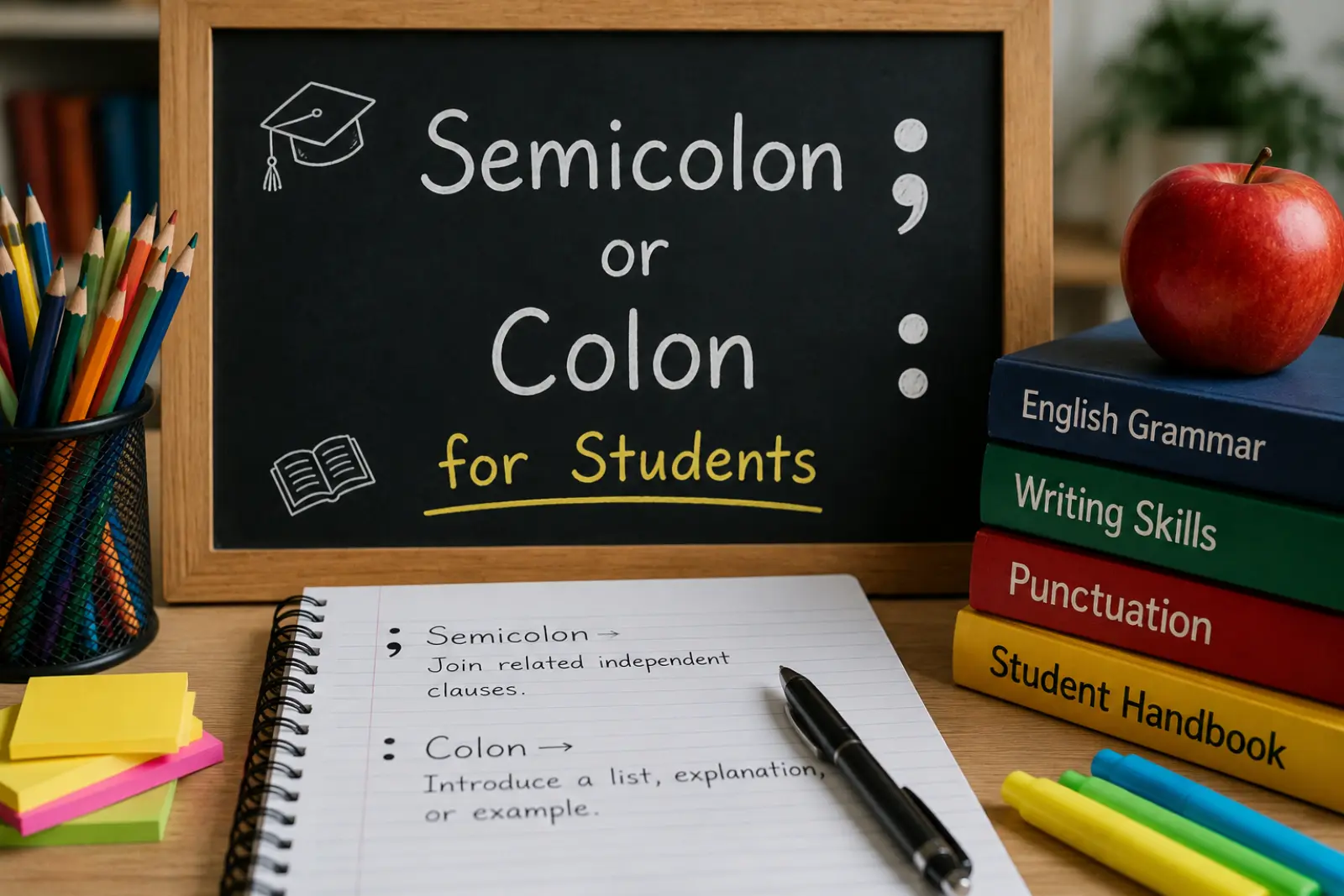
🎓 Semicolon or Colon for Students
Many students confuse these punctuation marks because both pause a sentence.
Easy trick:
- Semicolon joins.
- Colon introduces.
Practice by reading books and writing short paragraphs
🧩 Simple Trick to Remember
Think of it this way:
A semicolon is like a bridge connecting two ideas.
A colon is like an arrow pointing to something important that comes next.
🏆 Expert Tips
Many grammar guides focus only on definitions, but here’s a practical proofreading tip:
- If the second part explains the first, use a colon.
- If the second part is another complete, related sentence, use a semicolon.
- Read your sentence aloud. If it sounds like two connected thoughts, a semicolon may fit. If you’re introducing information, choose a colon.
🌐 Related Searches
People also ask:
- What is the difference between a semicolon and a colon?
- When should I use a semicolon?
- When do I use a colon?
- Can a semicolon replace a comma?
- Is a colon used before a list?
- Are semicolons formal?
- Can I use a colon after “such as”?
- What punctuation joins two sentences?
- Do British and American English use them differently?
- What are easy semicolon examples?
❓ FAQs
Is a semicolon stronger than a comma?
Yes. It creates a stronger pause than a comma but a weaker one than a period.
Can I use a colon before a list?
Yes, if the words before the colon form a complete sentence.
Can a semicolon replace “and”?
Sometimes. It can connect two closely related independent clauses.
Which punctuation is easier for beginners?
The colon is usually easier because its rules are more straightforward.
Are semicolons still used today?
Yes. They are common in academic, business, and professional writing.
Can I use both in one sentence?
Yes, if each punctuation mark follows its proper grammar rule.
🏁 Final Verdict
If you’re deciding between a semicolon or colon, remember this:
- Semicolon = Connects two complete, related ideas.
- Colon = Introduces a list, explanation, or example.
Using the right punctuation makes your writing clearer, more professional, and easier to read.
✅ Conclusion
Understanding the difference between semicolon or colon doesn’t have to be difficult. Once you remember that a semicolon connects related sentences and a colon introduces new information, you’ll avoid many common grammar mistakes. With regular practice, these punctuation marks will become a natural part of your writing.
Final memory trick:
Semicolon = Bridge. Colon = Arrow. If you’re connecting ideas, choose a semicolon. If you’re introducing something, choose a colon.

Camila Green is an English language writer who specializes in confusing word comparisons and spelling explanations. She creates simple, beginner-friendly guides on topics like “niece or neice” and other common English mistakes. Her writing focuses on clarity, real-life examples, and easy learning. At VerrsaPick, she helps readers improve their English with practical and engaging content.