Have you ever written saviour or savior and stopped to wonder which spelling is correct? You are not alone. These two words look almost identical, but the spelling can change depending on the type of English you are using.
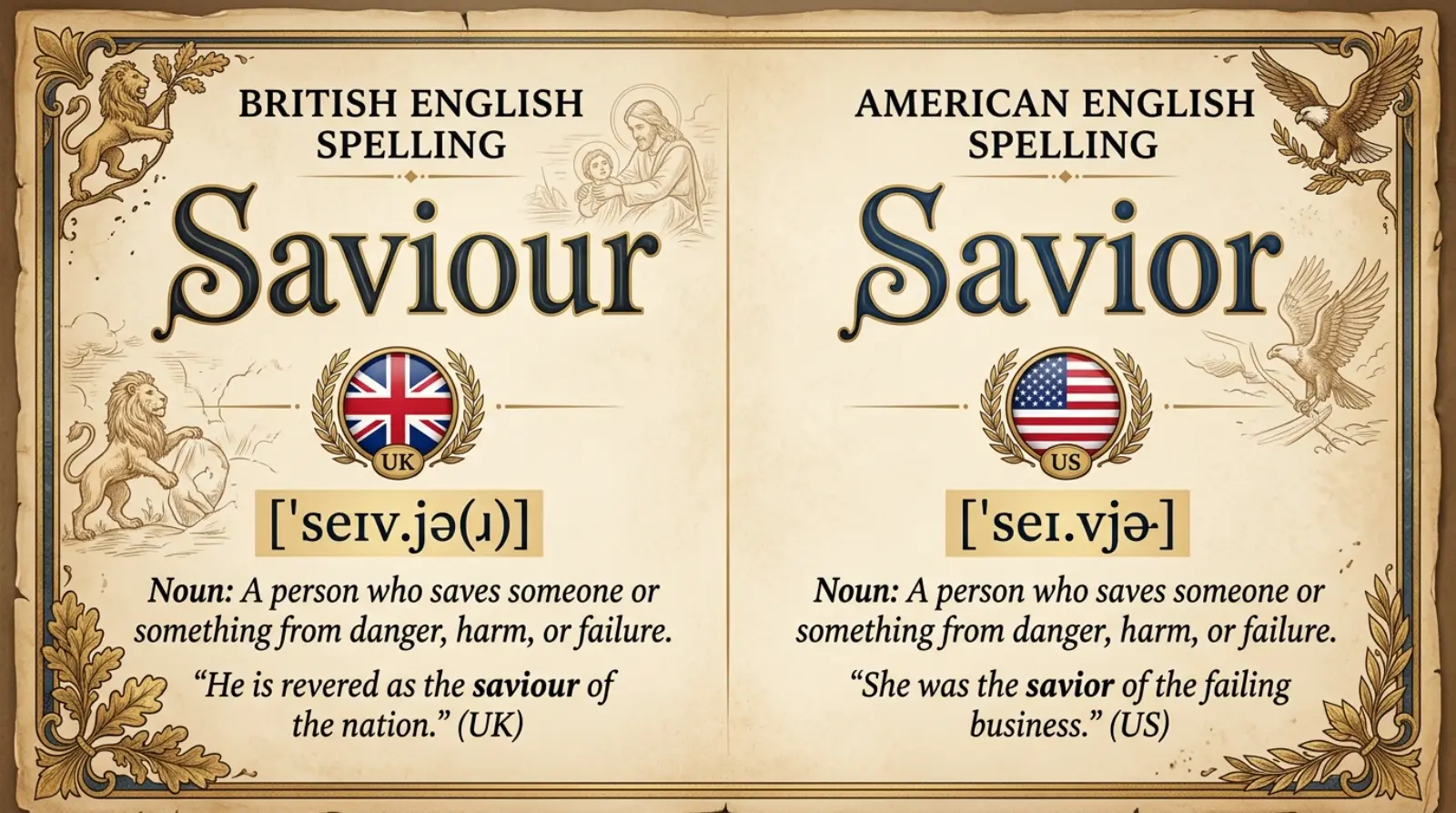
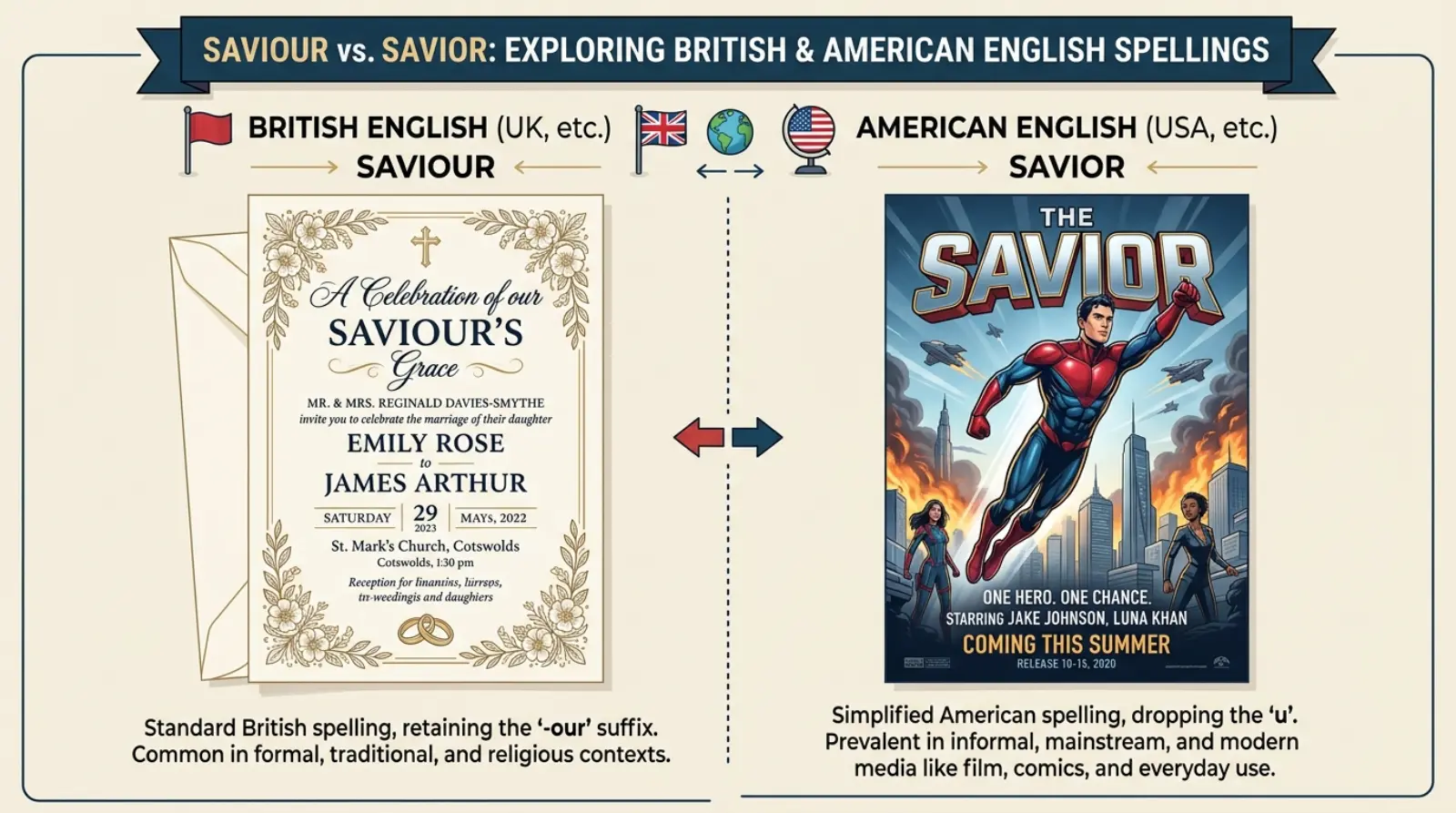
You may see saviour in British English, while savior is common in American English. Both words have the same meaning, pronunciation, and grammatical role. The main difference is the spelling.
People usually search for saviour or savior when they want to know the correct spelling, meaning, pronunciation, examples, usage, definition, or British and American English difference. The word can appear in school writing, books, religious texts, news articles, business content, social media posts, and everyday conversations.
The word can also have a strong emotional meaning. A person may call someone a “saviour” or “savior” when that person helps them during a difficult situation. In religious writing, especially Christianity, Savior or Saviour can refer to Jesus Christ.
For English learners, the extra u is often confusing. If you normally use American English, savior may look natural. If you follow British English, saviour may feel more familiar.
The good news is simple: both spellings are correct. Your choice mainly depends on the variety of English you are using.
In this guide, you’ll learn the meaning, pronunciation, examples, usage, grammar rules, common mistakes, expert tips, and simple explanations in easy English.
Saviour or Savior Quick Answer
👉 Saviour = British English spelling
👉 Savior = American English spelling
Both words mean a person who saves, rescues, or helps someone from danger or difficulty.
Examples:
- The firefighter was a saviour during the emergency. ✅
- The firefighter was a savior during the emergency. ✅
- Many Christians call Jesus the Saviour. ✅
- Many Americans write Savior in religious contexts. ✅
Simple Rule:
👉 British English usually uses saviour.
👉 American English usually uses savior.
Think of it like colour/color and favour/favor. British English often keeps the u, while American English usually removes it.
What Does Saviour or Savior Mean?
Saviour or savior is a noun. It describes someone or something that saves, rescues, or protects another person.
For example:
The lifeguard became a saviour when he rescued the swimmer.
The word can describe a real person, a symbolic helper, or a religious figure.
Synonyms
Common synonyms include:
- rescuer
- helper
- protector
- defender
- lifesaver
- deliverer
Opposites
Depending on the context, possible opposites include:
- attacker
- threat
- destroyer
- danger
Related Terms
You may also see:
- salvation
- save
- saved
- saving
- rescuer
- rescue
Common Variations
The main spelling variations are:
- saviour — British spelling
- savior — American spelling
The Origin of Saviour and Savior
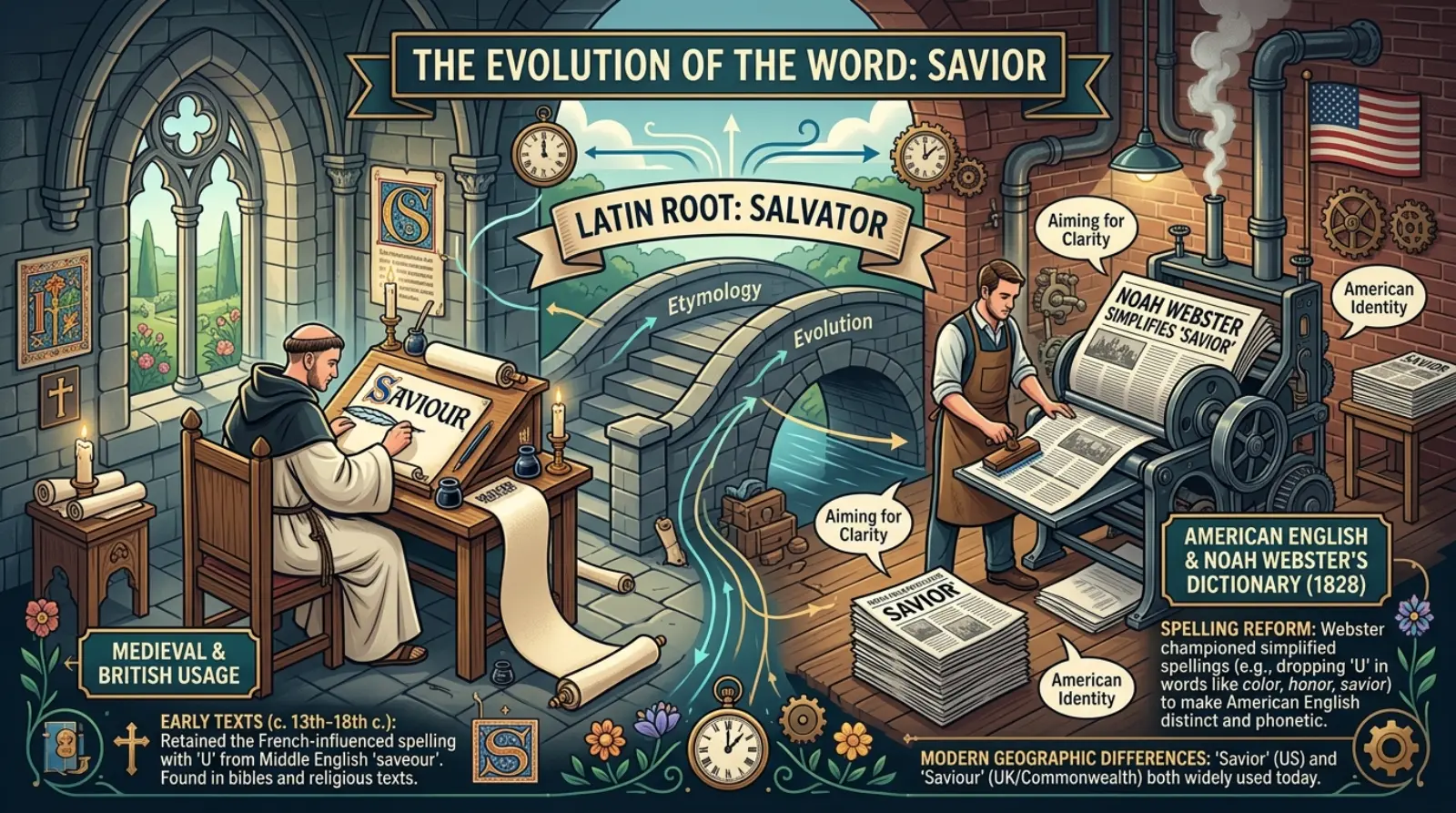
The word comes from the idea of saving or rescuing someone. It is related to the Latin verb salvare, meaning “to save” or “to make safe.”
The word entered English through older forms connected with French and Latin. Over time, saviour became an established English spelling.
American English later developed spelling preferences that removed the u from some words. This is why American English commonly uses savior, while British English generally uses saviour.
The difference is similar to:
- colour → color
- honour → honor
- favour → favor
The meaning does not change because of the spelling.
How to Pronounce Saviour or Savior
Both words are normally pronounced the same way.
A simple pronunciation is:
Saviour/Savior → SAY-vee-er
It has three syllables:
say + vee + er
The spelling may look different, but the pronunciation remains essentially the same in standard English.
A common mistake is trying to pronounce the extra u in saviour as a separate sound. You do not need to do this.
British English vs American English
The biggest difference is spelling, not meaning.
| Feature | British English | American English |
|---|---|---|
| Common spelling | Saviour | Savior |
| Meaning | Someone who saves | Someone who saves |
| Pronunciation | Usually the same | Usually the same |
| Grammar | Noun | Noun |
| Formal writing | Saviour | Savior |
| Religious writing | Saviour is common | Savior is common |
| Main difference | Extra “u” | No “u” |
Both forms are standard. The important thing is to stay consistent with the English style you are using.
Which One Should You Use?
Use saviour if you are writing mainly in British English.
Use savior if you are writing mainly in American English.
A quick guide:
- UK school writing: saviour
- US school writing: savior
- British workplace: saviour
- American workplace: savior
- British publications: saviour
- American publications: savior
- Social media: either, depending on your audience
- Religious writing: use the spelling that matches your chosen English style or source
If you are writing for a global audience, consistency matters more than choosing one form over the other.
Common Mistakes With Saviour or Savior
Mistake 1: Thinking one spelling is always wrong
❌ “Savior is incorrect English.”
✔ Savior is standard American English, while saviour is standard British English.
Tip: Check which English variety your writing follows.
Mistake 2: Mixing styles in one article
❌ The article uses colour, favour, and savior without a reason.
✔ Keep the spelling style consistent.
Tip: If you use British spelling, write saviour.
Mistake 3: Changing the pronunciation
❌ Pronouncing saviour and savior as completely different words.
✔ They are generally pronounced the same.
Mistake 4: Thinking the meaning changes
❌ “Saviour means one thing, while savior means another.”
✔ Both forms have the same basic meaning.
Mistake 5: Adding an unnecessary plural ending
❌ “Saviours” is always wrong.
✔ Saviours is the British plural, while saviors is the American plural.
Mistake 6: Using the word when you simply mean “helper”
The word saviour/savior can sound strong or emotional.
For ordinary situations, helper may sometimes sound more natural.
Saviour or Savior in Everyday Examples
Work:
“The new software was a real savior during the busy season.”
School:
“My classmate was my saviour when I missed the lesson.”
Social media:
“This little shortcut is a lifesaver!”
Daily life:
“Cold water was my saviour after the long walk.”
Email:
“Thank you for your help. You were a real saviour today.”
Text message:
“You are a savior! I really needed that.”
Online content:
“Here are five tips that can be a real saviour when you are studying.”
Conversation:
“You saved me from missing the bus. You are a lifesaver!”
Saviour or Savior in Different Contexts
Religion
In Christianity, Saviour/Savior is commonly used as a title for Jesus Christ. Capitalization can depend on the religious style and context.
Example:
“Christians believe Jesus is the Savior.”
Education
Students may see saviour in British textbooks and savior in American textbooks. The meaning remains the same.
Business
A company may describe a product as a “savior” when it solves a major problem, but this is usually figurative.
Example:
“The new tool was a savior for small businesses.”
Writing and Literature
Writers often use the word to create a strong emotional image of someone who brings help, safety, or hope.
Social Media
On social media, people may use savior or saviour casually to praise someone who helped them.
Example:
“You are my savior for sending me those notes!”
Saviour or Savior Google Trends and Usage
People search saviour or savior mainly because English spelling differs between countries. Searches often come from students, writers, English learners, and people checking text before publishing it.
The United States generally follows savior, while the United Kingdom commonly uses saviour. Canadian, Australian, Indian, and Pakistani English may often follow British spelling conventions, although individual publications and organizations can use different style guides.
Long-tail searches include:
- Is saviour or savior correct?
- Saviour or savior British English
- Saviour or savior American English
- How do you spell saviour?
- How do you spell savior?
- What does saviour mean?
- What does savior mean?
- Is savior American spelling?
- Is saviour British spelling?
- How do you pronounce saviour?
Saviour or Savior Comparison
| Feature | Saviour | Savior |
|---|---|---|
| Standard variety | British English | American English |
| Meaning | Person who saves | Person who saves |
| Word type | Noun | Noun |
| Pronunciation | Same | Same |
| Extra “u” | Yes | No |
| Academic use | Common in UK style | Common in US style |
| Professional use | British style | American style |
| Religious use | Common | Common |
| Correct spelling | Yes | Yes |
Saviour or Savior in Professional Life
In professional writing, your choice should match the style guide of your company, university, publication, or target audience.
For example, a British company might write:
“The new system became a real saviour during the transition.”
An American company might write:
“The new system became a real savior during the transition.”
Neither sentence is wrong because of the spelling.
Saviour or Savior for Students
Students often struggle because they learn different spelling systems online.
The easiest approach is to identify the English style required by your teacher or institution.
If your course uses British English, remember:
saviour
If it uses American English, remember:
savior
Do not try to memorize them as two different words. They are simply two spelling forms of the same word.
Common Uses of Saviour or Savior
You will commonly see the word in:
- religious writing
- books and literature
- news articles
- school assignments
- workplace writing
- social media posts
- personal conversations
- dramatic or emotional descriptions
- stories about rescue
- figurative expressions
The word can describe both literal rescue and figurative help.
Simple Trick to Remember Saviour or Savior
Think about the letter U.
👉 British English = U stays
saviour
👉 American English = U goes
savior
Think of similar pairs:
colour → color
favour → favor
honour → honor
saviour → savior
Think of it this way: British spelling often keeps the u, while American spelling often removes it.
Expert Tips
Here are a few simple tips that can prevent spelling mistakes:
- Check your target audience. UK readers usually expect British spelling.
- Stay consistent. Do not randomly switch between British and American spelling.
- Check your style guide. Schools, businesses, and publishers may have specific rules.
- Do not change the meaning. Saviour and savior mean the same thing.
- Remember similar words. Colour/color and favour/favor follow the same pattern.
- Focus on context. Religious writing may capitalize Savior/Saviour when used as a title.
Related Searches People Also Ask
Is saviour or savior correct?
Both are correct. Saviour is British English, while savior is American English.
Is savior American spelling?
Yes. Savior is the standard American spelling.
Is saviour British spelling?
Yes. Saviour is the common British spelling.
Do saviour and savior mean the same thing?
Yes. They have the same basic meaning.
How do you pronounce saviour?
It is generally pronounced “SAY-vee-er.”
How do you pronounce savior?
It is generally pronounced “SAY-vee-er.”
What is the plural of saviour?
The British plural is saviours.
What is the plural of savior?
The American plural is saviors.
Can I use savior in British English?
It may be understood, but saviour is the usual British spelling.
Can I use saviour in American English?
It will be understood, but savior is the usual American spelling.
FAQs
Is Saviour or Savior the correct spelling?
Both are correct. Saviour is mainly British English, while savior is mainly American English.
Does saviour have a different meaning from savior?
No. The meaning is essentially the same.
Is saviour more formal than savior?
No. The spelling difference is mainly regional, not a difference in formality.
Are saviour and savior pronounced differently?
Usually no. They are generally pronounced the same way.
Which spelling should students use?
Students should follow the English variety required by their school, teacher, university, or assignment.
Is Savior used in religious writing?
Yes. Savior is common in American Christian writing, while Saviour is common in British Christian writing.
Can saviour describe a person?
Yes. It can describe someone who rescues or helps another person.
Can the word be used figuratively?
Yes. For example, someone might call a useful product a “savior” because it solved a difficult problem.
Final Verdict
Saviour and savior are both correct spellings.
👉 Saviour = British English
👉 Savior = American English
The meaning and pronunciation are essentially the same. The main difference is the extra u.
Conclusion
The saviour or savior spelling question is much easier once you understand the British and American English difference.
Use saviour when following British English. Use savior when following American English. Both words refer to someone who saves, rescues, or provides important help.
The best memory trick is simple: British keeps the U; American drops the U.
So, if you see saviour or savior, remember that you are looking at two regional spellings of the same word—not two different words.

Camila Green is an English language writer who specializes in confusing word comparisons and spelling explanations. She creates simple, beginner-friendly guides on topics like “niece or neice” and other common English mistakes. Her writing focuses on clarity, real-life examples, and easy learning. At VerrsaPick, she helps readers improve their English with practical and engaging content.