Imagine you are studying chemistry and your teacher asks, “Is NaCl ionic or covalent?” You know that NaCl is common table salt, but the terms ionic bond and covalent bond can make the answer confusing at first.
If you have searched “nacl ionic or covalent”, you are probably trying to understand whether sodium chloride contains an ionic bond or a covalent bond, how the bond forms, and how to identify similar compounds.
This question commonly appears in school chemistry, homework, laboratory lessons, exams, online science discussions, and beginner chemistry searches. It is also connected with questions such as “Is NaCl an ionic compound?”, “Why is NaCl ionic?”, “Does NaCl have covalent bonds?”, and “How does sodium chloride form?”
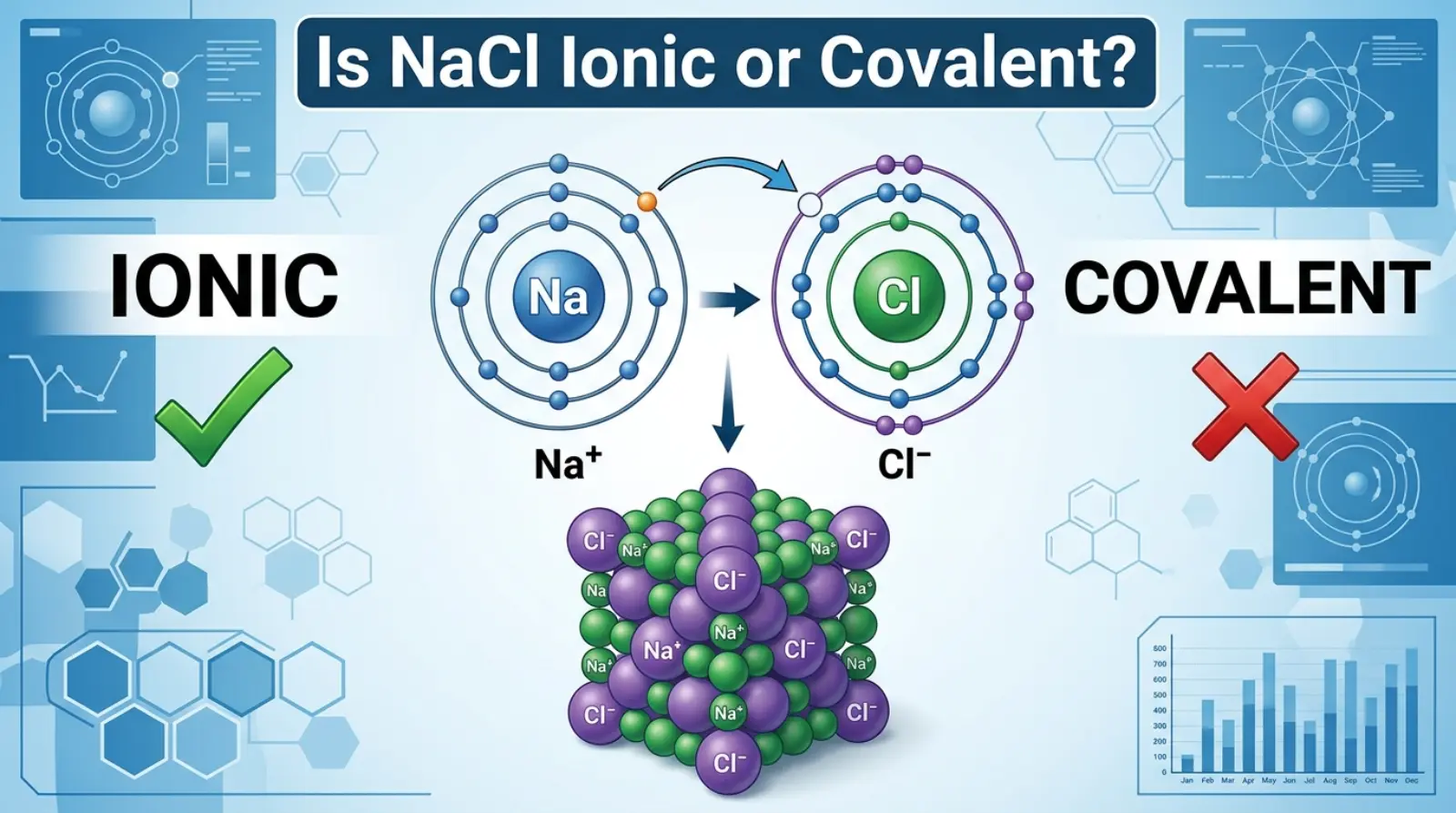
The good news is that the basic answer is simple. NaCl is an ionic compound. It forms when sodium transfers one electron to chlorine. Sodium becomes a positively charged sodium ion (Na⁺), while chlorine becomes a negatively charged chloride ion (Cl⁻). The opposite charges attract each other and form an ionic lattice.
People usually search for:
- NaCl ionic or covalent meaning
- Is NaCl ionic or covalent?
- Why is NaCl ionic?
- Is sodium chloride an ionic compound?
- NaCl bond type
- NaCl ionic bond explanation
- Does NaCl have covalent bonds?
- How to tell if a compound is ionic or covalent
- NaCl electron transfer
- Sodium chloride Lewis structure
In this guide, you’ll learn the meaning, pronunciation, examples, usage, grammar rules, common mistakes, expert tips, and simple explanations in easy English.
NaCl Ionic or Covalent – Quick Answer
👉 NaCl = Ionic compound
NaCl stands for sodium chloride. It is made from sodium (Na), a metal, and chlorine (Cl), a nonmetal.
Sodium gives one electron to chlorine:
Na → Na⁺ + e⁻
Chlorine accepts that electron:
Cl + e⁻ → Cl⁻
The resulting Na⁺ and Cl⁻ ions attract each other because they have opposite charges.
Simple Example
NaCl → Na⁺ + Cl⁻
So, the bond between sodium and chloride ions is classified as ionic.
Easy Rule
👉 Metal + nonmetal = usually ionic
Since sodium is a metal and chlorine is a nonmetal:
Sodium + Chlorine → Ionic compound
Examples of Other Ionic Compounds
- NaCl — sodium chloride
- KCl — potassium chloride
- MgO — magnesium oxide
- CaCl₂ — calcium chloride
- Na₂O — sodium oxide
What Does NaCl Mean?
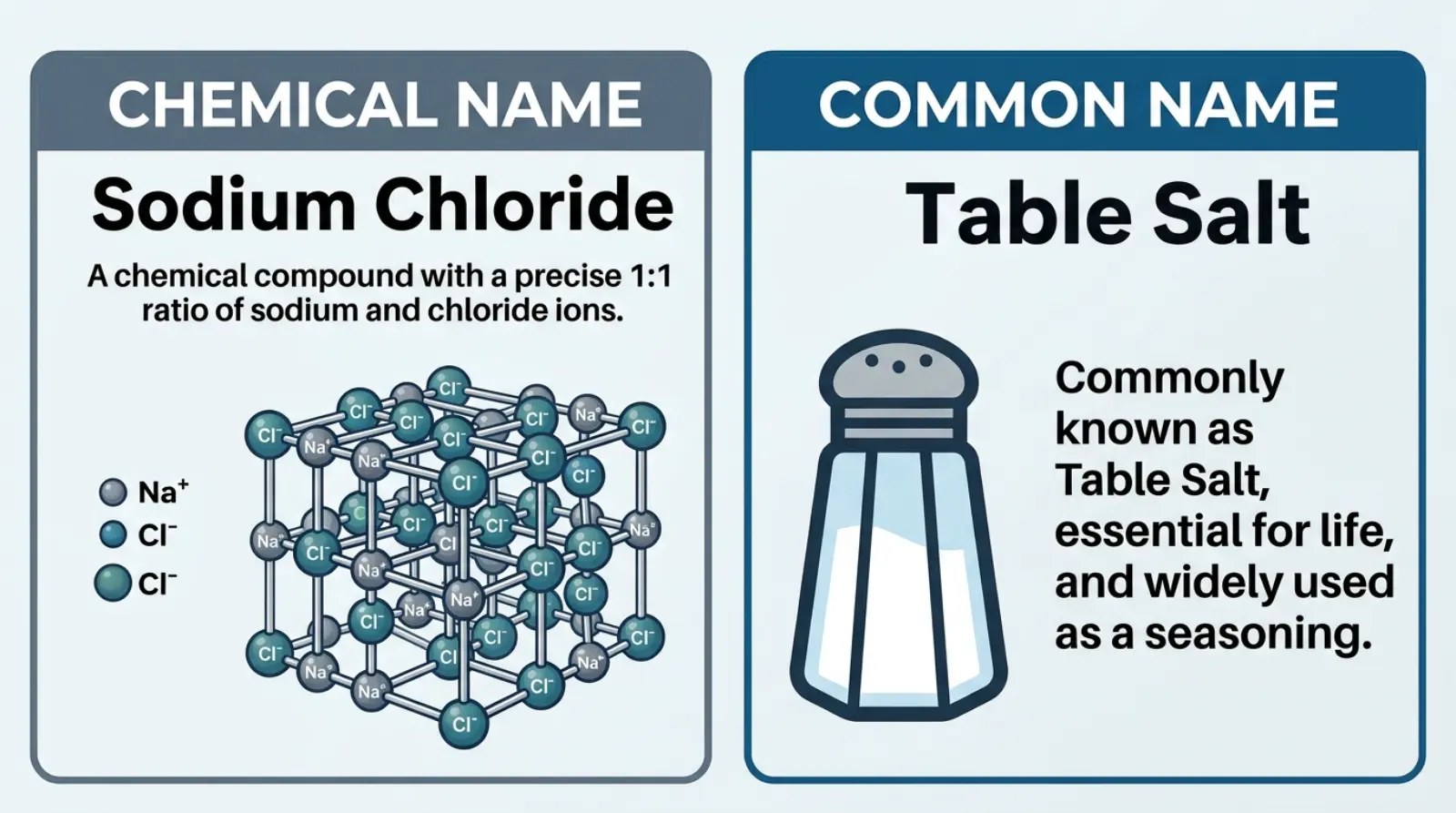
NaCl is the chemical formula for sodium chloride, commonly known as table salt.
The formula tells us that each formula unit contains sodium and chloride in a 1:1 ratio. Sodium forms a +1 ion, while chlorine forms a −1 ion, so one of each balances the total charge.
NaCl is not a molecule in the same way that water, H₂O, is often described as a molecule. Solid sodium chloride forms a large, repeating crystal lattice of Na⁺ and Cl⁻ ions.
What Is an Ionic Bond?
An ionic bond is the electrostatic attraction between oppositely charged ions.
In NaCl:
- Sodium loses one electron.
- Sodium becomes Na⁺.
- Chlorine gains one electron.
- Chlorine becomes Cl⁻.
- Na⁺ attracts Cl⁻.
- Together, they form sodium chloride.
What Is a Covalent Bond?
A covalent bond usually forms when atoms share electrons.
For example, in H₂O, hydrogen and oxygen share electrons through covalent bonds.
This is different from NaCl, where an electron is transferred from sodium to chlorine.
Related Terms
Some important chemistry terms related to NaCl include:
- Ion — an atom or group with an electrical charge
- Cation — a positively charged ion
- Anion — a negatively charged ion
- Ionic bond — attraction between oppositely charged ions
- Covalent bond — a bond involving shared electrons
- Electronegativity — an atom’s ability to attract bonding electrons
- Crystal lattice — a repeating arrangement of particles in a solid
The Origin of NaCl and Its Chemical Formula
The name sodium chloride comes from the names of its two elements: sodium and chlorine.
The symbol Na comes from the Latin name natrium, while Cl represents chlorine.
The formula NaCl developed from the charge relationship between the two ions. Sodium commonly forms Na⁺, while chlorine commonly forms Cl⁻. Because the charges are +1 and −1, they combine in a one-to-one ratio.
This gives us:
Na⁺ + Cl⁻ → NaCl
The compound has been known and used for thousands of years because sodium chloride occurs naturally as mineral salt and is essential in many biological processes.
How to Pronounce NaCl
NaCl is commonly pronounced by saying the chemical symbols:
“N-A-C-L”
You may also simply call it:
“sodium chloride.”
Pronunciation Breakdown
- NaCl: “en-ay-see-el”
- Sodium: “SO-dee-um”
- Chloride: “KLOR-eyed”
A common beginner mistake is to pronounce NaCl like an ordinary word. In chemistry classes, spelling out the symbols is usually clearer.
British English vs American English Usage
The chemistry is the same in British and American English. There is no difference in whether NaCl is ionic or covalent.
| Feature | British English | American English | Notes |
|---|---|---|---|
| Chemical formula | NaCl | NaCl | Same worldwide |
| Compound name | Sodium chloride | Sodium chloride | Same |
| Bond type | Ionic | Ionic | Same chemistry |
| Common name | Table salt | Table salt | Same |
| Spelling | Ionic | Ionic | No spelling difference |
Scientific formulas do not change between British and American English.
Which One Should You Use?
If a chemistry question asks “Is NaCl ionic or covalent?”, the correct answer is:
👉 NaCl is ionic.
For school or academic writing, you can write:
NaCl is an ionic compound formed by the electrostatic attraction between Na⁺ and Cl⁻ ions.
For a beginner-friendly answer:
NaCl is ionic because sodium transfers an electron to chlorine.
In an exam, mention the electron transfer and the formation of Na⁺ and Cl⁻. This shows why the compound is ionic instead of simply memorizing the answer.
Common Mistakes With NaCl Ionic or Covalent
Mistake 1: Calling NaCl Covalent
❌ Incorrect: NaCl is a covalent compound.
✔ Correct: NaCl is an ionic compound.
Why? Sodium is a metal and chlorine is a nonmetal. Sodium transfers an electron to chlorine.
Beginner tip: Remember metal + nonmetal = usually ionic.
Mistake 2: Saying Sodium Shares Its Electron
❌ Incorrect: Sodium shares one electron with chlorine.
✔ Correct: Sodium transfers one electron to chlorine.
Why? Ionic bonding involves electron transfer, while covalent bonding involves electron sharing.
Mistake 3: Forgetting the Ion Charges
❌ Incorrect: Na and Cl simply stick together.
✔ Correct: Na⁺ and Cl⁻ attract because they have opposite charges.
Beginner tip: Always write the ions when explaining an ionic bond.
Mistake 4: Calling NaCl a Single Molecule
❌ Incorrect: One NaCl molecule exists in solid table salt.
✔ Better: Solid NaCl forms an ionic crystal lattice made of Na⁺ and Cl⁻ ions.
This distinction becomes important in higher-level chemistry.
Mistake 5: Thinking Every Compound With Chlorine Is Ionic
❌ Incorrect: Any compound containing chlorine must be ionic.
✔ Correct: The type of bonding depends on the elements involved and their bonding behavior.
For example, HCl and CCl₄ involve covalent bonding, while NaCl is ionic.
Mistake 6: Thinking “Ionic” Means the Compound Has No Electrons Shared Anywhere
The important point is that the main bonding between Na⁺ and Cl⁻ in NaCl is ionic. Chemistry can become more detailed when discussing electron density and polarization, but that does not change the standard classification of NaCl as an ionic compound.
NaCl in Everyday Examples
Work
A laboratory worker may use sodium chloride solutions during an experiment.
Example:
“We prepared a NaCl solution for the laboratory test.”
School
Example:
“Our chemistry teacher asked whether NaCl is ionic or covalent.”
Daily Life
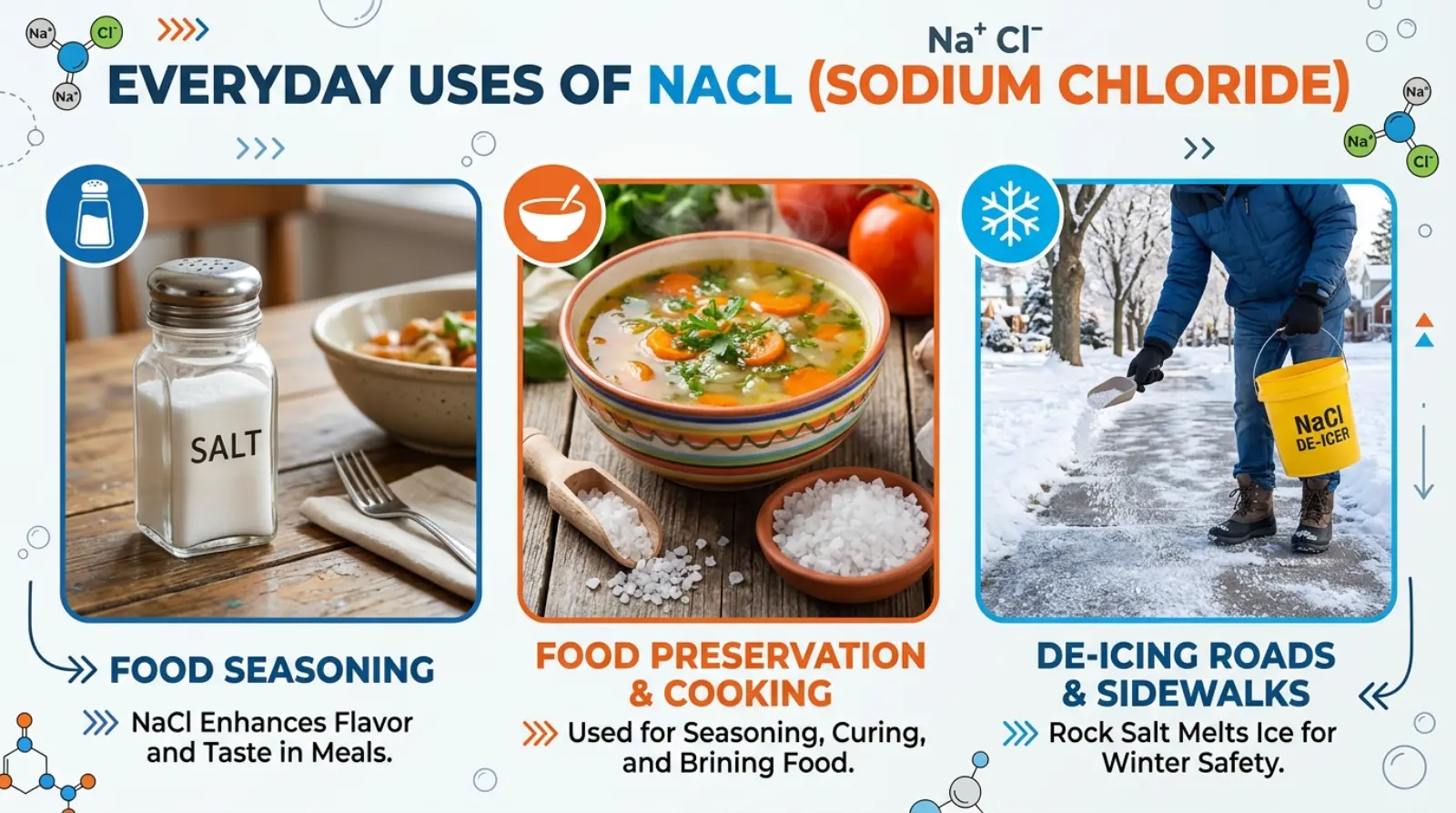
Table salt used in cooking is mainly sodium chloride.
Example:
“Add a small amount of NaCl to the solution.”
Emails
Example:
“Please record the concentration of the NaCl solution in the report.”
Text Messages
Example:
“Is NaCl ionic or covalent? I forgot 😭”
Online Content
Students may search:
“Why is NaCl ionic?”
or
“How do I know if NaCl is ionic?”
Conversations
Student: “Is sodium chloride covalent?”
Teacher: “No. NaCl is an ionic compound because sodium transfers an electron to chlorine.”
NaCl in Different Chemistry Contexts
Education
NaCl is one of the easiest examples used to teach ionic bonding.
Students learn that sodium has one valence electron that it can lose, while chlorine needs one electron to complete its outer shell.
This makes electron transfer easy to visualize.
NaCl and Electron Transfer
The key process is:
Na → Na⁺ + e⁻
followed by:
Cl + e⁻ → Cl⁻
Then:
Na⁺ + Cl⁻ → NaCl
The attraction between the ions produces the ionic compound.
NaCl and Electrical Conductivity
Solid NaCl does not conduct electricity well because its ions are held in fixed positions in the crystal lattice.
When NaCl is molten or dissolved in water, its ions can move more freely. This allows the substance to conduct electricity.
This is an important property of ionic compounds.
NaCl and Water
NaCl dissolves in water because water molecules interact strongly with the charged ions.
The sodium and chloride ions become surrounded by water molecules. This allows them to move through the solution.
NaCl in Chemistry Labs
Sodium chloride is often used in educational demonstrations and laboratory solutions because it is familiar, inexpensive, and highly soluble in water.
NaCl – Google Trends & Usage Data
The search phrase “nacl ionic or covalent” reflects a common educational search intent. People usually type this exact question when they want a fast answer for homework, revision, or exam preparation.
Related long-tail searches include:
- Is NaCl ionic or covalent?
- Why is NaCl ionic?
- Is sodium chloride ionic?
- What type of bond is NaCl?
- Is NaCl an ionic compound?
- NaCl bond type explained
- Does NaCl have an ionic bond?
- How does NaCl form?
- Is sodium chloride a molecule?
- Why does NaCl form an ionic lattice?
Students in the US, UK, India, Pakistan, Canada, and Australia may encounter the same chemistry question because ionic and covalent bonding are standard topics in many school chemistry courses.
Voice searches may sound more conversational, such as:
“Is sodium chloride ionic or covalent?”
“Why is NaCl an ionic compound?”
“What type of bond does NaCl have?”
These longer questions show clear beginner search intent.
Comparison Table: NaCl Ionic or Covalent
| Feature | NaCl / Ionic | Typical Covalent Compound |
|---|---|---|
| NaCl classification | Ionic | Not applicable |
| Main bonding | Ionic attraction | Shared electrons |
| Elements involved | Metal + nonmetal | Usually nonmetal + nonmetal |
| Electron behavior | Transfer | Sharing |
| Ions present | Na⁺ and Cl⁻ | Usually no separate ions in the molecular structure |
| Solid structure | Crystal lattice | Often individual molecules or networks |
| Electrical conductivity | Conducts when molten or dissolved | Usually poor, with important exceptions |
| Example | NaCl | H₂O |
| Common beginner clue | Metal + nonmetal | Nonmetal + nonmetal |
NaCl in Professional Life
Understanding ionic compounds is useful beyond school chemistry.
Chemists, laboratory technicians, teachers, food scientists, medical researchers, and industrial workers may work with sodium chloride or salt solutions.
In professional writing, it is better to use precise language.
Instead of saying:
❌ “NaCl sticks together because the atoms like each other.”
Use:
✔ “NaCl forms through electrostatic attraction between sodium and chloride ions.”
For workplace laboratory documentation, also include relevant details such as concentration, solution volume, temperature, and experimental conditions when needed.
NaCl for Students or Beginners
Many beginners struggle with ionic and covalent compounds because both involve electrons. The easiest way to separate them is to focus on what happens to the electrons.
Ionic Bond
Electrons are transferred.
Covalent Bond
Electrons are shared.
For NaCl:
Sodium gives → chlorine receives → opposite ions attract.
That is the basic idea.
Beginner Shortcut
Look at the elements:
Na = metal
Cl = nonmetal
Therefore:
Metal + nonmetal → ionic
This shortcut works for many basic chemistry questions, although more advanced chemistry requires a deeper look at bonding.
Signs and Characteristics of NaCl’s Ionic Nature
You can recognize NaCl as an ionic compound through several characteristics:
- It contains a metal and a nonmetal.
- It forms Na⁺ and Cl⁻ ions.
- Electron transfer occurs during the basic bonding model.
- It forms a crystal lattice as a solid.
- It has strong electrostatic attractions between ions.
- It can conduct electricity when molten.
- It can conduct electricity when dissolved in water.
- It has a relatively high melting point compared with many simple molecular compounds.
- It commonly forms crystals.
These characteristics help distinguish NaCl from many molecular covalent substances.
Simple Trick to Remember NaCl Ionic or Covalent
Here is the easiest memory trick:
Metal + Nonmetal = Ionic
Nonmetal + Nonmetal = Covalent
Think of sodium as the giver and chlorine as the receiver.
👉 Sodium gives away one electron.
👉 Chlorine accepts one electron.
👉 They become Na⁺ and Cl⁻.
👉 Opposite charges attract.
👉 NaCl is ionic.
Think of It This Way:
Imagine sodium has an extra ball and chlorine needs one.
Sodium hands the ball to chlorine instead of sharing it back and forth.
That simple picture represents the basic idea of electron transfer in NaCl.
Expert Tips for Identifying Ionic Compounds
1. Check the Periodic Table
First ask whether the elements are metals or nonmetals.
2. Look for Electron Transfer
If one atom tends to lose electrons and another tends to gain them, ionic bonding may be involved.
3. Check for Ions
Ionic compounds contain positively and negatively charged ions.
4. Learn Common Ions
Memorizing common charges makes chemistry much easier.
For example:
- Na⁺
- K⁺
- Mg²⁺
- Ca²⁺
- Cl⁻
- O²⁻
5. Do Not Depend on One Rule Alone
“Metal + nonmetal” is an excellent beginner shortcut, but chemistry has exceptions and more complex bonding situations. As you advance, consider electronegativity, structure, and the actual bonding environment.
Related Searches People Also Ask
Is NaCl ionic or covalent?
NaCl is ionic. Sodium transfers one electron to chlorine, producing Na⁺ and Cl⁻ ions.
Why is NaCl ionic?
NaCl is ionic because sodium is a metal that loses an electron, while chlorine is a nonmetal that gains the electron.
What type of bond is present in NaCl?
The main bond type in NaCl is ionic bonding, based on attraction between Na⁺ and Cl⁻ ions.
Is sodium chloride an ionic compound?
Yes. Sodium chloride, or NaCl, is a classic example of an ionic compound.
Does NaCl have covalent bonds?
In basic chemistry classification, NaCl is considered ionic rather than covalent. The Na⁺ and Cl⁻ ions are held together by electrostatic attraction.
Is NaCl a molecule?
Solid NaCl is better described as an ionic lattice rather than a collection of separate NaCl molecules.
Why does sodium become Na⁺?
Sodium has one outer electron that it can lose. After losing it, sodium has a stable electron arrangement and a +1 charge.
Why does chlorine become Cl⁻?
Chlorine gains one electron to complete its outer electron shell, giving it a −1 charge.
Does NaCl conduct electricity?
Solid NaCl does not conduct electricity well because its ions cannot move freely. Molten NaCl and aqueous NaCl solutions can conduct electricity because their ions can move.
What is the difference between ionic and covalent bonding?
Ionic bonding involves attraction between ions after electron transfer, while covalent bonding involves sharing electrons between atoms.
Is NaCl polar or nonpolar?
NaCl is an ionic compound, so describing the whole solid simply as “polar” or “nonpolar” is less useful than describing its ionic lattice and charged ions.
Is NaCl soluble in water?
Yes. Sodium chloride is highly soluble in water because water interacts with and stabilizes its ions.
FAQs About NaCl Ionic or Covalent
Is NaCl ionic or covalent?
NaCl is ionic. It contains sodium ions (Na⁺) and chloride ions (Cl⁻).
Is NaCl an ionic bond?
NaCl contains ionic bonding between oppositely charged sodium and chloride ions.
Why is NaCl not covalent?
NaCl is not classified as a typical covalent compound because sodium transfers an electron to chlorine rather than forming a bond through ordinary electron sharing.
What happens to sodium’s electron in NaCl?
Sodium transfers its outer electron to chlorine. Sodium becomes Na⁺, while chlorine becomes Cl⁻.
What happens to chlorine in NaCl?
Chlorine gains one electron and becomes the negatively charged chloride ion, Cl⁻.
What is the easiest way to identify NaCl as ionic?
Look at the elements. Sodium is a metal and chlorine is a nonmetal. A metal combined with a nonmetal is usually ionic.
Is NaCl a molecule or compound?
NaCl is an ionic compound. In solid form, it exists as a repeating crystal lattice rather than separate molecular units.
Does NaCl have a crystal structure?
Yes. Solid sodium chloride forms a regular three-dimensional ionic crystal lattice.
What is NaCl called?
NaCl is called sodium chloride, commonly known as table salt.
Can NaCl conduct electricity?
Solid NaCl has very limited electrical conductivity, but molten NaCl and NaCl dissolved in water conduct electricity because the ions can move.
Final Verdict: NaCl Ionic or Covalent?
NaCl is ionic, not covalent.
The easiest explanation is:
👉 Sodium (Na) is a metal.
👉 Chlorine (Cl) is a nonmetal.
👉 Sodium transfers one electron to chlorine.
👉 Na⁺ and Cl⁻ ions form.
👉 Opposite charges attract to form ionic sodium chloride.
If you remember only one rule, remember:
Metal + nonmetal → usually ionic.
Conclusion
The answer to “nacl ionic or covalent” is clear: NaCl is an ionic compound. It forms when sodium transfers one electron to chlorine, creating Na⁺ and Cl⁻ ions. The attraction between these opposite charges holds the ions together in an ionic crystal lattice.
The most useful beginner trick is to look at the elements first. Sodium is a metal, and chlorine is a nonmetal, so NaCl fits the common pattern of an ionic compound.
When you see NaCl in a chemistry question, think:
Na gives → Cl receives → ions form → opposite charges attract → ionic bond.
That simple chain will help you remember why NaCl is ionic.

Camila Green is an English language writer who specializes in confusing word comparisons and spelling explanations. She creates simple, beginner-friendly guides on topics like “niece or neice” and other common English mistakes. Her writing focuses on clarity, real-life examples, and easy learning. At VerrsaPick, she helps readers improve their English with practical and engaging content.