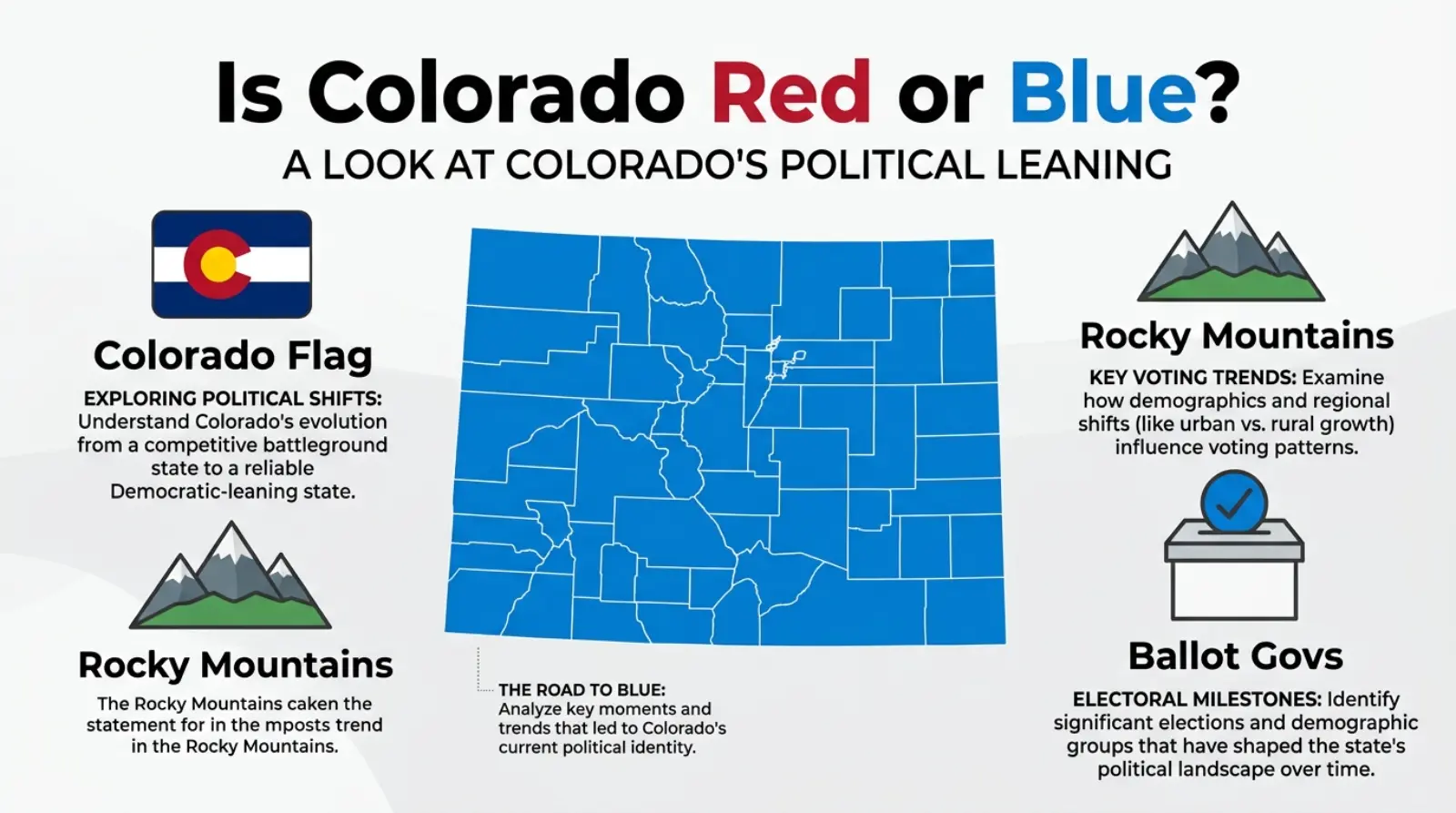
Imagine someone asks, “Is Colorado a red state or a blue state?” The answer may seem simple, but Colorado’s political story is more interesting than a one-word label.
Colorado has changed politically over the past few decades. It was once considered a competitive swing state, but Democrats have become increasingly successful in statewide elections. At the same time, Republicans remain important in many rural areas and some parts of the state.
That is why people searching “is Colorado red or blue” may actually be asking several different questions: Is Colorado a Democratic state? Is Colorado Republican? Who controls the state government? How did Colorado vote for president? Is Colorado still a swing state? What are Colorado’s red and blue counties?
You may see these questions in school discussions, political articles, election coverage, social media, news reports, and online searches.
People usually search for:
- Is Colorado a red or blue state?
- Is Colorado Democratic or Republican?
- Did Colorado vote Democrat or Republican?
- Is Colorado a swing state?
- Who controls Colorado?
- Why is Colorado considered blue?
- What political party is Colorado?
In this guide, you’ll learn the political meaning, recent voting patterns, election history, regional differences, common misconceptions, and simple explanations in easy English.
Is Colorado Red or Blue – Quick Answer
Colorado is generally considered a blue state in modern presidential politics.
👉 Blue = Democratic-leaning
👉 Red = Republican-leaning
Colorado has voted for the Democratic presidential candidate in every election since 2008. In the 2024 presidential election, Democrat Kamala Harris won Colorado over Republican Donald Trump.
Simple examples
- Colorado overall: Blue-leaning
- Denver: Strongly Democratic
- Many rural areas: More Republican
- Colorado presidential elections: Democratic-leaning in recent years
- State politics: Democrats have held significant power, although Republicans remain competitive in some regions
Easy memory trick:
👉 Colorado = blue statewide, but not every part of Colorado is blue.
What Does “Is Colorado Red or Blue” Mean?
The phrase “is Colorado red or blue” is asking about Colorado’s political tendency.
In U.S. politics:
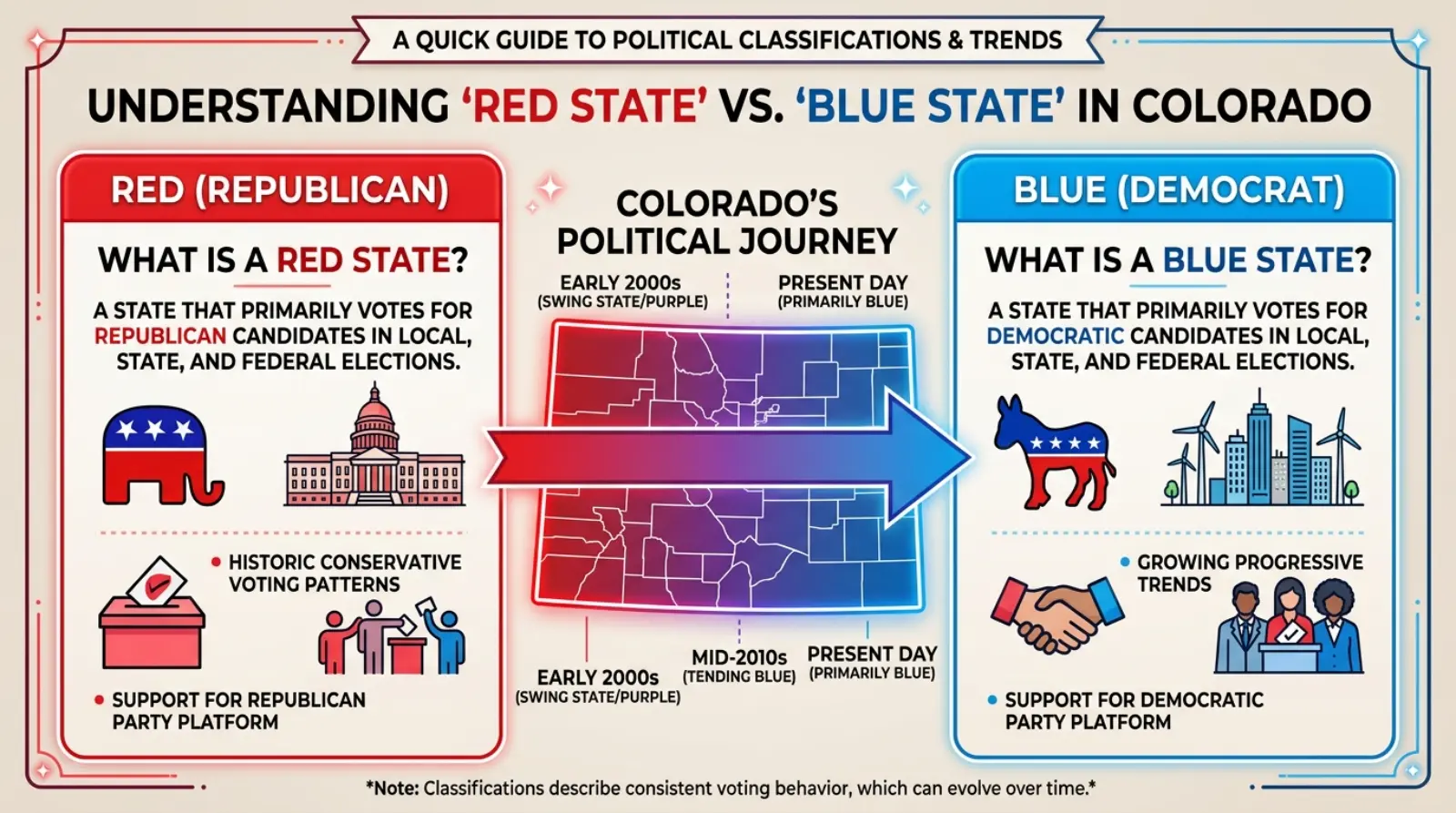
- Blue usually represents the Democratic Party.
- Red usually represents the Republican Party.
These colors are commonly used on election maps to show which party won a state or area.
When someone calls Colorado a blue state, they usually mean that Democratic candidates have had stronger statewide results, especially in recent presidential elections.
That does not mean every Colorado voter is a Democrat.
Colorado has Democratic voters, Republican voters, independent voters, and people who do not strongly identify with either major party.
Related political terms
Blue state: A state that generally favors Democratic candidates.
Red state: A state that generally favors Republican candidates.
Swing state: A state where either major party has a realistic chance of winning.
Purple state: Another informal term for a politically competitive state.
Colorado politics: The broader political activity, voting patterns, elections, and government of Colorado.
Colorado’s Political History
Colorado has not always been as clearly Democratic-leaning as it is today.
For much of its history, Colorado politics were competitive. Republicans performed strongly in many elections, and the state was often viewed as a battleground.
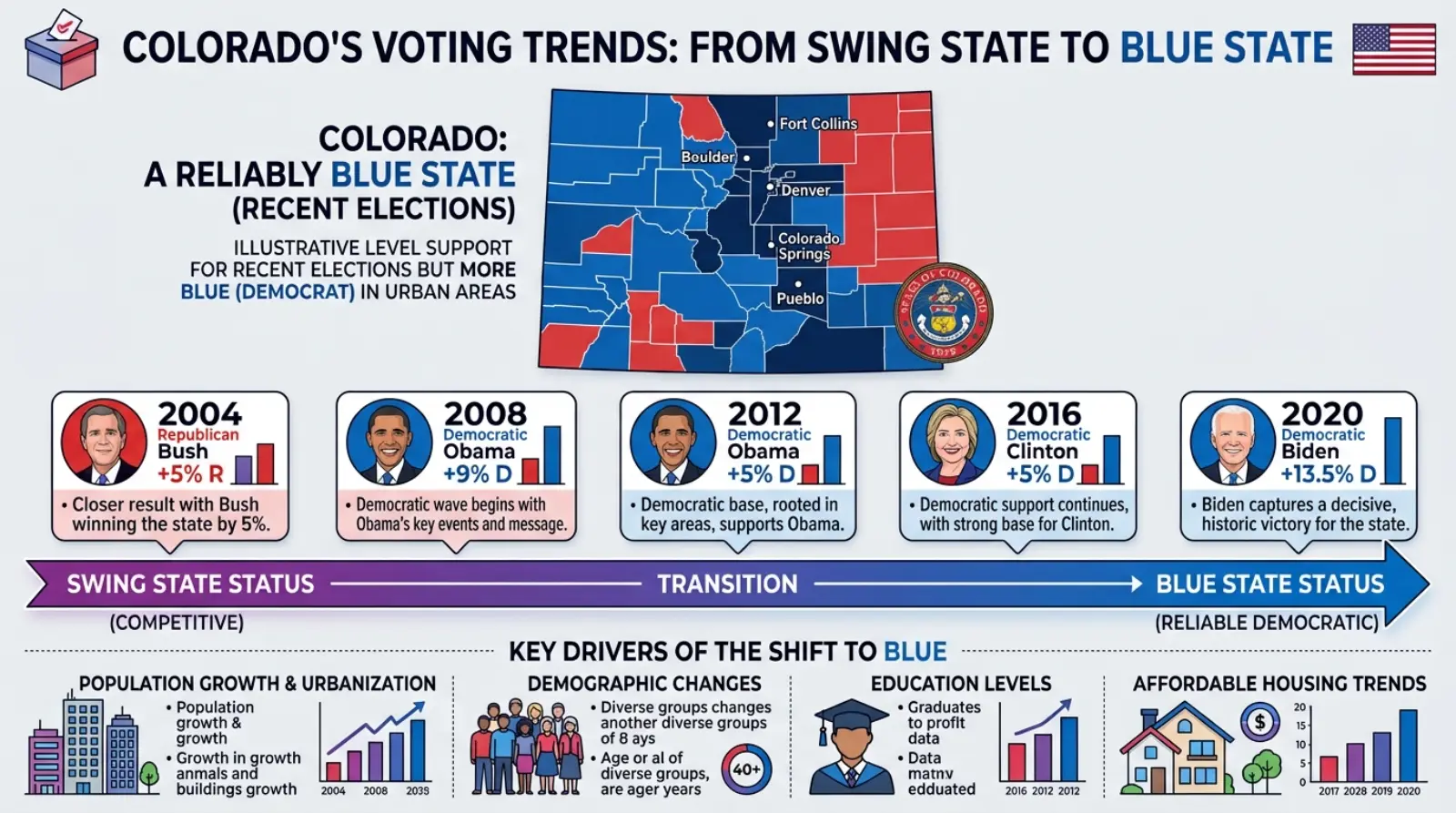
The political balance began shifting more clearly toward Democrats in the 2000s.
In presidential elections:
| Election | Colorado’s Winner |
|---|---|
| 2000 | Republican George W. Bush |
| 2004 | Republican George W. Bush |
| 2008 | Democrat Barack Obama |
| 2012 | Democrat Barack Obama |
| 2016 | Democrat Hillary Clinton |
| 2020 | Democrat Joe Biden |
| 2024 | Democrat Kamala Harris |
The biggest modern turning point was 2008, when Barack Obama carried Colorado after George W. Bush had won the state in 2000 and 2004. Colorado then continued voting Democratic in presidential elections through 2024.
This history is why some older articles may still describe Colorado as a swing state, even though its recent presidential voting record is more consistently Democratic.
Why Is Colorado Considered Blue?
Several factors help explain Colorado’s modern political direction.
1. Denver is strongly Democratic
The Denver metropolitan area has a large population and tends to vote heavily Democratic.
Denver is an important part of Colorado’s statewide political picture.
2. Growing urban and suburban populations
Colorado has experienced major population growth, especially around the Front Range.
Large population centers such as Denver, Boulder, Aurora, and Fort Collins tend to give Democrats strong support.
3. Younger voters
Colorado has many younger adults, particularly around universities and growing metropolitan areas. Younger voters nationally have often leaned Democratic.
4. Education and demographics
Highly educated urban and suburban voters have increasingly supported Democratic candidates in many parts of the United States, including Colorado.
5. Changing political coalitions
Colorado’s Democratic coalition has grown in strength over time, helping Democrats win many statewide races.
Is Colorado Still a Swing State?
This is where things get interesting.
Colorado is less of a traditional swing state than it was in the past.
A swing state is normally a state where presidential elections are highly competitive. Recent presidential results show Colorado has moved away from that role.
However, political competition has not disappeared.
Republicans can still win elections in particular districts and communities. Rural Colorado is generally more Republican-leaning, while major urban areas are much more Democratic.
So the best description is:
👉 Colorado is a blue-leaning state with Republican-leaning regions.
Calling it simply “100% Democratic” would be misleading.
Colorado Red vs. Blue: Regional Differences
One of the easiest ways to understand Colorado is to look beyond the statewide label.
Denver
Denver is strongly Democratic and is one of the state’s biggest sources of Democratic votes.
Boulder
Boulder is also strongly Democratic-leaning.
Colorado Springs
Colorado Springs and El Paso County have historically been much more favorable to Republicans than Denver and Boulder.
Rural Colorado
Many rural counties lean Republican, particularly compared with Colorado’s major metropolitan areas.
Front Range
The Front Range contains much of Colorado’s population and includes several major cities. Democratic candidates generally perform strongly in many of these population centers.
This creates an important distinction:
Colorado can be blue statewide while containing many red areas.
Is Colorado Red or Blue in Presidential Elections?
For recent presidential elections, Colorado has been blue.
The state’s presidential voting pattern changed significantly after 2004.
Democratic presidential candidates won Colorado in:
- 2008
- 2012
- 2016
- 2020
- 2024
The 2024 result is especially important when answering the question “Is Colorado red or blue in 2026?” The most recent presidential election result available before 2026 was a Democratic victory in Colorado.
Is Colorado Democratic or Republican?
Colorado is currently more Democratic-leaning at the statewide level.
But this does not mean Republicans have no influence.
Republicans remain a major political party in Colorado and have strong support in certain counties and communities.
The simplest explanation is:
| Question | Answer |
|---|---|
| Is Colorado generally blue? | Yes |
| Is Colorado entirely Democratic? | No |
| Do Republicans have support? | Yes |
| Is Denver Democratic-leaning? | Strongly |
| Are some rural areas Republican? | Yes |
| Has Colorado voted Democratic recently for president? | Yes |
Is Colorado Red or Blue in Everyday Political Discussion?
You may hear Colorado described in several ways:
“Colorado is blue.”
Usually means Democrats have a statewide advantage.
“Colorado used to be a swing state.”
Refers to its more competitive political history.
“Rural Colorado is red.”
Refers to Republican strength in many rural areas.
“Denver is deep blue.”
Refers to strong Democratic support in Denver.
“Colorado is purple.”
This can describe the state’s competitive history or specific local races, but it is less accurate as a description of recent presidential voting.
Colorado Political Comparison Table
| Feature | Colorado |
|---|---|
| General statewide tendency | Blue/Democratic-leaning |
| Democratic strength | Strong in major cities |
| Republican strength | Stronger in many rural areas |
| Presidential trend | Democratic since 2008 |
| Major Democratic center | Denver metro area |
| Major Republican areas | Many rural regions and some conservative communities |
| Traditional swing-state status | Less competitive than in the past |
| Political diversity | High |
| Completely blue? | No |
| Completely red? | No |
Common Misunderstandings About Colorado Politics
Mistake 1: “Blue state means everyone votes Democrat.”
Not true.
A blue state simply means the state tends to favor Democratic candidates in important elections.
Mistake 2: “Every county in Colorado is blue.”
Not true.
Colorado has many Republican-leaning counties.
Mistake 3: “Colorado has always been Democratic.”
No. Colorado has changed politically over time.
Mistake 4: “Republicans cannot win in Colorado.”
That is also incorrect.
Republicans remain competitive in local elections, congressional districts, and many communities.
Mistake 5: “Colorado is still exactly the same swing state it was in 2004.”
Political patterns have changed considerably since then.
Is Colorado Red or Blue for Students and Beginners?
If you’re learning U.S. geography or politics, remember three simple ideas.
First: Learn the colors
🔵 Blue = Democrats
🔴 Red = Republicans
Second: Look at recent elections
Colorado has recently favored Democratic presidential candidates.
Third: Don’t confuse statewide politics with local politics
A state can vote blue overall while having red counties.
This happens because election results combine millions of individual votes from different communities.
Is Colorado Red or Blue in Professional and News Writing?
If you are writing about Colorado politics, avoid overly broad statements.
Instead of saying:
“Everyone in Colorado is liberal.”
Use:
“Colorado has generally leaned Democratic in recent presidential elections.”
This is more accurate and professional.
For academic writing, you can also explain that political identity varies by region, election type, and candidate.
Google Trends and Search Intent: Why People Ask “Is Colorado Red or Blue?”
The search “is colorado red or blue” is a straightforward informational query.
People may search it when:
- learning about U.S. states
- following presidential elections
- planning a move
- researching Colorado politics
- comparing states
- reading election maps
- watching political news
- studying American government
- checking whether Colorado is a swing state
Related long-tail searches include:
- Is Colorado a blue state?
- Is Colorado Republican or Democrat?
- Is Colorado a swing state?
- Is Denver red or blue?
- Why is Colorado blue?
- How did Colorado vote in 2024?
- What political party controls Colorado?
- Is Colorado conservative or liberal?
- What are the most Republican counties in Colorado?
- What are the most Democratic cities in Colorado?
These searches show why a simple red-versus-blue answer does not tell the whole story.
Expert Tips for Understanding Colorado Politics
Tip 1: Look at the election date.
Political patterns can change.
Tip 2: Separate presidential and local elections.
A state may favor one party for president while electing officials from another party.
Tip 3: Look at counties.
Statewide results can hide major regional differences.
Tip 4: Don’t treat party labels as personality labels.
Being in a blue state does not tell you what every individual believes.
Tip 5: Check recent results.
Older descriptions of Colorado may not accurately describe its current political direction.
Related Searches People Also Ask
Is Colorado a blue state?
Yes. Colorado is generally considered a blue or Democratic-leaning state based on its recent presidential voting record.
Is Colorado a red state?
No, not at the statewide presidential level in recent elections. However, many parts of Colorado have strong Republican support.
Is Colorado a swing state?
Colorado was more competitive in earlier presidential elections. Its recent presidential results have made it less of a classic swing state.
Is Denver red or blue?
Denver is strongly Democratic-leaning.
Is Colorado conservative or liberal?
Colorado is politically mixed, but statewide politics have generally moved toward the Democratic side in recent years.
Did Colorado vote for Trump?
Donald Trump won Colorado in 2016? No. Hillary Clinton won Colorado in 2016, Joe Biden won it in 2020, and Kamala Harris won it in 2024.
Did Colorado vote for Biden?
Yes. Joe Biden won Colorado in the 2020 presidential election.
Did Colorado vote for Harris?
Yes. Kamala Harris won Colorado in the 2024 presidential election.
Why is Colorado blue?
Several factors contribute, including Democratic strength in major metropolitan areas and changes in the state’s voting coalition over time.
Are there red areas in Colorado?
Yes. Many rural communities and some regions have historically leaned Republican.
FAQs About “Is Colorado Red or Blue?”
Is Colorado red or blue in 2026?
Colorado is generally considered blue/Democratic-leaning, especially based on its recent presidential election record.
What color is Colorado politically?
Colorado is generally represented as blue on recent presidential election maps.
Is Colorado a Democrat state?
Colorado has recently leaned Democratic in statewide presidential elections, but it has voters from both major parties.
Is Colorado Republican or Democrat?
At the statewide level, Colorado currently leans Democratic, while Republicans remain strong in several regions.
Has Colorado always been blue?
No. Colorado has changed politically. Republicans won the state in the 2000 and 2004 presidential elections before Democrats began a long winning streak in presidential contests.
Is Colorado a purple state?
Historically, Colorado was often described as purple or a swing state. Its recent presidential voting pattern is more clearly Democratic-leaning.
Why does Colorado have red counties if it is blue?
The statewide result combines votes from every county. Republican candidates can win many counties while Democrats receive larger totals in heavily populated metropolitan areas.
Is Colorado liberal or conservative?
Colorado contains both liberal and conservative communities. Overall, statewide politics have become more Democratic-leaning in recent years.
Is Colorado politically divided?
Yes. Political views vary significantly between metropolitan, suburban, rural, and mountain communities.
What is the easiest way to remember Colorado’s political color?
Remember: Colorado is blue statewide, but it contains plenty of red areas.
Final Verdict
Is Colorado red or blue?
👉 Colorado is generally blue.
The state has voted Democratic in every presidential election since 2008, including the 2024 election.
But Colorado is not uniformly Democratic. Rural communities and several regions have strong Republican support.
Easy rule:
🔵 Colorado overall = blue
🔴 Some regions = red
🟣 Historically = more competitive
Conclusion
If you only need the short answer, Colorado is a blue state in modern presidential politics.
But the full story is more interesting. Colorado has a mix of political views, and its cities, suburbs, rural communities, and individual counties can vote very differently. Denver and other large population centers tend to be strongly Democratic, while many rural areas are more Republican.
That is why calling Colorado simply “Democratic” or “Republican” can hide the state’s political diversity.
For someone asking “is colorado red or blue,” the easiest answer to remember is:
🔵 Colorado is blue statewide, but there are many red parts of Colorado.

Camila Green is an English language writer who specializes in confusing word comparisons and spelling explanations. She creates simple, beginner-friendly guides on topics like “niece or neice” and other common English mistakes. Her writing focuses on clarity, real-life examples, and easy learning. At VerrsaPick, she helps readers improve their English with practical and engaging content.